



Premium File
322 Q&A
$76.99$69.99
CompTIA Cloud Essentials+ CLO-002 Exam Questions & Answers, Accurate & Verified By IT Experts
Instant Download, Free Fast Updates, 99.6% Pass Rate

CLO-002 Premium File: 322 Questions & Answers
Last Update: Oct 21, 2026
CLO-002 PDF Study Guide: 559 Pages
$74.99
CompTIA Cloud Essentials+ CLO-002 Exam Screenshots
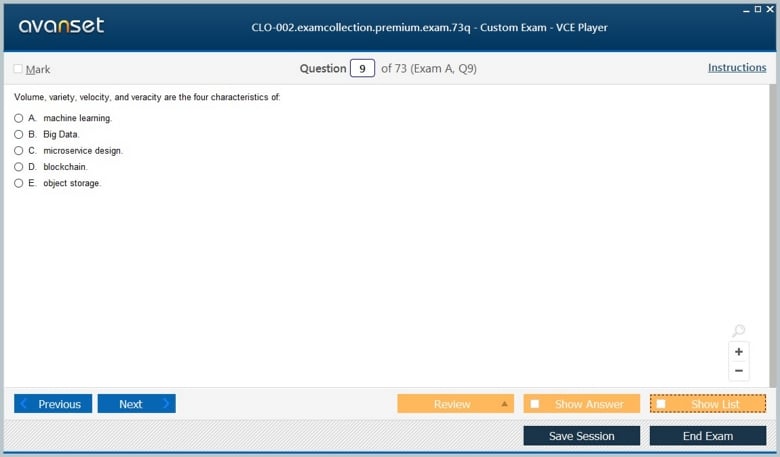
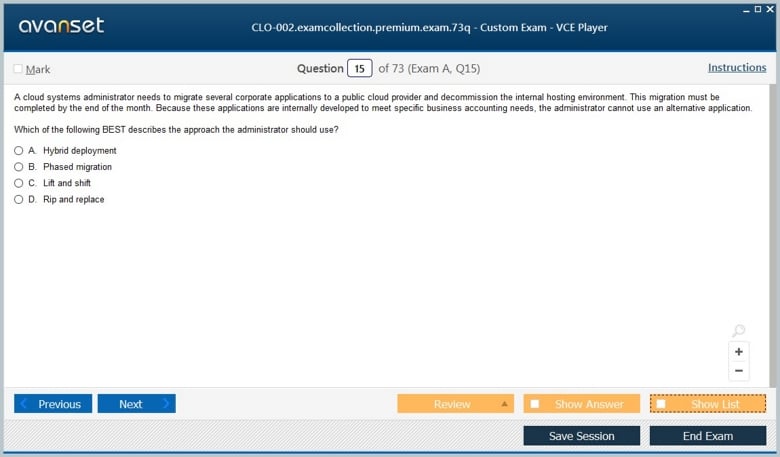
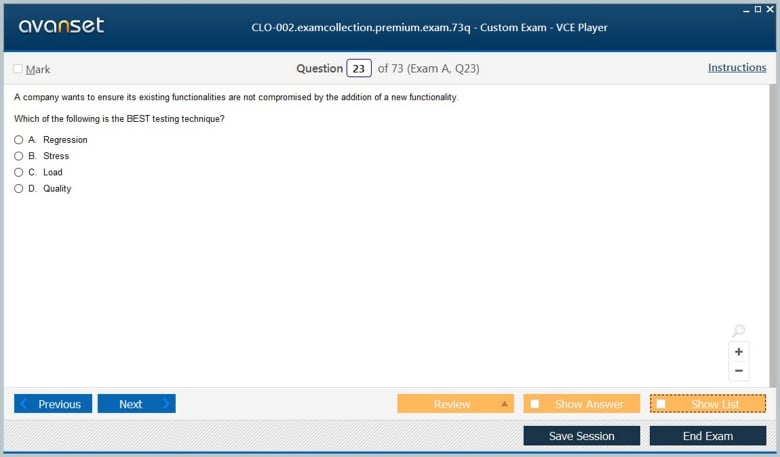
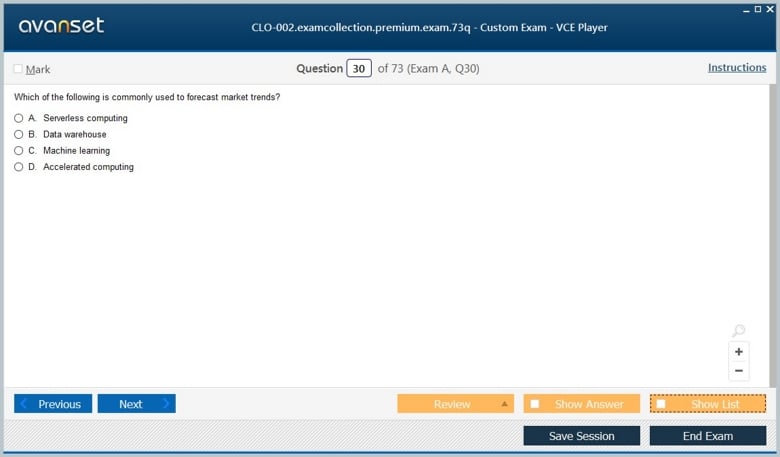
CompTIA Cloud Essentials+ CLO-002 Practice Test Questions in VCE Format
| File | Votes | Size | Date |
|---|---|---|---|
File CompTIA.braindumps.CLO-002.v2026-07-31.by.leo.79q.vce |
Votes 1 |
Size 242.42 KB |
Date Jul 31, 2026 |
File CompTIA.passcertification.CLO-002.v2021-12-13.by.oliver.64q.vce |
Votes 1 |
Size 225.85 KB |
Date Dec 13, 2021 |
File CompTIA.practicetest.CLO-002.v2021-04-26.by.noam.40q.vce |
Votes 1 |
Size 43.12 KB |
Date Apr 28, 2021 |
File CompTIA.Actualtests.CLO-002.v2020-03-16.by.Brian.36q.vce |
Votes 4 |
Size 38.93 KB |
Date Mar 16, 2020 |
CompTIA Cloud Essentials+ CLO-002 Practice Test Questions, Exam Dumps
CompTIA CLO-002 (CompTIA Cloud Essentials+) exam dumps vce, practice test questions, study guide & video training course to study and pass quickly and easily. CompTIA CLO-002 CompTIA Cloud Essentials+ exam dumps & practice test questions and answers. You need avanset vce exam simulator in order to study the CompTIA Cloud Essentials+ CLO-002 certification exam dumps & CompTIA Cloud Essentials+ CLO-002 practice test questions in vce format.
CompTIA Cloud Essentials+ CLO-002 is now a retired exam. CompTIA lists Cloud Essentials+ as retired in 2025, so new candidates should not treat old voucher, scheduling, or preparation pages as evidence that CLO-002 can still be booked. The page remains useful for historical study because the credential framed cloud computing around business decisions rather than around administration of one vendor platform.
The historical blueprint divided the exam into Cloud Concepts at 24 percent, Business Principles of Cloud Environments at 28 percent, Management and Technical Operations at 26 percent, and Governance, Risk, Compliance, and Security for the Cloud at 22 percent. That balance explains why CLO-002 was relevant to analysts, project stakeholders, sales professionals, managers, and technical staff who needed a common cloud vocabulary.
There is no reason to invent a direct successor where CompTIA has not named one. Current candidates should choose a live path based on role: the CompTIA Cloud+ certification is more technical and operational, while other CompTIA credentials address networking, security, data, and advanced hybrid architecture.
CLO-002 was not designed to make a candidate a cloud engineer. Its value was in explaining what changes when infrastructure, platforms, applications, storage, and business processes move to service-based delivery. A reader needed to understand service models, deployment models, elasticity, self-service, availability, metering, and shared responsibility well enough to participate in planning conversations.
A concise explanation of cloud-computing fundamentals still captures much of that baseline. The key question is not “what command provisions a virtual machine?” but “what responsibility moves to the provider, what remains with the customer, and how does that change cost, control, risk, and operations?”
That framing remains useful because cloud projects often fail for nontechnical reasons. An organization can choose a technically capable platform and still underestimate data movement, operating-model change, licensing, skills, governance, or vendor dependency.
The familiar IaaS, PaaS, and SaaS categories were central to the historical exam because they change who manages what. Comparing IaaS, PaaS, and SaaS helps reveal the trade-off: moving upward in abstraction can reduce operational burden while also reducing direct control over infrastructure and platform components.
Shared responsibility should be treated as a matrix rather than a slogan. The provider may secure facilities and physical infrastructure while the customer remains responsible for identities, permissions, data classification, application configuration, and endpoint security. The exact boundary changes by service.
Business stakeholders need this distinction because contracts and budgets can create a false belief that “the cloud provider handles security.” A good cloud decision identifies each control owner before migration, not after an incident exposes a gap.
At 28 percent, Business Principles of Cloud Environments was the largest historical CLO-002 domain. It covered assessments, financial considerations, vendor relationships, solution benefits, risk, and migration thinking. Cloud adoption is ultimately an operating-model and investment decision, so the exam emphasized whether a proposed cloud move actually solves a business problem.
Cloud cost management is a useful example. Consumption pricing can improve flexibility, but variable usage, data transfer, idle resources, premium services, licensing, and operational labor can make cost behavior less predictable than a simple “pay only for what you use” slogan suggests.
Candidates studying the historical material should practice comparing alternatives with total cost, time to value, risk, scalability, compliance, staffing, and exit strategy in view. The cheapest service on a price sheet is not necessarily the lowest-cost business outcome.
CLO-002 included migration considerations because not every workload belongs in the same destination. Organizations may rehost, replatform, refactor, replace, retain, or retire applications depending on business value and technical constraints. The migration choice affects schedule, cost, architecture, testing, and operational readiness.
Cloud migration strategy becomes clearer when discovery comes first. Teams need to understand application dependencies, data volumes, latency, compliance, licensing, identity integrations, maintenance windows, and recovery requirements before choosing a migration pattern.
Even for historical study, avoid treating “move to cloud” as a destination by itself. A strong answer explains what is moving, why, which service model will host it, how users and systems connect to it, how data is protected, and how the organization exits or recovers if the plan fails.
The Management and Technical Operations domain connected provisioning with ongoing monitoring, capacity, performance, maintenance, automation, and service management. Cloud resources can be created quickly, which makes operational discipline more important rather than less important.
Resource sprawl, inconsistent tagging, unowned accounts, stale snapshots, overprovisioned instances, missing alerts, and forgotten test environments are operational failures that can undermine both cost and security. The historical exam encouraged candidates to think beyond the initial deployment.
Modern operational practice also relies on telemetry and automation. Even if CLO-002 itself remained foundational, the principle is still current: cloud services need owners, baselines, budgets, monitoring, change control, lifecycle rules, and tested recovery procedures.
The final historical domain combined governance, risk, compliance, and security because those topics are connected. Data classification influences storage and encryption. Privacy obligations influence location and access. Audit requirements influence logging. Contract terms influence incident notification and provider responsibilities.
Cloud shared-responsibility security is especially important because controls are distributed across customer and provider layers. A secure provider does not compensate for an exposed customer credential, an overprivileged role, a public storage bucket, or weak application authentication.
Good governance defines who may create resources, which regions and services are allowed, how identities are approved, how costs are attributed, how exceptions are reviewed, and how resources are retired. These questions remain relevant regardless of which current certification a learner chooses next.
The current CompTIA Cloud+ CV0-004 exam moves far deeper into architecture, deployment, operations, security, DevOps fundamentals, and troubleshooting. It is a practical technical certification, not simply a renamed Cloud Essentials+.
That distinction matters for people who find old CLO-002 materials and assume the next version must be Cloud+. Cloud Essentials+ targeted cloud literacy and business judgment across technical and nontechnical roles. Cloud+ expects hands-on experience operating cloud environments and solving implementation problems.
If your goal is cloud operations or engineering, Cloud+ may be relevant. If your goal is business analysis, procurement, governance, product management, finance, or a vendor-specific role, another current learning path may fit better. Choose by the work you need to perform, not by which code looks numerically newer.
For senior network architects, CompTIA CloudNetX CNX-001 addresses hybrid network design, security, operations, and troubleshooting at a much more advanced level. That illustrates how CompTIA’s cloud-related portfolio has become more role-specific since the broad Cloud Essentials+ era.
CloudNetX is not a replacement for CLO-002 either. It assumes years of network architecture experience and deals with complex hybrid connectivity, availability, security, monitoring, and troubleshooting. A business analyst who once benefited from Cloud Essentials+ would not automatically be the target audience.
The broader CompTIA certifications should therefore be read as a set of role-oriented paths, not a linear sequence of version numbers. Historical CLO-002 knowledge can support many of those paths, but it does not define them.
If you already earned Cloud Essentials+, the historical credential remains part of your record. If you are researching older training, use the four-domain blueprint to understand what the material was intended to teach. If you are starting a new certification plan, verify a current credential before buying a voucher or course.
The most durable lessons are conceptual: understand service and deployment models, map shared responsibility, connect cloud adoption to business value, evaluate migration options, plan operations, and govern risk. Those ideas still matter even when specific products and certification codes change.
That is the right way to treat a retired page: preserve the knowledge and historical context, clearly mark the status, avoid implying current availability, and connect readers to live options only when the relationship is genuine rather than manufactured.
Historical CLO-002 study is also useful when reviewing a past cloud decision. The old blueprint encourages a structured postmortem: what service model was selected, what business benefit was expected, how cost was forecast, which responsibilities moved to the provider, which risks remained with the customer, and whether operations were ready for the new model. That framework can reveal why a technically successful migration still failed to meet the original business objective.
Another durable CLO-002 lesson is vendor evaluation. Contracts should be read for service limits, support scope, availability commitments, portability, data ownership, termination procedures, and responsibilities during incidents. Cloud services can reduce infrastructure ownership without eliminating supplier risk, so procurement and technical teams need a shared model of what the provider promises and what the customer must still operate. That shared model is especially important during outages, security incidents, data-export projects, and contract termination, when assumptions about responsibility become operational rather than theoretical.
Go to testing centre with ease on our mind when you use CompTIA Cloud Essentials+ CLO-002 vce exam dumps, practice test questions and answers. CompTIA CLO-002 CompTIA Cloud Essentials+ certification practice test questions and answers, study guide, exam dumps and video training course in vce format to help you study with ease. Prepare with confidence and study using CompTIA Cloud Essentials+ CLO-002 exam dumps & practice test questions and answers vce from ExamCollection.
Purchase Individually

Top CompTIA Certifications



Top CompTIA Certification Exams
Site Search:

SPECIAL OFFER: GET 10% OFF

Pass your Exam with ExamCollection's PREMIUM files!
SPECIAL OFFER: GET 10% OFF
Use Discount Code:
MIN10OFF
A confirmation link was sent to your e-mail.
Please check your mailbox for a message from support@examcollection.com and follow the directions.

Download Free Demo of VCE Exam Simulator
Experience Avanset VCE Exam Simulator for yourself.
Simply submit your e-mail address below to get started with our interactive software demo of your free trial.
I was referred to this website by my colleague who aced the CompTIA CLO-002 exam last month using these premium questions with answers. She said that they were the key reason for her success. To be honest, I was doubtful about this. But, I tried them and can say that they were incredibly useful. Today, I’m very happy after being notified that I passed my test as well.
I would say that CLO-002 is not an easy exam. It was very difficult for me to prepare for it until I found this site. It was still not easy after I bought the bundle, but I was able to score 74% while practicing. Considering the fact that this is my very first IT exam, I was glad. I am thinking to study for two more weeks and try to pass the exam eventually.
I’ve received a congratulatory email from CompTIA Certmetrics. I scored 92% in my CLO-002! Soon, I’ll get my CompTIA Cloud Essentials+ certification. Examcollection is the best site ever for IT exams!!!! Before taking this test, I also nailed some other exams with the help of this platform. Thank you very much!