



Premium File
63 Q&A
$76.99$69.99
VMware 5V0-62.19 Exam Questions & Answers, Accurate & Verified By IT Experts
Instant Download, Free Fast Updates, 99.6% Pass Rate
63 Questions & Answers
Last Update: Sep 15, 2026
$69.99
VMware 5V0-62.19 Exam Screenshots
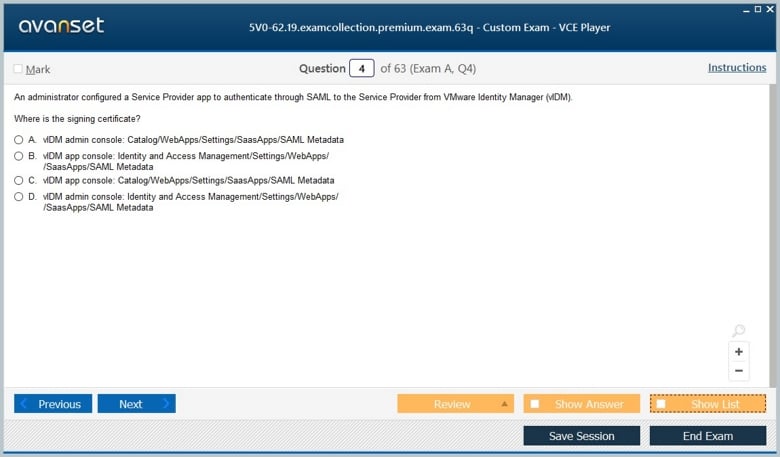
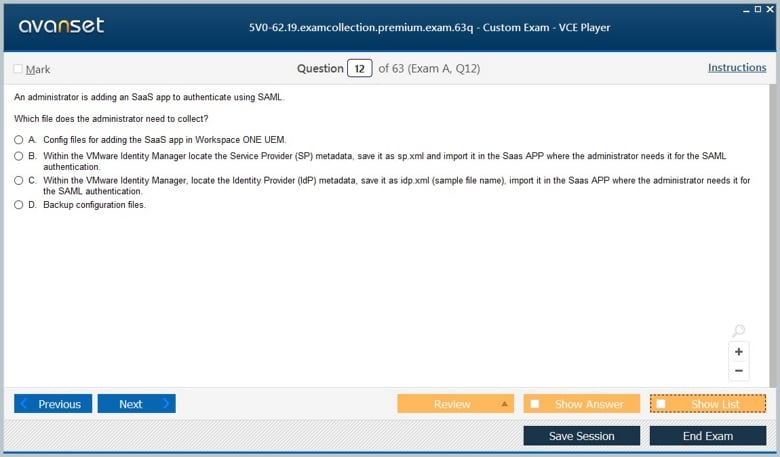
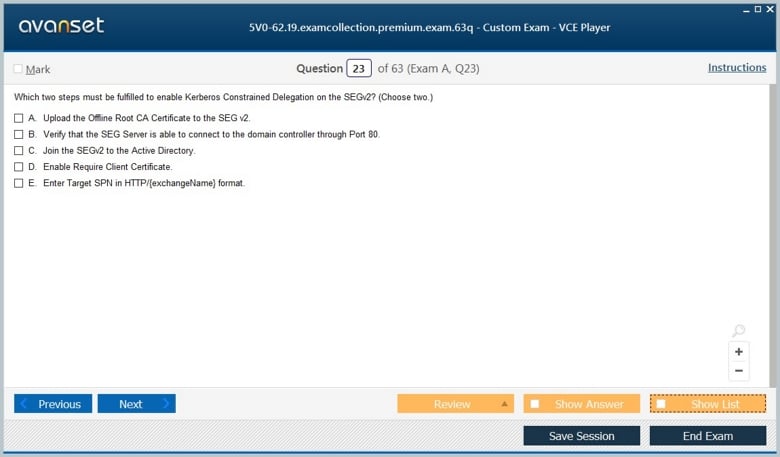
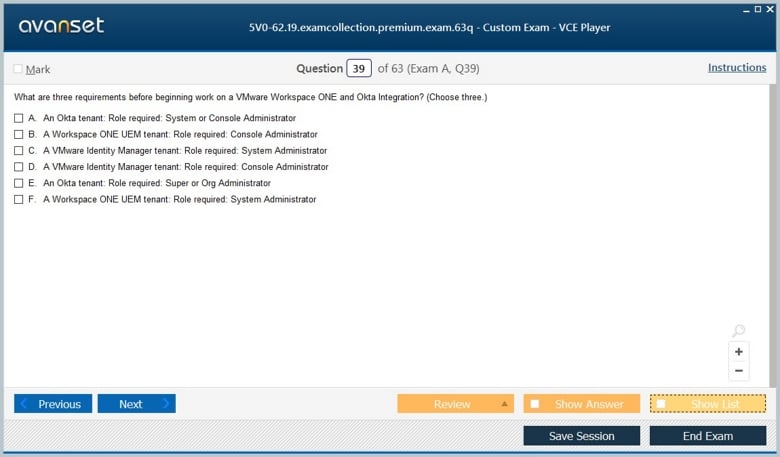
VMware 5V0-62.19 Practice Test Questions in VCE Format
| File | Votes | Size | Date |
|---|---|---|---|
File VMware.Test-king.5V0-62.19.v2026-08-27.by.Elizabeth.31q.vce |
Votes 3 |
Size 132.34 KB |
Date Aug 29, 2026 |
VMware 5V0-62.19 Practice Test Questions, Exam Dumps
VMware 5V0-62.19 (VMware Workspace ONE Design and Advanced Integration Specialist) exam dumps vce, practice test questions, study guide & video training course to study and pass quickly and easily. VMware 5V0-62.19 VMware Workspace ONE Design and Advanced Integration Specialist exam dumps & practice test questions and answers. You need avanset vce exam simulator in order to study the VMware 5V0-62.19 certification exam dumps & VMware 5V0-62.19 practice test questions in vce format.
The Workspace ONE Design and Advanced Integration Specialist (5V0-62-19) exam belonged to an earlier VMware End-User Computing generation and was retired on June 30, 2022. Its subject was broader than day-to-day UEM administration: candidates had to think about architecture, scale, availability, identity, networking, certificate services, application access, and the integration components needed to deliver Workspace ONE as an enterprise platform. In 2026 the product and certification lineage sit with Omnissa, not VMware.
The design mindset remains useful because endpoint management is never only a console. A production service depends on directory sources, connectors, certificate authorities, email systems, tunneling gateways, application infrastructure, internet access, firewall rules, load balancing, and support processes. A sound architecture makes those dependencies explicit, sizes them for the expected population, and defines how service continues when one component fails.
Before selecting components, classify the endpoint estate. Corporate-owned mobile devices, employee-owned phones, rugged shared devices, Windows laptops, and macOS endpoints have different enrollment, privacy, application, and security requirements. User populations also differ: employees, contractors, frontline workers, administrators, and external partners may use different identity sources and applications.
Those differences drive architecture. A BYOD program may emphasize privacy and containerized access, while a corporate-owned deployment may allow stronger device restrictions. Shared devices may require rapid user switching and limited local state. Remote employees need enrollment and recovery paths that work without visiting an office. Good design starts with operating models, not with the number of console features available.
Organization groups and administrative boundaries need to map to who owns policy and who is allowed to change it. Geography, subsidiaries, business units, and device types can all be valid grouping dimensions, but mixing them without a governance model creates confusing inheritance. The hierarchy should support delegated administration while keeping global settings controlled.
A design review should ask where settings are inherited, where exceptions are allowed, how administrators are scoped, and how common profiles are reused. If every region copies the same profile independently, drift becomes likely. If all policy is centralized, local regulatory or application differences may be difficult to support. The architecture should intentionally balance consistency with legitimate autonomy.
Workspace ONE integrations often require connectors or gateways to reach internal directory, certificate, email, content, or application services. Placement should minimize unnecessary exposure while preserving reliable outbound or inbound paths. Firewall rules, proxies, load balancers, DNS, TLS inspection, and high availability all influence whether those components can perform their role.
Draw the traffic flows for enrollment, directory synchronization, certificate issuance, email access, per-app tunnel, and application authentication. Mark which connections initiate from the cloud and which originate internally. This diagram becomes both a security review artifact and a troubleshooting map. If a port is opened without a documented flow, the architecture is missing an explanation.
Identity design includes directory sources, federation, authentication methods, conditional access, group mapping, and account lifecycle. It should also consider what happens when one identity component is unavailable. If every application depends on one connector with no resilient path, the endpoint-management service can become unusable even though UEM itself remains online.
Attribute design matters as well. User principal name, email, immutable identifiers, employee IDs, and group membership may be consumed by different systems. Changing one mapping can have consequences across SaaS federation, certificate subjects, application entitlements, and support workflows. Advanced integration is easier when identity attributes have documented ownership and meaning.
Certificates can authenticate devices to Wi-Fi, VPN, email, and other services. At enterprise scale, the architecture must consider certificate authority availability, connector placement, template permissions, issuance throughput, renewal timing, and revocation. A design that works for a pilot of fifty devices may fail when tens of thousands renew certificates within the same window.
Certificate lifecycle should be observable. Administrators need to know which certificates are nearing expiry, which requests fail, and whether revoked devices can still reach protected resources. The design should also minimize the amount of private-key handling outside the endpoint and trusted certificate infrastructure. Trust is strongest when issuance and renewal are automated but auditable.
An application can be distributed successfully and still be unusable if its network path is wrong. Internal mobile applications may depend on per-app tunnel, reverse proxy, VPN, or direct internet access. The architecture should define which traffic is tunneled, where the tunnel terminates, how DNS is resolved, and how identity is passed to the application.
Avoid turning the tunnel into an invisible default route for everything unless that is an explicit requirement. Broad tunneling can increase latency, concentrate bandwidth, and create a larger failure domain. Per-app models can reduce that blast radius, but only if app identifiers and assignments are accurate. Design should include both traffic intent and the operational method for verifying it.
High availability is often misunderstood as duplicating the obvious gateway. A resilient Workspace ONE design also considers DNS, load balancers, certificate authorities, directory connectivity, mail gateways, internet circuits, database dependencies where applicable, and operational access. If one shared dependency fails, several redundant application nodes may still be useless.
Define recovery objectives for each dependency and decide which failures justify automatic failover versus manual recovery. Test the failure path before production. A secondary connector that has never synchronized correctly is not real redundancy. A disaster-recovery site that lacks the same certificate trust or firewall rules is not ready merely because the virtual machines exist.
Today the appropriate certification and product context is Omnissa. Omnissa has changed credential names and continues to evolve Workspace ONE capabilities, while the VMware-era 5V0-62-19 blueprint reflects much older software and architecture. Use the old exam to understand design categories, but verify supported components, cloud-service behavior, scaling guidance, and security controls against current Omnissa documentation.
The later Workspace ONE Advanced Integration Specialist material is a natural historical continuation because it focuses more deeply on the identity and integration contracts that a design must support. The relationship is useful as context, not as a current certification path.
A mature design ends with operations. Define ownership, logging, monitoring, maintenance windows, certificate rotation, connector upgrades, profile change control, and escalation. Architecture is not complete when a diagram is approved; it is complete when the service can be deployed, observed, changed, and recovered by the teams who will actually run it.
Scale planning should include peak events rather than only average device count. Enrollment campaigns, annual certificate renewal, a major operating-system release, or a companywide application update can create bursts of traffic and support demand. Components that appear lightly loaded during ordinary weeks may become bottlenecks during those events. Capacity plans should include concurrency, not just total population.
Administrative access deserves its own availability and security design. If the console uses federated identity, define a protected emergency path for situations where the identity provider is unavailable. If privileged roles are delegated across regions, establish consistent role templates and approval. Administrative recovery should not depend on the same service that is being repaired without an alternate, tightly controlled mechanism.
Logging architecture should answer where evidence is retained and for how long. Gateway, connector, console, and endpoint logs may have different retention periods and clocks. Centralizing critical events in a SIEM or operational logging system can make cross-component incidents easier to reconstruct, but only if identifiers and timestamps are preserved. Decide which logs are required for security investigations, service troubleshooting, and compliance before an incident occurs.
Change domains should be separated to reduce blast radius. A global directory mapping, tenant-wide certificate integration, or root-level profile can affect every device, while a smart-group assignment may affect only one population. Design review should classify changes by scope and require stronger testing for higher-blast-radius objects. This converts hierarchy into an operational safety mechanism rather than just an organizational convenience.
The Workspace ONE UEM Troubleshooting Specialist path is useful historical follow-on material because a design should make failures diagnosable. Clear traffic flows, component ownership, redundant connectors, certificate monitoring, and scoped policy all reduce the time needed to isolate an incident. If a design cannot be troubleshot systematically, it is not operationally mature.
Data residency and privacy can also affect architecture. User and device inventory may contain personal or regulated information, and organizations operating across jurisdictions may impose restrictions on where services are hosted or who can administer them. Even when a cloud service controls much of the platform architecture, the customer still needs a governance model for data access, retention, and regional administration.
Design documentation should include support boundaries and escalation paths. When an endpoint cannot authenticate to a protected application, the failure may belong to UEM, identity, PKI, network security, or the application itself. If each team knows which logs and tests it owns, incidents can move quickly across boundaries without restarting diagnosis. Architecture that ignores operational ownership often creates longer outages than architecture with one fewer redundant component but clear responsibility.
Pilot design should include representative failure as well as representative success. Test a connector loss, certificate-renewal failure, directory interruption, and gateway outage before rollout. Record the user-visible symptom and the operational alarm for each case. This produces evidence that redundancy, monitoring, and escalation behave as the architecture claims, rather than discovering those gaps during the first production incident.
Go to testing centre with ease on our mind when you use VMware 5V0-62.19 vce exam dumps, practice test questions and answers. VMware 5V0-62.19 VMware Workspace ONE Design and Advanced Integration Specialist certification practice test questions and answers, study guide, exam dumps and video training course in vce format to help you study with ease. Prepare with confidence and study using VMware 5V0-62.19 exam dumps & practice test questions and answers vce from ExamCollection.
Purchase Individually
Top VMware Certifications




Top VMware Certification Exams
Site Search:

SPECIAL OFFER: GET 10% OFF

Pass your Exam with ExamCollection's PREMIUM files!
SPECIAL OFFER: GET 10% OFF
Use Discount Code:
MIN10OFF
A confirmation link was sent to your e-mail.
Please check your mailbox for a message from support@examcollection.com and follow the directions.

Download Free Demo of VCE Exam Simulator
Experience Avanset VCE Exam Simulator for yourself.
Simply submit your e-mail address below to get started with our interactive software demo of your free trial.