



Premium File
140 Q&A
$76.99$69.99
Nokia 4A0-M02 Exam Questions & Answers, Accurate & Verified By IT Experts
Instant Download, Free Fast Updates, 99.6% Pass Rate
140 Questions & Answers
Last Update: Sep 09, 2026
$69.99
Nokia 4A0-M02 Exam Screenshots
Nokia 4A0-M02 Practice Test Questions in VCE Format
| File | Votes | Size | Date |
|---|---|---|---|
File Nokia.test-king.4A0-M02.v2026-08-13.by.marc.65q.vce |
Votes 1 |
Size 2.24 MB |
Date Aug 13, 2026 |
Nokia 4A0-M02 Practice Test Questions, Exam Dumps
Nokia 4A0-M02 (Nokia Mobile Gateways) exam dumps vce, practice test questions, study guide & video training course to study and pass quickly and easily. Nokia 4A0-M02 Nokia Mobile Gateways exam dumps & practice test questions and answers. You need avanset vce exam simulator in order to study the Nokia 4A0-M02 certification exam dumps & Nokia 4A0-M02 practice test questions in vce format.
Historical Nokia material places the 4A0-M02 exam in the LTE Evolved Packet Core era under the subject Mobile Gateways for the LTE Evolved Packet Core. It belongs to an earlier generation of Nokia service-provider certification and should be treated as a legacy exam target rather than assumed to be part of a current public certification path. The architecture is still worth learning because modern packet cores inherit many of the same control/user separation, policy, mobility, tunneling, and quality-of-service ideas.
The strongest way to read 4A0-M02 today is as an EPC systems exam. It is not simply about configuring one gateway. A candidate needs to understand how the user equipment, radio network, Mobility Management Entity, Serving Gateway, Packet Data Network Gateway, subscriber database, and policy systems cooperate to establish connectivity. Within the wider set of Nokia certifications, this makes the exam a useful bridge between IP routing knowledge and mobile-core behavior.
Nokia's current packet-core portfolio has evolved well beyond the physical and virtual gateway models associated with the original exam. Cloud-native implementations now carry functions across 4G and 5G, and control-plane and user-plane components can scale independently. That evolution does not erase the EPC model. It makes it more important to understand what a gateway is logically responsible for before trying to understand how the same functions are decomposed in a cloud-native core.
The EPC is easier to troubleshoot when every element is associated with a clear responsibility. The eNodeB terminates the LTE radio side and forwards control signaling toward the MME. The MME owns major control-plane functions such as registration state, authentication coordination, mobility state, bearer signaling, and gateway selection. The SGW anchors user-plane mobility inside the LTE access network, while the PGW connects the subscriber session toward external packet data networks and participates in policy and charging enforcement.
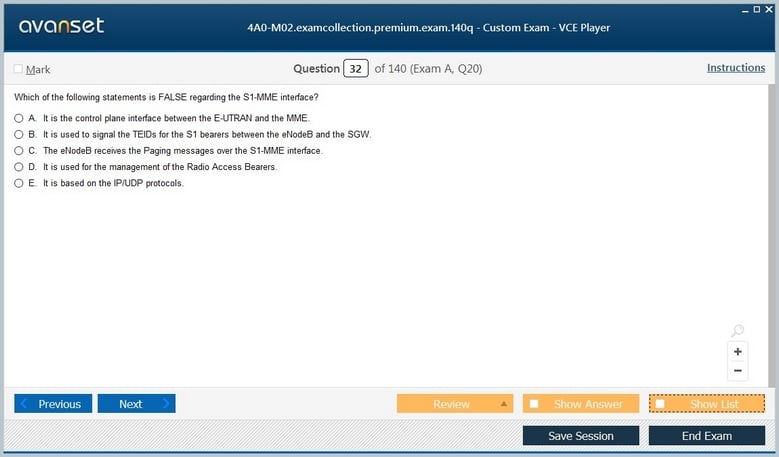
Draw the architecture without looking at a reference, then annotate every interface with the type of information it carries. S1-MME is control plane, while S1-U carries user traffic. S11 connects MME and SGW signaling. S5/S8 connects SGW and PGW functions. SGi leads from the packet gateway toward external networks. This exercise matters because a symptom should be mapped first to the interface that could create it. A UE that authenticates but cannot pass user traffic presents a different fault domain from a UE that never completes attach.
Strong preparation also depends on ordinary IP fundamentals. The packet core still needs addressing, routing, redundancy, DNS, MTU consistency, and reachability between functions. Skills represented by IP Networks and Services Fundamentals remain relevant because GTP tunnels and mobile procedures cannot compensate for a broken underlay.
GPRS Tunneling Protocol is one of the architectural anchors of the exam. GTP-C carries signaling used to create, modify, and remove tunnel state, while GTP-U carries subscriber packets across the mobile core. The important distinction is not merely the letter at the end of the acronym. Control-plane state tells the network where the user plane should go, and the resulting tunnel identifiers let multiple subscribers share the same infrastructure while remaining logically distinct.
Practice tracing a packet from the UE toward an external data network. Note where the radio bearer ends, where the S1-U tunnel begins, which SGW context identifies the session, how the PGW associates it with an APN and IP address, and where ordinary IP forwarding resumes. Then reverse the direction. If the downlink packet reaches the PGW but never reaches the UE, identify which pieces of tunnel and mobility state must be present at every hop.
Failure analysis becomes more precise when control and user plane are tested separately. A control-plane session may appear healthy while a GTP-U path is blocked, misrouted, or mapped to stale state. Conversely, IP reachability between gateways may be perfect while the control plane has never installed the subscriber context required to use it. The exam's value comes from learning to distinguish those conditions instead of treating the packet core as one large black box.
An EPS bearer is more than a tunnel. It represents a packet-delivery treatment with associated quality-of-service attributes. Candidates should distinguish default and dedicated bearers, understand why a default bearer is created as part of PDN connectivity, and recognize when an application or policy decision justifies a dedicated bearer with different treatment. Concepts such as QCI, allocation and retention priority, and guaranteed versus non-guaranteed bit rate affect admission, scheduling, and congestion behavior.
This is where mobile core knowledge meets the wider discipline of Quality of Service. A QCI value is only useful if you can reason about what the network must do with the traffic. Build examples with conversational voice, ordinary internet access, and a latency-sensitive service. Ask what happens if resources are insufficient, what can be pre-empted, and which nodes must preserve the intended treatment.
Operationally, a bearer problem should be traced from policy decision to control signaling to the data plane. Verify the subscriber's APN and profile, the selected policy rule, the bearer parameters signaled to the access side, and the resulting forwarding treatment. This turns QoS from a list of values into a causal chain that can be tested.
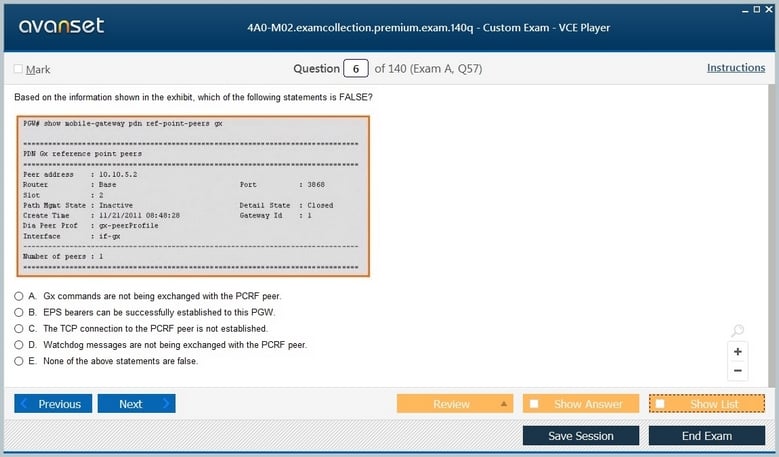
The PGW sits at an important boundary between connectivity and policy. Policy and Charging Control allows the network to apply service rules based on subscriber, application, plan, or network conditions. The Policy and Charging Rules Function can provide dynamic rules, while locally defined behavior can cover static cases. Diameter signaling is therefore part of the operational picture even though the user packet itself does not travel over Diameter.
Learn to separate authentication and subscriber-data questions from policy questions. If a subscriber can attach but receives the wrong treatment for a specific service, the fault may be in policy selection rather than basic mobility. If policy signaling toward the appropriate peer is down, the network may fall back, reject a request, or use local rules depending on design. The correct troubleshooting step is to determine which state was expected and which state was actually installed.
APN handling also deserves attention. An APN influences which external service the subscriber reaches and can affect gateway selection, addressing, policy, and routing. Compare two APNs on the same subscriber and document which parts of the session change. That exercise makes it easier to understand why an enterprise APN can fail while ordinary internet access works normally.
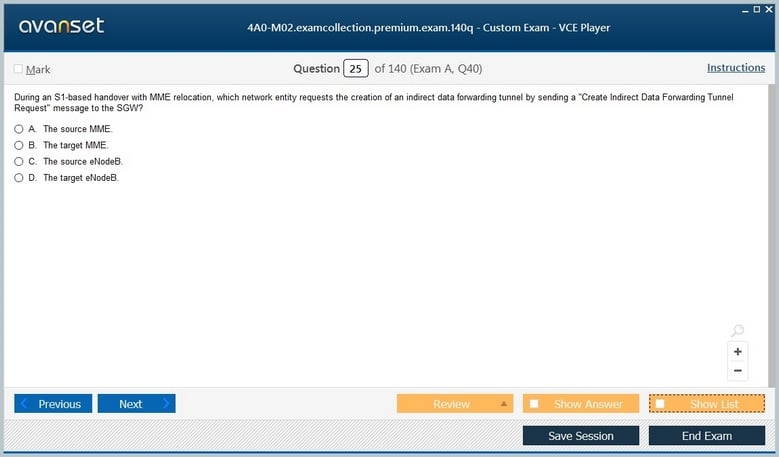
LTE procedures become much easier once they are treated as ordered state transitions. During attach, the network establishes identity and security context, selects serving functions, creates default connectivity, and returns the information the UE needs to operate. A service request restores active user-plane resources for a UE that remains registered but has moved into an idle state. Handover preserves session continuity while the radio attachment changes. Detach removes state deliberately.
For each procedure, write down the trigger, the participating nodes, the essential messages, the state created or changed, and the data-plane consequence. Then inject a failure at one step. If gateway selection fails, the procedure should break differently from an authentication failure. If an S1 release completes normally, subscriber context remains at the core even though the radio/user-plane resources are removed. Those distinctions are common sources of operational confusion.
The next exam in this packet-core sequence, Nokia Mobility Manager, puts more weight on the control-plane side of these same procedures. Studying the two topics together reveals why mobility control and gateway forwarding must be understood as complementary functions.
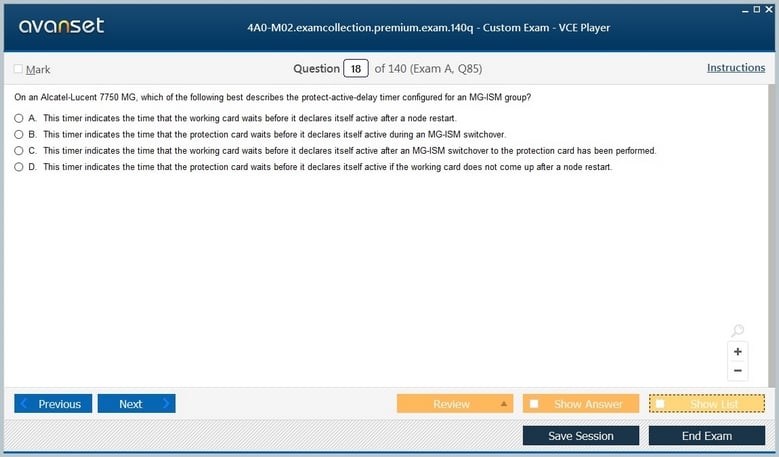
Mobile gateways are stateful network functions. Redundancy therefore involves more than placing two devices behind a routed path. Engineers must consider how sessions are distributed, how a replacement function is selected, what state can be preserved, and what procedures are triggered when state cannot be preserved. Pooling and gateway selection also affect load distribution and failure recovery.
Use failure scenarios that change one variable at a time. Remove a signaling path while keeping user-plane connectivity. Remove a user-plane path while control signaling stays up. Make the preferred gateway unreachable. Change DNS or selection information so a different gateway is chosen. In each case, predict whether new sessions, existing sessions, or both should be affected. This forces a deeper understanding than simply memorizing redundancy terminology.
Metrics matter during these tests. Session creation rate, active bearer count, signaling errors, GTP tunnel counters, dropped packets, CPU load, and interface utilization can reveal whether the incident is a capacity problem, a control-plane problem, or a forwarding problem. The best operational answer usually combines protocol evidence with platform health.
Nokia's packet-core architecture moved from appliance-oriented gateway implementations toward virtualized and cloud-native functions. The Cloud Packet Core material expands the discussion into virtual infrastructure and lifecycle operations, while 5G Packet Core Architecture replaces EPC's monolithic control roles with service-based 5G network functions such as AMF, SMF, NRF, and NSSF and evolves the user-plane role into the UPF.
The useful study bridge is functional, not just chronological. Ask what happened to the MME's responsibilities in 5G, where session management moved, what became of the gateway user plane, how policy still influences packet treatment, and how mobility procedures changed. If you can answer those questions from first principles, 4A0-M02 becomes more than a retired-code study exercise; it becomes a foundation for understanding why the newer core looks the way it does.
Prepare with packet traces, procedure diagrams, routing checks, and failure injection rather than question memorization. The exam's enduring lesson is that mobile connectivity is created by coordinated state across radio, control plane, gateway, policy, and IP transport. When one layer fails, the engineer's job is to prove exactly where the expected state stops matching reality.
Go to testing centre with ease on our mind when you use Nokia 4A0-M02 vce exam dumps, practice test questions and answers. Nokia 4A0-M02 Nokia Mobile Gateways certification practice test questions and answers, study guide, exam dumps and video training course in vce format to help you study with ease. Prepare with confidence and study using Nokia 4A0-M02 exam dumps & practice test questions and answers vce from ExamCollection.
Purchase Individually
Top Nokia Certification Exams
Site Search:

SPECIAL OFFER: GET 10% OFF

Pass your Exam with ExamCollection's PREMIUM files!
SPECIAL OFFER: GET 10% OFF
Use Discount Code:
MIN10OFF
A confirmation link was sent to your e-mail.
Please check your mailbox for a message from support@examcollection.com and follow the directions.

Download Free Demo of VCE Exam Simulator
Experience Avanset VCE Exam Simulator for yourself.
Simply submit your e-mail address below to get started with our interactive software demo of your free trial.