



Premium File
83 Q&A
$76.99$69.99
VMware 3V0-752 Exam Questions & Answers, Accurate & Verified By IT Experts
Instant Download, Free Fast Updates, 99.6% Pass Rate

3V0-752 Premium File: 83 Questions & Answers
Last Update: Sep 30, 2026
3V0-752 Training Course: 29 Video Lectures
$74.99
VMware 3V0-752 Exam Screenshots
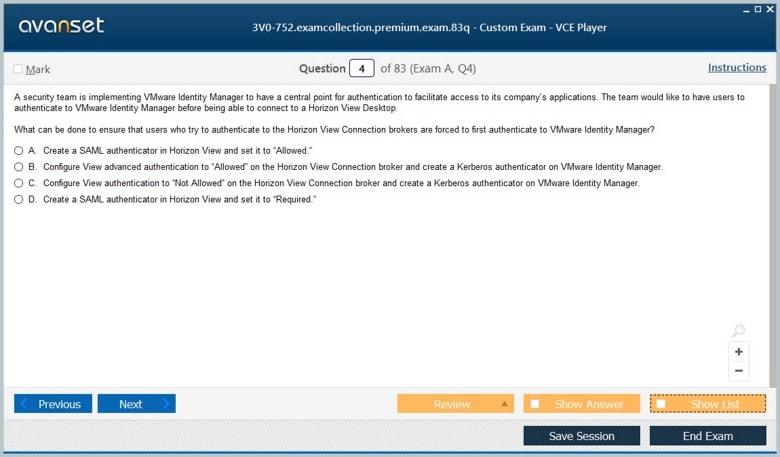
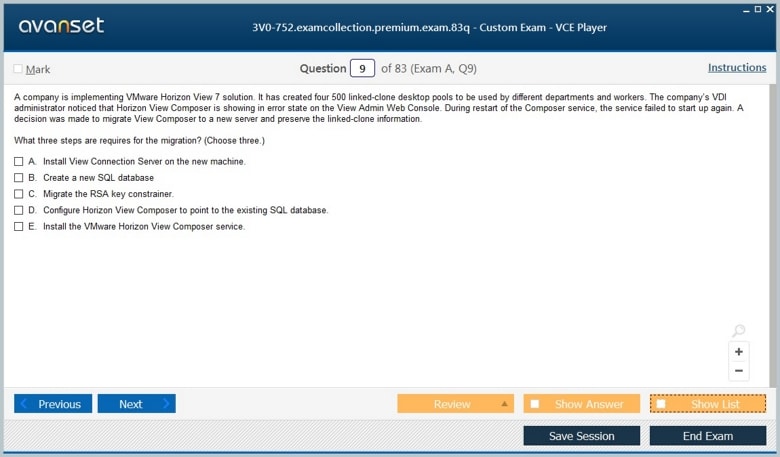
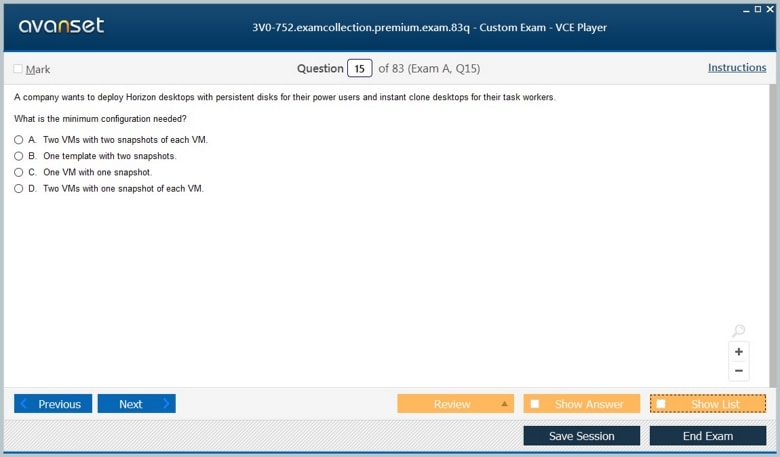
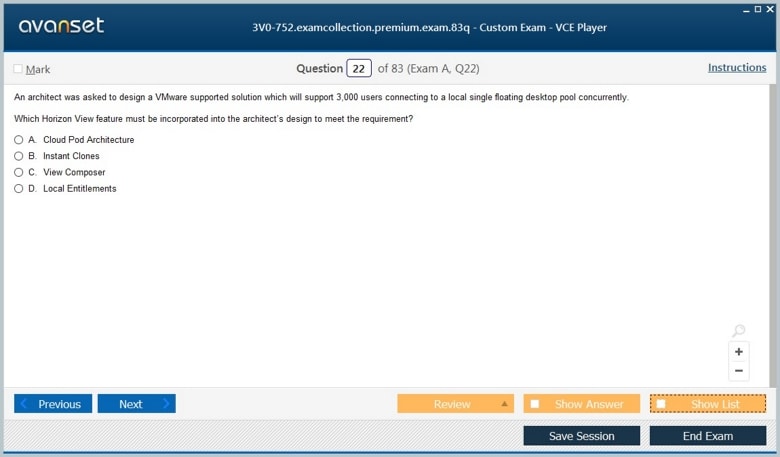
VMware 3V0-752 Practice Test Questions in VCE Format
| File | Votes | Size | Date |
|---|---|---|---|
File VMware.actualtests.3V0-752.v2026-10-10.by.harry.46q.vce |
Votes 1 |
Size 161.61 KB |
Date Oct 09, 2026 |
File VMware.Actualtests.3V0-752.v2019-05-20.by.Nick.45q.vce |
Votes 2 |
Size 161.83 KB |
Date May 26, 2019 |
VMware 3V0-752 Practice Test Questions, Exam Dumps
VMware 3V0-752 (VMware Certified Advanced Professional 7 - Desktop and Mobility Design) exam dumps vce, practice test questions, study guide & video training course to study and pass quickly and easily. VMware 3V0-752 VMware Certified Advanced Professional 7 - Desktop and Mobility Design exam dumps & practice test questions and answers. You need avanset vce exam simulator in order to study the VMware 3V0-752 certification exam dumps & VMware 3V0-752 practice test questions in vce format.
The VMware Certified Advanced Professional 7 - Desktop and Mobility Design (3V0-752) exam belongs to an earlier generation of VMware Horizon architecture. It later appeared as a qualifying design exam in VMware's desktop-and-mobility certification lineage, but the end-user computing business and current certification program now sit with Omnissa. The code should therefore be treated as legacy VMware certification content.
The architectural discipline behind the exam remains useful. Desktop virtualization design forces candidates to balance user experience, application requirements, identity, security, image management, profile behavior, network conditions, storage, site resilience, and operations. A credible design explains not only what components are deployed but why the proposed service will meet measurable user and business requirements.
Virtual desktop projects fail when architecture begins with server counts instead of user requirements. Classify users by location, device, application set, concurrency, graphics needs, data sensitivity, offline expectations, peripheral requirements, and tolerance for session loss. Separate task workers from knowledge workers, developers, contractors, call-center users, and specialized graphics users because they may need different delivery models.
Application analysis is equally important. Identify applications that require local installation, published delivery, special drivers, low latency, hardware acceleration, persistent settings, or proximity to data. Record licensing and compatibility constraints early. A pool architecture should be the result of these findings rather than a default pattern applied to every employee.
Document why each major decision exists. A requirement might specify remote access for a defined percentage of users; a constraint might require reuse of two data centers; an assumption might state that WAN latency stays below a tested threshold; a risk might identify dependency on a profile share in one site. Keeping these categories separate exposes which decisions need validation.
Translate subjective goals into measurable criteria. “Fast login” should have a target and a measurement method. “Highly available” should define tolerated downtime, capacity during failure, and recovery objectives. “Secure access” should identify authentication, network boundaries, endpoint conditions, and administrative controls. A design becomes defensible when success can be tested.
Choose between dedicated and floating desktops, persistent and nonpersistent patterns, automated and manual pools, and the image technologies available in the relevant Horizon generation. The decision affects storage consumption, patching, recovery, personalization, and support. Nonpersistent pools simplify reset and image governance but require applications and user state to be separated cleanly from the base desktop.
Design the image lifecycle from build to retirement. Include operating-system updates, Horizon Agent changes, application testing, optimization, security tooling, versioning, rollout rings, and rollback. If a release causes a problem, operators should know which pools are affected and how to return to a known-good image without rebuilding the environment manually.
A desktop VM may start quickly while the user still waits for profile loading, policies, scripts, environment settings, and application attachment. Design user-environment management with file-service capacity, geographic location, permissions, exclusion rules, and failure handling in mind. Separate settings that need roaming from cache or transient data that should remain local.
Application delivery may use the base image, published applications, application layering, or other mechanisms. Select the approach by update frequency, compatibility, isolation needs, and operational ownership. A frequently updated application should not necessarily force a new golden image for every desktop. Conversely, an application with deep OS integration may be a poor candidate for dynamic attachment.
Design connection servers, load balancers, certificates, DNS, Active Directory, and secure external access as a service chain. Multiple brokers improve resilience only if clients can reach them and their shared dependencies remain available. External access should use a secure gateway layer rather than exposing internal brokers or desktops directly to the internet.
Model sign-in and launch as separate stages. Authentication can succeed while the display protocol fails, and a protocol tunnel can be reachable while desktop assignment fails. Define which logs and monitoring points diagnose each stage. This decomposition helps operations teams identify whether an incident belongs to identity, brokering, gateway access, desktop health, or the network.
Average utilization is not enough for virtual desktop sizing. Model concurrent sessions, boot storms, login storms, patch windows, antivirus activity, application peaks, storage IOPS, network throughput, and graphics demand. Then reserve capacity for host maintenance and failure. A cluster sized to 90 percent under normal operation has little room to absorb a host outage or a sudden return-to-office login peak.
Storage design should consider both capacity and latency. Replica or image behavior, disposable disks, profiles, user data, application packages, and desktop write patterns can produce different workloads. Measure representative sessions rather than relying on generic ratios. The final design should state what metrics trigger scale-out and how additional capacity is introduced without disrupting users.
Display protocols are sensitive to latency, packet loss, bandwidth, and graphics workload. Map office, branch, home, and external user paths to the data center, including security devices and WAN links that can affect traffic. Decide which protocol policies are appropriate for the user population and how voice, video, USB, printing, or graphics redirection changes the bandwidth model.
Test from representative locations. A design proven only on the same LAN as the Horizon servers says little about a remote workforce. Establish acceptable user-experience measures and correlate them with infrastructure metrics. This gives operations a baseline for distinguishing endpoint or WAN problems from desktop compute and storage issues.
Horizon site resilience can use multiple pods and global entitlement concepts, but brokering is only one layer of recovery. Define where images, applications, profiles, home directories, identity services, certificate services, and data live. Decide whether users fail over automatically, whether they have a preferred site, and what capacity is reserved to receive them.
Recovery objectives should account for synchronization. If a secondary site has yesterday's image and cannot reach current application data, the broker may function while the business service is still degraded. Exercise failure scenarios on paper and in tests, including loss of a broker, pod, storage system, network path, and entire site.
Operational design should also make the environment diagnosable and maintainable.
Include monitoring, logging, backup, patching, certificate renewal, image release, capacity review, and incident ownership in the architecture. Decide who manages each layer and which alerts are actionable. A complex virtual-desktop platform becomes fragile when no team owns the boundaries between Horizon, vSphere, networking, identity, profiles, applications, and endpoint support.
Standardize naming and configuration patterns so operators can compare healthy and unhealthy pools. Define maintenance procedures that preserve capacity and user access. Good architecture reduces the number of exceptional cases administrators must remember and provides evidence for deciding whether a problem is local to one user, one pool, one host, one site, or the shared platform.
The deployment-oriented Advanced Deploy VMware Horizon 7.X exam complements this architecture focus, while Horizon 8.x Professional represents a later VMware-era generation. Workspace ONE's older VMware lineage can be seen in Workspace ONE 22.x Professional. None of those legacy codes should be confused with today's Omnissa certification program.
Current Horizon certifications are published by Omnissa, including administrator, engineer, and design-engineer paths. The VMware certifications inventory remains useful for historical navigation. For 3V0-752, practice architecture as a chain of evidence: collect requirements, classify constraints and risks, design pools and images, secure access, size failure capacity, plan multi-site behavior, and document how operators will maintain and troubleshoot the service.
Security design should extend beyond the connection gateway. Define administrative roles, privileged access, certificate lifecycle, desktop network segmentation, endpoint trust, USB and clipboard policy, data-loss controls, logging, and how security teams receive evidence. Different user groups may need different policies, but exceptions should be explicit. A secure architecture lets users complete their work without giving every session the same broad network or device access.
Designers should also consider how supportability changes with personalization. The more persistent state a desktop carries, the harder it may be to reset a broken session to a known-good baseline. Decide which user settings genuinely require persistence and which can be reconstructed. Pair this with application ownership so that support teams know whether to repair the desktop, recompose it, replace the profile, or escalate to an application team.
A proof of concept should test the riskiest assumptions rather than merely demonstrate that a desktop can launch. Reproduce remote-network conditions, representative applications, login concurrency, graphics demand, printing, peripherals, authentication, and failover. Record acceptance criteria before the test. Otherwise a proof of concept can produce a visually successful demo without validating the factors most likely to determine production success.
Capacity and operations should be revisited after deployment begins. Actual session density, protocol behavior, application growth, image size, and user-profile patterns may differ from estimates. Define periodic review points and thresholds that trigger scale-out or design adjustment. Architecture is not frozen at handover; the original design should provide the measurements and decision rules needed to evolve the service safely.
Cost and licensing assumptions should be visible too. A design can meet technical requirements and still fail if the selected delivery model, concurrent-user estimate, application licensing, or infrastructure footprint is financially unrealistic. Treat commercial constraints as architecture inputs without letting them obscure user experience or resilience requirements. Where tradeoffs are necessary, document what capability is reduced and which business owner accepts the consequence.
Go to testing centre with ease on our mind when you use VMware 3V0-752 vce exam dumps, practice test questions and answers. VMware 3V0-752 VMware Certified Advanced Professional 7 - Desktop and Mobility Design certification practice test questions and answers, study guide, exam dumps and video training course in vce format to help you study with ease. Prepare with confidence and study using VMware 3V0-752 exam dumps & practice test questions and answers vce from ExamCollection.
Purchase Individually

VMware 3V0-752 Video Course
Top VMware Certifications




Top VMware Certification Exams
Site Search:

SPECIAL OFFER: GET 10% OFF

Pass your Exam with ExamCollection's PREMIUM files!
SPECIAL OFFER: GET 10% OFF
Use Discount Code:
MIN10OFF
A confirmation link was sent to your e-mail.
Please check your mailbox for a message from support@examcollection.com and follow the directions.

Download Free Demo of VCE Exam Simulator
Experience Avanset VCE Exam Simulator for yourself.
Simply submit your e-mail address below to get started with our interactive software demo of your free trial.

How reliable are these questions
Looking for VMware 3V0-752 exam
Looking for dumps for this exam, 3VO-752