



Premium File
58 Q&A
$76.99$69.99
Pegasystems PEGAPCSSA80V1_2019 Exam Questions & Answers, Accurate & Verified By IT Experts
Instant Download, Free Fast Updates, 99.6% Pass Rate
58 Questions & Answers
Last Update: Sep 20, 2026
$69.99
Pegasystems PEGAPCSSA80V1_2019 Exam Screenshots
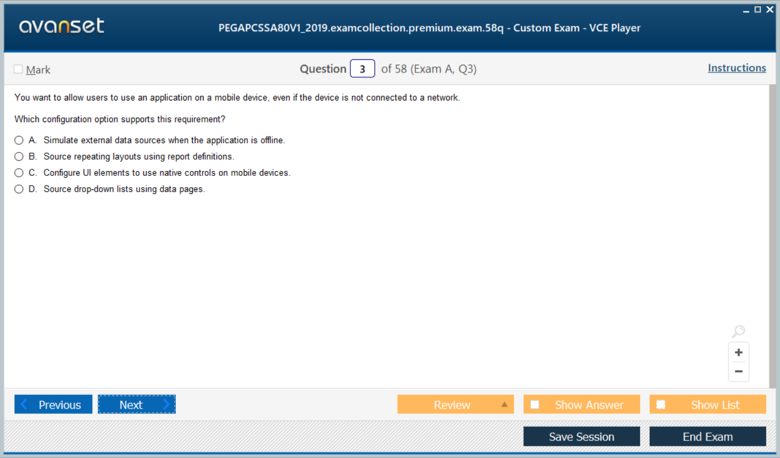
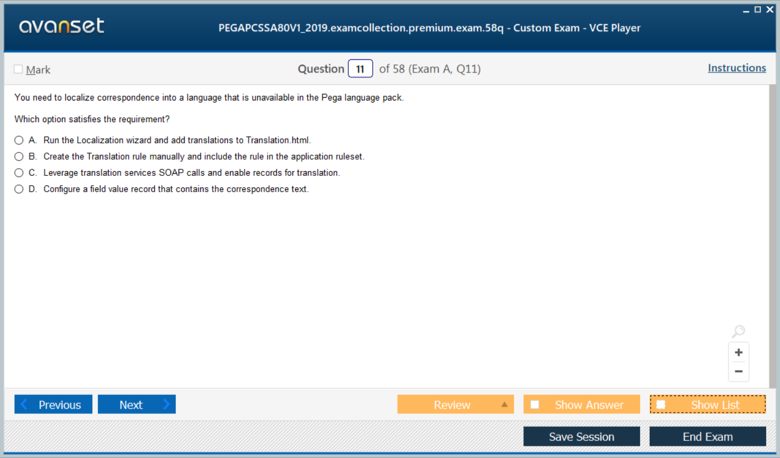
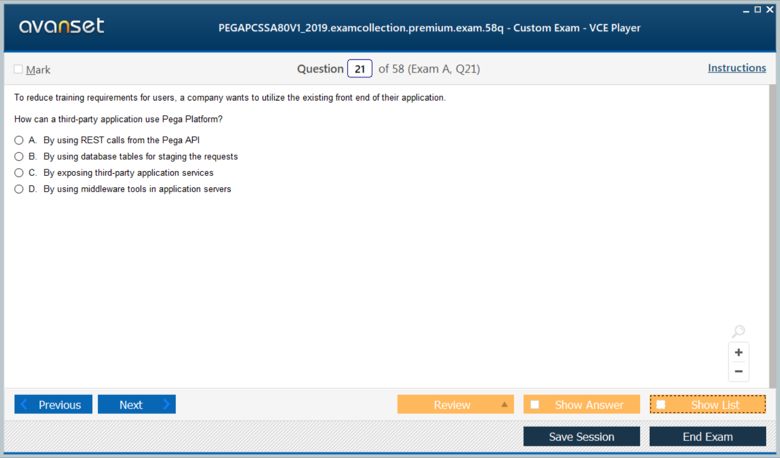
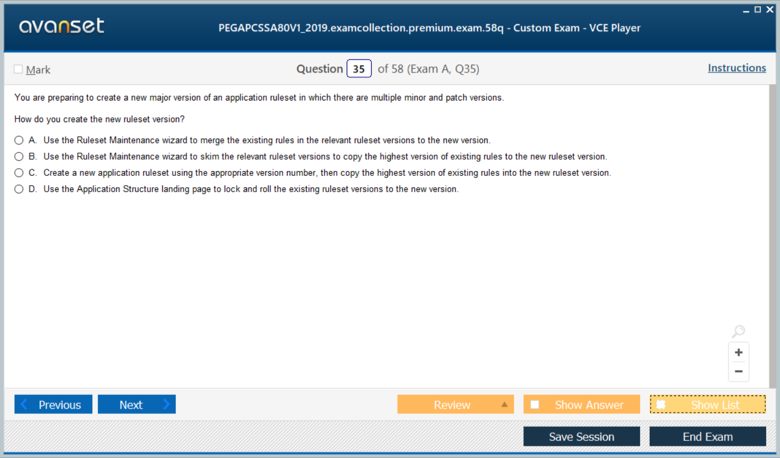
Pegasystems PEGAPCSSA80V1_2019 Practice Test Questions in VCE Format
| File | Votes | Size | Date |
|---|---|---|---|
File Pegasystems.prep4sure.PEGAPCSSA80V1_2019.v2026-09-09.by.maya.15q.vce |
Votes 1 |
Size 26.27 KB |
Date Sep 10, 2026 |
File Pegasystems.pass4sures.PEGAPCSSA80V1_2019.v2020-04-30.by.ahmed.24q.vce |
Votes 2 |
Size 343.97 KB |
Date Apr 30, 2020 |
Pegasystems PEGAPCSSA80V1_2019 Practice Test Questions, Exam Dumps
Pegasystems PEGAPCSSA80V1_2019 (Pega Certified Senior System Architect 80V1) exam dumps vce, practice test questions, study guide & video training course to study and pass quickly and easily. Pegasystems PEGAPCSSA80V1_2019 Pega Certified Senior System Architect 80V1 exam dumps & practice test questions and answers. You need avanset vce exam simulator in order to study the Pegasystems PEGAPCSSA80V1_2019 certification exam dumps & Pegasystems PEGAPCSSA80V1_2019 practice test questions in vce format.
The PEGAPCSSA80V1-2019 exam represents the Certified Pega Senior System Architect path for the Pega 8.0 generation. Pega Academy’s published version lists 60 questions, 90 minutes, a 70 percent passing score, and retirement on April 30, 2021, with a Certified Pega System Architect prerequisite. Its domains span application development, case management, data modeling, user interface, reporting, information exchange, security, deployments, and mobility.
The senior distinction matters. A System Architect can configure common case behavior; a Senior System Architect is expected to reason about application structure, rule selection, reusable components, integrations, performance, security, and delivery choices that affect a wider solution.
Within Pegasystems certifications, the same-generation PEGAPCSA80V1-2019 System Architect exam is therefore the right conceptual foundation before moving into this senior material.
A senior architect should design classes around meaningful ownership rather than convenience. Shared behavior belongs at a level where its business meaning remains true for every consumer. Moving a rule too high can create exceptions; keeping it too low can produce duplication across case types and applications.
The best structure makes future change easier to predict. A developer should be able to locate common behavior, understand which applications inherit it, and know who owns the decision to change it.
Enterprise reuse also requires governance. Shared rules need tests and stable contracts because their blast radius is larger than a local rule used by one case.
When several versions or variants of a rule exist, the runtime system must select one. Senior architects need to understand the factors that influence that selection so they can explain why the application executed a particular rule instead of adding another override.
Circumstancing can express legitimate variation by context, but too many variants can fragment behavior. Before creating a circumstance, determine whether the difference is truly structural or whether data-driven decision logic would be clearer.
Debugging should trace the selected rule and context. That evidence is more reliable than assuming that the most recently edited rule is the one being executed.
Performance problems can originate in database access, integrations, reports, large clipboard structures, repeated calculations, or rules that execute more often than expected. Tuning without measurement risks optimizing the wrong layer.
Senior architects should identify where time and resources are consumed, then ask whether that work is needed at all. Loading an entire collection when the user needs one record is an architectural problem, not merely a hardware problem.
Caching can help when data is reused and freshness requirements allow it, but stale data can be worse than slow data in decisions that require current information. Performance and correctness have to be designed together.
Large applications can contain subprocesses, child cases, parallel work, escalations, and specialized exceptions. The senior architect’s job is to keep that complexity understandable. Splitting work into child cases can clarify ownership and scale, but excessive decomposition can make users lose sight of the overall outcome.
Concurrency also needs explicit thought. Two users or processes may attempt to update related work at the same time. Locking and update patterns should protect data integrity without unnecessarily blocking legitimate parallel work.
Cases should fail in a recoverable state. If an external dependency fails after part of a process has completed, the application should make it clear what can be retried and what already happened.
Integration is not complete when a connector returns a successful response. Senior architects need to define the request and response contract, map external data into an appropriate internal representation, protect credentials, handle timeouts, and decide which failures can safely be retried.
Idempotence is important when the same request may be submitted more than once. A retry after a lost response should not create duplicate transactions if the external operation already succeeded.
Database access deserves the same discipline. Queries and keyed data access should retrieve only what the application needs, respect transaction boundaries, and avoid turning the database into an undocumented integration shortcut.
Senior architects must think beyond visible screens. Sensitive data can be exposed through reports, APIs, logs, background processing, or diagnostic tools even when a user interface hides the field.
Access models should reflect business responsibility and least privilege. Where data requires stronger protection, encryption and secure handling should be considered alongside authorization. Auditing should capture meaningful security events without logging secrets.
Security testing needs negative cases: prove that unauthorized users and processes cannot perform the action, not only that authorized users can.
Multiple teams changing shared rules create coordination risk. A senior architect should understand how work is isolated, reviewed, merged, packaged, and promoted through environments so that one release does not accidentally include unfinished or incompatible changes.
Environment-specific values should be separated from application logic. Endpoints, credentials, and operational settings often differ across development, test, and production; hard-coding them into rules makes deployment fragile.
Rollback is part of release design. Teams should know how to restore known-good behavior and how data created by the new release will be handled if code is reverted.
A case may be used on mobile devices or exposed inside another application. Those channels can have different connectivity, screen space, security context, and interaction patterns. Reusing the same business behavior is desirable, but blindly duplicating a desktop experience is not.
Mobile design should prioritize the actions that genuinely matter away from a desk and account for intermittent connectivity where relevant. Embedded experiences should preserve authorization and avoid leaking application assumptions into the host system.
Channel differences are another reason to keep business rules separate from presentation. The same policy should not be reimplemented independently in every user experience.
The older PEGACSSA74V1 exam shows the preceding 7.4 lineage, while PEGAPCSSA87V1 represents a later 8.x stage. The PEGACPSSA24V1 Senior System Architect exam belongs to a much newer platform generation and is a better comparison for current skills planning.
Modern Pega architecture introduces newer experience patterns and platform services, but senior responsibilities remain recognizable: choose appropriate reuse boundaries, understand rule behavior, keep integrations resilient, control access, protect performance, and deliver changes safely.
Legacy modernization should therefore preserve intent rather than implementation by default. A custom 8.0 rule may represent an essential business requirement, or it may only work around a historical product limitation. The architect must determine which before carrying it forward.
PEGAPCSSA80V1-2019 is retired, but it remains a useful skills map for architects responsible for Pega 8.0-era solutions. Its strongest lessons are architectural rather than cosmetic: shared behavior needs clear ownership, runtime rule selection must be explainable, integrations need failure contracts, performance needs evidence, security must span every access path, and deployments must be recoverable.
Current certification candidates should use Pega’s live Academy material for their target version. Legacy teams can still use this blueprint to structure maintenance and modernization work, provided they keep the historical context explicit. Senior architecture is ultimately about making change safer across a system, and that responsibility survives product-version changes better than any individual screen or rule name.
Reporting architecture can also become a performance and governance issue at senior level. A report that joins large tables, retrieves unused columns, or runs without selective filters may work during development and become expensive under production volume. Architects should start from the operational question, retrieve only necessary data, and understand whether the report belongs in the transactional application or in a separate analytical environment.
Background and asynchronous processing deserve explicit transaction design. Work moved out of an interactive request should have clear retry behavior, ownership, and observability. Reprocessing is safe only when the operation is designed for it; otherwise repeated execution can create duplicate external actions or conflicting case updates.
Diagnostic tools should be used methodically. Trace the path that consumes time or selects an unexpected rule, collect enough evidence to identify the layer responsible, and change one assumption at a time. Senior troubleshooting is less about knowing every tool option than about forming a precise hypothesis and proving or disproving it.
Shared data patterns also need freshness and invalidation rules. Caching can reduce external calls and database load, but the team must know how long the value can remain valid and what event should force a refresh. A fast application that makes a decision on obsolete customer or policy data is not a successful optimization.
Modernization reviews should map these senior concerns before implementation begins. Inventory shared classes, circumstances, integration contracts, security controls, performance-sensitive rules, deployment dependencies, and channel-specific customizations. Then determine which business responsibilities remain and which historical mechanisms can be replaced by newer platform capabilities. That prevents an upgrade from becoming a mechanical copy of 8.0 architecture.
Senior architects should also plan for observability before incidents occur. Important background work, integrations, and high-volume processes need signals that reveal failure rates, backlog growth, unusual latency, or repeated retries. Waiting for users to report symptoms makes diagnosis slower and can allow a small defect to become a large operational problem. Useful monitoring should point toward a component or transaction without exposing sensitive payloads, and ownership for each alert should be clear enough that the correct team can act on it.
It also gives release reviewers evidence that operational risk was considered before promotion.
Evidence matters.
Go to testing centre with ease on our mind when you use Pegasystems PEGAPCSSA80V1_2019 vce exam dumps, practice test questions and answers. Pegasystems PEGAPCSSA80V1_2019 Pega Certified Senior System Architect 80V1 certification practice test questions and answers, study guide, exam dumps and video training course in vce format to help you study with ease. Prepare with confidence and study using Pegasystems PEGAPCSSA80V1_2019 exam dumps & practice test questions and answers vce from ExamCollection.
Purchase Individually
Top Pegasystems Certification Exams
Site Search:

SPECIAL OFFER: GET 10% OFF

Pass your Exam with ExamCollection's PREMIUM files!
SPECIAL OFFER: GET 10% OFF
Use Discount Code:
MIN10OFF
A confirmation link was sent to your e-mail.
Please check your mailbox for a message from support@examcollection.com and follow the directions.

Download Free Demo of VCE Exam Simulator
Experience Avanset VCE Exam Simulator for yourself.
Simply submit your e-mail address below to get started with our interactive software demo of your free trial.