



Premium File
60 Q&A
$76.99$69.99
Pegasystems PEGACSSA74V1 Exam Questions & Answers, Accurate & Verified By IT Experts
Instant Download, Free Fast Updates, 99.6% Pass Rate
60 Questions & Answers
Last Update: Sep 27, 2026
$69.99
Pegasystems PEGACSSA74V1 Exam Screenshots
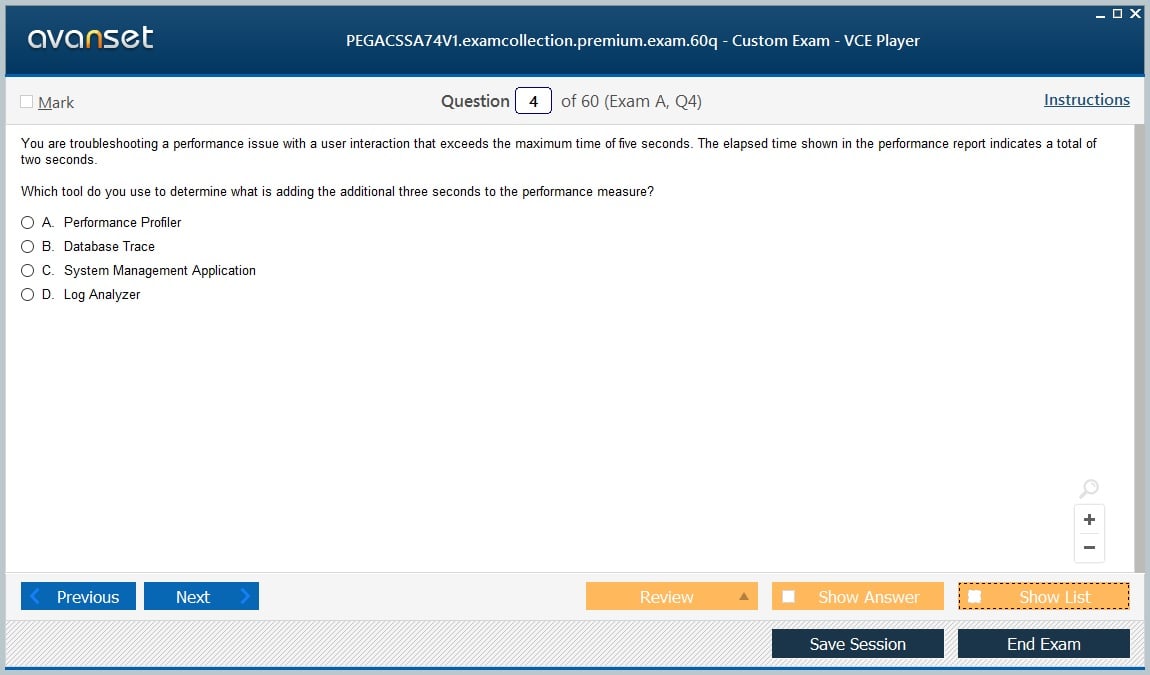


Pegasystems PEGACSSA74V1 Practice Test Questions in VCE Format
| File | Votes | Size | Date |
|---|---|---|---|
File Pegasystems.Actualtests.PEGACSSA74V1.v2026-07-11.by.Ben.28q.vce |
Votes 5 |
Size 206.33 KB |
Date Jul 12, 2026 |
Pegasystems PEGACSSA74V1 Practice Test Questions, Exam Dumps
Pegasystems PEGACSSA74V1 (Certified Senior System Architect (CSSA) 74V1) exam dumps vce, practice test questions, study guide & video training course to study and pass quickly and easily. Pegasystems PEGACSSA74V1 Certified Senior System Architect (CSSA) 74V1 exam dumps & practice test questions and answers. You need avanset vce exam simulator in order to study the Pegasystems PEGACSSA74V1 certification exam dumps & Pegasystems PEGACSSA74V1 practice test questions in vce format.
The PEGACSSA74V1 exam belongs to the Pega 7.4 generation of the Certified Senior System Architect path. It is legacy material, so its old interface and version assumptions should not be mistaken for the current Senior System Architect blueprint. Its strongest value is architectural: it reflects a point where a developer was expected to move beyond configuring individual cases and start reasoning about reuse, rule selection, integration, performance, security, and delivery across an application.
That shift in responsibility is still useful for experienced Pega practitioners. Across Pegasystems certifications, senior architecture begins when a local design choice can affect many cases, teams, channels, or releases. The architect therefore needs to understand not only how a rule works, but where it belongs, how the platform will find it, how it behaves under load, and how another developer will safely change it later.
The same-era PEGACSA74V1 System Architect exam provides the natural foundation: case, data, rules, UI, and common application behavior. Senior-level study should build on that base rather than repeat it.
Reuse is not achieved by putting every rule in the highest class possible. A rule should live at the broadest level where its meaning is still correct. Behavior that is truly common across an enterprise may belong in a shared layer, while a process unique to one line of business should remain close to that business application.
The design question is semantic, not merely technical. If a validation exists because of a universal customer-data policy, central reuse may be appropriate. If it exists because one product has a special contract rule, moving it upward can create exceptions elsewhere and make the supposedly reusable component harder to understand.
Senior architects should also consider change ownership. Shared components need stable contracts, documentation, and tests because a small change can affect many consuming applications. Reuse lowers duplication only when teams can trust the shared behavior.
Pega’s rule engine can select behavior according to class, inheritance, ruleset context, versions, circumstances, and other conditions. At senior level, it is not enough to know that a rule exists. The architect must be able to explain why a particular rule instance is selected for a particular case and user context.
This becomes especially important when an application has accumulated overrides over several releases. A developer may see two similarly named rules and assume the newest is always used. In reality, the runtime context may point elsewhere. Diagnosing that correctly avoids the dangerous pattern of adding another override just to make a symptom disappear.
A useful study exercise is to trace a rule from a running case back through its class and ruleset context, then change one factor at a time. That makes rule resolution concrete rather than an abstract list of precedence rules.
When behavior varies by product, jurisdiction, customer segment, date, or another business condition, circumstancing can be powerful. It can also become a maintenance trap if teams create a separate variant for every exception without a coherent model.
A senior architect should ask whether the variability belongs in rule selection, decision logic, data, or configuration. If the difference is simply a threshold, a data-driven decision may be clearer than multiple near-identical rules. If the behavior genuinely changes for a well-defined context, a circumstance may be more expressive.
The goal is to keep the reason for variation visible. Future maintainers should be able to tell which base behavior applies, what condition selects the specialized version, and whether that condition is still valid.
Enterprise Pega applications rarely operate alone. They read customer information, send updates, invoke services, receive events, and coordinate with systems that have their own availability and data rules. Integration therefore needs more than a connector that succeeds in a test environment.
A strong design defines what the external system owns, which data is required, how authentication works, what timeout is acceptable, and what the application should do when the dependency fails. Retrying every error can be as dangerous as never retrying: a non-idempotent operation may create duplicates if the first request succeeded but the response was lost.
Mappings should also make responsibility clear. Transforming an external payload into a stable internal representation can isolate the rest of the application from unnecessary external change. Conversely, copying large external structures directly into a case can create tight coupling that becomes expensive during upgrades.
Slow Pega applications can have many causes: excessive database access, inefficient reports, repeated data retrieval, large clipboard structures, heavy UI behavior, integration latency, or rules that execute more often than expected. Senior architects should diagnose the path before attempting a fix.
The first question is where time is being spent. If an external service dominates response time, optimizing a local data transform will not solve the user problem. If the application repeatedly queries unchanged reference data, caching or data-page design may matter more than adding infrastructure.
Performance also has a design dimension. A case that loads every possible child record on every screen may be logically correct but operationally wasteful. The best optimization is often to reduce unnecessary work rather than make unnecessary work slightly faster.
Senior responsibility goes beyond deciding who sees a button. The application should enforce which roles may perform sensitive actions, which records they may access, which fields require stronger protection, and how authorization is applied consistently across user interfaces and integrations.
Data security deserves special attention because a rule can expose information without presenting it on an ordinary screen. Reports, APIs, logs, clipboard inspection, and background processing all create paths through which sensitive values can travel.
Least privilege and explicit access models make systems easier to reason about. Broad access granted for convenience during development tends to persist, and later attempts to restrict it become harder because teams cannot tell which workflows truly depend on the privilege.
As more developers work in the same application, rule conflicts and release coordination become architectural concerns. Teams need conventions for rulesets, branches or equivalent change isolation, merge review, versioning, and promotion between environments.
A senior architect should also consider backward compatibility. If one team changes a shared rule signature while another release still depends on the old behavior, an apparently small change can break unrelated work. Stable interfaces and automated tests reduce that risk.
Deployment planning includes rollback. A release process that can promote a change but cannot quickly restore known-good behavior leaves operations exposed. Clear packaging and configuration separation are as important to maintainability as the rules themselves.
The PEGAPCSSA80V1-2019 exam represents the next broad platform generation, while PEGAPCSSA87V1 moves the lineage farther into the 8.x era. Comparing those versions with 7.4 helps distinguish durable architecture from product-specific mechanics.
More recent Pega material places stronger emphasis on newer UI architecture, deployment practices, background processing, and current platform services. The PEGACPSSA24V1 Senior System Architect exam is therefore a better reference for candidates planning a modern certification path.
Legacy specialists should not skip that comparison. Understanding the target architecture helps identify which customizations are still business-critical and which only compensate for limitations or conventions from the older platform.
Memorizing rule names is not enough for a senior role. A better exercise is to take an application scenario and explain several viable designs, then choose among them using reuse, performance, security, change ownership, and operational support as criteria.
For example, consider a customer verification step used by several cases. Decide whether it belongs in a shared component, how data should be sourced, what happens when the verification service is unavailable, how unauthorized users are prevented from viewing sensitive results, and how a future version of the service can be introduced without breaking every consumer.
That style of practice mirrors real architecture work. The hardest problems rarely have only one syntactically valid solution; the task is to choose the design that remains understandable and supportable after the first release.
PEGACSSA74V1 is therefore most valuable as a historical architecture lens. Its version is old, but the questions it raises remain recognizable: where should behavior live, how should it vary, how is the right rule selected, how do integrations fail safely, and how can shared solutions be changed without surprising other teams?
For current certification, candidates should work from Pega Academy’s current Senior System Architect requirements and use older exam material only with explicit version awareness. For legacy maintenance, the reverse is true: understanding the old architecture is necessary, but every modernization decision should be informed by the newer platform direction. That combination preserves business behavior without preserving technical debt by default.
Legacy architecture reviews should also distinguish essential customization from accidental complexity. Before replacing a 7.4 rule, identify the business policy it protects, the consumers that inherit it, and any external contract it satisfies. A customization that once compensated for a platform limitation may no longer be necessary, while another may encode a critical operational requirement that is absent from documentation.
This is where senior architects add value during modernization. They can map old rule behavior to current capabilities, preserve the intent that matters, and remove structure that exists only because of the historical implementation. The result is not a mechanical version upgrade but a controlled redesign with traceable decisions.
Go to testing centre with ease on our mind when you use Pegasystems PEGACSSA74V1 vce exam dumps, practice test questions and answers. Pegasystems PEGACSSA74V1 Certified Senior System Architect (CSSA) 74V1 certification practice test questions and answers, study guide, exam dumps and video training course in vce format to help you study with ease. Prepare with confidence and study using Pegasystems PEGACSSA74V1 exam dumps & practice test questions and answers vce from ExamCollection.
Purchase Individually
Top Pegasystems Certification Exams
Site Search:

SPECIAL OFFER: GET 10% OFF

Pass your Exam with ExamCollection's PREMIUM files!
SPECIAL OFFER: GET 10% OFF
Use Discount Code:
MIN10OFF
A confirmation link was sent to your e-mail.
Please check your mailbox for a message from support@examcollection.com and follow the directions.

Download Free Demo of VCE Exam Simulator
Experience Avanset VCE Exam Simulator for yourself.
Simply submit your e-mail address below to get started with our interactive software demo of your free trial.
need CSA 7.4 dumps
i need cssa 7.4 dump for pega certification
Need CSSA 7.4 dumps