



Premium File
61 Q&A
$76.99$69.99
Pegasystems PEGAPCSA80V1_2019 Exam Questions & Answers, Accurate & Verified By IT Experts
Instant Download, Free Fast Updates, 99.6% Pass Rate
61 Questions & Answers
Last Update: Oct 29, 2026
$69.99
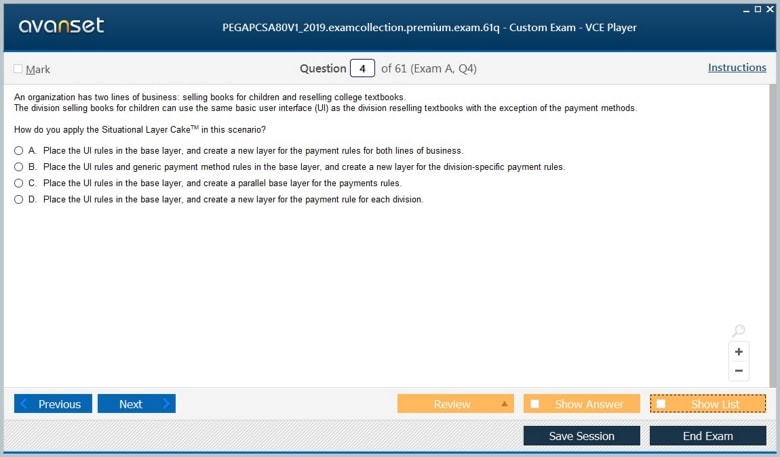
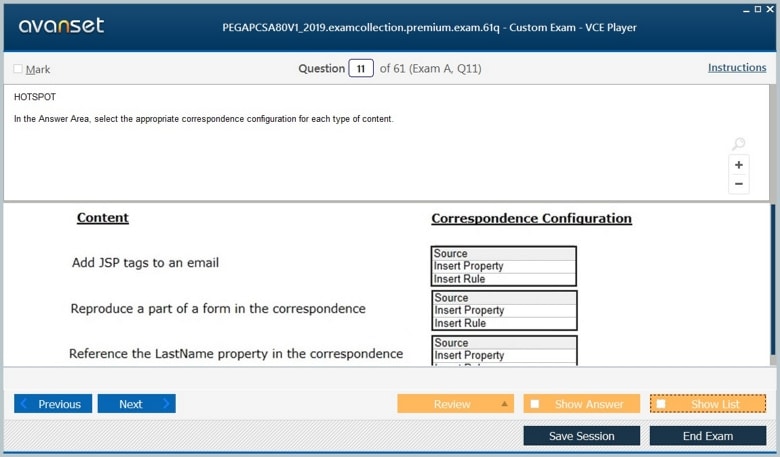
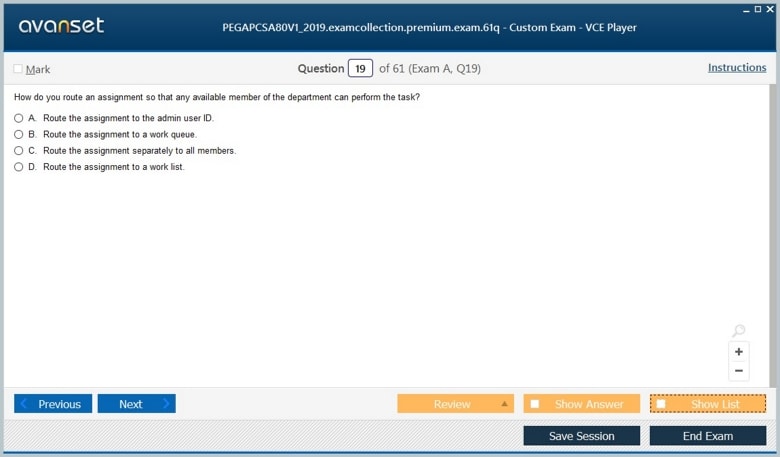
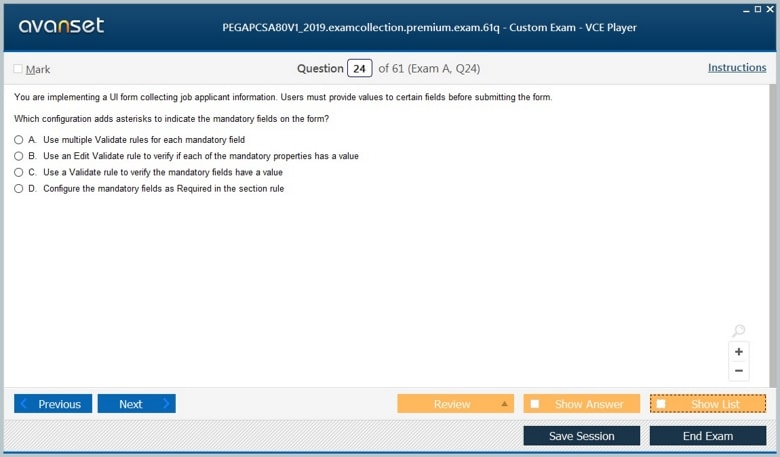
Pegasystems PEGAPCSA80V1_2019 Exam Screenshots
Pegasystems PEGAPCSA80V1_2019 Practice Test Questions in VCE Format
| File | Votes | Size | Date |
|---|---|---|---|
File Pegasystems.pass4sures.PEGAPCSA80V1_2019.v2026-09-10.by.harriet.37q.vce |
Votes 1 |
Size 57.57 KB |
Date Sep 10, 2026 |
File Pegasystems.pass4sureexam.PEGAPCSA80V1_2019.v2020-02-07.by.george.33q.vce |
Votes 4 |
Size 95.02 KB |
Date Feb 07, 2020 |
File Pegasystems.Testking.PEGAPCSA80V1_2019.v2019-12-30.by.Stephen.29q.vce |
Votes 3 |
Size 248.66 KB |
Date Jan 03, 2020 |
Pegasystems PEGAPCSA80V1_2019 Practice Test Questions, Exam Dumps
Pegasystems PEGAPCSA80V1_2019 (Pega Certified System Architect) exam dumps vce, practice test questions, study guide & video training course to study and pass quickly and easily. Pegasystems PEGAPCSA80V1_2019 Pega Certified System Architect exam dumps & practice test questions and answers. You need avanset vce exam simulator in order to study the Pegasystems PEGAPCSA80V1_2019 certification exam dumps & Pegasystems PEGAPCSA80V1_2019 practice test questions in vce format.
The PEGAPCSA80V1-2019 exam represents a Pega System Architect certification version from the early Pega 8 generation. It should be treated as version-specific material rather than as today’s System Architect blueprint, but it remains a useful foundation for understanding how Pega applications model cases, route work, use data, apply rules, integrate with other systems, and control user access.
The System Architect role sits at the point where business process design becomes executable application behavior. Candidates need enough platform knowledge to build common case patterns and enough structural awareness to understand what the visual configuration creates underneath.
Within Pegasystems certifications, the older PEGACSA74V1 exam shows the preceding 7.4 lineage, while later System Architect versions demonstrate how those same responsibilities evolved through Pega 8 and into the current platform.
Case management is not simply a sequence of forms. A well-designed case expresses stages of progress, assignments that have clear owners, decisions that reflect business policy, and a resolution that can be measured. The design should help a user understand what has happened, what must happen next, and what conditions can change the normal path.
Stages should describe meaningful progress rather than technical implementation. An approval step belongs where authority is required, while an optional action belongs where users may legitimately choose additional work without changing the fundamental lifecycle.
For study, take a familiar business process and model both its normal path and its exceptions. If the diagram becomes dominated by rare branches, consider whether some variation belongs in decision rules or subprocesses instead.
Every assignment needs an owner. Routing can send work to a person, a team, or another appropriate work destination based on role and context. The correct design depends on who is responsible, not merely who happens to perform the task during development.
Approvals should reflect real authority boundaries. A manager approval added simply because “that is how we have always done it” may create delay without adding control. Conversely, removing a required separation of duties can create a compliance problem.
Service levels make time expectations explicit. They can increase urgency or support escalation, but they should be paired with meaningful operational responses. An overdue case still needs someone who can act on it.
Pega cases combine transient work data, reusable reference data, and information owned by external systems. A System Architect should distinguish those categories before deciding where values live and how they are refreshed.
Data owned by a system of record should not be copied into Pega without a reason. Sometimes a case requires a historical snapshot; in other situations it needs the current value. The choice affects consistency, auditing, and integration load.
Validation and data transforms should keep assumptions visible. If a field must exist before a downstream operation, validate it before the operation. If an external structure must be mapped into application data, centralize that mapping rather than repeating it across flows.
Decision tables, trees, and related rules are useful when business policy can change independently from the overall case lifecycle. Separating the policy makes it easier to test boundaries and explain why a route or outcome was selected.
System Architects should resist placing complex business policy inside scattered conditions simply because each condition is easy to add. The result may work, but maintenance becomes difficult because nobody can see the complete rule.
Good decision design includes examples. Test ordinary values, boundaries, missing inputs, and conflicting conditions. A rule that only succeeds for the demonstration data is not ready for production.
Pega’s visual tooling makes it easy to expose many fields, but a usable interface should focus on the user’s task. The screen should present the information needed to make the next decision and avoid forcing users to understand internal data structures.
Conditional visibility can simplify a view when it follows business context, but it should not become a substitute for access control. Hiding a field from a screen does not necessarily prevent a user from accessing its data through other paths.
Consistent labels, validation messages, and layout behavior also reduce support cost. A technically correct interface that users routinely misunderstand is still a design problem.
System Architects do not need Senior System Architect depth in rule resolution, but they do need to understand the structural consequences of their work. Rules live in classes and rulesets, inherit behavior, and can be reused or overridden in defined contexts.
That knowledge helps prevent duplication. Before creating a new rule, determine whether suitable behavior already exists in the application or an inherited layer. Reuse should be deliberate, because overriding a shared rule can affect multiple case types or applications.
The later PEGAPCSA86V1 exam and PEGAPCSA87V1 exam continue this System Architect lineage with newer platform capabilities.
A connector or data source that works in a test does not complete the integration design. The application must know what to do when the external system is slow, unavailable, returns incomplete data, or rejects a request.
Timeouts and errors should lead to behavior that preserves case integrity. Some operations can be retried safely; others may create duplicates if the first request completed even though the response was lost. The architect should understand that difference before adding automatic retry.
Users also need meaningful feedback. A generic technical error may be appropriate for a support log but not for the person trying to complete an assignment.
Testing should verify business behavior across normal and exception paths. Unit-level checks are useful for specific rules, while scenario testing can reveal failures that only appear when routing, data, decisions, and user context interact.
Security should be designed around roles and data responsibilities. A user should receive only the access required to perform the job, and privileged actions should be enforced by the application rather than merely omitted from a screen.
These concerns reinforce each other. Tests should include users with different roles so teams can prove both that authorized work succeeds and that unauthorized operations are actually blocked.
The PEGACPSA88V1 exam reflects a mature later 8.x blueprint, while the PEGACPSA25V1 exam belongs to a much newer platform generation. Comparing them with 8.0 shows which responsibilities endure even when interface architecture and platform services change.
The next historical senior step is represented by the PEGAPCSSA80V1-2019 exam, where rule resolution, reuse, integration, performance, security, and deployment become deeper architectural concerns.
For hands-on preparation, build one small case that includes routing, service levels, data from an external source, a decision rule, role-based access, and tests. Then deliberately break the integration and change the user role. The platform becomes much easier to understand when candidates observe runtime behavior instead of studying configuration in isolation.
PEGAPCSA80V1-2019 is a legacy certification code, but its central engineering lessons remain strong. Case design should reveal the business outcome, data ownership should be explicit, rules should be placed for understandable reuse, integrations should fail safely, and security should be enforced rather than implied.
Version awareness is what makes that material useful instead of misleading. Use the older objectives to understand older applications and the foundation of the System Architect role; use current Pega Academy material when making a current certification decision. The durable skill is being able to explain why the application behaves as it does and how a change will affect the case, the data, and the people who rely on it.
Operational support provides another reason to understand the runtime model. When a user reports that a case “went to the wrong place,” the useful investigation is not to change routing immediately. Capture the case data, user context, decision inputs, assignment history, and rule version that produced the route. That evidence can reveal whether the configuration is wrong, the data was unexpected, or the business policy itself needs clarification.
Application settings and environment configuration deserve deliberate separation. A service endpoint, feature switch, or operational threshold that differs between test and production should not require developers to edit core process rules during deployment. Separating those concerns reduces release mistakes and makes it easier to reproduce production behavior in a controlled environment.
Reporting should be designed around operational questions. A supervisor may need to know which cases are aging, where assignments are accumulating, or which exceptions are increasing. A report that simply exposes every property may be technically easy but does not help someone manage the process. The same discipline applies to dashboards: each metric should connect to a decision or action.
Maintenance teams should also keep an upgrade inventory of custom rules, integrations, and UI patterns. Before moving an 8.0 application forward, identify which components rely on version-specific behavior and which already follow durable platform patterns. That inventory gives architects a realistic modernization scope and helps them avoid carrying unnecessary customization into a newer release.
Another useful exercise is to review rule changes through the eyes of a second application that might inherit them. A modification that solves one local case can create an unintended effect wherever the shared rule is used. Checking references, class context, and automated tests before changing common behavior develops the impact-analysis habit expected as architects move toward senior responsibilities. It also reduces the temptation to create a duplicate rule simply to avoid understanding the existing structure.
Go to testing centre with ease on our mind when you use Pegasystems PEGAPCSA80V1_2019 vce exam dumps, practice test questions and answers. Pegasystems PEGAPCSA80V1_2019 Pega Certified System Architect certification practice test questions and answers, study guide, exam dumps and video training course in vce format to help you study with ease. Prepare with confidence and study using Pegasystems PEGAPCSA80V1_2019 exam dumps & practice test questions and answers vce from ExamCollection.
Purchase Individually
Top Pegasystems Certification Exams
Site Search:

SPECIAL OFFER: GET 10% OFF

Pass your Exam with ExamCollection's PREMIUM files!
SPECIAL OFFER: GET 10% OFF
Use Discount Code:
MIN10OFF
A confirmation link was sent to your e-mail.
Please check your mailbox for a message from support@examcollection.com and follow the directions.

Download Free Demo of VCE Exam Simulator
Experience Avanset VCE Exam Simulator for yourself.
Simply submit your e-mail address below to get started with our interactive software demo of your free trial.
@Ethan707, the PEGAPCSA80V1_2019 exam dumps are definitely still valid! I confirmed this during my exam two days ago. there were no unfamiliar questions so I was very happy to remember the answers provided in these materials! they are the best materials I used and due to them i scored highly!! don’t panic, these dumps will help you pass. Goodluck
Can anyone confirm whether these dumps for PEGAPCSA80V1_2019 exam are still valid??? i will take my exam next week but am still undecided on whether to include these materials in my final preparations for the exam… please.. answer if you used them…
Thanks to the PEGAPCSA80V1_2019 braindumps I found here! I finally attained my Pega Certified System Architect credential!! so happy! a lot of thanks to examcollection for these top quality materials!! they made my exam much easier!
@liam, as far as my exam results go I can confirm that these PEGAPCSA80V1_2019 questions and answers are up to date. i took my exam yesterday and didn’t find any strange questions. this made my passing easier! use these materials if you want to crack this exam easily too
Are these Pegasystems PEGAPCSA80V1_2019 practice tests the updated versions?
these vce files for PEGAPCSA80V1_2019 are the best materials for passing this exam... the knowledge I gained from thm helped me find my way around the exam questions without struggling. thanks a lot!!