



Premium File
122 Q&A
$76.99$69.99
Magento M70-101 Exam Questions & Answers, Accurate & Verified By IT Experts
Instant Download, Free Fast Updates, 99.6% Pass Rate
122 Questions & Answers
Last Update: Sep 11, 2026
$69.99
Magento M70-101 Exam Screenshots
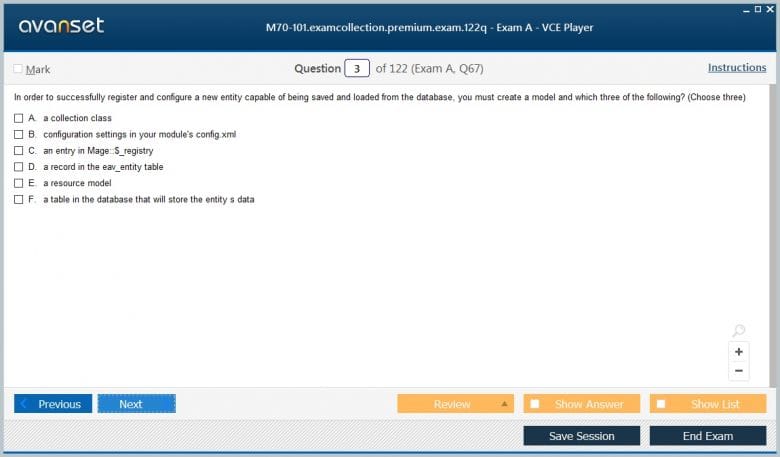
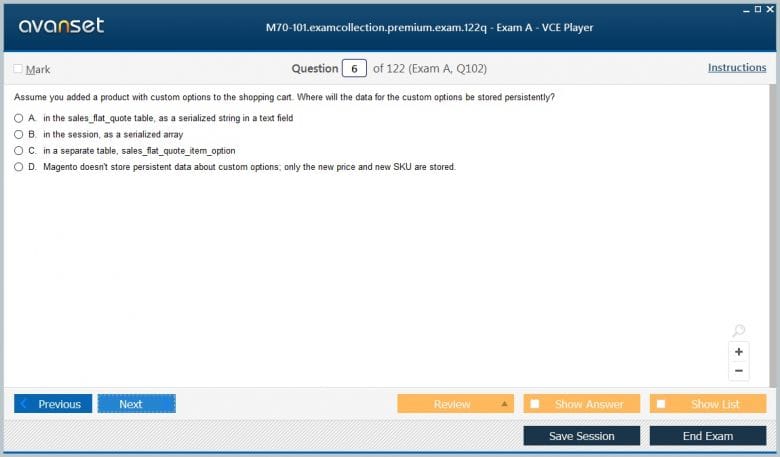
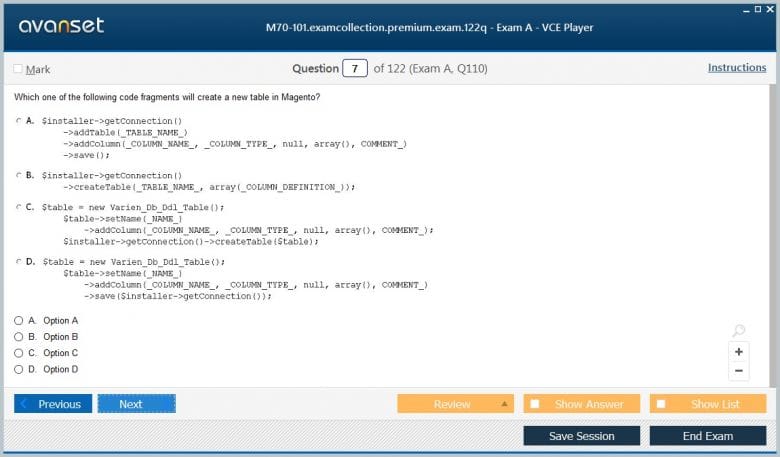
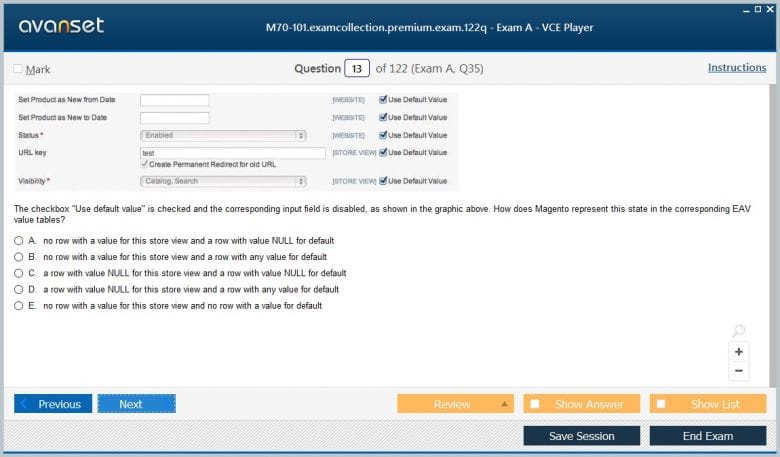
Magento M70-101 Practice Test Questions in VCE Format
| File | Votes | Size | Date |
|---|---|---|---|
File Magento.testking.M70-101.v2026-09-09.by.jordan.67q.vce |
Votes 1 |
Size 245.5 KB |
Date Sep 09, 2026 |
Magento M70-101 Practice Test Questions, Exam Dumps
Magento M70-101 (Magento Certified Developer) exam dumps vce, practice test questions, study guide & video training course to study and pass quickly and easily. Magento M70-101 Magento Certified Developer exam dumps & practice test questions and answers. You need avanset vce exam simulator in order to study the Magento M70-101 certification exam dumps & Magento M70-101 practice test questions in vce format.
M70-101 belongs to an earlier era of Magento certification, when the platform’s developer credential was built around Magento 1 architecture rather than the Adobe Commerce stack developers use today. That makes the exam historically important but easy to misread. A candidate who finds an old study guide, question set, or employer reference should first understand that the code describes a retired technical baseline, not a current Adobe exam that can simply be scheduled today.
The original M70-101 Magento Certified Developer exam rewarded developers who could reason through Magento’s request flow, configuration, models, resource models, blocks, layout, catalog structures, checkout behavior, and extension mechanisms. Those subjects were tightly connected: a seemingly small storefront change could require understanding configuration XML, class rewrites, database-backed entities, event observers, and the rendering layer at the same time.
For a modern reader, the useful way to approach M70-101 is therefore as a map of the architecture that shaped Magento development practice. The terminology is old in places, but the habits it tested—trace execution, locate the correct customization layer, understand data ownership, and avoid brittle core modifications—remain valuable when comparing legacy Magento systems with current Adobe Commerce implementations.
M70-101 was never only about memorizing administration screens. Its difficult questions tended to ask what Magento would actually do after configuration was merged, a request was routed, a model was instantiated, or an event was dispatched. That distinction matters because Magento 1 deliberately hid a great deal of behavior behind factories, XML configuration, naming conventions, inheritance, and dependency relationships. A developer could know PHP well and still be lost if the framework’s indirection was unfamiliar.
This is why the broader Magento certification family is useful context. The developer credential sat inside a platform-specific ecosystem in which architecture knowledge was the differentiator. General PHP competence helped, but candidates also had to understand why a Magento module was structured the way it was, how configuration connected class aliases to implementations, and where the platform expected custom code to participate rather than replace core behavior.
Request flow and configuration were the spine of Magento 1. A strong historical study plan begins with the lifecycle of a request. Magento bootstrapped the application, loaded and merged configuration, initialized areas and stores, matched routers and controllers, dispatched actions, assembled layout, instantiated blocks, and rendered output. Exam questions could probe any break in that chain. If a route failed, for example, the real issue might be module configuration rather than controller code; if a block was missing, the fault could sit in layout XML rather than the template.
Configuration also controlled rewrites, event observers, model aliases, resource models, helpers, blocks, and many other extension points. The practical lesson was to ask what layer owns the behavior before touching code. That remains a sound engineering habit. In large PHP applications, performance or execution problems are also easier to diagnose when developers understand the runtime path; techniques such as PHP-FPM slow logging are most useful when the application’s own flow is already clear.
Magento 1 separated much business logic from persistence through models, resource models, and collections. Candidates had to know which object represented domain behavior, which object handled database work, and how collections turned filters and attribute selections into queries. That architecture was especially important in catalog work, where products and categories relied heavily on the entity-attribute-value model instead of a single flat table containing every possible field.
EAV solved a real extensibility problem but created complexity. Attributes could have different backend storage types, scopes, source models, validation behavior, and indexing implications. A question about reading or saving an attribute was rarely just a SQL question. It could involve store scope, attribute metadata, collection loading, indexing, or cache state. Modern Adobe Commerce has evolved considerably, yet anyone maintaining an older installation still benefits from understanding why catalog data behaves differently from conventional relational records.
Products were not isolated objects. Product type, websites, stores, categories, price rules, inventory configuration, attribute sets, visibility, status, URL rewrites, and indexers all influenced what a shopper ultimately saw. M70-101 expected candidates to reason across those relationships rather than treat “the catalog” as one table or one screen. It also rewarded awareness that reading product data inefficiently could become expensive quickly on a large store.
That performance perspective is still useful. Magento workloads can generate large numbers of repeated PHP executions, object creations, configuration reads, and cache lookups. At the PHP runtime layer, mechanisms such as PHP OPcache address a different problem from Magento application caches, but the distinction is instructive: good troubleshooting depends on knowing whether time is being spent compiling PHP, executing framework logic, querying data, rebuilding indexes, or waiting on external services.
The checkout path exposed candidates to quotes, quote items, addresses, totals, payment methods, shipping methods, orders, invoices, shipments, credit memos, and transactional emails. A quote was not merely an unfinished order. It had its own lifecycle and calculations, and conversion into an order involved a set of transformations and events. Understanding those transitions mattered more than memorizing a list of class names.
The strongest way to review this area is to follow one order from cart creation to completion and ask what data exists at each stage, which objects are mutable, when totals are recalculated, and which later documents depend on the order. That exercise also exposes why careless customizations can have financial consequences. A checkout observer or rewrite that looks harmless in a single happy-path test may behave differently with discounts, taxes, multiple addresses, partial invoices, refunds, or a failed payment authorization.
Magento 1 administrators interacted with a separate area whose controllers, blocks, layouts, permissions, and configuration had their own conventions. Developers needed to understand access-control resources, system configuration, grids, forms, and the way backend functionality was wired into the application. The exam also covered integration surfaces, which at the time included SOAP and XML-RPC APIs and platform-specific authentication and resource structures.
The technology has changed, but the integration lesson remains recognizable. Modern commerce platforms expose far richer REST and GraphQL capabilities, yet reliable integrations still depend on explicit contracts, authentication, error handling, idempotency, and data ownership. A useful companion concept is the broader role of the modern API: M70-101’s older interfaces are best understood as one stage in the evolution toward today’s service-oriented commerce integrations.
The base developer exam was only one part of the old Magento ecosystem. M70-201 Magento Certified Developer Plus pushed farther into difficult implementation and architecture scenarios, while M70-301 Front End Certified Developer concentrated on the Magento 1 presentation stack. Those relationships help explain M70-101’s breadth: it had to establish enough common architecture for candidates to work across modules, data, catalog, checkout, and rendering before specialization made sense.
For historical study, this also provides a practical boundary. If a topic becomes highly specialized—advanced enterprise features, obscure edge cases, or deep theme implementation—it may belong more naturally to one of the adjacent credentials. M70-101 should be read as the framework-centered foundation for Magento 1 developers, not as an exhaustive inventory of everything a senior Magento engineer might encounter.
Adobe’s current Commerce certification program no longer uses M70-101. Developers working on the present platform should use the active Adobe credential structure rather than trying to recreate the old exam. The later Magento 2 Certified Associate Developer credential represents the next architectural generation and makes the shift away from Magento 1 assumptions visible.
The best reason to revisit M70-101 in 2026 is therefore diagnostic and historical. It helps maintainers recognize legacy modules, understand old codebases, and separate enduring framework ideas from obsolete implementation details. Study the architecture deeply enough to explain why it worked, then deliberately map those ideas to current Adobe Commerce documentation and certification objectives. That approach preserves the value of the old credential without mistaking a retired exam for a current professional target.
A practical historical lab should use a small Magento 1 codebase and follow one feature through configuration, routing, models, layout, blocks, templates, and persistence. The purpose is not to rebuild an obsolete production stack for its own sake. It is to connect vocabulary to execution. When a candidate can explain why Magento instantiated a particular class, where an attribute value came from, and which event or layout handle altered the result, the framework stops looking like a collection of unrelated conventions.
Old question banks also need careful handling because product editions and versions changed during Magento 1’s lifetime. Treat a remembered answer as a prompt to reconstruct the mechanism, not as an authority. If two sources disagree, identify which platform version or edition the behavior belongs to. That habit prevents an old implementation detail from hardening into a false general rule and is particularly important when maintaining inherited stores whose extensions may themselves have version-specific assumptions.
Teams that still operate Magento 1-derived systems should also place security and lifecycle risk ahead of certification nostalgia. Unsupported platform components, old PHP dependencies, abandoned extensions, and custom integrations create maintenance exposure that no exam preparation can solve. Historical architecture knowledge helps engineers plan migrations because it reveals what the existing store actually depends on, which custom behavior must be preserved, and where technical debt is concentrated.
For that reason, a strong M70-101 review ends with a translation exercise: list each major legacy mechanism and identify its modern equivalent, successor, or deliberate absence in Adobe Commerce. The exercise makes the transition concrete and shows which knowledge is conceptual rather than syntactic. The exam then becomes what it should be in 2026—a disciplined way to understand the legacy platform, not a substitute for current Adobe objectives.
Go to testing centre with ease on our mind when you use Magento M70-101 vce exam dumps, practice test questions and answers. Magento M70-101 Magento Certified Developer certification practice test questions and answers, study guide, exam dumps and video training course in vce format to help you study with ease. Prepare with confidence and study using Magento M70-101 exam dumps & practice test questions and answers vce from ExamCollection.
Purchase Individually
Site Search:

SPECIAL OFFER: GET 10% OFF

Pass your Exam with ExamCollection's PREMIUM files!
SPECIAL OFFER: GET 10% OFF
Use Discount Code:
MIN10OFF
A confirmation link was sent to your e-mail.
Please check your mailbox for a message from support@examcollection.com and follow the directions.

Download Free Demo of VCE Exam Simulator
Experience Avanset VCE Exam Simulator for yourself.
Simply submit your e-mail address below to get started with our interactive software demo of your free trial.