



Premium File
107 Q&A
$76.99$69.99
Magento M70-301 Exam Questions & Answers, Accurate & Verified By IT Experts
Instant Download, Free Fast Updates, 99.6% Pass Rate
107 Questions & Answers
Last Update: Sep 15, 2026
$69.99
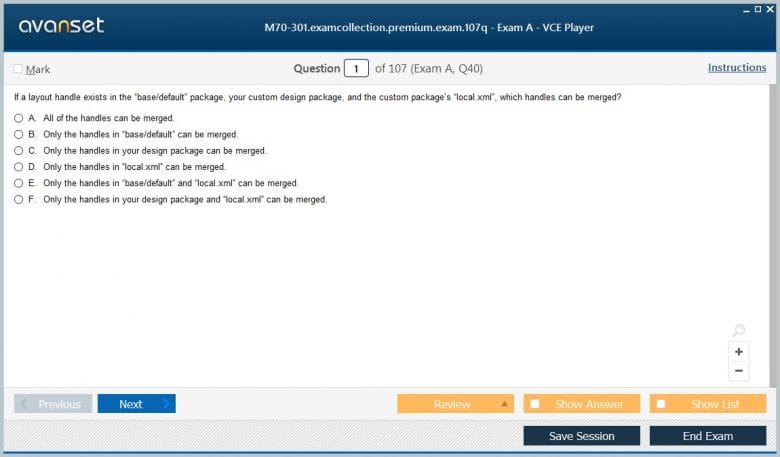
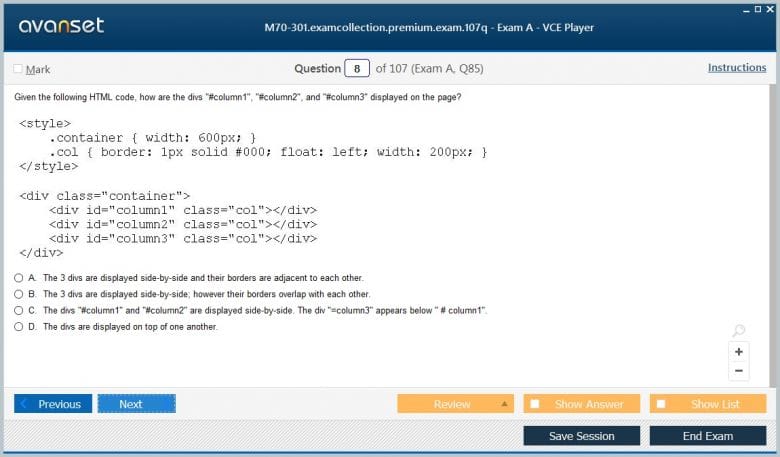
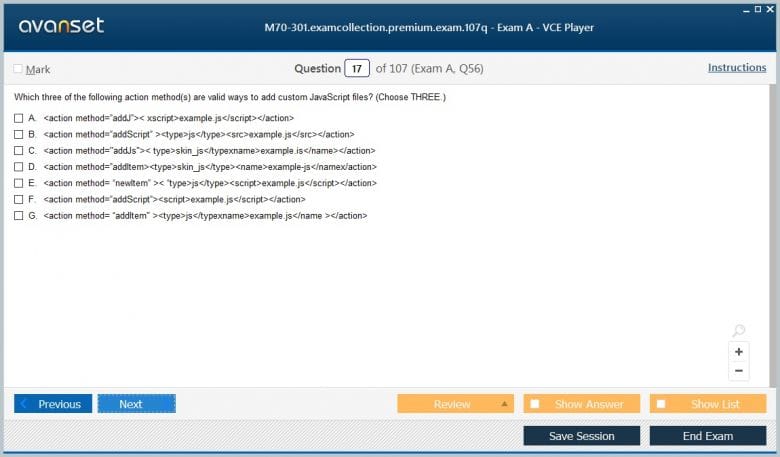
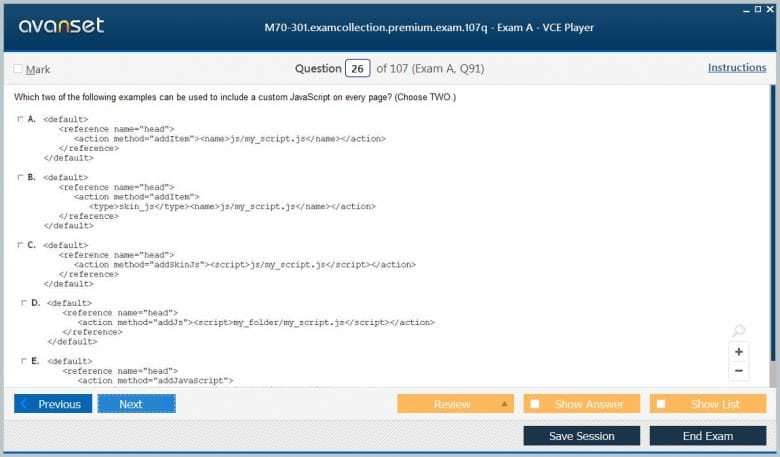
Magento M70-301 Exam Screenshots
Magento M70-301 Practice Test Questions in VCE Format
| File | Votes | Size | Date |
|---|---|---|---|
File Magento.Pass4sure.M70-301.v2026-08-04.by.Amanda.58q.vce |
Votes 3 |
Size 1.09 MB |
Date Aug 08, 2026 |
Magento M70-301 Practice Test Questions, Exam Dumps
Magento M70-301 (Front End Certified Developer) exam dumps vce, practice test questions, study guide & video training course to study and pass quickly and easily. Magento M70-301 Front End Certified Developer exam dumps & practice test questions and answers. You need avanset vce exam simulator in order to study the Magento M70-301 certification exam dumps & Magento M70-301 practice test questions in vce format.
M70-301 was Magento’s front-end certification for the Magento 1 generation. It focused on the presentation system that produced storefront pages: design packages and themes, layout XML, blocks, templates, JavaScript, CSS, fallback behavior, localization, and the configuration that connected those pieces. The exam is retired, but it remains a useful reference for anyone maintaining a Magento 1 storefront or trying to understand why an old theme behaves the way it does.
The M70-301 Front End Certified Developer credential was distinct from Magento’s general developer exams. A candidate could not rely on generic HTML and CSS skill alone, because Magento determined which templates rendered through a framework-controlled hierarchy. Front-end work required reading layout handles, understanding block/template relationships, knowing design fallback, and making changes without copying the entire base theme into a custom package.
That framework-specific discipline is the key to reading M70-301 today. Many frontend technologies have changed, but the exam’s central question is still recognizable: how do you customize presentation while preserving maintainability, upgradeability, and a clear separation between structure, data, and visual styling?
Magento 1 organized presentation files into design packages and themes, with separate areas such as frontend and adminhtml. A custom theme did not need to contain every possible template, layout file, image, or stylesheet because Magento could fall back through configured locations when an override was absent. Understanding that resolution process was critical: copying too much created maintenance debt, while overriding too little could leave a storefront dependent on unexpected base behavior.
The exam therefore rewarded selective customization. A developer should know which file truly needs to change and let fallback provide the rest. That same principle is still valuable in modern theming systems: inherit defaults intentionally, override only what the business requirement demands, and keep the custom surface area small enough that upgrades remain comprehensible.
One of Magento 1’s most distinctive front-end ideas was that page structure was assembled through layout XML. Handles selected updates for page types or routes; blocks were created, named, nested, moved, and configured before templates produced HTML. A candidate had to be able to read those instructions and predict what block tree would exist for a request. Editing a template was often the wrong first move if the required block had never been added to the layout.
This made debugging a two-stage exercise. First determine whether the correct handle and layout update were active; then inspect the block and template. If a value was missing, the issue could lie in the block class or data assignment rather than the `.phtml` file. That separation is why the broader M70-101 developer architecture remained relevant to front-end specialists even though M70-301 had a presentation focus.
Magento templates were PHP files, but the intended design kept much application behavior in block classes and models rather than burying it in presentation code. Blocks could prepare values, load child blocks, expose helpers, participate in caching, and connect layout configuration to a template. Candidates needed to recognize when a template was merely displaying data and when custom presentation logic belonged in a dedicated block or helper.
That boundary also improved testability and reuse. A template overloaded with data queries, product loading, and business rules might display the right page today but become slow and difficult to maintain. Keeping data preparation out of markup made it easier to reason about performance and to reuse the same underlying behavior in multiple presentation contexts.
M70-301 included JavaScript and CSS because storefront behavior extended beyond server-rendered templates. Magento 1 shipped with its own JavaScript dependencies and conventions, and themes could add or replace assets through layout. Candidates needed to understand loading order, theme locations, inline versus external behavior, and the risk of solving one visual problem by introducing global conflicts elsewhere on the site.
The browser ecosystem has moved dramatically since the Magento 1 period, but the maintainability lesson survives. Front-end assets should be attached at the correct scope, dependencies should be explicit, and a theme should avoid unnecessary global overrides. A modern web application may use very different tooling, yet uncontrolled JavaScript and CSS can still turn a small storefront change into a regression across checkout, account, and catalog pages.
The final storefront depended not only on files in a theme but also on configuration: package and theme selection, store views, locale, transactional settings, and administrative choices could alter the rendered result. Internationalization introduced translation files and locale-specific output, while store-view scope could make one storefront behave differently from another even when they shared most code and design assets.
That context is especially important when debugging a legacy multisite installation. A file can be correct and still appear ineffective because another theme is selected for a store, an exception applies, a translated string is coming from a different locale, or cached layout output is masking the change. M70-301 encouraged developers to treat presentation as a system rather than assume every problem lived in HTML.
A theme influences perceived speed through asset count, image weight, JavaScript execution, CSS complexity, caching behavior, and how much dynamic content prevents reusable page fragments. Magento 1 also placed heavy server-side demands on PHP. Front-end specialists did not own every performance layer, but they needed enough awareness to avoid designs that multiplied server work or blocked the browser unnecessarily.
Modern diagnostic thinking can help interpret these older systems. PHP-FPM slow logging addresses server execution rather than browser rendering, while CDN design addresses delivery of cacheable assets. The value is in separating concerns: determine whether a slow page is waiting on PHP, database work, network delivery, or client-side execution before changing the theme blindly.
Magento’s old certification family divided responsibilities without pretending they were independent. M70-201 Developer Plus emphasized advanced framework and implementation judgment, while M70-301 concentrated on presentation. A front-end developer still needed enough backend literacy to follow block classes, helpers, configuration, catalog entities, and URL generation; a backend developer still needed to understand how layout and templates exposed their work to shoppers.
That overlap mirrors real commerce teams. A storefront defect may cross several ownership boundaries, and the fastest resolution often comes from a developer who can follow the issue one layer beyond their primary specialty. Historical M70-301 preparation is most useful when it develops that ability rather than reducing the exam to a list of theme directories.
Front-end troubleshooting also benefits from testing the same theme change across several page families rather than judging it from one storefront screen. Product detail, category, search, customer-account, cart, and checkout pages can load different layout handles and block hierarchies, while store-view configuration or fallback can expose files that seem unused in a single test case. A careful developer would compare rendered markup, loaded assets, JavaScript behavior, cache state, and template hints before assuming the source of a visual defect. That method matters especially on inherited Magento 1 themes, where a small override in a child theme can interact with base-package files or extensions in ways that are not obvious from the edited template alone.
Today’s Adobe Commerce program has professional and expert front-end developer credentials, and the underlying platform is Magento 2/Adobe Commerce rather than Magento 1. The modern architecture uses different theme inheritance, module/view structures, JavaScript tooling, layout behavior, and extensibility mechanisms. Candidates pursuing a current credential should use Adobe’s active objectives, not the M70-301 blueprint.
For legacy maintainers, however, M70-301 still provides a coherent checklist of the old rendering system. Review fallback, layout XML, blocks, templates, design configuration, JavaScript, CSS, localization, and cache interactions as one chain. Then compare those ideas with current Magento and Adobe Commerce certification material so that historical knowledge informs modern work instead of being mistaken for it.
A useful M70-301 lab starts with a deliberately minimal custom theme. Change one layout instruction, one block/template relationship, one translation, and one asset inclusion while relying on fallback for everything else. Then trace which files Magento resolves and why. This small exercise teaches more than copying a complete base theme because it makes inheritance visible and demonstrates how little custom code is actually required for a targeted change.
Debugging should include cache awareness. Magento 1 could cache configuration, layouts, blocks, and other derived data, so a correct file change might not appear immediately. The disciplined response is to identify which cache layer could affect the symptom rather than clear every cache reflexively. That distinction reduces disruption and teaches the same layered reasoning that modern commerce developers need when full-page caches, CDNs, browser caches, and generated assets are involved.
Accessibility and responsive design were not the center of the original certification to the degree they are in contemporary storefront work, which is another reason the legacy blueprint cannot stand in for a modern frontend curriculum. Teams maintaining old themes should supplement M70-301 knowledge with current accessibility, performance, security, and device requirements. Historical framework competence tells you how to make the change; modern web standards tell you what the change needs to achieve.
The most productive outcome is an architectural map of the old storefront: request and handle, block tree, template, theme fallback, assets, configuration, localization, and cache. Once that chain is clear, a developer can compare it with Adobe Commerce’s current frontend model without confusing similar terminology for identical behavior. M70-301 then serves as a precise legacy reference rather than an outdated recipe book.
Go to testing centre with ease on our mind when you use Magento M70-301 vce exam dumps, practice test questions and answers. Magento M70-301 Front End Certified Developer certification practice test questions and answers, study guide, exam dumps and video training course in vce format to help you study with ease. Prepare with confidence and study using Magento M70-301 exam dumps & practice test questions and answers vce from ExamCollection.
Purchase Individually
Site Search:

SPECIAL OFFER: GET 10% OFF

Pass your Exam with ExamCollection's PREMIUM files!
SPECIAL OFFER: GET 10% OFF
Use Discount Code:
MIN10OFF
A confirmation link was sent to your e-mail.
Please check your mailbox for a message from support@examcollection.com and follow the directions.

Download Free Demo of VCE Exam Simulator
Experience Avanset VCE Exam Simulator for yourself.
Simply submit your e-mail address below to get started with our interactive software demo of your free trial.