



Premium File
102 Q&A
$76.99$69.99
Magento Magento 2 Certified Associate Developer Exam Questions & Answers, Accurate & Verified By IT Experts
Instant Download, Free Fast Updates, 99.6% Pass Rate

Magento 2 Certified Associate Developer Premium File: 102 Questions & Answers
Last Update: Nov 05, 2026
Magento 2 Certified Associate Developer Training Course: 77 Video Lectures
$74.99
Magento Magento 2 Certified Associate Developer Exam Screenshots
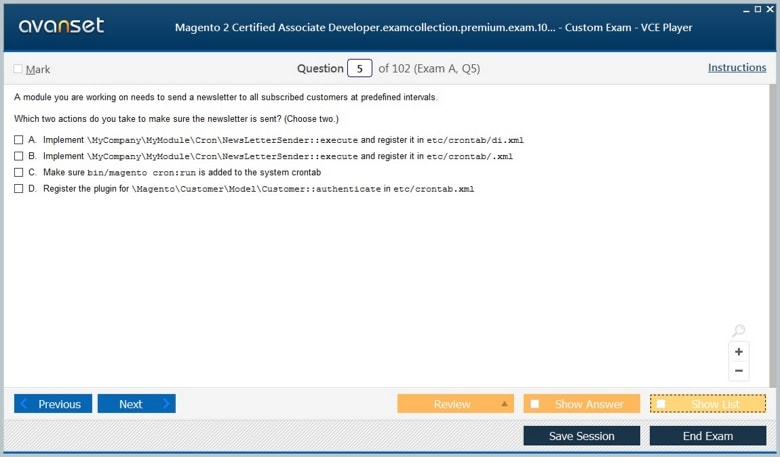
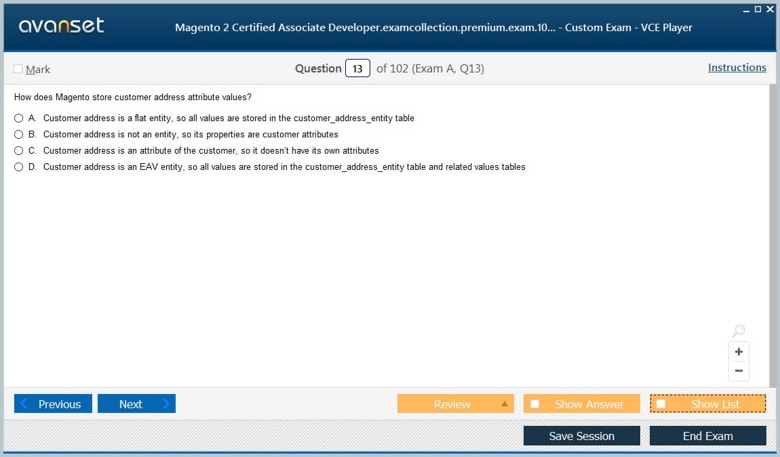
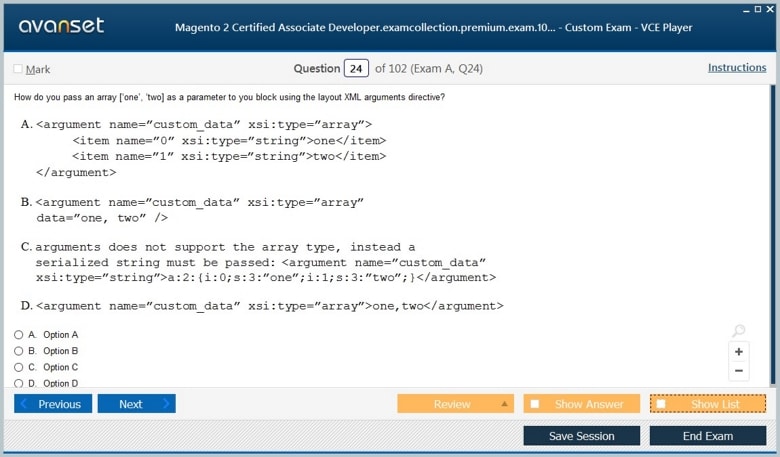
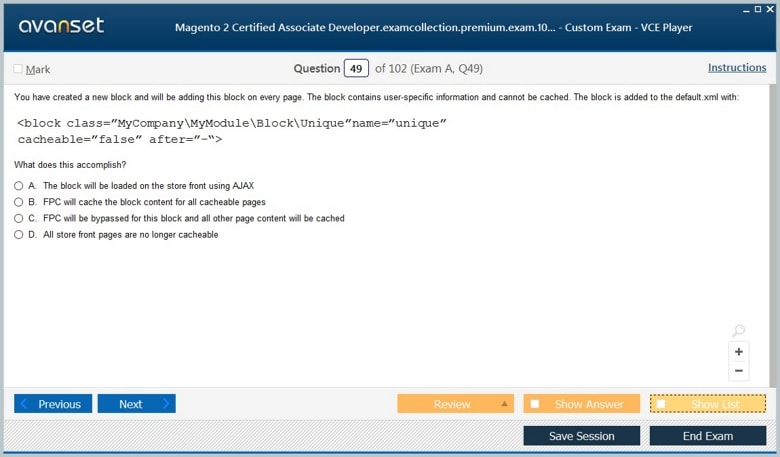
Magento Magento 2 Certified Associate Developer Practice Test Questions in VCE Format
| File | Votes | Size | Date |
|---|---|---|---|
File Magento.actualtests.Magento 2 Certified Associate Developer.v2026-10-01.by.khalid.61q.vce |
Votes 1 |
Size 791.09 KB |
Date Oct 01, 2026 |
File Magento.examdumps.Magento 2 Certified Associate Developer.v2020-03-30.by.holly.57q.vce |
Votes 5 |
Size 867.24 KB |
Date Mar 30, 2020 |
File Magento.Testking.Magento 2 Certified Associate Developer.v2019-09-27.by.Samuel.51q.vce |
Votes 3 |
Size 703.87 KB |
Date Sep 30, 2019 |
Magento Magento 2 Certified Associate Developer Practice Test Questions, Exam Dumps
Magento Magento 2 Certified Associate Developer (Magento 2 Certified Associate Developer) exam dumps vce, practice test questions, study guide & video training course to study and pass quickly and easily. Magento Magento 2 Certified Associate Developer Magento 2 Certified Associate Developer exam dumps & practice test questions and answers. You need avanset vce exam simulator in order to study the Magento Magento 2 Certified Associate Developer certification exam dumps & Magento Magento 2 Certified Associate Developer practice test questions in vce format.
The Magento 2 Certified Associate Developer credential represented a major change in what a Magento developer was expected to know. Instead of the Magento 1 patterns behind the M70 series, the exam focused on Magento 2 module structure, dependency injection, service contracts, plugins and observers, database setup, admin customization, catalog behavior, checkout, routing, and the newer presentation architecture. It was an entry point for developers with practical Magento 2 experience rather than a continuation of Magento 1 memorization.
The Magento 2 Certified Associate Developer credential is now historical because Adobe has reorganized Commerce certifications under the Adobe credential program. Even so, it sits at an important transition point. Developers moving from Magento 1 had to unlearn habits such as class rewrites and embrace dependency injection, interception, Composer packaging, declarative boundaries, and more explicit APIs.
That makes the credential useful as a bridge document. It shows which concepts survived the platform rewrite—catalog, checkout, stores, EAV, events, layout—and which implementation mechanisms changed enough that old study material could become actively misleading.
Magento 1 often relied on global registries, factory aliases, helper lookups, and XML rewrites. Magento 2 moved much more construction logic into dependency injection. Classes declare collaborators through constructors, object configuration can substitute implementations, and generated factories or proxies handle cases where direct injection would be inefficient or semantically wrong. Associate-level developers needed to recognize these patterns because they affect both code design and debugging.
The practical consequence is testability and clarity. A class whose dependencies are explicit is easier to isolate than one that repeatedly reaches into a global object manager. Magento 2 does provide an object manager, but application code is generally expected to use constructor injection rather than treat it as a service locator. Exam preparation should therefore focus on why a dependency is injected, when a factory is appropriate, and how configuration changes the resolved implementation.
Interception is one of the clearest examples of the architectural shift. Magento 2 plugins can run before, after, or around public method calls on interceptable classes, allowing modules to modify behavior without claiming an exclusive rewrite. Events and observers still exist for looser notifications, while preferences can replace implementations when substitution is truly needed. Choosing among those mechanisms is a core design decision.
A good study method is to classify customizations by intent. If several modules may need to react independently, an event may fit. If behavior around one public method must be adjusted, a plugin may be cleaner. If an interface implementation must change globally, dependency configuration may be appropriate. The goal is not to memorize a hierarchy of “best” mechanisms but to understand coupling, execution order, scope, and the consequences for other extensions.
Magento 2 introduced service contracts—interfaces intended to define stable APIs between modules and for external integrations. Repository interfaces, data interfaces, search criteria, and web API configuration made business operations more explicit than the loosely coupled model-loading patterns common in Magento 1. Associate developers needed to understand when application code should depend on a service contract rather than reach directly into persistence details.
This design aligns with broader API engineering. A contract should describe what consumers can rely on while allowing implementation details to evolve behind it. The same idea appears in the wider modern API integrations: stable boundaries, authentication, validation, versioning, and predictable error behavior matter more as systems become distributed and integrations multiply.
Magento 2 modules use a different registration and packaging model from Magento 1. Developers work with `registration.php`, `module.xml`, Composer metadata, dependency declarations, configuration files, and setup mechanisms that evolved over time toward declarative schema and data patches. The exam’s historical version may reference the mechanisms current at that moment, so modern learners should distinguish enduring structure from version-specific setup syntax.
The important principle is that a module should declare what it needs and own its changes. Database modifications, configuration defaults, routes, ACL resources, dependency injection preferences, web APIs, and UI configuration all have explicit locations. That structure can feel verbose, but it reduces the number of hidden conventions a maintainer must infer from runtime behavior.
Magento 2 retained EAV for important entities such as products and customers, so attribute sets, scopes, backend types, source models, and indexers still mattered. What changed was how developers accessed and extended those capabilities. Repositories, dependency injection, newer indexer architecture, cache layers, and service contracts changed the preferred path even when the underlying business concept looked familiar.
This is where Magento 1 experience can either help or hurt. A developer who understands why scoped attributes and indexing exist starts with useful domain knowledge; a developer who assumes the old model/resource API must still be the correct implementation path can build brittle Magento 2 code. The retired M70-101 developer exam is therefore best treated as historical architecture, not as a source of Magento 2 coding patterns.
Associate developers were expected to handle more than backend classes. Checkout customizations can touch JavaScript UI components, layout configuration, totals collectors, quote data, payment or shipping integrations, and order conversion. Admin changes can involve ACL, menus, routes, UI components, data providers, forms, grids, and configuration. A question about “adding a field” may therefore span persistence, service data, validation, rendering, and permissions.
The safest preparation is to trace a small feature end to end. Add one piece of data to a domain object, expose it through the correct interface, persist it, display it in the right context, and confirm how caching and API serialization affect it. This turns a collection of XML filenames into an architecture that makes sense.
Magento 2 can be resource intensive, and developers need a disciplined way to locate bottlenecks. PHP compilation overhead, dependency generation, database queries, cache misses, indexer backlog, full-page cache behavior, search services, message queues, and frontend delivery can all influence latency. Changing one layer without evidence can hide the symptom rather than solve the cause.
At the runtime level, PHP OPcache reduces repeated PHP compilation, while PHP-FPM slow logging can reveal slow execution paths. Those are not Magento-specific fixes; they are examples of the layered diagnostic thinking an application developer should bring to a complex Commerce deployment.
Upgrade-safe extension design was another practical test of whether a developer understood Magento 2 rather than merely reproducing Magento 1 habits. Before overriding behavior, the developer should identify the supported extension point, confirm the public contract being relied on, and understand how generated code, compilation, caches, and dependency configuration affect the change. A plugin may be appropriate for one public method, an observer for a published event, a preference only in narrower circumstances, and a service-contract implementation for an integration boundary. The key is to choose the least invasive mechanism that still expresses the requirement clearly, then verify the change through integration tests and realistic storefront or API flows so upgrades do not become a series of fragile patches.
Adobe’s active Commerce certification catalog now uses professional, expert, and master levels with role-based credentials such as Developer and Front-end Developer. That program is the right source for candidates seeking a current certification. Historical Magento 2 associate material can still help explain foundational architecture, but current objectives should decide what deserves study time because product versions, cloud tooling, APIs, frontend frameworks, and deployment practices continue to evolve.
The broader Magento certification lineage makes the transition easier to see, including the later Magento Professional Cloud Developer credential. Read that lineage as a technology transition: Magento 1 established the original framework model, Magento 2 redesigned core extension patterns, and Adobe Commerce continues to develop the platform and its certification roles.
A strong hands-on plan for this historical credential should build a small module rather than rehearse XML filenames in isolation. Register the module, inject a service, expose configuration, add an observer or plugin for a justified reason, persist data through the supported layer, and surface the result in either storefront or admin UI. Then deliberately test what breaks when caches are stale, an interface implementation changes, or a dependency is unavailable. This turns architecture into behavior.
Developers should also practice reading generated and intercepted behavior without editing generated code. Magento 2 can feel opaque when factories, proxies, interceptors, compiled dependency injection, and generated classes appear in a stack trace. The skill is to trace those artifacts back to source configuration and application classes. Once that relationship is understood, generated code becomes evidence of the framework’s composition process rather than a mysterious place to patch.
Version awareness matters because Magento 2 has evolved substantially since the Associate Developer credential was introduced. Setup scripts gave way to newer declarative mechanisms, frontend approaches changed, supported PHP versions moved, APIs expanded, and Adobe Commerce cloud practices matured. When old study material names a command or file, candidates should distinguish the architectural purpose from the exact syntax used by that release.
That discipline also protects modern implementations from “Magento 1 thinking in Magento 2 syntax.” The point of the platform redesign was not merely different folders; it was clearer contracts, more composable extension mechanisms, and stronger dependency management. The historical associate exam is most valuable when it helps developers internalize that change and then move forward to current Adobe Commerce objectives with the right mental model.
Go to testing centre with ease on our mind when you use Magento Magento 2 Certified Associate Developer vce exam dumps, practice test questions and answers. Magento Magento 2 Certified Associate Developer Magento 2 Certified Associate Developer certification practice test questions and answers, study guide, exam dumps and video training course in vce format to help you study with ease. Prepare with confidence and study using Magento Magento 2 Certified Associate Developer exam dumps & practice test questions and answers vce from ExamCollection.
Purchase Individually

Magento Magento 2 Certified Associate Developer Video Course

Site Search:

SPECIAL OFFER: GET 10% OFF

Pass your Exam with ExamCollection's PREMIUM files!
SPECIAL OFFER: GET 10% OFF
Use Discount Code:
MIN10OFF
A confirmation link was sent to your e-mail.
Please check your mailbox for a message from support@examcollection.com and follow the directions.

Download Free Demo of VCE Exam Simulator
Experience Avanset VCE Exam Simulator for yourself.
Simply submit your e-mail address below to get started with our interactive software demo of your free trial.
@Chong555, yes! these magento 2 certified associate developer braindumps are very useful and most importantly…..they updated to cover the latest exam objectives… I succeed in my exam and…..all the questions I completed there were familiar to me. I priced them in the vce player….so I’m lucky to find this website. Examcollection you are the best! .
hey guyz….can somebody telling me should I use the dumps for the magento 2 certfied associate developer exam? My cert exam is coming soon….
@Sabrina100 I recently used these dumps for the Magento 2 certified associate developer exam and passed my test……. but I’d like to say that I met about 4-5 new questions,,,that’s why use them but find addiitional material to prepare well.
can I pass the exam using only these magento 2 certified associate developer practice tests?
@ross23, use the ExamCollection resources if you want one of the easiest ways to pass your exam. I passed my exam about one month ago and I found these practice questions and answers for the magento 2 certified associate developer exam really helpful during my preparation.
should I use these vce files for magento 2 certified associate developer exam? I have never trained with such materials,,,,,what can you advice me???
hi guys!!!! . I used these magento 2 certified associate developer vce files to study for my exam. I have to say these materials are great to revise your knowledge and skills but I met 3-4 new questions in the test, so study hard... use additional material keenly!!!