Premium File
26 Q&A
$76.99$69.99
ITIL ITILSC-OSA Exam Questions & Answers, Accurate & Verified By IT Experts
Instant Download, Free Fast Updates, 99.6% Pass Rate

ITILSC-OSA Premium File: 26 Questions & Answers
Last Update: Sep 21, 2026
ITILSC-OSA Training Course: 286 Video Lectures
$74.99
ITIL ITILSC-OSA Exam Screenshots
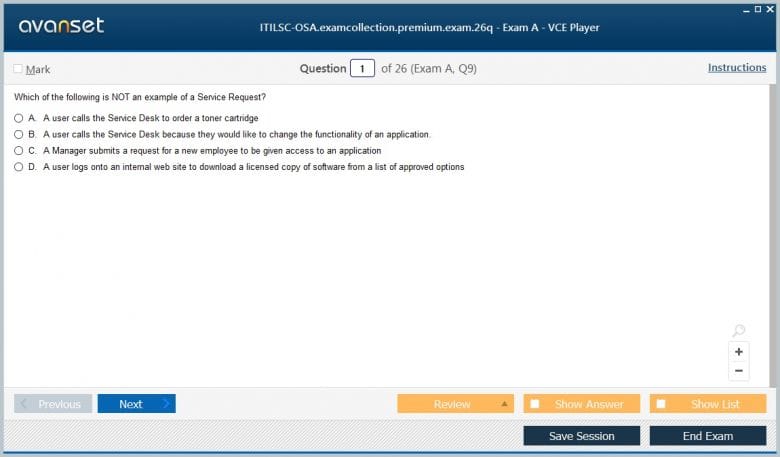
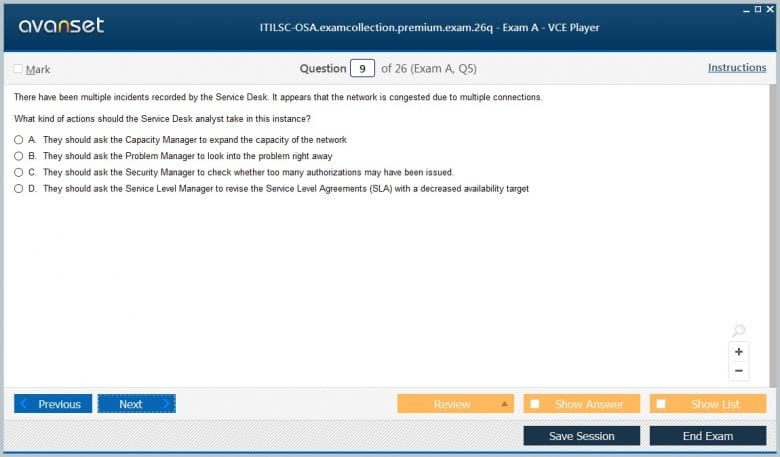
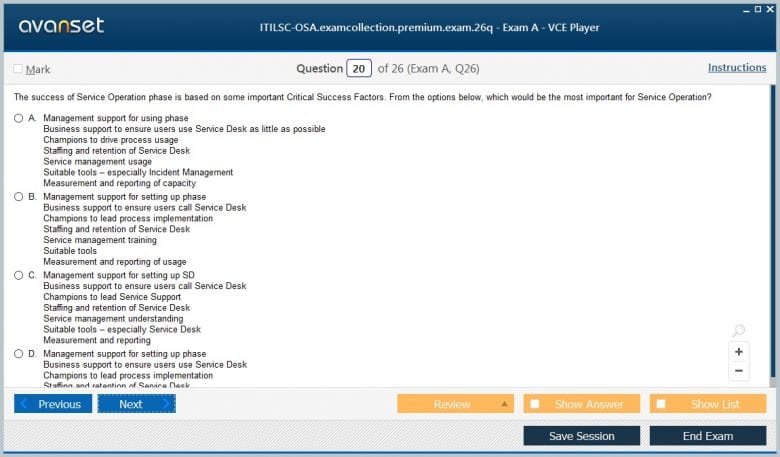
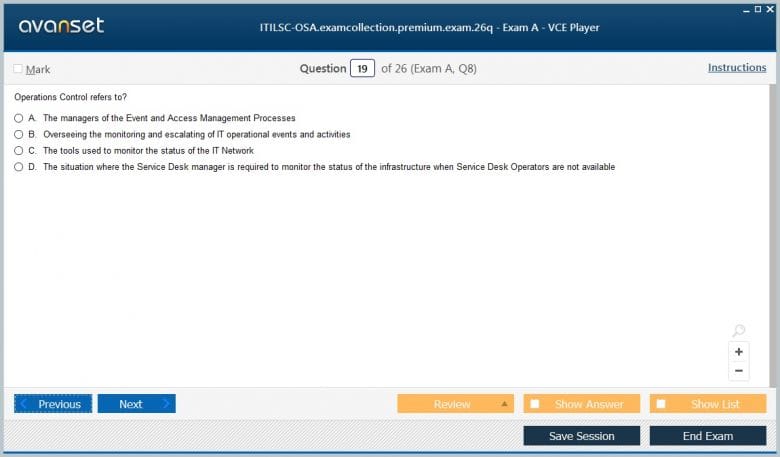
ITIL ITILSC-OSA Practice Test Questions in VCE Format
| File | Votes | Size | Date |
|---|---|---|---|
File ITIL.Selftestengine.ITILSC-OSA.v2026-09-02.by.Raymond.14q.vce |
Votes 2 |
Size 1.6 MB |
Date Sep 07, 2026 |
ITIL ITILSC-OSA Practice Test Questions, Exam Dumps
ITIL ITILSC-OSA (ITIL Service Capability Operational Support and Analysis) exam dumps vce, practice test questions, study guide & video training course to study and pass quickly and easily. ITIL ITILSC-OSA ITIL Service Capability Operational Support and Analysis exam dumps & practice test questions and answers. You need avanset vce exam simulator in order to study the ITIL ITILSC-OSA certification exam dumps & ITIL ITILSC-OSA practice test questions in vce format.
ITIL Service Capability: Operational Support and Analysis belongs to the ITIL v3/2011 Intermediate era and should now be treated as a legacy exam page, not as a current PeopleCert scheduling path. Historically, OSA concentrated on operational practices including event management, incident management, request fulfilment, problem management, access management, and the functions that supported day-to-day service operation. The page still has value because those disciplines remain recognizable in modern service management, but their certification structure has changed.
The strongest way to use this legacy content is to separate historical exam intent from current pathways. Today, several closely related capabilities appear in the current ITIL 4 Monitor, Support and Fulfil module and in individual practice exams such as Monitoring and Event Management. Candidates encountering the OSA code through older training records or search results should therefore understand both what OSA taught and why the modern route is not a one-for-one rename.
The historical module focused on the work required to keep live services stable and useful. That included recognizing events, restoring service after incidents, fulfilling routine user requests, investigating recurring failures, and controlling access. It also covered operational functions such as the service desk, technical management, application management, and IT operations management. The unifying idea was that service operation needed disciplined coordination rather than ad hoc firefighting.
This focus explains why OSA appealed to service desk leads, operations managers, infrastructure specialists, and support professionals. It was not primarily a strategy or design qualification. Its questions expected candidates to understand how operational processes interacted under pressure. That historical emphasis remains useful when reading old documentation because the same organizational problems still exist even though current ITIL packages them differently.
OSA treated event management as the mechanism for detecting significant changes of state in infrastructure and services. Informational, warning, and exception events supported different responses, and effective operations depended on filtering and correlation. A major lesson was that monitoring should reduce uncertainty, not simply produce more messages.
That logic maps directly to the current ITIL 4 Monitoring and Event Management practice, although the modern syllabus adds contemporary practice-success, capability, technology, and value-stream framing. Legacy learners should recognize the continuity without assuming the old OSA exam is still valid. The operational concept survived; the qualification architecture changed.
The OSA era emphasized restoring normal service quickly when disruption occurred. Classification, prioritization, escalation, investigation, resolution, and closure were coordinated to reduce business impact. Candidates learned that an incident can be resolved through a workaround or restoration action before the underlying cause is fully known.
That distinction remains fundamental. An operations team that blocks restoration until root cause is proven can extend user impact unnecessarily. Conversely, closing every incident without learning creates recurrence. The historical exam therefore linked incident management closely with problem management, and modern service-management practice continues to depend on that separation of immediate recovery from deeper analysis.
Priority decisions in the OSA model depended on impact and urgency rather than on technical complexity. A simple fault affecting a critical business service could deserve more attention than a difficult fault with little user impact. This remains a useful operational discipline because technical teams can otherwise prioritize the most interesting engineering problem instead of the most important service outcome.
Major incidents also require coordinated communication. Technical recovery, business updates, supplier escalation, management involvement, and post-incident learning can occur simultaneously. Historical OSA material is valuable here because it frames incident handling as an organizational capability, not just the work of the engineer who eventually finds the fix.
User requests for information, access, standard changes, or predefined services need a different flow from unplanned incidents. OSA used request fulfilment to formalize that work. Catalog definitions, approvals, standard procedures, expected fulfilment times, and communication helped organizations avoid treating every contact as an emergency.
Modern ITIL expresses the same capability through service request management. Automation has increased the number of requests that can be fulfilled without analyst intervention, but the design principles remain recognizable: define the request, validate entitlement, collect required information, execute safely, communicate progress, and close with evidence that the requested outcome was delivered.
OSA gave problem management a strong role in identifying causes, documenting workarounds, and controlling known errors. That historical logic is visible in the current problem management practice. The key difference is not that modern ITIL abandoned root-cause analysis; it is that the capability now sits inside a different architecture of practices and value streams.
Candidates reading legacy OSA material should pay attention to the learning loop. Incident records, monitoring data, technical diagnostics, change history, and supplier evidence can reveal patterns. A useful problem record should influence future detection, knowledge, risk decisions, and improvement work. If root-cause findings never change how the service is managed, the analysis has little operational value.
Known-error information was intended to shorten future diagnosis. Once a recurring issue had a documented cause or workaround, support teams could restore service faster while permanent correction was planned. This creates a direct knowledge-management benefit: the value of analysis increases when findings are made available to the people who will encounter the symptom again.
Legacy OSA study also highlighted the danger of confusing severity with recurrence. A low-impact incident repeated hundreds of times can consume substantial support effort and indicate hidden technical debt. A rare high-impact failure may deserve different treatment. Problem prioritization should therefore consider frequency, business impact, risk, workaround quality, and the cost of permanent resolution.
In the ITIL v3 service-operation model, access management implemented policies defined through information security management and controlled rights to use services or service groups. Modern environments still require identity, authorization, entitlement, and revocation controls, but current ITIL certification structures do not present access management as the same standalone process taught in OSA.
This is an important example of why legacy-to-current mapping should be conceptual rather than mechanical. A learner should carry forward the need to enforce authorized use, remove rights when conditions change, and connect access decisions to policy and risk. They should not assume that finding an old process name means there must be a current exam with an identical title.
OSA did not treat operational success as process documentation alone. The service desk created a communication point for users, technical management supplied specialist expertise, application management supported software throughout its lifecycle, and IT operations management handled day-to-day operational activities. These functions made the process model executable.
Modern organizations may organize teams differently—platform teams, site reliability engineering, product-aligned support, managed services, or cloud operations—but the structural questions remain. Who receives demand? Who owns communication? Who has technical authority? Who operates common infrastructure? Who provides specialized application knowledge? Good service management still requires explicit answers.
OSA also emphasized escalation because first-line teams cannot own every technical problem. Functional escalation moved work to people with deeper expertise, while hierarchical escalation brought management attention when impact, risk, or authority required it. The useful distinction is purpose: escalation should add capability or decision authority, not merely move a ticket away from the person currently holding it.
Operational handoffs were a source of risk even in the ITIL v3 model. Poorly defined ownership caused incidents to bounce between teams, requests to stall, and users to receive inconsistent updates. Modern tooling can automate routing, but automation does not fix unclear accountability. Historical OSA is still instructive because it makes the organization confront who owns communication, diagnosis, restoration, and follow-up.
The old ITIL v3 Foundation and Intermediate Service Capability structure have been superseded. For current operations-focused certification, candidates should review current ITIL certifications and the modern Practice Manager options rather than buying training labeled OSA. The current Monitor, Support and Fulfil module is the closest high-level destination for several OSA themes, but it is not an official one-to-one replacement because its practice composition and syllabus are different.
The page remains useful for professionals interpreting old résumés, training records, service-management documentation, or organizational terminology. Understanding OSA shows how modern operational practices evolved and why incident, request, problem, monitoring, and support capabilities continue to depend on one another. Historical accuracy is therefore more valuable here than pretending a retired exam is still a live credential.
Organizations that still use OSA terminology in procedures should map those terms carefully when modernizing. Renaming an old process is not enough; teams should decide which current practice owns the purpose, what information should move between practices, and whether legacy controls still match modern technology and sourcing. A deliberate mapping avoids losing useful operational discipline during framework updates.
The same caution applies to exam logistics. Historical references to eight scenario-based, gradient-scored questions and ITIL Intermediate prerequisites describe the old qualification environment, not a current booking option. Readers should preserve those facts as historical context while using current PeopleCert requirements for any new certification plan.
Go to testing centre with ease on our mind when you use ITIL ITILSC-OSA vce exam dumps, practice test questions and answers. ITIL ITILSC-OSA ITIL Service Capability Operational Support and Analysis certification practice test questions and answers, study guide, exam dumps and video training course in vce format to help you study with ease. Prepare with confidence and study using ITIL ITILSC-OSA exam dumps & practice test questions and answers vce from ExamCollection.
Purchase Individually

ITIL ITILSC-OSA Video Course
Top ITIL Certifications

Top ITIL Certification Exams
Site Search:

SPECIAL OFFER: GET 10% OFF

Pass your Exam with ExamCollection's PREMIUM files!
SPECIAL OFFER: GET 10% OFF
Use Discount Code:
MIN10OFF
A confirmation link was sent to your e-mail.
Please check your mailbox for a message from support@examcollection.com and follow the directions.

Download Free Demo of VCE Exam Simulator
Experience Avanset VCE Exam Simulator for yourself.
Simply submit your e-mail address below to get started with our interactive software demo of your free trial.