



Premium File
126 Q&A
$76.99$69.99
HP HPE6-A71 Exam Questions & Answers, Accurate & Verified By IT Experts
Instant Download, Free Fast Updates, 99.6% Pass Rate
126 Questions & Answers
Last Update: Sep 24, 2026
$69.99
HP HPE6-A71 Exam Screenshots
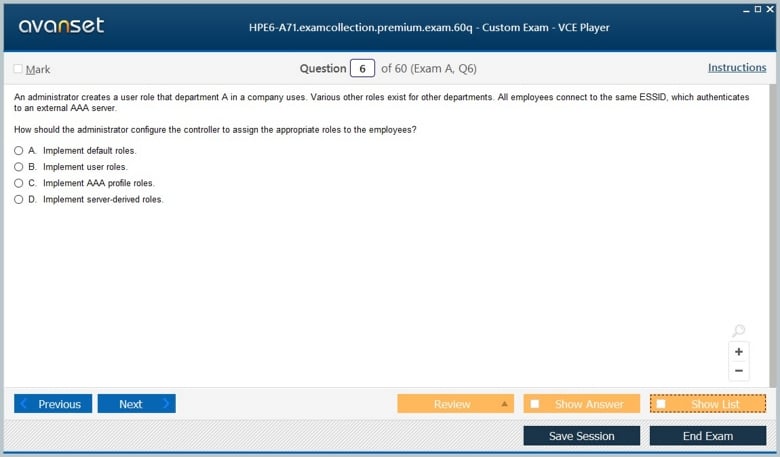
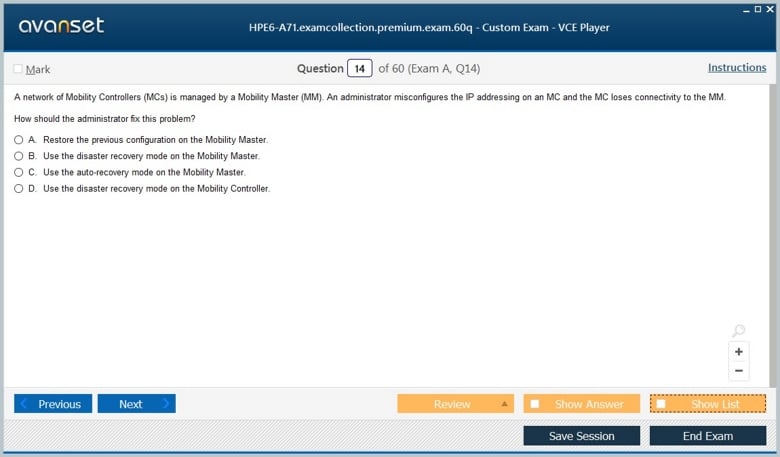
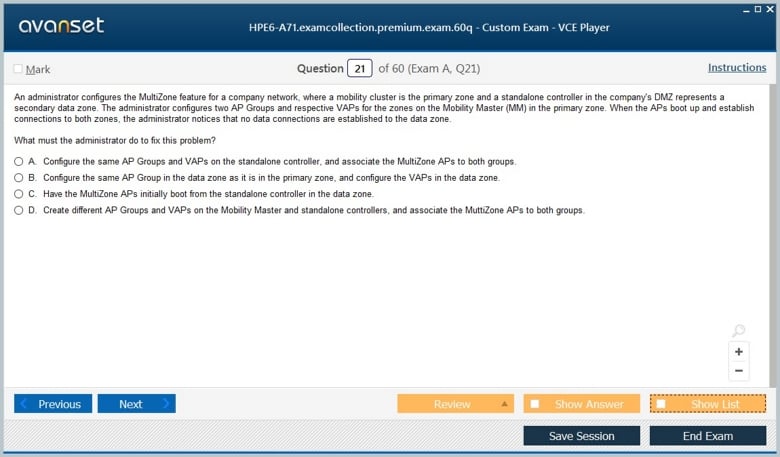
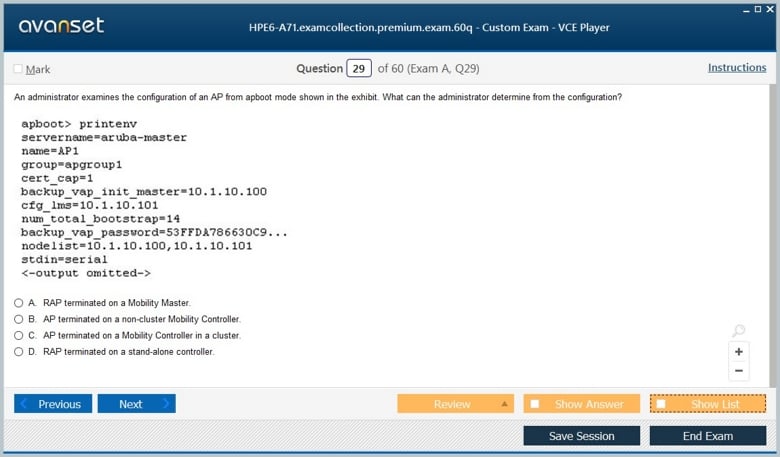
HP HPE6-A71 Practice Test Questions in VCE Format
| File | Votes | Size | Date |
|---|---|---|---|
File HP.practiceexam.HPE6-A71.v2026-05-03.by.blake.53q.vce |
Votes 1 |
Size 857.47 KB |
Date May 03, 2026 |
File HP.selftestengine.HPE6-A71.v2020-02-14.by.jude.27q.vce |
Votes 3 |
Size 237.9 KB |
Date Feb 14, 2020 |
HP HPE6-A71 Practice Test Questions, Exam Dumps
HP HPE6-A71 (Aruba Certified Mobility Professional Exam) exam dumps vce, practice test questions, study guide & video training course to study and pass quickly and easily. HP HPE6-A71 Aruba Certified Mobility Professional Exam exam dumps & practice test questions and answers. You need avanset vce exam simulator in order to study the HP HPE6-A71 certification exam dumps & HP HPE6-A71 practice test questions in vce format.
HPE6-A71, the Aruba Certified Mobility Professional exam, belongs to the previous Aruba mobility certification generation and is no longer active. HPE’s current certification records mark both the exam and the ACMP credential as inactive. That status matters because older preparation material still circulates widely and can make the code look current long after the certification program has moved on.
The underlying work did not disappear. HPE Aruba Networking simply reorganized campus networking around a newer Campus Access model that combines wired and wireless operations more explicitly. Candidates looking for a current entry point should now think in terms of HPE6-A85 Campus Access Associate, followed by the professional and expert levels represented by HPE7-A01 Campus Access Professional and HPE7-A07 Campus Access Mobility Expert.
That makes A71 useful as a historical map of the skills that mature wireless administrators were expected to possess: controller and gateway design, WLAN configuration, authentication, roaming, redundancy, branch and remote access, QoS, RF behavior, monitoring, and troubleshooting. The technology vocabulary has changed, but the operational reasoning remains valuable.
A wireless client does not simply connect to an access point and reach the application. Its traffic may pass through AP forwarding logic, gateways or controllers, VLANs, routing boundaries, policy enforcement, authentication services, DNS, DHCP, WAN links, and security controls. A strong mobility engineer needs to visualize that path before changing configuration. Many apparently “wireless” failures are actually upstream routing, authentication, name-resolution, or policy problems.
A71-era scenarios rewarded candidates who could distinguish management, control, and client traffic. That remains a durable skill. When a user can associate to an SSID but cannot reach an application, the administrator should not immediately change RF settings. The right sequence is to confirm association, authentication, address assignment, role or policy, gateway reachability, name resolution, and the application path. This layered method is more reliable than guessing from symptoms.
Mobility networks are expected to preserve usable sessions while clients move. That requires more than overlapping radio coverage. SSID configuration, security methods, authentication state, VLAN or role assignment, mobility domains, gateway behavior, and RF design all influence whether a client roams smoothly. Real-time voice and collaboration applications expose weak roaming designs quickly because brief interruptions that are invisible during web browsing can damage an active call.
The most useful way to study roaming is to connect protocol behavior with client experience. Ask what must remain consistent as the device changes APs, which state can be reused, where a new authentication is required, and which part of the network owns the user’s policy. In today’s HPE Aruba Networking Certified Professional - Campus Access track, those questions sit inside a broader campus architecture rather than a standalone “mobility” silo.
Enterprise WLANs commonly separate employees, guests, contractors, IoT devices, and specialized endpoints. That separation should be based on identity and risk where possible, not only on which SSID a device selected. An administrator needs to understand 802.1X, RADIUS, certificates, EAP methods, directory integration, captive portals, and the relationship between authentication and authorization. A successful login is only the beginning; the assigned role or policy determines what the user can actually do.
This is where mobility operations overlap with ClearPass and network security. Current engineers should understand how authentication requests are evaluated, how attributes influence role selection, how policy failures appear in logs, and how to distinguish a rejected identity from a network transport failure. The current HPE6-A88 ClearPass exam is a useful destination for deeper network-access-control study.
Wireless problems are often blamed on “signal” when the real issue is contention, interference, poor channel reuse, sticky client behavior, insufficient capacity, asymmetric power, or application sensitivity. Professional-level troubleshooting therefore combines RF measurements with infrastructure health and client telemetry. RSSI is useful, but it is not enough to explain airtime utilization, retries, channel overlap, or roaming decisions.
A mature workflow starts by defining the complaint precisely. Is the issue limited to one client type, one application, one floor, one band, one AP group, or one time of day? Does the client remain associated? Are retries or channel utilization high? Are authentication delays involved? Can a wired test reproduce the problem? The point is to narrow the failure domain before changing power levels or channel plans.
Older Aruba mobility deployments frequently included remote APs and branch scenarios in which traffic traversed private or public WAN links back toward central services. Those designs forced engineers to think about tunneling, encryption, local versus centralized forwarding, survivability, bandwidth, latency, and what should happen if the central site becomes unreachable. Those questions remain relevant even though current products and architectures have evolved.
Branch design should begin with application and security requirements. Sensitive traffic may require encryption across the WAN. Voice or local applications may need local breakout. Authentication may depend on remote services. A resilient design should define what continues to work during a WAN outage and what fails closed. That reasoning is more valuable than memorizing the behavior of a particular historical controller release.
Mobility environments depend on gateways, authentication systems, switching, DHCP, DNS, WAN connectivity, and management services. Installing redundant appliances does not automatically make the service highly available. The administrator needs to know how state is synchronized, how clients are redistributed, what convergence looks like, whether upstream paths are independent, and how maintenance affects active sessions.
Scenario practice should therefore remove components deliberately. What happens when one gateway fails? What if an authentication server is unreachable? What if a WAN path fails but the AP remains powered? What if the network still forwards traffic but policy synchronization is lost? This failure-domain approach maps naturally into the current campus access architecture and is one of the strongest reasons legacy A71 material can still be useful.
The mistake is not studying an older exam; it is studying it without understanding its status. A71 can still teach valuable professional-level wireless reasoning, especially around roaming, policy, branch operation, RF troubleshooting, and service resilience. What it cannot do is describe the current HPE Aruba Networking certification sequence or every current management workflow.
For present-day planning, use the broader HPE Aruba Networking exam inventory and map the old topics into today’s Campus Access track. That approach preserves the technical value of the legacy material while keeping certification decisions current.
A mobility engineer also needs to understand why simply seeing a strong signal does not prove a WLAN has enough capacity. A lecture hall, contact center, or event space can have excellent coverage and still perform poorly when too many active clients compete for airtime. Client capabilities, channel width, band selection, application mix, retransmissions, and co-channel contention all influence how much useful capacity is available. Planning should therefore estimate who will connect, what they will do, and when the busiest periods occur rather than relying only on AP counts.
This distinction changes troubleshooting. If performance degrades only when occupancy rises, adding transmit power may increase interference rather than solve the bottleneck. Engineers should compare client counts, airtime utilization, retry rates, channel conditions, and application demand. A71-era mobility work expected candidates to think beyond simple coverage, and that remains a core skill in current campus wireless design.
Wireless changes can affect many users at once because configuration is often shared across AP groups, SSIDs, gateways, or sites. A modification to authentication, RF settings, VLAN mapping, or firewall policy should therefore be treated as a controlled change. Engineers should know the current baseline, identify affected locations, define validation tests, choose a rollback point, and monitor user experience after deployment. Centralized management makes changes easier to push, but it also makes mistakes easier to distribute widely.
The strongest operational habit is to stage changes where possible. Apply a policy or RF adjustment to a limited group, verify authentication and application behavior, review monitoring data, and only then expand the scope. That discipline carries directly into modern HPE Aruba Networking operations and is one of the professional behaviors that an older mobility exam can still teach effectively.
Intermittent wireless incidents are especially difficult when engineers cannot reconstruct the environment at the time of failure. Useful documentation should capture topology, AP and gateway relationships, authentication dependencies, addressing, SSID-to-role mappings, WAN paths, and the location of critical services. During an incident, notes should preserve timestamps, client identifiers, affected APs, observed roles, addresses, and the tests already performed.
This may feel administrative, but it is a technical advantage. A clean record lets teams correlate client events with infrastructure logs and distinguish repeated failures from unrelated complaints. It also supports escalation to senior engineers or vendors without forcing the investigation to begin again. Expert-level troubleshooting depends as much on evidence quality as on protocol knowledge.
For practical review, build one end-to-end client story and keep it consistent across every layer. Start with a device entering coverage, selecting the intended SSID, authenticating, receiving a role and address, reaching local services, and then roaming to another AP. Next, introduce a failure at one point in that sequence and predict which logs or symptoms should change. This kind of narrative forces the engineer to connect RF, identity, forwarding, and application behavior instead of studying each topic in isolation.
It is also useful to compare a healthy client with a failing one. Differences in AP association, authentication result, assigned role, DHCP timing, route, or retry rate often reveal more than looking at the failing device alone. Comparative troubleshooting is especially valuable for intermittent mobility issues because it provides a baseline for what the infrastructure should be doing at the same time and location.
Go to testing centre with ease on our mind when you use HP HPE6-A71 vce exam dumps, practice test questions and answers. HP HPE6-A71 Aruba Certified Mobility Professional Exam certification practice test questions and answers, study guide, exam dumps and video training course in vce format to help you study with ease. Prepare with confidence and study using HP HPE6-A71 exam dumps & practice test questions and answers vce from ExamCollection.
Purchase Individually
Top HP Certifications


Top HP Certification Exams
Site Search:

SPECIAL OFFER: GET 10% OFF

Pass your Exam with ExamCollection's PREMIUM files!
SPECIAL OFFER: GET 10% OFF
Use Discount Code:
MIN10OFF
A confirmation link was sent to your e-mail.
Please check your mailbox for a message from support@examcollection.com and follow the directions.

Download Free Demo of VCE Exam Simulator
Experience Avanset VCE Exam Simulator for yourself.
Simply submit your e-mail address below to get started with our interactive software demo of your free trial.