



Premium File
60 Q&A
$76.99$69.99
HP HPE6-A70 Exam Questions & Answers, Accurate & Verified By IT Experts
Instant Download, Free Fast Updates, 99.6% Pass Rate

HPE6-A70 Premium File: 60 Questions & Answers
Last Update: Nov 10, 2026
HPE6-A70 PDF Study Guide: 482 Pages
$74.99
HP HPE6-A70 Exam Screenshots
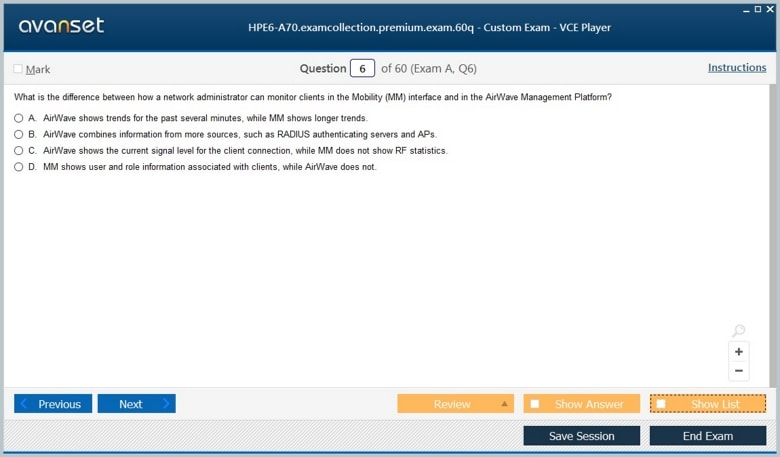
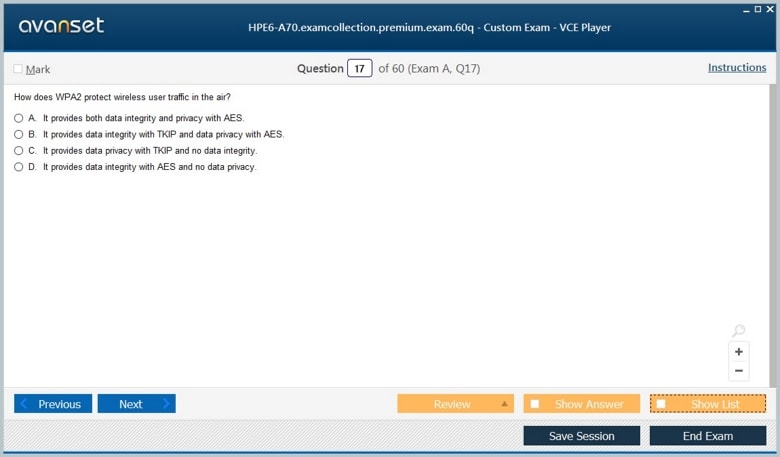
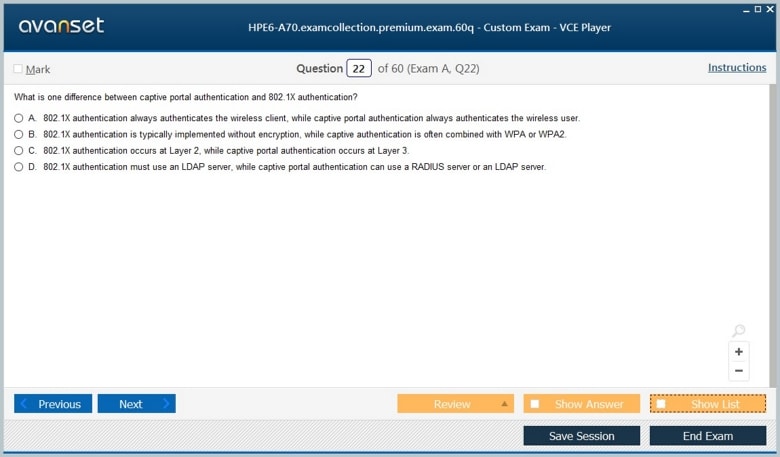
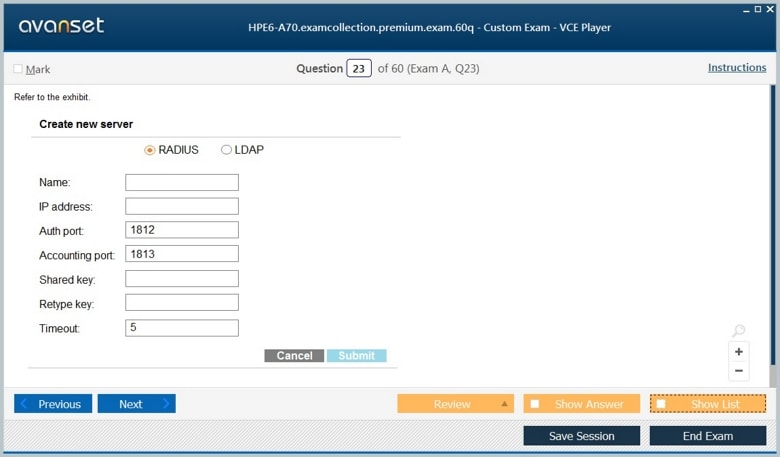
HP HPE6-A70 Practice Test Questions in VCE Format
| File | Votes | Size | Date |
|---|---|---|---|
File HP.braindumps.HPE6-A70.v2026-07-04.by.zeynep.28q.vce |
Votes 1 |
Size 413.22 KB |
Date Jul 04, 2026 |
File HP.Test-king.HPE6-A70.v2020-01-23.by.Alex.28q.vce |
Votes 3 |
Size 932.47 KB |
Date Jan 23, 2020 |
HP HPE6-A70 Practice Test Questions, Exam Dumps
HP HPE6-A70 (Aruba Certified Mobility Associate Exam) exam dumps vce, practice test questions, study guide & video training course to study and pass quickly and easily. HP HPE6-A70 Aruba Certified Mobility Associate Exam exam dumps & practice test questions and answers. You need avanset vce exam simulator in order to study the HP HPE6-A70 certification exam dumps & HP HPE6-A70 practice test questions in vce format.
HPE6-A70 Aruba Certified Mobility Associate is an inactive exam from the former ACMA certification track. HPE’s current records identify the resource as no longer active, so the code should be treated as legacy. The old exam validated foundational knowledge for configuring and operating Aruba wireless LANs, making it useful historical context but not a current certification target.
HPE Aruba Networking has since reorganized mobility skills into the broader Campus Access program. The current HPE Network Campus Access Associate exam combines basic wired and wireless knowledge, while professional and expert paths deepen campus implementation, troubleshooting, and RF design. That change reflects how user access increasingly spans switches, access points, policy, cloud management, and security as one system.
The old ACMA material still contains durable WLAN concepts. Radio behavior, SSIDs, authentication, roles, VLANs, roaming, controller or gateway functions, monitoring, and troubleshooting remain useful. The key is to learn those concepts without treating retired ArubaOS generations or old certification relationships as current facts.
Wi-Fi is a shared radio medium, so client experience depends on more than signal strength. Channel width, interference, contention, retransmissions, data rates, client capability, transmit power, and the number of active devices all affect usable capacity. Associate-level engineers should be able to distinguish a coverage problem from a capacity or interference problem.
The RF environment also changes over time. New neighboring networks, building modifications, additional devices, or client upgrades can alter performance after installation. Monitoring and periodic validation matter because a design that was healthy at deployment can become congested later.
Good troubleshooting starts with evidence: signal and noise, channel utilization, retries, client association, roaming behavior, and upstream connectivity. Rebooting access points without understanding the RF problem may temporarily hide symptoms without correcting the cause.
An SSID is the visible entry point to a wireless service, but the real design includes authentication, encryption, role, VLAN or tunnel behavior, addressing, DNS, access policy, and application reachability. Too many SSIDs can waste airtime and complicate operations, so designers should create them for meaningful service differences rather than organizational convenience.
Employee, guest, IoT, and specialized device populations may need different onboarding and access. The network should make those differences explicit while keeping the operational model manageable. Identity-aware roles can sometimes reduce the need for separate SSIDs by applying policy after authentication.
Associate candidates should practice tracing a client from SSID selection through authentication, address assignment, role or VLAN, routing, and final application access. That end-to-end view prevents wireless troubleshooting from stopping at the access point.
Enterprise WLANs may use personal credentials, enterprise authentication, certificates, captive portals, or device-specific methods depending on the use case. Engineers need to understand the difference between proving identity, encrypting the radio link, and authorizing access after authentication.
Certificate-based enterprise access can provide strong identity but depends on trust, enrollment, supplicant configuration, and lifecycle management. Password-based methods may be easier to deploy but have different security and user-experience trade-offs. Guest access introduces sponsorship, expiration, terms of use, and segmentation concerns.
Current campus access design also integrates network access control more tightly across wired and wireless infrastructure. This is one reason modern HPE certification treats campus access as a combined discipline instead of preserving mobility as an isolated associate track.
Users expect voice, video, and interactive applications to continue while they move. Roaming involves signal thresholds, client decisions, authentication, key handling, AP placement, and network design. The infrastructure can support fast transition mechanisms, but the client ultimately participates in the decision to roam.
Troubleshooting therefore requires both sides of the conversation. A client that clings to a distant AP may experience poor performance even when a better AP is available. Conversely, aggressive roaming or unstable RF can create frequent transitions. Engineers should compare client events, signal history, AP load, and authentication timing.
Design should also consider mobility across floors, buildings, and high-density areas. Good coverage overlap supports roaming, but excessive overlap can increase contention. The goal is a balanced RF plan, not maximum signal everywhere.
The ACMA era placed significant emphasis on controllers, gateways, roles, tunneling, clustering, and centralized wireless services. Those concepts help explain how policy and traffic could be coordinated across many access points. Modern architectures have evolved, but candidates still need to understand where control, forwarding, authentication, and policy functions live.
Failure analysis should identify which functions are local and which depend on a controller, gateway, cloud service, or upstream network. If an access point remains powered but loses a required control connection, client behavior may change. If a gateway fails, redundancy design determines whether sessions continue or reconnect.
Historical material becomes most useful when it teaches this dependency mapping. Exact controller models and interfaces may be obsolete, but understanding control plane, data plane, state, and failover remains foundational.
The current HPE Campus Access Professional exam validates intermediate wired and wireless implementation, including routing, switching, RF, security, connectivity, and troubleshooting. That scope shows how far the program has moved from treating mobility as a separate island.
For operations teams, the integrated view is practical. A wireless user may fail because of RF, authentication, DHCP, VLAN configuration, routing, switch uplinks, policy, DNS, or application reachability. The engineer needs enough cross-domain knowledge to follow the service path instead of handing off every symptom at the first boundary.
The current HPE Aruba Networking Certified Professional - Campus Access material is therefore a more accurate modern continuation of many skills that began in separate mobility and switching tracks.
HPE still recognizes deep wireless expertise, but it now sits higher in the Campus Access program. The current HPE Campus Access Mobility Expert written exam focuses on mastery of complex campus wireless networking while also requiring understanding of the wired environment.
This progression makes sense. Entry-level engineers need broad campus fundamentals, while expert wireless engineers need deeper RF design, optimization, troubleshooting, and architecture skills. The specialty remains, but it is connected more explicitly to the rest of the campus.
For someone reading A70 material, the implication is clear: keep the wireless foundation, then broaden into current campus networking rather than searching for a direct modern exam with the same “Mobility Associate” name.
Cloud-based management has become more prominent since the ACMA generation. Centralized configuration, monitoring, client visibility, analytics, and troubleshooting can reduce operational effort across many sites. The underlying WLAN still depends on RF and network fundamentals, but the management workflow is different.
Engineers should understand what cloud management can and cannot see, how devices connect to the management service, how configuration is organized, and what happens when management connectivity is unavailable. A cloud dashboard does not remove the need to understand local forwarding or upstream dependencies.
The shift from controller-centric training to broader campus and cloud operations is one of the biggest contextual changes between A70 and current HPE Aruba Networking certification.
ExamCollection’s older ACMA V8 announcement is useful as a historical marker because it shows the certification in the period when mobility had its own associate identity. It should be read as history, not as evidence that HPE6-A70 is active today.
For current planning, use the HPE Aruba Networking exam inventory and active Campus Access destinations. When reviewing old questions, keep RF, authentication, roaming, policy, and troubleshooting concepts; verify product-specific commands, architecture, licensing, and exam logistics against current material.
The durable lesson from A70 is that reliable wireless access requires coordinated RF design, identity, policy, forwarding, and operations. Modern Campus Access simply places that lesson inside a broader wired-and-wireless architecture.
Client diversity is another reason mobility skills remain relevant. Phones, laptops, scanners, voice handsets, sensors, and older embedded devices can support different bands, security methods, roaming capabilities, and power-saving behavior. A WLAN must often accommodate that diversity without lowering security or performance for every user.
Capacity planning should therefore use representative clients and applications rather than theoretical radio maximums. Video meetings, voice, software distribution, dense classroom use, and IoT telemetry create different airtime patterns. Observing real client behavior is often more useful than relying on a single headline throughput figure.
Operations teams should also maintain a baseline of normal behavior—client counts, channel utilization, authentication time, roaming events, retry rates, and common failure patterns. Troubleshooting is faster when engineers can compare an incident to known-good conditions instead of starting from zero.
Mobility design also benefits from explicit user-journey testing. A client does not experience the network as separate controller, access-point, authentication, DHCP, DNS, and application components; it experiences one session. Engineers should therefore test association, authentication, address acquisition, policy assignment, roaming, name resolution, and application reachability as a sequence. That helps isolate whether a symptom belongs to RF, identity, switching, services, or the application path.
When moving from the A70 era into current Campus Access, the same end-to-end thinking should guide migration planning. Pilot users and locations should represent real device types and roaming patterns, and success criteria should include latency, authentication reliability, voice or real-time behavior where relevant, policy enforcement, and operational visibility. This is a better use of legacy ACMA material than memorizing retired controller workflows: it preserves the troubleshooting model while allowing the current architecture and tooling to change.
Go to testing centre with ease on our mind when you use HP HPE6-A70 vce exam dumps, practice test questions and answers. HP HPE6-A70 Aruba Certified Mobility Associate Exam certification practice test questions and answers, study guide, exam dumps and video training course in vce format to help you study with ease. Prepare with confidence and study using HP HPE6-A70 exam dumps & practice test questions and answers vce from ExamCollection.
Purchase Individually

Top HP Certifications


Top HP Certification Exams
Site Search:

SPECIAL OFFER: GET 10% OFF

Pass your Exam with ExamCollection's PREMIUM files!
SPECIAL OFFER: GET 10% OFF
Use Discount Code:
MIN10OFF
A confirmation link was sent to your e-mail.
Please check your mailbox for a message from support@examcollection.com and follow the directions.

Download Free Demo of VCE Exam Simulator
Experience Avanset VCE Exam Simulator for yourself.
Simply submit your e-mail address below to get started with our interactive software demo of your free trial.
@Grant, well,,,,the practice questions and answers for HPE6-A70 exam are what you need to crack the test as they help to see your readiness for it. they helped me pass my exm today….and... with a high score! So i highly recommend this to you because you’ll know all the answers and be confident in your knowledge and stills ant that’s important.
someone to please comment about the validity of exam HP HPE6-A70 questions and answers… my exam day is coming soon…. any advise will be appreciated...
@barett, yes hpe6-A70 practice test is still actual and worth using... I confirmed this during my exam yesterday… I was already familiar with almost all the questions I found there… I passed easily! I recommend this material. some advice, try not to rely only on these questions and answers, but be properly prepard for the exam.all the best
it has been a while since a friend of mine recommended this site to me, so I need to clarify again whether HPE6-A70 vce file is still valid?? is there someone who knows?
@hazel, HPE6-A70 exam dump will surely help you succeed in your exam. i used materials from examcollection more than once and can verify they are valid and well compiled to sharpen the knowledge and skills assessed in this exam and some others. they helped me pass my assessments… you should proceed with using this vce file
I failed this exam in first attempt and will have my second trial in two weeks...do you guys think HPE6-A70 braindump can help me pass this exam???