



Premium File
68 Q&A
$76.99$69.99
HP HPE6-A47 Exam Questions & Answers, Accurate & Verified By IT Experts
Instant Download, Free Fast Updates, 99.6% Pass Rate

HPE6-A47 Premium File: 68 Questions & Answers
Last Update: Sep 09, 2026
HPE6-A47 PDF Study Guide: 702 Pages
$74.99
HP HPE6-A47 Exam Screenshots
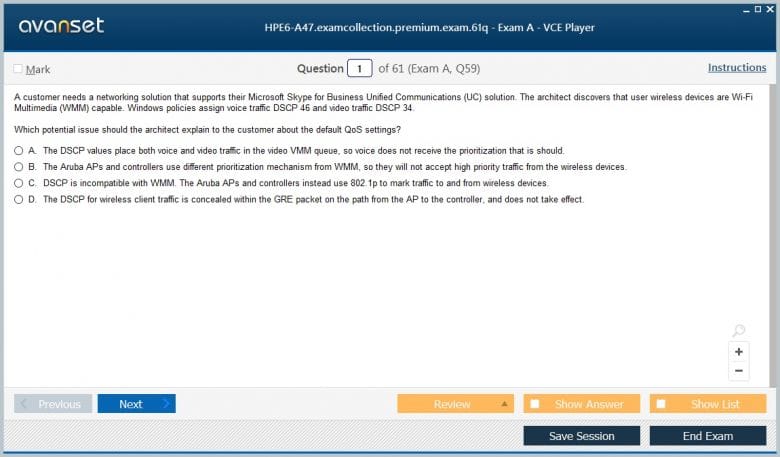
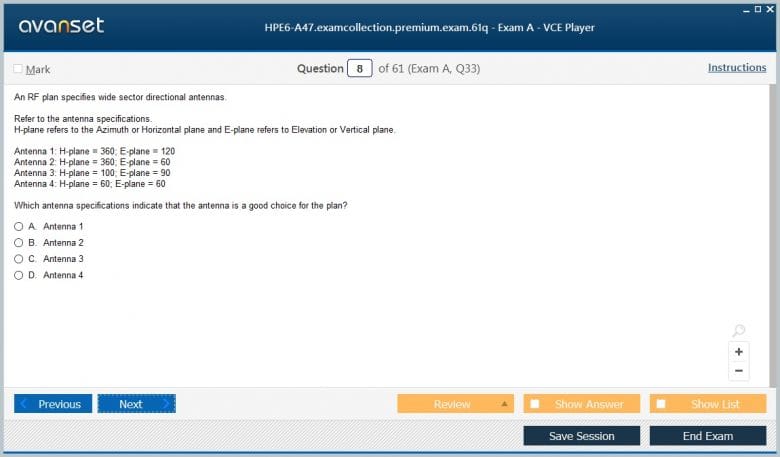
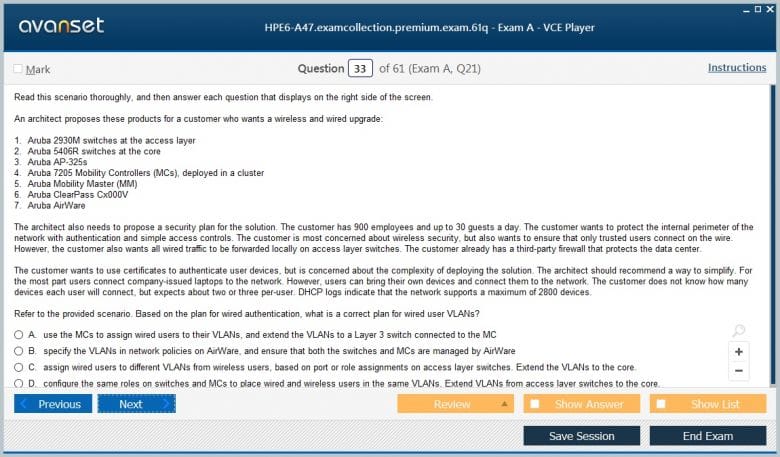
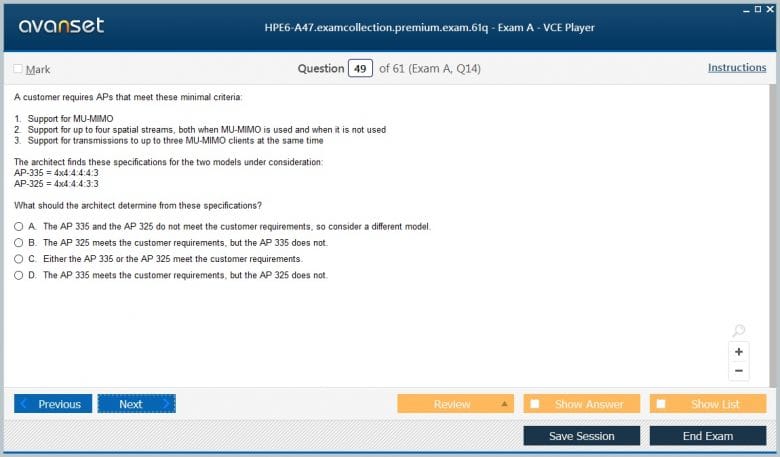
HP HPE6-A47 Practice Test Questions in VCE Format
| File | Votes | Size | Date |
|---|---|---|---|
File HP.Prepaway.HPE6-A47.v2026-06-30.by.Gary.37q.vce |
Votes 4 |
Size 3.75 MB |
Date Jul 01, 2026 |
HP HPE6-A47 Practice Test Questions, Exam Dumps
HP HPE6-A47 (Designing Aruba Solutions) exam dumps vce, practice test questions, study guide & video training course to study and pass quickly and easily. HP HPE6-A47 Designing Aruba Solutions exam dumps & practice test questions and answers. You need avanset vce exam simulator in order to study the HP HPE6-A47 certification exam dumps & HP HPE6-A47 practice test questions in vce format.
HPE6-A47 Aruba Certified Design Professional is a retired Aruba exam. HPE’s current certification records mark the old ACDP credential and the HPE6-A47 exam as inactive. The code belongs to an earlier design track, so historical material should not be presented as a current registration path.
The architecture skills behind the exam remain useful. Professional network design still means translating business requirements into a technically viable wired and wireless architecture, validating capacity and resiliency, planning addressing and segmentation, understanding radio-frequency constraints, selecting appropriate products, and documenting a design clearly enough that an implementation team can build it.
Today, HPE Aruba Networking organizes these responsibilities differently. The current HPE Network Campus Access Professional Architect exam validates the ability to translate customer requirements into cost-optimized campus solutions, including migration and bill-of-materials work. That is not a one-for-one rename of A47, but it is a useful modern destination for the design discipline that A47 represented.
A network architect needs more than floor plans and port counts. Business requirements define availability, user experience, growth, security, budget, deployment timing, and operational constraints. Technical discovery adds existing topology, WAN connectivity, addressing, authentication, cabling, RF environment, device types, applications, and support capabilities.
The professional skill is converting vague statements into design criteria. “Wireless is slow” might mean coverage gaps, interference, insufficient capacity, WAN congestion, authentication delay, or application problems. “We need redundancy” is incomplete until the architect knows which failures must be survived and what interruption is acceptable.
A strong design record keeps those requirements traceable. Each major architecture decision should be explainable in terms of an identified need or constraint. That prevents unnecessary complexity and gives reviewers a way to challenge assumptions before hardware is purchased.
Coverage and capacity are different problems. An access point may provide detectable signal across a large area while still being unable to support the required number of clients, applications, and airtime demand. Professional design therefore considers attenuation, interference, channel reuse, transmit power, client capabilities, roaming, application sensitivity, and user density.
Site surveys and predictive models provide evidence, but they are not substitutes for judgment. Building materials, neighboring networks, ceiling height, high-density rooms, outdoor areas, and specialized devices can all change the RF plan. Architects should document assumptions and validate them against the physical environment.
Good designs also plan for operations. AP placement should support maintenance, monitoring should expose client experience, and the architecture should allow reasonable growth. A network that meets coverage targets on opening day but has no capacity margin may fail quickly as device counts increase.
Access points depend on switching for power, VLANs, uplink capacity, redundancy, and policy integration. A wireless design that ignores the wired edge can be bottlenecked by insufficient PoE, oversubscribed uplinks, inconsistent VLAN configuration, or switch failure domains.
Professional architects therefore model campus switching as part of the same service. They consider access-layer density, uplink design, aggregation, routing boundaries, loop prevention, segmentation, QoS, multicast, and resiliency. The current HPE Aruba Networking program separates some of these specialties, but the design still has to integrate them.
For deeper current context, the HPE Aruba Networking Certified Professional - Switching material represents a modern implementation path for advanced wired networking. Architects do not need to perform every operational task, but they must design something the switching team can support.
Modern campus design cannot treat security as a firewall added at the perimeter. Users, guests, contractors, IoT devices, corporate endpoints, and infrastructure systems have different access needs. Identity-aware policy, role assignment, segmentation, and authentication should therefore influence VLAN design, routing, wireless SSIDs, access control, and management architecture.
The architect should ask where identity comes from, how devices that cannot perform user authentication are classified, how guest access is approved, and where policy is enforced. The answers may involve ClearPass, network roles, dynamic segmentation, certificates, or other controls, but the important design principle is that access policy follows an explicit trust model.
Security also affects resilience and operations. Authentication services need redundancy, administrative access needs protection, and logging must be available when troubleshooting an access failure. A design that is secure only under normal conditions is incomplete.
Redundancy is not simply buying two of everything. Architects need to identify failure domains—power, switch, controller or gateway, uplink, WAN circuit, authentication service, data center, and sometimes cloud connectivity—and then decide which failures the business requires the network to survive.
The design must also consider convergence and state. Two devices may be present but still depend on the same upstream path. A redundant link may exist but may not carry the required VLANs. A backup authentication server may be configured but unreachable from part of the network. Availability comes from tested end-to-end behavior rather than component count.
Scenario practice is useful here. Remove one component at a time and trace what happens to users. Then remove a larger failure domain. This exposes hidden single points of failure and teaches the architect to reason about service continuity rather than hardware duplication.
A professional design eventually becomes a bill of materials, but the BOM should follow architecture rather than drive it. Counts and models need to reflect capacity, port types, PoE budgets, optics, subscriptions, licenses, support, mounting, power, redundancy, and growth. Missing a “small” dependency can delay an implementation just as effectively as choosing the wrong switch.
Cost optimization does not mean selecting the cheapest device in every location. It means meeting requirements without paying for capability that is not needed while preserving supportability and lifecycle consistency. Standardizing on a smaller number of models can sometimes reduce operational cost even when unit price is higher.
The current HPE7-A11 exam makes this explicit by including solution translation and BOM work. That connection is one reason the current professional architect path is useful context for readers of A47 material.
Older design tracks sometimes covered broad enterprise networking under one umbrella. Current HPE Aruba Networking certification is more specialized. The HPE Network Data Center Professional Architect exam focuses on complex, scalable multi-site data-center environments and the specific business and technical requirements that come with them.
This specialization makes sense because campus and data-center architectures have different traffic patterns, scale, automation, availability models, and integration requirements. A designer should understand where the disciplines overlap and where expertise needs to become deeper.
For legacy A47 study, the lesson is not to force every old topic into one modern credential. Instead, identify the design skill being practiced—campus access, switching, wireless, security, or data center—and map it to the current HPE Aruba Networking area that owns it.
Historical questions and scenarios can still be useful if they are stripped of obsolete product assumptions. Take the customer requirement, draw the logical design, identify failure domains, estimate capacity, define policy boundaries, and explain why each component exists. Then compare the result with current HPE Aruba Networking architecture.
The older HPE6-A66 Design Associate exam represents the foundational layer below A47’s professional expectations. Both are inactive, but comparing them helps show the progression from assisting with requirements and basic designs to owning more complex architecture decisions.
Current candidates should use the HPE Aruba Networking exam inventory for active paths and treat A47 as historical context. Its most durable contribution is a professional mindset: requirements first, architecture second, products third, and documentation throughout.
Migration planning is another professional-level responsibility that remains important beyond the retired exam. A new campus design often has to coexist with an older network during rollout. The architect should define transition states, interoperability assumptions, maintenance windows, rollback points, and which users or buildings move first. A target architecture that cannot be reached safely from the starting environment is not complete.
Operational handoff should be designed as deliberately as deployment. Monitoring ownership, configuration standards, diagrams, IP plans, support escalation, software lifecycle, and acceptance tests need to be clear before the implementation team leaves. The best architecture reduces ambiguity for the people who will operate it for years.
Finally, design review should include explicit challenge. Ask another engineer to look for single points of failure, unsupported assumptions, missing licenses, weak security boundaries, unrealistic RF expectations, and capacity bottlenecks. Professional architecture improves when decisions can survive informed criticism rather than merely pass a checklist.
The design-professional mindset behind A47 is also visible in how requirements are translated into testable acceptance criteria. “Good Wi-Fi” or “secure access” is not an architecture requirement until it is expressed through measurable coverage, capacity, roaming, authentication, segmentation, availability, manageability, and operational outcomes. A designer should be able to trace each major design decision back to one of those requirements and explain the trade-off introduced by the choice.
That traceability matters during migration. A modern HPE Aruba Networking architecture may use different hardware, software, and certification terminology than the A47 era, but the migration still needs coexistence rules, change windows, rollback points, pilot validation, and a definition of success. Legacy A47 study therefore remains useful when it is used to practice requirements analysis and design defense—not when old product tables are memorized as though they describe today’s supported portfolio.
Design review should also expose assumptions that cannot be proven from diagrams alone. Capacity estimates, roaming expectations, application sensitivity, security controls, and operational staffing may require surveys, traffic data, stakeholder interviews, or pilot testing. Recording those assumptions lets the implementation team know what must be validated before rollout. It also makes later troubleshooting more disciplined because engineers can compare real behavior with the conditions the architecture was designed to support.
Go to testing centre with ease on our mind when you use HP HPE6-A47 vce exam dumps, practice test questions and answers. HP HPE6-A47 Designing Aruba Solutions certification practice test questions and answers, study guide, exam dumps and video training course in vce format to help you study with ease. Prepare with confidence and study using HP HPE6-A47 exam dumps & practice test questions and answers vce from ExamCollection.
Purchase Individually

Top HP Certifications


Top HP Certification Exams
Site Search:

SPECIAL OFFER: GET 10% OFF

Pass your Exam with ExamCollection's PREMIUM files!
SPECIAL OFFER: GET 10% OFF
Use Discount Code:
MIN10OFF
A confirmation link was sent to your e-mail.
Please check your mailbox for a message from support@examcollection.com and follow the directions.

Download Free Demo of VCE Exam Simulator
Experience Avanset VCE Exam Simulator for yourself.
Simply submit your e-mail address below to get started with our interactive software demo of your free trial.
Anyone uses this dump and pass the exam?
Any feedback here ?
can anyone confirm if these dumps are valid and correct?