



Premium File
62 Q&A
$76.99$69.99
HP HPE2-K42 Exam Questions & Answers, Accurate & Verified By IT Experts
Instant Download, Free Fast Updates, 99.6% Pass Rate
62 Questions & Answers
Last Update: Oct 30, 2026
$69.99
HP HPE2-K42 Exam Screenshots
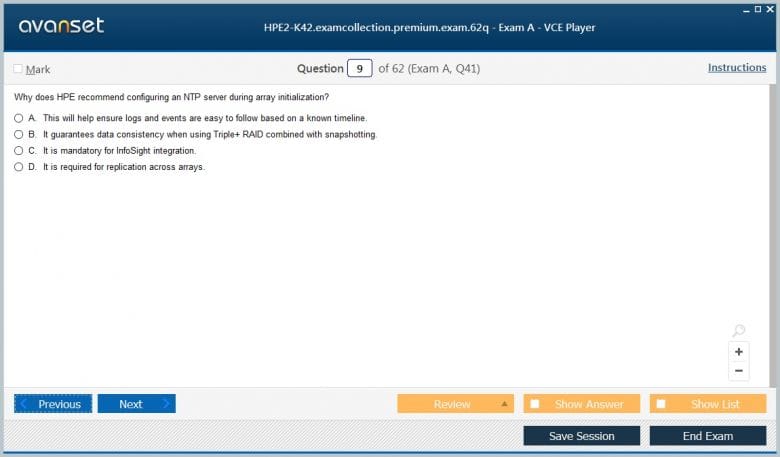
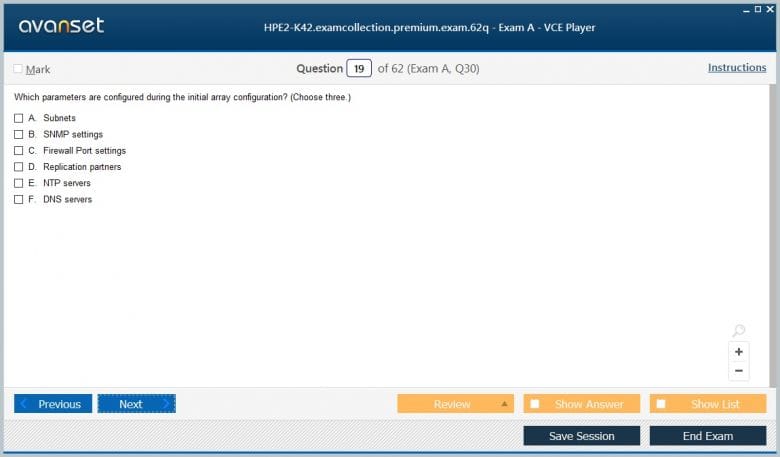
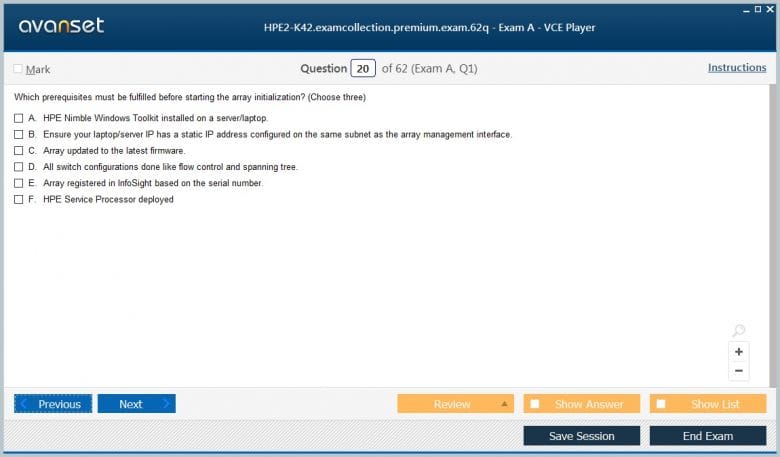
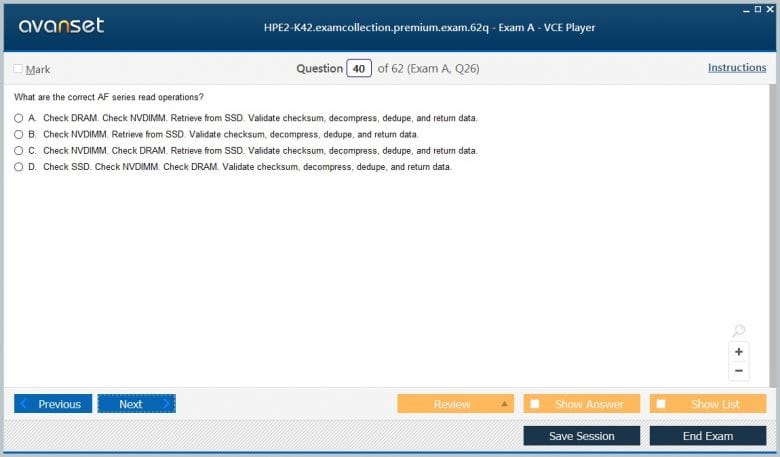
HP HPE2-K42 Practice Test Questions in VCE Format
| File | Votes | Size | Date |
|---|---|---|---|
File HP.Braindumps.HPE2-K42.v2026-06-29.by.Hunter.26q.vce |
Votes 2 |
Size 72.06 KB |
Date Jul 04, 2026 |
HP HPE2-K42 Practice Test Questions, Exam Dumps
HP HPE2-K42 (Designing HPE Nimble Solutions) exam dumps vce, practice test questions, study guide & video training course to study and pass quickly and easily. HP HPE2-K42 Designing HPE Nimble Solutions exam dumps & practice test questions and answers. You need avanset vce exam simulator in order to study the HP HPE2-K42 certification exam dumps & HP HPE2-K42 practice test questions in vce format.
HPE2-K42, Designing HPE Nimble Solutions, belongs to the HPE Product Certified - Nimble Solutions [2018] generation. HPE’s own 2018 and 2019 training material linked the exam to a two-day Designing HPE Nimble Solutions course covering Nimble hardware and software, initial configuration, volumes, snapshots, and replication. The credential is historical, so the page should not imply that the 2018 exam is a current HPE certification target.
Nimble is still a useful architecture case study because the exam centered on practical storage design. Candidates needed to identify customer requirements, position the platform, understand capacity and performance, plan protection, design connectivity, and explain how snapshots and replication supported availability and recovery goals.
Modern HPE storage has evolved substantially, but many of the design questions remain durable. The broader HPE exam inventory includes current and more recent storage destinations, while HPE2-K42 preserves the specific Nimble Solutions era.
Storage sizing that uses only terabytes is incomplete. Architects need to understand IOPS, latency sensitivity, read/write ratio, block size, sequential versus random behavior, working-set characteristics, data reduction, growth, snapshot retention, and replication. A system can have enough capacity and still deliver poor application performance.
Workload mix matters. Databases, virtual machines, file services, backup targets, and analytics can stress storage differently. Consolidating them onto one array may improve utilization but can also create contention. The design should identify priority workloads and the operational signals that will reveal pressure before users experience it.
Historical Nimble architecture placed significant emphasis on analytics and predictive support. That reinforces a useful principle: sizing should continue after installation. Real telemetry should be compared with the original assumptions so capacity and performance plans can be adjusted over time.
Raw drive capacity is not the same as application capacity. Protection overhead, metadata, reserve space, snapshots, replication, compression, and deduplication where applicable all influence usable space. Architects should explain those factors so customers understand why a system’s effective capacity differs from its physical total.
Data reduction estimates should be conservative. Some workloads compress or deduplicate well; encrypted or already-compressed data may not. A proposal that depends on an optimistic reduction ratio can create an early capacity problem. Design should show both expected and lower-efficiency scenarios.
Snapshots also consume capacity as data changes. Retention policy therefore belongs in sizing. Frequent snapshots with long retention may be appropriate for recovery objectives, but the capacity model needs to include the change rate that makes those snapshots grow.
Snapshots provide fast point-in-time recovery on the storage system, while replication can create copies at another location. Neither should be described as a universal backup replacement. Architects need to map each mechanism to failure scenarios and retention requirements.
Local snapshots can protect against accidental changes or support rapid rollback, but they remain tied to the storage system’s failure domain. Replication can improve site resilience, but it depends on network bandwidth, latency, replication intervals, and the consistency requirements of the application. Off-array backup may still be required for long-term retention, cyber resilience, or independent recovery.
Recovery point and recovery time objectives should drive the design. If the business can tolerate hours of data loss, the architecture may differ from a workload that can tolerate only minutes. The network and secondary capacity must be sized accordingly.
Storage arrays can provide redundant controllers and ports, but hosts only benefit if the end-to-end path is designed correctly. That includes host adapters, switches or fabrics, array ports, zoning or network segmentation, target configuration, and multipathing software.
Architects should map failure domains. Two host paths that traverse the same switch or physical cable are not truly redundant. Similarly, redundant fabrics that depend on one upstream power domain can share hidden risk. Design documentation should make those relationships visible.
Validation is critical. After provisioning, confirm that hosts see the expected paths, multipathing uses them correctly, failover occurs as designed, and performance is consistent. Storage resilience is proven through behavior, not through a diagram alone.
Nimble systems were frequently used with virtualized infrastructure, where many virtual machines share storage. This concentrates diverse I/O patterns and makes visibility important. A noisy workload can affect many neighbors if the environment lacks monitoring or appropriate controls.
Architects should understand datastore or volume layout, snapshot interactions, backup workflows, queue behavior, and the relationship between hypervisor and array metrics. Troubleshooting is faster when teams can correlate a slow virtual machine with host, network, and storage evidence rather than looking at each layer separately.
The legacy HPE Solutions with VMware exam is a relevant historical relationship because it represents the same era of HPE infrastructure integration, although both exams are now inactive.
Nimble’s InfoSight approach helped popularize the idea that storage support could use telemetry and analytics to identify patterns across installed systems. From an architecture perspective, that matters because operations become part of the design value, not merely a support feature.
Telemetry can reveal capacity trends, performance anomalies, configuration risks, and correlations that are difficult to see from a single host. The organization still needs processes for acting on the information. Predictive insight has little value if alerts have no owner or recommended changes are never reviewed.
Architects should therefore include monitoring, support connectivity, data-governance considerations, and escalation in the solution. Operational visibility is a design requirement when the business depends on the storage platform.
The HPE portfolio has moved through later Nimble, Primera, Alletra, and GreenLake storage generations, and certification roles have changed accordingly. HPE2-K42 should not be used as a map of the current product catalog. It is evidence of how HPE trained partners to design Nimble solutions in the 2018 period.
More recent approved storage destinations such as HPE0-J82 Designing HPE Storage Solutions and HPE0-J83 HPE Storage Solutions provide later architecture and integration context. Current candidates should still check HPE’s live certification portal because even recent exam families can change.
The useful continuity is in the design method: understand workloads, size with evidence, plan protection, build redundant connectivity, integrate operations, and validate recovery. Those skills survive portfolio changes.
Storage proposals often become lists of features: snapshots, replication, compression, analytics, performance, and availability. The architect’s job is to connect each feature to a customer outcome. Snapshots matter because recovery needs to be fast. Replication matters because site loss is in scope. Analytics matter because the operations team needs faster diagnosis.
This mapping prevents overdesign. A feature that does not address a requirement may still be useful, but it should not drive the architecture without justification. It also helps customers compare alternatives because the discussion stays focused on outcomes rather than brand terminology.
Financial justification should include support and operations. A platform that reduces troubleshooting time or improves capacity utilization can create value beyond hardware cost, but those benefits should be described realistically rather than assumed.
Create a customer scenario with measurable application demand, growth, recovery objectives, network constraints, virtualization, and operational requirements. Size capacity conservatively, choose protection methods, design host connectivity, define monitoring, and write acceptance tests. Then challenge the design with failures and growth.
Ask what changes if data reduction is lower than expected, if replication bandwidth is constrained, if snapshot retention doubles, or if one fabric fails during peak load. These variations develop judgment because they force the architect to identify which assumptions are most important.
HPE2-K42 is a historical Nimble certification exam, but it still represents good storage architecture discipline. The durable lessons are to size from workload evidence, account for protection and data efficiency, design true path redundancy, align snapshots and replication with recovery objectives, build operational visibility into the solution, and connect every storage feature to a business reason.
Capacity expansion should be planned before the array reaches a critical threshold. Growth projections, snapshot consumption, replication, and performance headroom can indicate when expansion is needed. Waiting until free space is nearly exhausted can force rushed purchases or disruptive cleanup. A useful design defines warning thresholds and identifies the expansion path from the beginning.
Data protection also needs cyber-resilience thinking. Snapshots and replicas can shorten recovery, but credentials, immutability characteristics, isolation, retention, and independent backups determine how well the environment withstands destructive administrative actions or ransomware. Recovery copies are valuable only if the same event cannot easily destroy all of them.
Operational handoff should include volume mappings, initiators, network or fabric configuration, protection policies, replication relationships, monitoring ownership, support access, and known capacity assumptions. Storage problems are often difficult because many teams share the data path; precise documentation reduces the time spent proving which layer owns the fault.
Performance validation should include both normal and degraded states. Measure the environment during representative workload, then observe behavior during a controlled path failure or maintenance event where safe to do so. A storage design that performs well only when every component is healthy may not meet the customer’s real service objective. Degraded-mode testing also reveals whether multipathing, queueing, and recovery behavior match the architecture assumptions.
Those validation results should be retained with the handoff so later teams know what “healthy” looked like when the solution was accepted.
This evidence becomes the baseline for later tuning and expansion.
That baseline should be reviewed after major firmware, network, or workload changes because the assumptions behind the original sizing may no longer hold.
Go to testing centre with ease on our mind when you use HP HPE2-K42 vce exam dumps, practice test questions and answers. HP HPE2-K42 Designing HPE Nimble Solutions certification practice test questions and answers, study guide, exam dumps and video training course in vce format to help you study with ease. Prepare with confidence and study using HP HPE2-K42 exam dumps & practice test questions and answers vce from ExamCollection.
Purchase Individually
Top HP Certifications


Top HP Certification Exams
Site Search:

SPECIAL OFFER: GET 10% OFF

Pass your Exam with ExamCollection's PREMIUM files!
SPECIAL OFFER: GET 10% OFF
Use Discount Code:
MIN10OFF
A confirmation link was sent to your e-mail.
Please check your mailbox for a message from support@examcollection.com and follow the directions.

Download Free Demo of VCE Exam Simulator
Experience Avanset VCE Exam Simulator for yourself.
Simply submit your e-mail address below to get started with our interactive software demo of your free trial.
Thnx. Premium Valid . 30/09/2020
Hi
is this still valid?