



Premium File
97 Q&A
$76.99$69.99
HP HPE0-S58 Exam Questions & Answers, Accurate & Verified By IT Experts
Instant Download, Free Fast Updates, 99.6% Pass Rate

HPE0-S58 Premium File: 97 Questions & Answers
Last Update: Sep 09, 2026
HPE0-S58 PDF Study Guide: 425 Pages
$74.99
HP HPE0-S58 Exam Screenshots
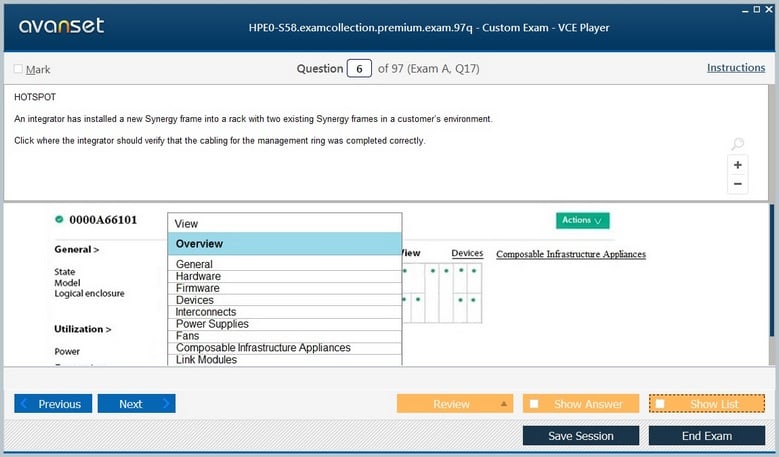
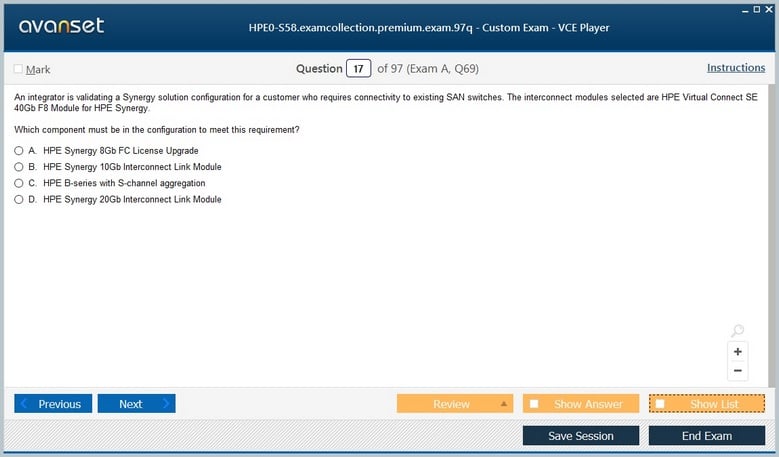
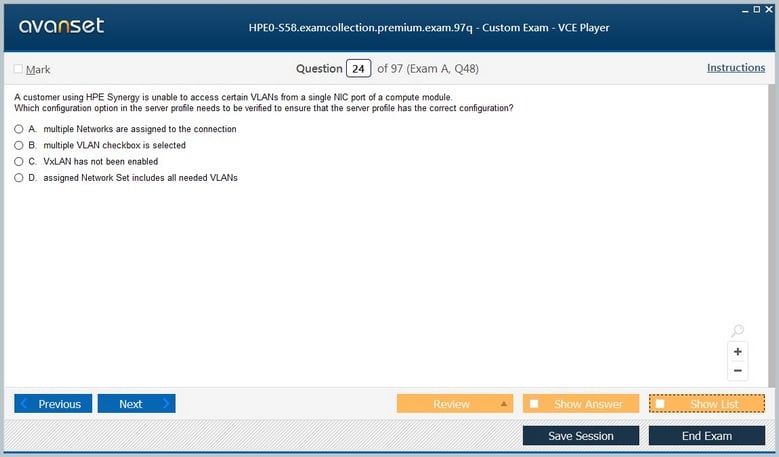
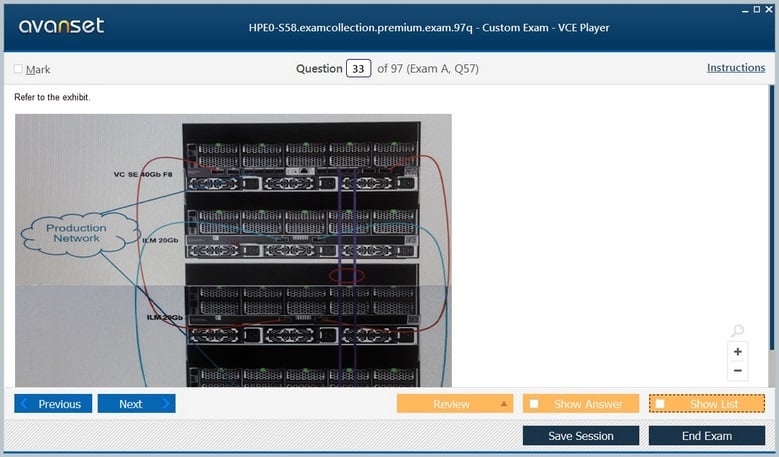
HP HPE0-S58 Practice Test Questions in VCE Format
| File | Votes | Size | Date |
|---|---|---|---|
File HP.test4prep.HPE0-S58.v2026-05-30.by.amina.38q.vce |
Votes 2 |
Size 1.44 MB |
Date May 30, 2026 |
File HP.Prep4sure.HPE0-S58.v2020-01-06.by.Ray.27q.vce |
Votes 3 |
Size 620.07 KB |
Date Jan 08, 2020 |
HP HPE0-S58 Practice Test Questions, Exam Dumps
HP HPE0-S58 (Implementing HPE Composable Infrastructure Solutions) exam dumps vce, practice test questions, study guide & video training course to study and pass quickly and easily. HP HPE0-S58 Implementing HPE Composable Infrastructure Solutions exam dumps & practice test questions and answers. You need avanset vce exam simulator in order to study the HP HPE0-S58 certification exam dumps & HP HPE0-S58 practice test questions in vce format.
HPE0-S58, Implementing HPE Composable Infrastructure Solutions, is an inactive HPE exam associated with the HPE ASE - Composable Infrastructure Integrator V1 path. HPE’s archived certification data now labels the exam inactive. The subject, however, captures an important stage in infrastructure operations: the shift from configuring individual servers as isolated devices toward managing pools of compute, fabric, firmware, and profiles as programmable infrastructure.
The central product context was HPE Synergy together with HPE OneView. Candidates were expected to understand frames, composers, interconnects, compute modules, logical enclosures, server profiles, firmware and image lifecycle, networking, storage connectivity, monitoring, troubleshooting, and automation. That made HPE0-S58 an implementation exam rather than a pure architecture exam.
For current readers, the right framing is historical but technical. The HPE certifications contains newer compute and management destinations, while the older Synergy-integrator exam records how composable infrastructure was actually deployed and operated. That distinction lets the page preserve the exam’s purpose without implying that HPE0-S58 remains schedulable.
Traditional server administration often starts with a physical server and configures it directly. Composable infrastructure reverses the emphasis. The administrator defines desired characteristics—firmware, connectivity, boot behavior, identity, BIOS settings, storage presentation, network mappings—and applies that intent through profiles and templates. Physical resources can then be associated with the required configuration in a repeatable way.
This changes the operational model. Consistency becomes an architectural property rather than a documentation goal. If multiple compute modules use the same approved template, the organization can reduce drift and make replacement or scaling more predictable. The implementation skill is therefore not merely knowing which screen to click; it is understanding which settings belong in reusable policy and which should remain instance-specific.
HPE0-S58 scenarios commonly make more sense when viewed through this lens. A candidate must understand the physical system, but many answers depend on how HPE OneView and Synergy Composer represent that physical system as managed resources.
HPE Synergy combines compute modules, frame infrastructure, management, and fabric connectivity. An integrator needs to understand how frames are discovered and grouped, how Composer provides the management plane, how interconnect modules provide network and storage connectivity, and how frame-linking and logical-enclosure concepts affect the design.
Hardware understanding matters because logical abstraction does not remove physical dependencies. Redundant management, power, cooling, fabrics, and uplinks still have to be cabled and validated correctly. A profile cannot compensate for an incorrectly installed interconnect or a missing redundant path. Strong implementation therefore moves back and forth between the physical and logical views of the same environment.
The approved blog article on the HPE ASE Synergy Solutions Integrator certification provides historical program context, but it should be read as a companion to the exam-era architecture rather than evidence that the old certification is still current.
Server profiles define how a compute module should behave. Depending on the generation and configuration, profiles can include connection settings, addresses, boot order, firmware baselines, BIOS options, local storage, SAN connectivity, and other hardware-level configuration. Templates make those settings reusable across groups of servers.
The operational benefit is speed, but the larger benefit is control. A profile makes the desired state explicit. That helps with replacement because the configuration can be reapplied to another compatible resource. It also helps with auditing because administrators can compare actual configuration with approved templates instead of reconstructing intent from many separate settings.
Good implementation practice still requires careful template design. If every server exception is added to a common template, the template becomes difficult to manage. If too little is standardized, the environment drifts. Candidates should understand which settings represent organizational policy and which are legitimately workload-specific.
OneView is central to the HPE0-S58 story because composable infrastructure depends on a management plane that understands hardware inventory, profiles, firmware, health, connectivity, and lifecycle. The current HPE OneView destination is a useful deeper link for the management concepts that outlived this particular exam.
Automation is especially important. A well-designed environment can use APIs or scripting to create consistent infrastructure workflows instead of relying on repetitive manual configuration. Automation does not remove the need for change control; it makes change repeatable. The integrator must understand authentication, scope, error handling, idempotent behavior where possible, and the risk of automating an incorrect assumption at scale.
Lifecycle management also includes firmware baselines. Compute modules and infrastructure components need compatible firmware, and updates must be planned around redundancy and application requirements. An integrator should know how to identify compliance, schedule changes, observe progress, and confirm health afterward.
HPE Synergy Image Streamer extended composability beyond hardware configuration toward the operating environment. Instead of treating every server’s local boot image as a separately managed artifact, organizations could use image-based deployment approaches that fit the broader goal of rapid, repeatable provisioning.
The implementation challenge is understanding dependencies. Network access, storage, image repositories, profile configuration, boot settings, and application expectations all have to align. A stateless approach can make recovery and scaling faster, but only if the organization also manages image lifecycle, versioning, testing, and rollback carefully.
For exam study, this topic illustrates a wider principle: composability is not one feature. It is a set of coordinated abstractions that move infrastructure state into controlled definitions. The more state that becomes reusable and policy-driven, the more important version control, validation, and governance become.
Composable systems simplify configuration, but the data path remains physical. Integrators need to understand uplinks, logical interconnects, VLANs, bandwidth, redundancy, Fibre Channel or Ethernet storage paths, SAN zoning dependencies, host mappings, and multipathing. A green status indicator in one management console does not prove that the host can reach every required service.
End-to-end validation follows the path. Start at the server profile, confirm the virtual or physical connection, verify the interconnect configuration, confirm upstream switching or SAN behavior, check storage presentation, and finally validate at the operating-system level. This layered method avoids random troubleshooting because every test narrows the possible fault domain.
Redundancy should also be tested, not assumed. Disconnecting or administratively disabling one path in a controlled test can reveal whether failover behaves as designed. The same principle applies to management and power dependencies where operational procedures allow safe validation.
One of the distinctive challenges in a profile-driven environment is determining whether a failure comes from the desired configuration, the management system, or the underlying hardware. A profile can be internally consistent and still fail because a physical component is degraded. Conversely, healthy hardware can fail to provide service because the profile contains an incorrect network, boot, or storage setting.
A disciplined troubleshooting sequence starts with symptoms and recent changes, then checks health at each layer. Review alerts, task history, profile compliance, interconnect status, firmware, cabling, upstream dependencies, and host behavior. Avoid changing several variables at once because that destroys evidence about the root cause.
Support workflows also matter. Generating appropriate support data, documenting the environment, recording firmware and software versions, and capturing the sequence of events can shorten escalation. HPE0-S58 was an integrator exam, so the candidate was expected to move beyond recognition and show operational judgment.
The old certification paired HPE0-S58 with OneView-related requirements and focused heavily on HPE Synergy. The modern HPE compute program is organized differently. HPE now distinguishes current compute architecture and integration roles more explicitly, and the approved inventory includes both Advanced HPE Compute Architect and Advanced HPE Compute Integrator Solutions.
That does not mean the new exams are direct replacements for every HPE0-S58 objective. Product scope, program structure, and role definitions have changed. The useful connection is professional: the old exam taught how to implement policy-driven compute infrastructure, while current integrator roles continue to require disciplined deployment, lifecycle management, automation, and troubleshooting across newer platforms.
Candidates interested in current certification should use current HPE exam requirements. Readers maintaining older Synergy environments can still use HPE0-S58-era concepts to understand why profiles, templates, lifecycle controls, and end-to-end validation were central to composable infrastructure operations.
Instead of memorizing an archived question bank, reconstruct the deployment sequence. Start with site and frame readiness, management connectivity, discovery, firmware and health baselines, logical enclosure and interconnect configuration, networks and storage, profile templates, server profiles, operating-environment deployment, validation, monitoring, and handoff. At each stage, identify what can fail and what evidence proves success.
Then practice changes after the initial build. Replace a compute module, update firmware, add a network, change a profile template, expand a frame, or troubleshoot a lost storage path. Production infrastructure is defined as much by safe change as by first installation.
HPE0-S58 is therefore best understood as a historical implementation exam for the HPE Synergy composable-infrastructure era. Its current value is not certification eligibility; it is the operational model it represents: define intent, automate consistently, understand the physical system beneath the abstraction, validate every path, and manage lifecycle changes without losing control of service.
Operational documentation should mirror the composable model. Record logical enclosures, interconnect relationships, profile templates, firmware baselines, networks, storage dependencies, and the intended ownership of changes. When a later administrator can see both the desired state and the physical dependency map, troubleshooting becomes faster and profile-driven automation becomes safer.
Change windows are another place where composability has to meet operational reality. A profile or firmware action may be quick to define, but the workload still needs an approved maintenance sequence, health checks, dependency awareness, and rollback criteria. Integrators should coordinate infrastructure automation with application owners so that a technically successful change does not become a service incident.
Go to testing centre with ease on our mind when you use HP HPE0-S58 vce exam dumps, practice test questions and answers. HP HPE0-S58 Implementing HPE Composable Infrastructure Solutions certification practice test questions and answers, study guide, exam dumps and video training course in vce format to help you study with ease. Prepare with confidence and study using HP HPE0-S58 exam dumps & practice test questions and answers vce from ExamCollection.
Purchase Individually

Top HP Certifications


Top HP Certification Exams
Site Search:

SPECIAL OFFER: GET 10% OFF

Pass your Exam with ExamCollection's PREMIUM files!
SPECIAL OFFER: GET 10% OFF
Use Discount Code:
MIN10OFF
A confirmation link was sent to your e-mail.
Please check your mailbox for a message from support@examcollection.com and follow the directions.

Download Free Demo of VCE Exam Simulator
Experience Avanset VCE Exam Simulator for yourself.
Simply submit your e-mail address below to get started with our interactive software demo of your free trial.