



Premium File
787 Q&A
$76.99$69.99
ASQ CMQ-OE Exam Questions & Answers, Accurate & Verified By IT Experts
Instant Download, Free Fast Updates, 99.6% Pass Rate

CMQ-OE Premium File: 787 Questions & Answers
Last Update: Oct 29, 2026
CMQ-OE PDF Study Guide: 150 Pages
$74.99
ASQ CMQ-OE Exam Screenshots
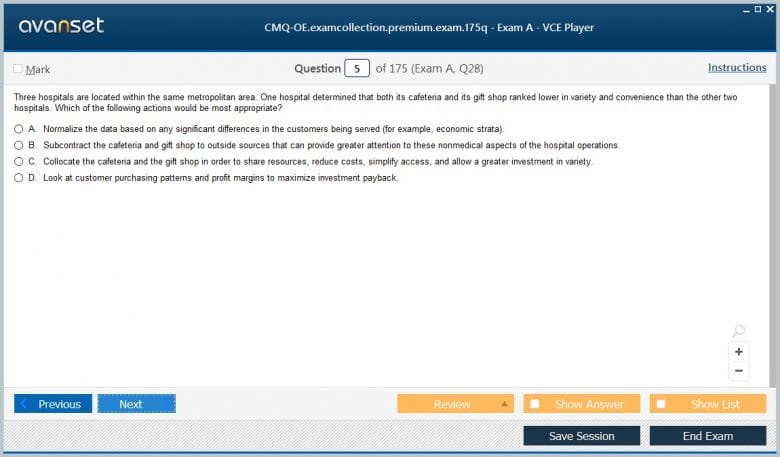
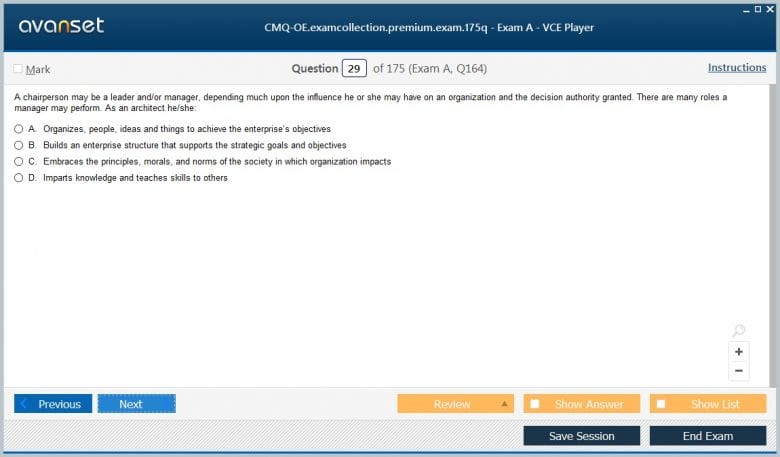
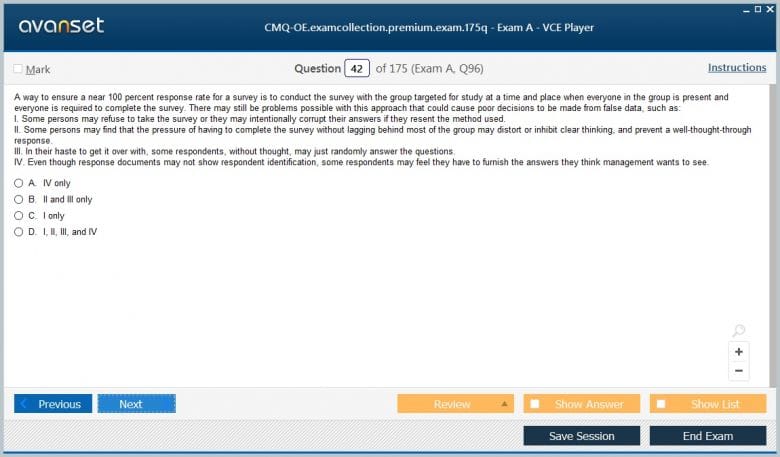
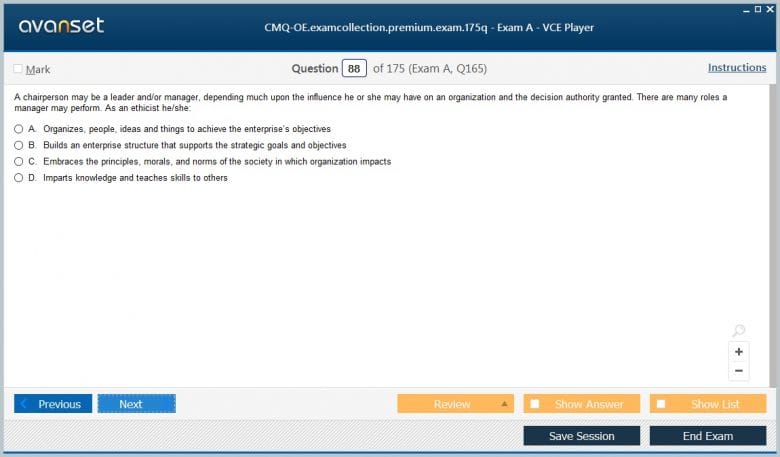
ASQ CMQ-OE Practice Test Questions in VCE Format
| File | Votes | Size | Date |
|---|---|---|---|
File ASQ.testking.CMQ-OE.v2026-08-25.by.harley.174q.vce |
Votes 1 |
Size 3 MB |
Date Aug 25, 2026 |
File ASQ.train4sure.CMQ-OE.v2022-01-03.by.leo.138q.vce |
Votes 1 |
Size 2.51 MB |
Date Jan 03, 2022 |
File ASQ.pass4sure.CMQ-OE.v2021-12-14.by.wangjing.102q.vce |
Votes 1 |
Size 123.2 KB |
Date Dec 14, 2021 |
File ASQ.Pass4sureexam.CMQ-OE.v2019-02-07.by.Andrew.95q.vce |
Votes 2 |
Size 114.65 KB |
Date Feb 10, 2019 |
ASQ CMQ-OE Practice Test Questions, Exam Dumps
ASQ CMQ-OE (Certified Manager of Quality/Organizational Excellence) exam dumps vce, practice test questions, study guide & video training course to study and pass quickly and easily. ASQ CMQ-OE Certified Manager of Quality/Organizational Excellence exam dumps & practice test questions and answers. You need avanset vce exam simulator in order to study the ASQ CMQ-OE certification exam dumps & ASQ CMQ-OE practice test questions in vce format.
ASQ's Certified Manager of Quality/Organizational Excellence credential is designed for professionals who lead improvement across an organization rather than optimize one technical process in isolation. CMQ/OE brings together strategy, customers, process management, people, finance, risk, knowledge, quality systems, and improvement methods. The central idea is that quality becomes sustainable only when leadership decisions, operating processes, measures, and culture reinforce one another.
The current computer-based CMQ/OE exam contains 180 questions, with 165 scored and 15 unscored, and an appointment of four hours and 18 minutes. ASQ treats it as open book. Eligibility normally requires ten years of full-time paid experience in relevant areas, including five years in a decision-making position, with education waivers available for part of the experience requirement. ASQ's 2026 Body of Knowledge became effective July 1, 2026, so candidates using older preparation materials should verify that their study plan maps to the current outline.
Within the wider ASQ certifications, CMQ/OE is distinctive because it asks managers to connect technical quality work to organizational outcomes. A Certified Quality Engineer may go deeply into process capability or reliability, while a CMQ/OE candidate must also decide which measures matter strategically, how resources should be allocated, how change should be led, and how competing stakeholder needs should be balanced.
Senior leaders influence quality through priorities, resource decisions, expectations, governance, and the behaviors they reward. A policy statement alone does not create a quality culture. Employees watch what happens when schedule conflicts with conformance, whether bad news is suppressed or examined, whether corrective actions receive resources, and whether leaders use data consistently. Quality becomes credible when management actions align with stated values.
Governance clarifies who has authority to make decisions and who is accountable for outcomes. Quality councils, management reviews, process owners, functional leaders, and project sponsors can all contribute, but overlapping committees can also obscure responsibility. Candidates should be able to distinguish oversight from execution and understand when an issue belongs at the process level versus when it represents an enterprise risk requiring executive attention.
Ethics and organizational integrity are part of leadership because measurement systems can be distorted by pressure. If employees are rewarded only for output, they may hide defects. If customer complaints are treated as an embarrassment, valuable signals disappear. Leaders need measures that encourage the desired behavior and mechanisms that allow concerns to surface without retaliation. Sound quality management depends on trustworthy information.
Strategic planning connects the organization's mission and environment to a manageable set of objectives. Quality leaders may contribute through environmental scans, stakeholder analysis, risk assessment, benchmarking, customer data, process performance, and lessons learned. The objective is not to produce a large plan; it is to make choices about where the organization will compete, what capabilities it must develop, and which outcomes need sustained attention.
Deployment matters as much as formulation. Broad goals such as improve customer experience or reduce operational risk must become specific measures, initiatives, ownership, and review cycles. Hoshin-style deployment, balanced measurement systems, policy deployment, project portfolios, and ordinary management reviews can all serve this purpose when used coherently. A strategy that does not change resource allocation or operating behavior is mostly a communication exercise.
Candidates should also understand the difference between leading and lagging indicators. Revenue, warranty cost, customer loss, and defect escapes may show what has already happened. Process capability, response time, preventive-maintenance completion, training effectiveness, or supplier-risk indicators may provide earlier signals. The strongest management system uses both, with clear understanding of what each measure can and cannot predict.
Voice-of-customer work goes beyond collecting satisfaction scores. Organizations need to identify customer segments, understand explicit and latent needs, translate those needs into requirements, and measure whether processes deliver the expected value. Interviews, surveys, complaint analysis, journey mapping, warranty data, observation, market research, and frontline feedback can all contribute different evidence.
Stakeholders may have competing requirements. Customers may seek speed and customization, regulators may require controls, investors may focus on sustainable performance, employees may need safe and workable processes, and suppliers may need stable forecasts. Quality leadership involves making tradeoffs visible rather than pretending every objective can be maximized simultaneously. The best decision is the one aligned with strategy, obligations, risk tolerance, and evidence.
Customer complaints deserve particular attention because they are both service events and process signals. Rapid resolution can restore confidence, but management should also determine whether the complaint reveals a systemic weakness. Trend analysis, escalation criteria, root-cause review, and closed-loop corrective action prevent organizations from repeatedly resolving symptoms while leaving the underlying process unchanged.
Most customer outcomes cross departmental boundaries. An order may involve sales, credit, planning, procurement, operations, logistics, invoicing, and service. Optimizing each function independently can still produce a poor end-to-end result. Process management identifies the sequence that creates value, assigns ownership, defines inputs and outputs, establishes controls, and measures performance across those boundaries.
Process maps, SIPOC diagrams, value-stream views, responsibility matrices, standard work, control plans, and dashboards are useful only when they support decisions. A process owner should know what good performance looks like, which risks threaten it, what variation is normal, and when escalation is required. The manager should also distinguish chronic systemic problems from isolated special causes so improvement resources are not wasted.
More analytical process work may overlap with Six Sigma Black Belt methods, but CMQ/OE stays broader. A leader must decide which improvement approach fits the problem, ensure projects align with strategy, remove organizational barriers, and sustain the results after the project team disbands. Technique selection is part of management judgment.
Quality initiatives often fail because technical solutions ignore how people experience the change. Roles, workload, incentives, skills, identity, informal influence, communication, and trust all affect adoption. Change leadership should therefore identify stakeholders, anticipate resistance, communicate the reason for change, involve affected people appropriately, develop capability, and reinforce desired behavior after implementation.
Teams also require structure. Sponsors set direction and remove barriers; leaders coordinate work; facilitators support process; subject-matter experts provide technical depth; and members contribute operational knowledge. Effective teams clarify scope, decision rights, deliverables, and norms. Conflict is not automatically bad. Task conflict can improve decisions when evidence is considered respectfully; unresolved personal conflict can damage trust and execution.
Training should be evaluated by performance, not attendance. A completed course does not prove that employees can apply a new method. Competency assessment, supervised practice, qualification, coaching, observation, error trends, and outcome measures can show whether learning transferred to the job. Quality leaders should connect development plans to future capability needs rather than treating training as an annual compliance event.
Quality leaders need enough financial understanding to frame improvement in business terms. Cost of poor quality can include scrap, rework, warranty, returns, expedites, complaint handling, downtime, concessions, lost capacity, and customer loss. Prevention and appraisal activities also cost money, so the aim is not zero spending on quality. It is an economically sensible balance that reduces failure and protects value.
Business cases may use return on investment, payback period, net present value, cost-benefit analysis, opportunity cost, or capacity impact. Candidates should understand what these measures communicate and their limitations. A project with modest direct savings may still be essential because it reduces regulatory or safety risk. Conversely, a large theoretical saving is weak if assumptions are unrealistic or the organization cannot realize the released capacity.
Budgeting and resource allocation also test strategic alignment. If an organization identifies customer data integrity as a major risk but funds only cosmetic improvement projects, the portfolio contradicts the strategy. CMQ/OE candidates should be prepared to prioritize initiatives based on value, risk, feasibility, dependency, capability, and timing rather than selecting projects solely because their metrics are easy to calculate.
Risk management helps leaders decide where additional control, contingency, or monitoring is justified. Risk registers can be useful, but only if they influence action. Effective practice identifies uncertainty, analyzes likelihood and consequence, assigns ownership, selects responses, monitors triggers, and revises treatment as conditions change. Quality risks often emerge through suppliers, technology, skills, regulation, process change, or weak information.
Knowledge management addresses a related problem: organizations can lose capability when expertise remains tacit or concentrated in a few people. Standard work, lessons learned, communities of practice, mentoring, repositories, succession planning, after-action reviews, and controlled documentation can preserve useful knowledge. The challenge is not storing more information. It is making validated knowledge accessible at the point where people need it.
Audits can provide another layer of assurance by testing whether the management system works as intended. The evidence discipline emphasized by the Certified Quality Auditor is relevant, but leaders should not use audits only to find nonconformities. Audit results, trends, corrective-action effectiveness, and systemic observations can inform strategic reviews and risk priorities.
Organizations can use PDCA, DMAIC, kaizen, breakthrough projects, redesign, benchmarking, mistake proofing, theory of constraints, or other approaches depending on the problem. Candidates should understand that no method is universally best. A stable process with a narrow performance gap may need incremental optimization; a fundamentally broken service model may require redesign; a severe special cause may require immediate containment before any long-term improvement work.
Measurement should support learning. Operational definitions, trustworthy data, baselines, control limits, capability measures, customer outcomes, and financial results help teams determine whether change produced a real improvement. Leaders should be wary of vanity metrics and short-term gains created by moving work elsewhere in the system. Sustainable improvement must be demonstrated where the customer and organization actually experience the result.
Standardization and control are often the neglected final steps. Updated procedures, system changes, ownership transfer, training, visual controls, dashboards, audit checks, and response plans help preserve gains. If the process reverts after the project team leaves, the organization completed an activity but did not improve its management system.
CMQ/OE preparation is strongest when candidates practice with leadership scenarios rather than memorizing isolated definitions. Given declining customer retention, what evidence should be gathered before launching projects? If two functions optimize conflicting metrics, what process-level measure would align them? If an improvement project produces savings but increases regulatory risk, how should leadership respond? These questions test integration across the body of knowledge.
Because the exam is open book, references should be organized and familiar, but searching cannot replace comprehension. The 2026 Body of Knowledge is the controlling map for study. Candidates should compare every older course or handbook to that outline and close any gaps created by the July 2026 revision. Particular attention should go to areas that experienced technical specialists may have encountered less often, such as finance, strategy, organizational design, and change leadership.
CMQ/OE represents the point where quality stops being a department and becomes a management system. The credential rewards professionals who can connect purpose, customers, processes, people, measures, risk, and improvement into one coherent operating model. That systems view is the core of both the exam and the organizational excellence work it is meant to support.
Go to testing centre with ease on our mind when you use ASQ CMQ-OE vce exam dumps, practice test questions and answers. ASQ CMQ-OE Certified Manager of Quality/Organizational Excellence certification practice test questions and answers, study guide, exam dumps and video training course in vce format to help you study with ease. Prepare with confidence and study using ASQ CMQ-OE exam dumps & practice test questions and answers vce from ExamCollection.
Purchase Individually

Site Search:

SPECIAL OFFER: GET 10% OFF

Pass your Exam with ExamCollection's PREMIUM files!
SPECIAL OFFER: GET 10% OFF
Use Discount Code:
MIN10OFF
A confirmation link was sent to your e-mail.
Please check your mailbox for a message from support@examcollection.com and follow the directions.

Download Free Demo of VCE Exam Simulator
Experience Avanset VCE Exam Simulator for yourself.
Simply submit your e-mail address below to get started with our interactive software demo of your free trial.