



Premium File
57 Q&A
$76.99$69.99
VMware 3V0-42.20 Exam Questions & Answers, Accurate & Verified By IT Experts
Instant Download, Free Fast Updates, 99.6% Pass Rate
57 Questions & Answers
Last Update: Sep 03, 2026
$69.99
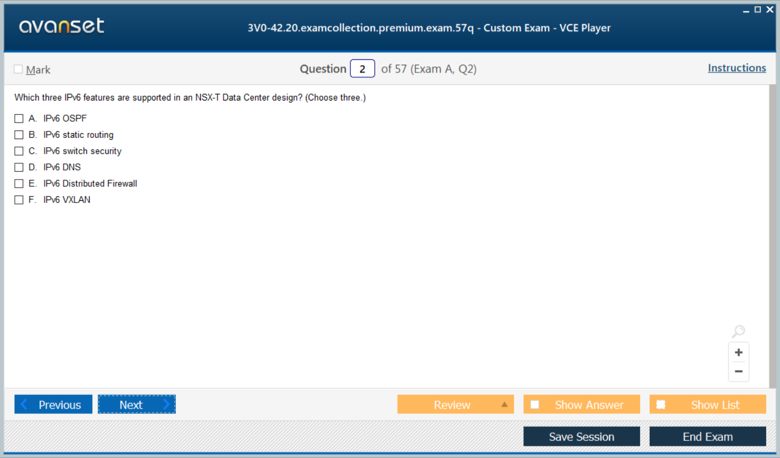
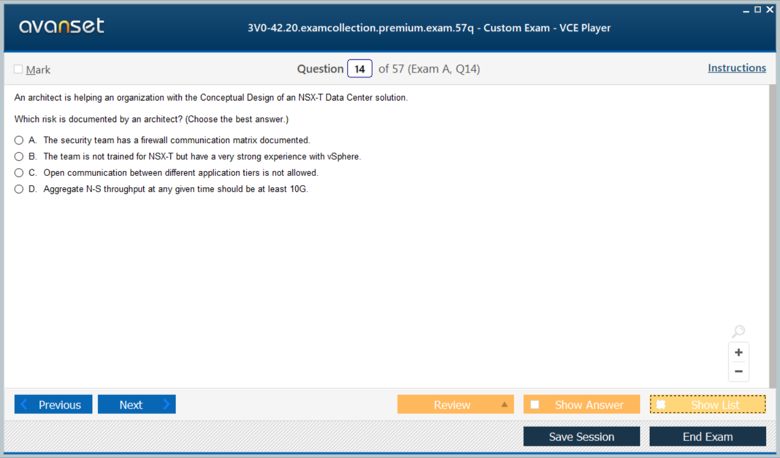
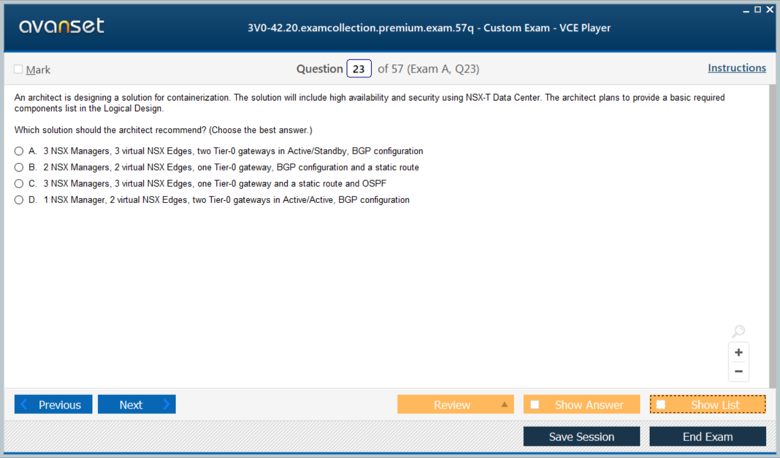
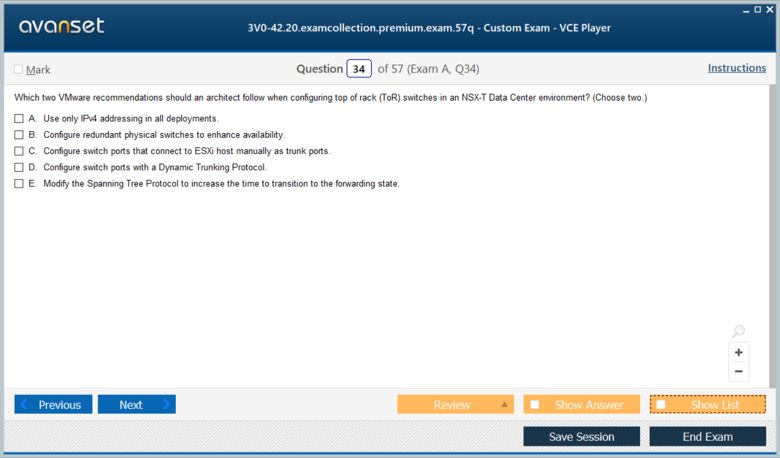
VMware 3V0-42.20 Exam Screenshots
VMware 3V0-42.20 Practice Test Questions in VCE Format
| File | Votes | Size | Date |
|---|---|---|---|
File VMware.test-inside.3V0-42.20.v2026-08-17.by.darcey.36q.vce |
Votes 1 |
Size 386.79 KB |
Date Aug 17, 2026 |
File VMware.passguide.3V0-42.20.v2020-12-09.by.wangtao.25q.vce |
Votes 1 |
Size 343.31 KB |
Date Dec 09, 2020 |
VMware 3V0-42.20 Practice Test Questions, Exam Dumps
VMware 3V0-42.20 (Advanced Design VMware NSX-T Data Center) exam dumps vce, practice test questions, study guide & video training course to study and pass quickly and easily. VMware 3V0-42.20 Advanced Design VMware NSX-T Data Center exam dumps & practice test questions and answers. You need avanset vce exam simulator in order to study the VMware 3V0-42.20 certification exam dumps & VMware 3V0-42.20 practice test questions in vce format.
The Advanced Design VMware NSX-T Data Center (3V0-42-20) exam tested the architecture skills behind the VMware Certified Advanced Professional Network Virtualization Design track. Broadcom's retired-exam material records this exam as retired, and its historical guide described an advanced design assessment for NSX-T Data Center 3.0. It should therefore be presented as a legacy design credential rather than as a current exam.
Its design method remains useful because network virtualization still requires architects to turn business needs into a logical and physical system. Candidates had to reason about transport infrastructure, edge capacity, routing, security, availability, manageability, and integration—not simply identify NSX features. Good preparation reconstructs that design thinking and keeps it separate from today's VMware Cloud Foundation networking certification.
Network architecture can fail before a diagram is drawn if the inputs are poorly classified. A requirement is something the solution must achieve, a constraint limits the choices, an assumption is accepted until it can be validated, and a risk describes uncertainty that may harm the outcome. For example, “use the existing border routers” is a constraint, while “the border routers have enough route scale” is an assumption that should be tested.
Turn broad statements into measurable criteria. Availability should define tolerated outage and failure domains. Security should identify segmentation boundaries, administrative trust, logging, and external exposure. Performance should include throughput, latency sensitivity, east-west and north-south patterns, and growth. Once requirements are measurable, design choices can be traced back to them instead of being justified by product preference.
Overlay networks simplify workload mobility, but they depend on a stable IP underlay. Design transport zones, TEP addressing, uplink profiles, teaming, MTU, host connectivity, and edge attachment with the physical network in mind. Decide where VLAN-backed connectivity is required and where overlays are appropriate. The underlay should provide predictable reachability without being forced to learn every tenant workload route.
Failure-domain analysis is essential. Avoid designs in which redundant edge nodes, uplinks, or managers depend on the same switch, rack, power domain, or routed path. Document which failure each redundant component is intended to survive. Redundancy that shares the same hidden dependency can make a diagram look resilient while providing little real protection.
Tier-0 and Tier-1 gateways provide a way to separate provider connectivity, tenant routing, and services. Decide how many gateways are required, which services are centralized, how routes are advertised, and how workloads reach external networks. A large environment may need multiple gateways for scale, administration, tenancy, or failure isolation, while a smaller design may gain more from simplicity.
Trace representative packet flows before finalizing the topology. Include east-west traffic within an application, traffic between segments, north-south internet or data-center traffic, shared services, and management flows. If a design forces high-volume local traffic through an unnecessary edge hop, or makes stateful services asymmetric during failure, the topology should be reconsidered before implementation.
Edge nodes host routing adjacencies and centralized services, so their design must account for CPU, memory, throughput, interface count, service mix, and physical placement. Size for the surviving state, not only normal operation. If one node fails, its peer may inherit routing, NAT, VPN, load-balancing, or other work while also handling reconvergence.
Plan maintenance in the same way. An architecture that survives an unexpected node failure but cannot tolerate a planned upgrade without congestion is not operationally complete. Define how edges are drained, how upstream devices respond, which services are stateful, and what monitoring confirms the user path after failover.
Dynamic routing decisions should explain why BGP or another mechanism is used, where adjacencies terminate, which prefixes are originated, how routes are filtered, and what convergence behavior is acceptable. Route scale and administrative boundaries can matter as much as simple reachability. Advertising every tenant prefix everywhere may work in a lab but create unnecessary coupling in a production network.
Stateful services make symmetric behavior important. Model both directions of representative flows and identify where NAT, firewalling, or load balancing maintains state. Consider link, edge, or peer failure and verify that the new path still passes through the required service context. A routing design is incomplete if it explains only the forward direction under healthy conditions.
Distributed firewall policy is most effective when groups and rules reflect workloads, tiers, environments, or business roles rather than a brittle collection of IP addresses. Design the source of group membership, the tagging model, policy ownership, default behavior, exceptions, and logging. Dynamic grouping adds flexibility but also creates dependencies on accurate inventory and automation.
Policy lifecycle matters. Decide how new applications obtain rules, who reviews exceptions, how unused access is removed, and how emergency changes are audited. Include management, backup, monitoring, DNS, identity, and other shared services in the communication model. Security that protects an application while breaking its operational dependencies is not a successful design.
An NSX design must include the management cluster, identity, DNS, NTP, certificate trust, backup, log collection, monitoring, and access controls that keep the system operable. Determine where managers reside, how administrators reach them, what happens if a management host fails, and how configuration can be restored. Management services should not depend on the same network path they are expected to repair without an alternate access strategy.
Observability should cover both control-plane health and traffic behavior. Define which alarms, route states, interface counters, firewall events, flow records, and capacity signals matter. Decide where logs are retained and who can correlate network events with virtualization or application incidents. A well-designed virtual network is diagnosable; operators should not need to guess which component handled a packet.
NSX makes sophisticated designs possible, but every additional gateway, zone, routing policy, security group, and integration increases operational cost. Prefer the simplest architecture that meets requirements and scale. Complexity should buy a specific benefit such as isolation, performance, availability, or delegated control. If two designs satisfy the same requirement, the one that is easier to explain, monitor, upgrade, and recover is often stronger.
Document naming, ownership, standard patterns, change boundaries, and lifecycle procedures as part of the design. These decisions reduce variation and shorten troubleshooting later. The architecture should remain understandable to the operators who inherit it after the original project team leaves.
The deployment counterpart, Advanced Deploy VMware NSX-T Data Center 3.x, focused on implementation and troubleshooting rather than architecture. Broadcom still lists NSX 4.x Professional V2 under VMware Legacy Certifications, while the current advanced specialization is VMware Cloud Foundation Networking.
Those relationships are useful only when the eras stay explicit. The VMware certifications inventory can help candidates separate old and current codes. For 3V0-42-20, the most valuable preparation is to work through design scenarios and defend each choice in terms of requirements, risks, failure behavior, security, scale, and operations. That preserves the exam's architectural lessons without implying that the retired code is still available.
Address-management architecture should be included early rather than left to implementation. Define provider and tenant address spaces, TEP pools, service addresses, external uplinks, NAT requirements, and how IP allocation is coordinated with existing enterprise systems. Overlap may be intentional in isolated tenant environments, but the design must explain where translation or routing boundaries resolve it. Address planning is especially important when automation will create networks without a human reviewing every request.
Designers should also model migration and coexistence. Real environments rarely move from a legacy network to NSX-T in one event. Identify which workloads remain on VLANs, which move to overlays, how routing connects old and new domains, and how security policy is preserved during transition. A staged design needs rollback points and clear ownership so that temporary bridges do not become undocumented permanent dependencies.
Performance testing should reflect the services that traffic actually uses. Distributed east-west routing, north-south edge forwarding, stateful firewalling, load balancing, encryption, and overlay encapsulation have different resource paths. Define representative flows and expected throughput rather than relying only on aggregate platform specifications. This makes capacity decisions defensible and gives operations a baseline for identifying degradation later.
Finally, architecture documentation should identify which choices are standards and which are exceptions. If one tenant requires a unique gateway topology or a nonstandard routing policy, explain the requirement and operational cost. Exceptions that are not recorded tend to multiply, making upgrades and incident response harder. A mature design keeps the default pattern simple and makes deviations visible.
Certificate, DNS, and time-service dependencies deserve explicit treatment in a design because they support manager clustering, API clients, authentication, and integrations. Place these services so that a network incident does not remove the tools required to manage the incident. Define certificate ownership and renewal before expiry becomes an outage. The same principle applies to backups: specify repository reachability, retention, encryption, and a tested restore process instead of merely checking a backup box.
Multi-tenancy needs both technical and administrative boundaries. Decide whether tenants share gateways, edge clusters, transport zones, security policy ownership, and monitoring. Shared components improve efficiency but increase the number of consumers affected by one change. Dedicated components improve isolation but consume more capacity and operational effort. The design should explain which boundary is justified by risk, scale, or delegated administration rather than applying one model everywhere.
Go to testing centre with ease on our mind when you use VMware 3V0-42.20 vce exam dumps, practice test questions and answers. VMware 3V0-42.20 Advanced Design VMware NSX-T Data Center certification practice test questions and answers, study guide, exam dumps and video training course in vce format to help you study with ease. Prepare with confidence and study using VMware 3V0-42.20 exam dumps & practice test questions and answers vce from ExamCollection.
Purchase Individually
Top VMware Certifications




Top VMware Certification Exams
Site Search:

SPECIAL OFFER: GET 10% OFF

Pass your Exam with ExamCollection's PREMIUM files!
SPECIAL OFFER: GET 10% OFF
Use Discount Code:
MIN10OFF
A confirmation link was sent to your e-mail.
Please check your mailbox for a message from support@examcollection.com and follow the directions.

Download Free Demo of VCE Exam Simulator
Experience Avanset VCE Exam Simulator for yourself.
Simply submit your e-mail address below to get started with our interactive software demo of your free trial.