



Premium File
172 Q&A
$76.99$69.99
CIW 1D0-610 Exam Questions & Answers, Accurate & Verified By IT Experts
Instant Download, Free Fast Updates, 99.6% Pass Rate
172 Questions & Answers
Last Update: Sep 27, 2026
$69.99
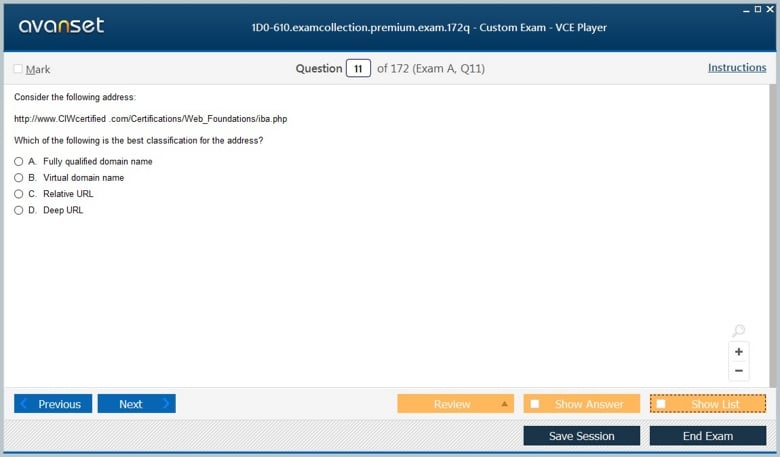
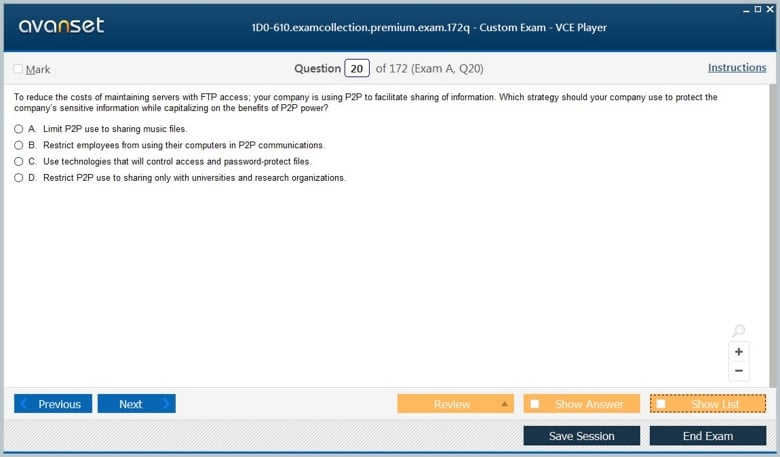
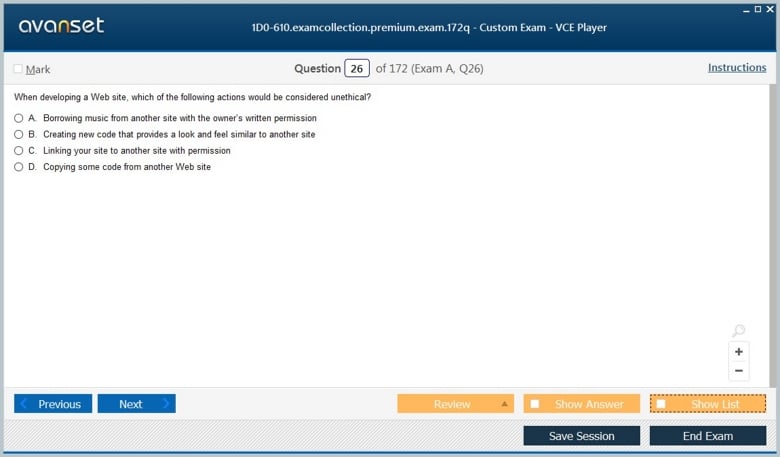
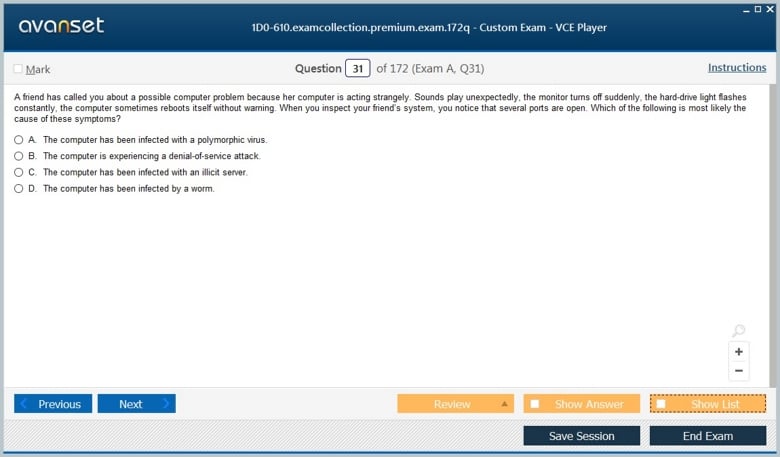
CIW 1D0-610 Exam Screenshots
CIW 1D0-610 Practice Test Questions in VCE Format
| File | Votes | Size | Date |
|---|---|---|---|
File CIW.ExamCollection.1D0-610.v2024-11-01.by.Anon.172q.vce |
Votes 16 |
Size 757.41 KB |
Date Nov 02, 2024 |
CIW 1D0-610 Practice Test Questions, Exam Dumps
CIW 1D0-610 (CIW Web Foundations Associate) exam dumps vce, practice test questions, study guide & video training course to study and pass quickly and easily. CIW 1D0-610 CIW Web Foundations Associate exam dumps & practice test questions and answers. You need avanset vce exam simulator in order to study the CIW 1D0-610 certification exam dumps & CIW 1D0-610 practice test questions in vce format.
CIW still lists 1D0-610 Web Foundations Associate as an active exam in 2026. CIW lists it as a live certification with a three-year validity period, and the official objectives show why the word “foundations” matters: the exam is not a narrow HTML test or a basic networking quiz. It combines Internet business, site development, networking, security, databases, project concepts, and the practical vocabulary needed to work around web systems.
That breadth makes 1D0-610 most useful when it is treated as an integration exam. A learner should be able to explain how a browser reaches a site, how DNS and network services make that possible, how HTML and CSS shape what the user sees, how data and security affect the application behind the page, and how business requirements influence the finished service. The wider CIW certification portfolio separates many of those subjects into more focused exams, but 1D0-610 deliberately brings them together.
The current Web Foundations Associate can also be understood through its three component areas. 1D0-61A Internet Business Associate, 1D0-61B Site Development Associate, and 1D0-61C Network Technology Associate each go deeper into a portion of the same foundation. Studying those relationships is more useful than memorizing an isolated list of terms because it reveals how the subjects interact in real systems.
A web professional does not need to be a carrier-network engineer, but the person should know what happens between a user action and an Internet service. That includes the roles of clients and servers, common protocols, addresses, names, ports, browsers, e-mail systems, file-transfer services, and the infrastructure required to establish connectivity. The exam expects candidates to recognize these pieces and describe their practical purpose rather than merely expand acronyms.
DNS is a good example. A user normally thinks in domain names, while network communication ultimately depends on addresses. The Domain Name System creates the naming layer that lets applications resolve human-readable names to the systems that provide a service. A deeper look at DNS analysis and resolution can help learners see that name resolution is not an abstract definition; it is observable infrastructure with records, queries, caching behavior, and failure modes.
Protocol knowledge should be similarly functional. HTTP and HTTPS describe application communication for the web, while the broader TCP/IP stack provides transport and internetworking behavior. The discussion of TCP/IP architecture is useful context because it shows why layered networking remains important even when users interact only with a browser interface.
The business portion of Web Foundations covers more than online shopping. Candidates should understand how organizations use Internet services for communication, research, collaboration, customer interaction, information sharing, and commerce. They should also recognize common IT roles and the way technical work connects with business objectives.
Search engines, social platforms, web-based communication, and personal information management tools are valuable because they help people find, organize, and exchange information. Their usefulness also creates governance questions. Employees need to distinguish professional use from risky behavior, understand that public posting can affect reputation, and recognize that data shared with online services may persist outside the organization’s direct control.
Project and program management concepts appear in the objectives because web work happens through organized delivery, not just individual technical activity. Scope, schedule, dependencies, stakeholders, risk, and communication affect whether a technically sound site solves the intended problem. The principles in enterprise project management provide a broader view of how technical tasks fit into coordinated business outcomes.
The site-development portion requires candidates to understand the building blocks of web pages. HTML provides document structure and semantics. CSS controls presentation and layout. Hyperlinks connect resources. Forms collect input. Images, audio, and video add media. The important skill is knowing why each mechanism exists and how they cooperate, not treating a page as one undifferentiated block of code.
Semantic markup is especially important because the same document may be consumed by browsers, assistive technology, search engines, automated tools, and mobile devices. Choosing headings for hierarchy, labels for form controls, and meaningful elements for document structure improves maintainability as well as usability. The article on moving beyond “just” HTML and CSS skills is a useful reminder that these fundamentals remain part of a larger professional toolkit.
Candidates should also understand that modern web development is iterative. A page may begin as a prototype, but production work adds validation, accessibility, responsive behavior, performance constraints, security controls, analytics, content processes, and deployment procedures. Foundations are valuable precisely because they make those later layers easier to reason about.
The networking portion of 1D0-610 covers hardware, transmission media, topologies, addressing, routing, wireless networking, cloud concepts, mobile devices, troubleshooting, and security. This is enough to explain why “the website is down” can describe very different failures. The local device may lack connectivity, DNS may fail, routing may be broken, a firewall may block traffic, the server may be unavailable, or the application itself may be returning an error.
Layered troubleshooting is therefore more useful than random experimentation. Candidates should first determine whether the problem is local or remote, then identify whether addressing and name resolution work, then test the relevant service. The same mental model supports security: a control placed at one layer does not eliminate threats at another.
Firewalls illustrate this point. They can enforce network policy, but they do not make an unsafe application safe. The overview of stateful and stateless firewall behavior helps connect a foundational control to the traffic decisions that occur before a browser request reaches an application.
CIW includes security throughout the objectives rather than treating it as a completely separate discipline. Browsers accept content from remote systems. E-mail carries links and attachments. Networks transport information across shared infrastructure. Applications receive user input. Each of those normal functions creates opportunities for abuse when trust is misplaced or data is handled carelessly.
Candidates should know the purpose of certificates, encryption, authentication, malware defenses, firewalls, updates, safe browsing practices, and privacy controls. They should also understand that a security feature has a defined scope. HTTPS protects a transport session; it does not guarantee that the site itself is trustworthy. A firewall can restrict connections; it does not validate every application transaction.
Ethical and legal issues matter as well. IT professionals often have elevated access or technical ability that could be misused. Responsible practice includes respecting authorization boundaries, protecting confidential information, following acceptable-use policies, and escalating suspected incidents through appropriate channels.
Web Foundations includes essential database concepts because dynamic sites depend on structured data. Candidates should recognize tables, rows, fields, keys, relationships, queries, and the general distinction between a database and the application that uses it. A form may collect customer information, for example, but the application must validate that input before storing it in a controlled data structure.
The relationship becomes clearer when compared with the current CIW 1D0-541 Database Design Specialist. That exam goes much deeper into relational design, normalization, SQL, transactions, concurrency, and security. For 1D0-610, the objective is not advanced database administration; it is knowing enough to understand how data storage participates in a web solution.
This distinction prevents a common learning error. A beginner may memorize SQL commands without understanding where a database fits in the request-response path. Web Foundations is stronger when the learner can describe the whole flow: a user submits information, the application validates it, database operations store or retrieve records, and a response is generated for the client.
The objectives also introduce proprietary and open-source development models, software tools, career planning, and communication with nontechnical audiences. These topics matter because technology work rarely happens in isolation from licensing, organizational policy, procurement, documentation, and collaboration.
Open source does not mean “no rules.” Projects use licenses that define how software may be used, modified, and redistributed. Proprietary software may offer commercial support or tightly controlled integration. A web professional should be able to discuss tradeoffs without assuming that one model is always superior.
Communication is equally important. Explaining a DNS failure to an executive requires different language from documenting it for a network engineer. The technical facts should remain accurate, but the level of detail and the decision being supported change. That ability to translate between technical and business concerns is one of the most transferable skills in the entire foundation curriculum.
A practical study plan can rotate through the three major foundation areas while repeatedly connecting them. Build a simple web page, inspect its HTML and CSS, publish it to a test environment, resolve its name, trace its network path, examine browser developer tools, submit a form, and identify where security controls apply. One small project can make dozens of terms concrete.
Use the official objectives as a coverage checklist, but turn each item into an explanation or demonstration. If the objective mentions DNS, be able to describe a lookup. If it mentions browsers and cookies, inspect cookie settings. If it mentions addressing, identify the local address and default gateway. If it mentions databases, sketch a small table relationship. Active practice exposes weak understanding more quickly than rereading.
The broader background article on CIW credentials can help place the exam in the vendor’s larger program, but candidates should use CIW’s live objectives and exam page as the authoritative boundary for preparation. The strongest outcome from 1D0-610 is not a collection of disconnected definitions. It is a working mental model of how Internet services, websites, networks, data, security, and business requirements fit together.
Go to testing centre with ease on our mind when you use CIW 1D0-610 vce exam dumps, practice test questions and answers. CIW 1D0-610 CIW Web Foundations Associate certification practice test questions and answers, study guide, exam dumps and video training course in vce format to help you study with ease. Prepare with confidence and study using CIW 1D0-610 exam dumps & practice test questions and answers vce from ExamCollection.
Purchase Individually
Site Search:

SPECIAL OFFER: GET 10% OFF

Pass your Exam with ExamCollection's PREMIUM files!
SPECIAL OFFER: GET 10% OFF
Use Discount Code:
MIN10OFF
A confirmation link was sent to your e-mail.
Please check your mailbox for a message from support@examcollection.com and follow the directions.

Download Free Demo of VCE Exam Simulator
Experience Avanset VCE Exam Simulator for yourself.
Simply submit your e-mail address below to get started with our interactive software demo of your free trial.