



Premium File
57 Q&A
$76.99$69.99
CIW 1D0-61A Exam Questions & Answers, Accurate & Verified By IT Experts
Instant Download, Free Fast Updates, 99.6% Pass Rate
57 Questions & Answers
Last Update: Oct 26, 2026
$69.99
CIW 1D0-61A Exam Screenshots
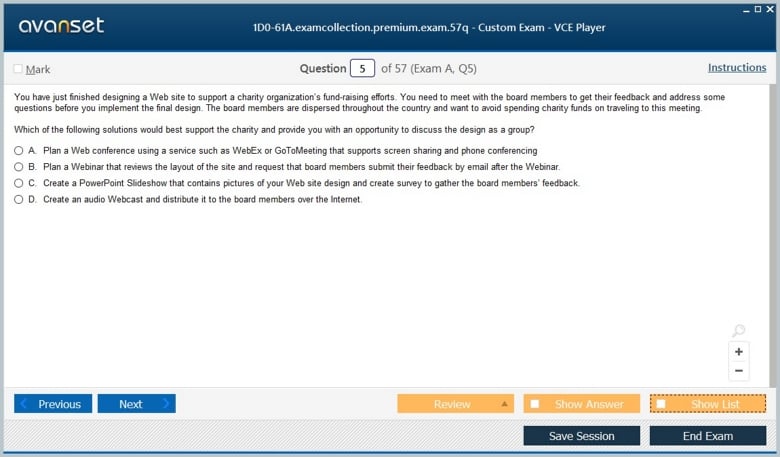
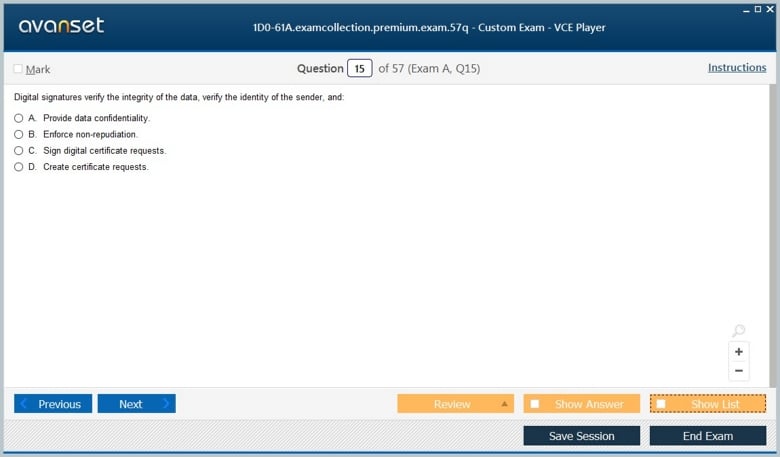
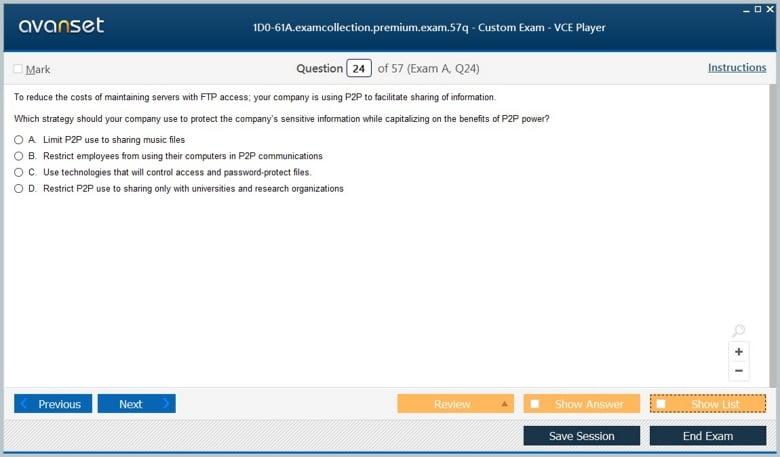
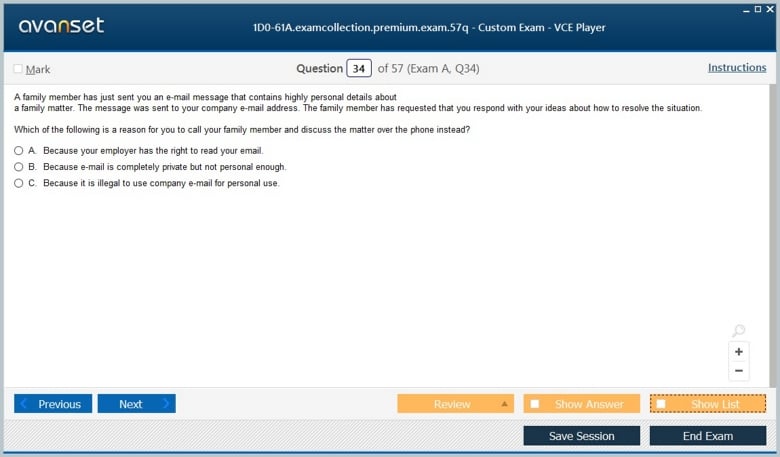
CIW 1D0-61A Practice Test Questions in VCE Format
| File | Votes | Size | Date |
|---|---|---|---|
File CIW.testkings.1D0-61A.v2026-05-23.by.zhanglei.22q.vce |
Votes 1 |
Size 31.93 KB |
Date May 22, 2026 |
CIW 1D0-61A Practice Test Questions, Exam Dumps
CIW 1D0-61A (CIW Internet Business Associate) exam dumps vce, practice test questions, study guide & video training course to study and pass quickly and easily. CIW 1D0-61A CIW Internet Business Associate exam dumps & practice test questions and answers. You need avanset vce exam simulator in order to study the CIW 1D0-61A certification exam dumps & CIW 1D0-61A practice test questions in vce format.
As of 2026, CIW continues to offer 1D0-61A Internet Business Associate as a live Web Foundations exam. CIW’s live course and exam information places it in the Web Foundations series and focuses on the business-facing Internet knowledge that almost every technology role uses: Internet communication, browsers, search, databases, e-mail, privacy, security, collaboration tools, software-development concepts, and project management.
The exam is easy to underestimate because many of its subjects are familiar from everyday Internet use. Familiarity, however, is not the same as professional understanding. A candidate may use a browser every day without knowing how cookies affect privacy, send e-mail without understanding message risks, or rely on search engines without evaluating source quality. 1D0-61A turns common tools into explicit professional knowledge.
Within CIW certifications, the exam forms one of the building blocks behind the broader 1D0-610 Web Foundations Associate. Its neighbors, 1D0-61B Site Development Associate and 1D0-61C Network Technology Associate, cover how web content is built and how network services deliver it. 1D0-61A concentrates on how people and organizations use those capabilities productively and safely.
The Internet is not one application. It is an infrastructure that supports the web, e-mail, messaging, file transfer, collaboration, streaming, cloud services, remote access, and many other forms of communication. Candidates should know that these services may use different protocols and architectures even when they appear through a single browser interface.
That distinction is useful when troubleshooting or evaluating a service. A user may have general network connectivity but still be unable to reach one website. E-mail may work while a browser session fails. A domain may resolve incorrectly even though the underlying server is healthy. Professional Internet literacy means separating the layers instead of describing every failure as “the Internet being down.”
Basic DNS knowledge therefore belongs in a business-oriented exam. Domain names make services usable, but resolution depends on distributed records and caching. The practical discussion of DNS analysis helps demonstrate why name resolution affects users, websites, e-mail infrastructure, and security at the same time.
Browsers are often the main client for enterprise software, customer portals, research tools, cloud applications, and communication platforms. Candidates should understand navigation, tabs, history, caching, cookies, downloads, certificates, extensions, and privacy settings well enough to explain what those features do.
Caching can improve performance by reusing content, but stale cached data can also complicate troubleshooting. Cookies can maintain sessions and preferences, but they may also carry identifiers that have privacy implications. Browser extensions can add useful capability while increasing the amount of code trusted inside the user’s browsing environment.
Certificates and HTTPS should be understood as trust and transport mechanisms rather than decorative padlock icons. Encryption protects data in transit when implemented correctly, but users still need to evaluate where they are sending information. A secure connection to a malicious destination is still a secure connection to the wrong party.
Internet research is a core business skill because decisions are increasingly made with information gathered online. Search engines rank and retrieve documents, but they do not guarantee that the most visible source is authoritative, current, independent, or relevant to the exact question being asked.
Candidates should use precise queries, compare multiple sources, check publication dates, distinguish primary from secondary material, and understand the difference between evidence and commentary. Vendor documentation may be strongest for a product specification; an independent technical analysis may be better for tradeoffs; a regulator may be authoritative for a legal requirement.
The same discipline applies when information is generated or summarized by automated tools. A polished answer can still contain an outdated version number or unsupported claim. Internet Business Associate is most valuable when it builds habits for validating information rather than assuming that quick access equals reliable knowledge.
Business e-mail involves more than composing messages. Professionals should understand addresses, attachments, distribution behavior, message organization, calendars, contacts, and the role of personal information management. They should also recognize phishing, spoofing, malicious attachments, unsafe links, and accidental disclosure as routine business risks.
Good practice includes verifying unexpected requests, handling confidential attachments carefully, using appropriate recipients, and recognizing when a conversation should move to another channel. Security policies may restrict automatic forwarding, external file sharing, or the use of personal accounts for company information.
Collaboration tools introduce similar questions. Shared documents, chat systems, conferencing, and social platforms make work faster, but access settings and retention behavior matter. The user needs to know who can see information now, who might gain access later, and whether a service is appropriate for the sensitivity of the material.
The course explicitly addresses protecting personal information and online reputation. That is important because personal and professional identities often overlap. Public profiles, old posts, leaked credentials, reused passwords, and unnecessary disclosure can all affect an individual or employer long after the original activity.
Privacy controls should be treated as risk-reduction tools, not guarantees. A platform may change its interface, another user may copy content, or an application may collect metadata that is not visible in the main post. Professionals should assume that sensitive information needs deliberate handling before it reaches an online service.
Security awareness also includes recognizing manipulative behavior. Social engineering often succeeds because attackers exploit urgency, authority, curiosity, or routine. Technical controls help, but users still need a habit of verifying unusual requests before acting.
Internet applications rely heavily on stored data. 1D0-61A does not require the depth of a database-design certification, but candidates should understand that databases organize information so applications can retrieve, update, search, and report on it. Records, fields, keys, queries, and relationships provide a foundation for thinking about structured information.
A useful business question is not simply “where is the data stored?” but “what is the system of record, who may change it, and how does the application use it?” A customer portal may display account information from several underlying systems. Search tools may index copies rather than query the original source directly. Analytics may use transformed datasets rather than operational records.
Understanding these distinctions improves communication with developers and analysts. It also helps a non-database specialist recognize why data quality, permissions, backup, retention, and consistent definitions are business issues rather than purely technical concerns.
CIW includes software-development tools, open-source concepts, proprietary models, patents, and licensing because Internet business depends on software choices. Open-source software may offer transparency, community development, and flexible deployment, but its license still imposes conditions. Proprietary software may offer integrated support, vendor accountability, or specialized functionality while limiting modification or redistribution.
A professional does not need to be a lawyer to recognize that “available online” does not mean “free to reuse however we want.” Images, code, fonts, datasets, and written material can all carry rights or license terms. Teams should know when legal, procurement, or security review is required.
This perspective also reduces the tendency to evaluate tools only by features. Total cost, support, integration, lifecycle, compliance, data portability, and vendor dependence can matter as much as the initial purchase price.
Many Internet projects fail for organizational reasons rather than because nobody knows the technology. Requirements change, stakeholders disagree, dependencies are missed, risks are discovered late, or teams do not define what completion means. Basic project vocabulary gives candidates a way to discuss those problems clearly.
Scope describes what the work is intended to deliver. Schedule organizes activities over time. Risks are uncertain events that could affect outcomes. Issues are problems that already exist. Stakeholders influence or are affected by the project. The larger treatment of project management methodologies and business value can help connect those terms to real organizational delivery.
Even an individual contributor benefits from this awareness. A developer who understands dependencies can flag them early. A support analyst who understands scope can distinguish a defect from a new requirement. A business user who understands acceptance criteria can provide more useful feedback.
Use the official objectives as a map, but study through actions. Configure browser privacy options and explain the tradeoffs. Inspect a certificate. Trace a DNS lookup. Organize e-mail and calendar information. Compare the reliability of several online sources. Review a software license at a high level. Build a small project plan with scope, stakeholders, risks, and milestones.
Those exercises expose misunderstandings that multiple-choice review may hide. A candidate who can define “cookie” may still struggle to explain why a site uses one. Someone who can define “open source” may not know that different licenses impose different obligations. Practice should move from recognition to explanation.
The broader discussion of what CIW credentials cover is useful for program context, but current CIW exam information should remain the final source for objectives and exam logistics. 1D0-61A is strongest as a professional-literacy certification: it turns routine Internet use into deliberate, informed, and safer business practice.
Go to testing centre with ease on our mind when you use CIW 1D0-61A vce exam dumps, practice test questions and answers. CIW 1D0-61A CIW Internet Business Associate certification practice test questions and answers, study guide, exam dumps and video training course in vce format to help you study with ease. Prepare with confidence and study using CIW 1D0-61A exam dumps & practice test questions and answers vce from ExamCollection.
Purchase Individually
Site Search:

SPECIAL OFFER: GET 10% OFF

Pass your Exam with ExamCollection's PREMIUM files!
SPECIAL OFFER: GET 10% OFF
Use Discount Code:
MIN10OFF
A confirmation link was sent to your e-mail.
Please check your mailbox for a message from support@examcollection.com and follow the directions.

Download Free Demo of VCE Exam Simulator
Experience Avanset VCE Exam Simulator for yourself.
Simply submit your e-mail address below to get started with our interactive software demo of your free trial.