



Premium File
74 Q&A
$76.99$69.99
English Test Preparation TOEFL Sentence Correction Test Questions & Answers, Accurate & Verified By IT Experts
Instant Download, Free Fast Updates, 99.6% Pass Rate
74 Questions & Answers
Last Update: Sep 03, 2026
$69.99
English Test Preparation TOEFL Sentence Correction Exam Screenshots
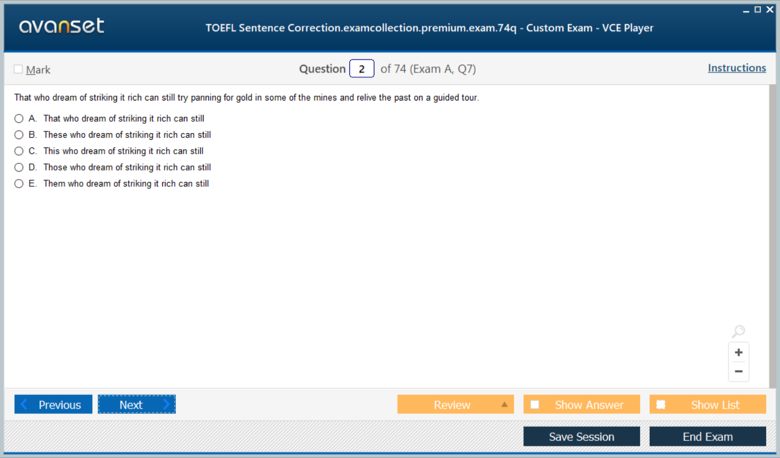
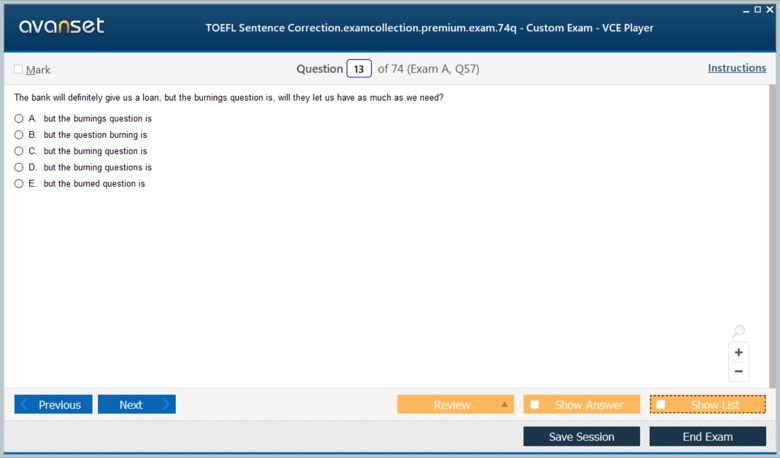
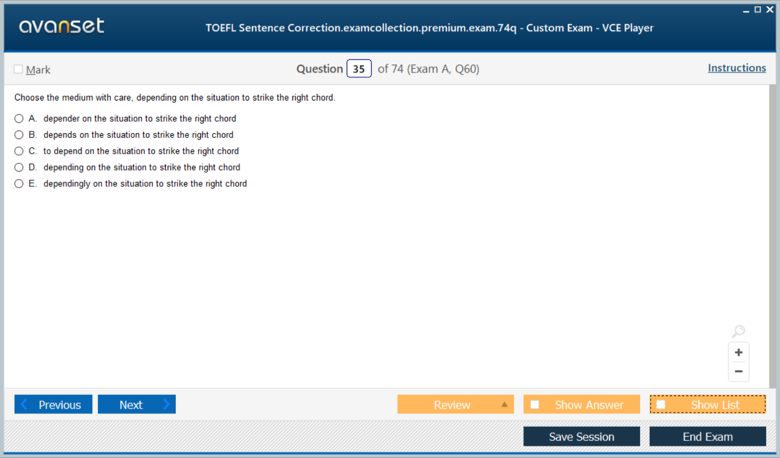
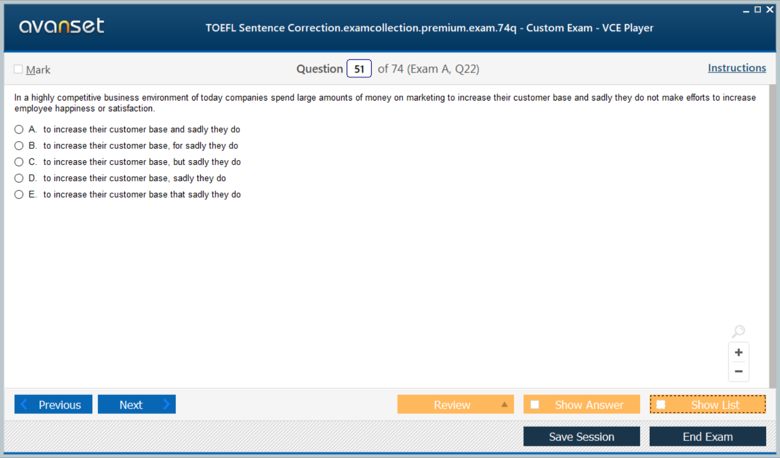
English Test Preparation TOEFL Sentence Correction Practice Test Questions in VCE Format
| File | Votes | Size | Date |
|---|---|---|---|
File English Test Preparation.selftestengine.TOEFL Sentence Correction.v2026-08-08.by.andrei.46q.vce |
Votes 1 |
Size 103.56 KB |
Date Aug 08, 2026 |
File English Test Preparation.examlabs.TOEFL Sentence Correction.v2020-05-27.by.elsie.44q.vce |
Votes 2 |
Size 93.86 KB |
Date May 27, 2020 |
English Test Preparation TOEFL Sentence Correction Practice Test Questions, Exam Dumps
English Test Preparation TOEFL Sentence Correction (Test of English as a Foreign Language - Sentence Correction) exam dumps vce, practice test questions, study guide & video training course to study and pass quickly and easily. English Test Preparation TOEFL Sentence Correction Test of English as a Foreign Language - Sentence Correction exam dumps & practice test questions and answers. You need avanset vce exam simulator in order to study the English Test Preparation TOEFL Sentence Correction certification exam dumps & English Test Preparation TOEFL Sentence Correction practice test questions in vce format.
TOEFL Sentence Correction is a legacy preparation category rather than a named section of the current TOEFL iBT. Older structure-oriented materials frequently asked candidates to identify or repair grammar errors. The 2026 TOEFL iBT now uses adaptive Reading and Listening, a revised Speaking section, and Writing tasks that include Build a Sentence, Write an Email, and Write for an Academic Discussion. Grammar remains important, but it is assessed inside communication rather than through a standalone correction section.
Legacy correction exercises are still useful when candidates treat them as diagnostic grammar practice. The aim is to identify why a sentence is wrong, repair it, and apply the same principle in reading, speaking, and writing. TOEFL practice tests and broader English test preparation resources should be anchored to the current ETS format rather than old section names.
Grammar cannot be repaired reliably without meaning. A candidate should first identify the main idea and the relationship between clauses, then check whether the structure expresses that meaning. This prevents “corrections” that create a different message simply because the replacement sounds grammatical in isolation.
Paraphrasing is a useful first step. Restate the sentence in simple language, then compare the original form. If the intended relationship is cause, contrast, condition, or comparison, the grammar should support that relationship. Meaning becomes the reference point for evaluating each possible error.
Editing is most reliable when meaning comes before labels. Read the whole sentence, identify its main claim, and decide whether the relationships between people, actions, and ideas make sense. Only then inspect grammar. This prevents a candidate from 'correcting' an unusual but valid structure simply because it looks unfamiliar. It also reveals errors that a narrow grammar checklist can miss, such as a connector that creates the wrong logical relationship or a pronoun that technically agrees in number but points to the wrong noun.
Long subjects make it easy to match the verb with the wrong noun. Phrases introduced by of, with, together with, and other modifiers can insert plural nouns between a singular subject and its verb. The candidate should locate the head noun that actually controls agreement.
A useful correction drill is to bracket the complete subject and circle its head noun. Do the same for relative clauses so each verb has a visible subject. This structural marking may feel slow at first, but it builds the pattern recognition needed to catch errors quickly in timed work.
A useful editing technique is to underline the head noun of the subject and temporarily bracket the material between that noun and the verb. Phrases introduced by prepositions, relative clauses, and parenthetical descriptions can contain plural nouns that do not control agreement. Once the core subject-verb pair is checked, the full sentence can be restored. This technique scales well to academic writing, where dense noun phrases are common and agreement mistakes can survive several rereads because the nearest noun sounds more prominent than the true subject.
Academic English depends on accurate use of a, an, the, zero article, this, these, much, many, fewer, less, and other determiners. The correct choice depends on whether the noun is countable, singular or plural, specific or general, and already known in the discourse.
Candidates should learn noun patterns together with vocabulary. Record whether a noun is countable, which prepositions commonly follow it, and whether it normally appears with an article. This reduces the number of separate rules that have to be remembered during writing.
Article use depends on whether a noun is countable, singular or plural, specific or general, and already known in the discourse. Candidates should therefore avoid memorizing 'a versus the' as a simple word-choice rule. When reviewing an error, write the noun with its determiner and explain why the reader can or cannot identify the referent. The same process helps with quantifiers such as much, many, fewer, and less, where countability and meaning interact. Repeated exposure to complete noun phrases builds better intuition than isolated article exercises.
Misplaced modifiers can make a sentence unintentionally describe the wrong noun or action. Participial phrases at the beginning of a sentence are especially risky if the grammatical subject that follows is not the person or thing performing the implied action.
To correct a modifier, ask a direct question: “What does this phrase describe?” Move the phrase beside that word or rewrite the clause explicitly. This habit improves both grammar exercises and real TOEFL writing because it removes ambiguity without requiring more complicated vocabulary.
Misplaced modifiers are easiest to detect by asking what each descriptive phrase could grammatically attach to. If a phrase sits next to the wrong noun or the sentence begins with a participial phrase whose logical subject is missing, the reader has to repair the meaning. Moving the modifier is often a cleaner correction than adding more words. Candidates should compare the original and revised versions aloud; awkward attachment frequently becomes obvious when the sentence is heard rather than only scanned visually.
Pronouns such as it, they, this, which, and those help writers avoid repetition, but an unclear reference can make a sentence difficult to follow. Error-correction practice should ask whether the reader can identify the exact noun or idea being referenced.
When a reference is ambiguous, replace the pronoun with the intended noun and see whether the sentence becomes clearer. If two possible antecedents remain, restructure the sentence. This is particularly important in academic discussion responses where several studies, groups, or ideas may be mentioned close together.
Reference problems can be subtle because the intended noun may seem obvious to the writer. In a test item, however, the pronoun must agree with its antecedent and identify it without unreasonable ambiguity. In longer writing, demonstratives such as this or these are often clearer when followed by a noun that names the idea being referenced. Reviewing pronouns in this way improves both grammar accuracy and cohesion, which is why correction practice can transfer directly to current TOEFL writing rather than remaining an isolated drill.
Comparisons should compare equivalent things. A sentence that compares “the salary of engineers” with “teachers” is structurally uneven because one side is a salary and the other is a group of people. Parallel lists have the same requirement: coordinated items should use compatible grammatical forms.
Draw two sides of the comparison and label them. Then rewrite the sentence so the categories match. For lists, underline the grammatical form of each item. This visual method makes hidden imbalance easier to spot than reading the sentence repeatedly and relying on intuition.
When a sentence compares two things, rewrite it as a simple frame: X is more ___ than Y, or X does A while Y does B. Then check whether the two sides are genuinely comparable. Parallel lists can be tested the same way by repeating the shared grammatical frame before each item. This removes distracting vocabulary and exposes mismatched forms. Once the structure is corrected, restore the full sentence and confirm that the intended meaning has not changed.
Some corrections depend on conventional combinations: interested in, responsible for, result in, depend on, associated with. These patterns are best learned from reading rather than from abstract rules because usage differs across words that have similar meanings.
Build a collocation notebook from authentic academic and professional text. Record the whole phrase and one example sentence. When reviewing a correction error, add the corrected phrase to the notebook. Over time, familiar patterns become automatic and free attention for more complex reasoning.
The 2026 Writing section explicitly includes Build a Sentence, which makes controlled word order and clause structure directly relevant. Error-correction practice can therefore be turned into construction practice: after fixing a sentence, close the answer and rebuild the sentence from its ideas.
The TOEFL sentence completion material is a natural companion because completion and correction examine the same structures from opposite directions. Follow both with short original writing so the rule becomes productive knowledge rather than recognition only.
The value of correction practice in the current TOEFL is transfer. After identifying an error, candidates should produce a new sentence using the corrected pattern, then use it in a short paragraph or Build a Sentence-style task. This forces active control of word order, agreement, connectors, and reference. It also reveals whether the rule is truly understood: recognizing a wrong option is easier than constructing a clear sentence without answer choices. Production should therefore be the final step of every correction set.
Instead of recording only the right answer, classify the error: verb form, agreement, article, preposition, modifier, pronoun, connector, comparison, parallelism, or word order. Count which categories repeat. The highest-frequency errors deserve focused drills and deliberate checking during writing.
The TOEFL preparation foundation is strongest when it leads to this kind of targeted review. Legacy correction exercises remain useful because they expose patterns precisely. The current exam simply expects candidates to apply that accuracy inside broader reading, speaking, and writing performance.
The log should record more than the corrected answer. Write the original error, the rule or meaning problem, a corrected version, and one new sentence that uses the same structure accurately. Review the collection by pattern every few days. When the same category stops recurring in fresh writing, it can move out of the active priority list. This makes correction practice cumulative: the objective is not to become good at spotting mistakes in prepared items, but to reduce the frequency of those mistakes in new language.
Go to testing centre with ease on our mind when you use English Test Preparation TOEFL Sentence Correction vce exam dumps, practice test questions and answers. English Test Preparation TOEFL Sentence Correction Test of English as a Foreign Language - Sentence Correction certification practice test questions and answers, study guide, exam dumps and video training course in vce format to help you study with ease. Prepare with confidence and study using English Test Preparation TOEFL Sentence Correction exam dumps & practice test questions and answers vce from ExamCollection.
Purchase Individually
Top English Test Preparation Certifications


Top English Test Preparation Certification Exams
Site Search:

SPECIAL OFFER: GET 10% OFF

Pass your Exam with ExamCollection's PREMIUM files!
SPECIAL OFFER: GET 10% OFF
Use Discount Code:
MIN10OFF
A confirmation link was sent to your e-mail.
Please check your mailbox for a message from support@examcollection.com and follow the directions.

Download Free Demo of VCE Exam Simulator
Experience Avanset VCE Exam Simulator for yourself.
Simply submit your e-mail address below to get started with our interactive software demo of your free trial.