



Premium File
73 Q&A
$76.99$69.99
English Test Preparation TOEFL Reading Comprehension Test Questions & Answers, Accurate & Verified By IT Experts
Instant Download, Free Fast Updates, 99.6% Pass Rate
73 Questions & Answers
Last Update: Oct 29, 2026
$69.99
English Test Preparation TOEFL Reading Comprehension Exam Screenshots
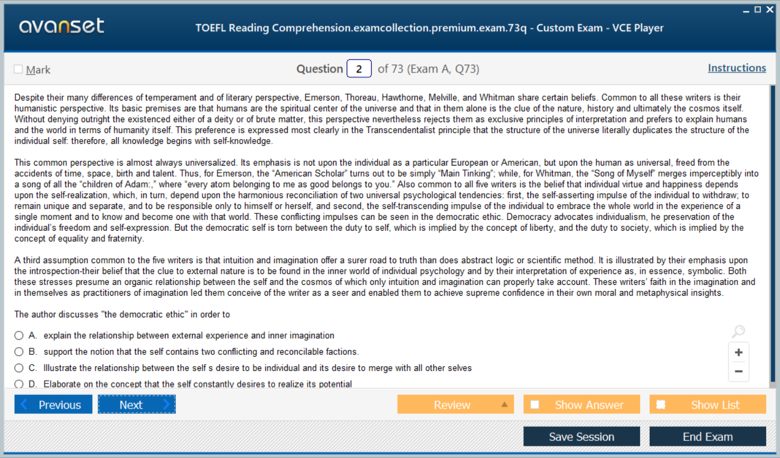
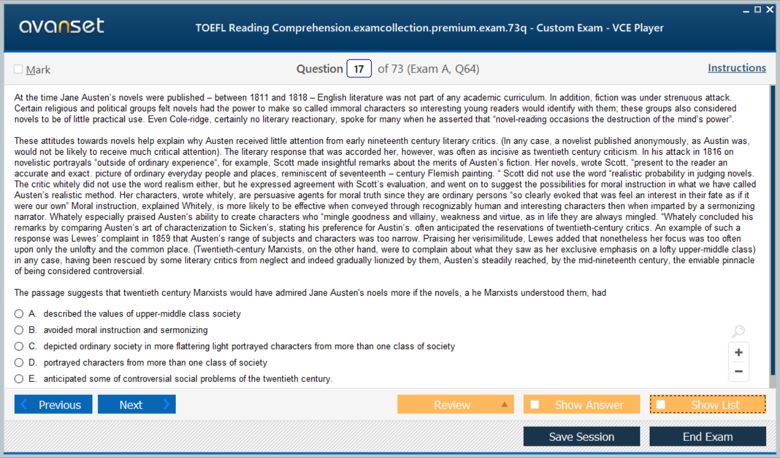
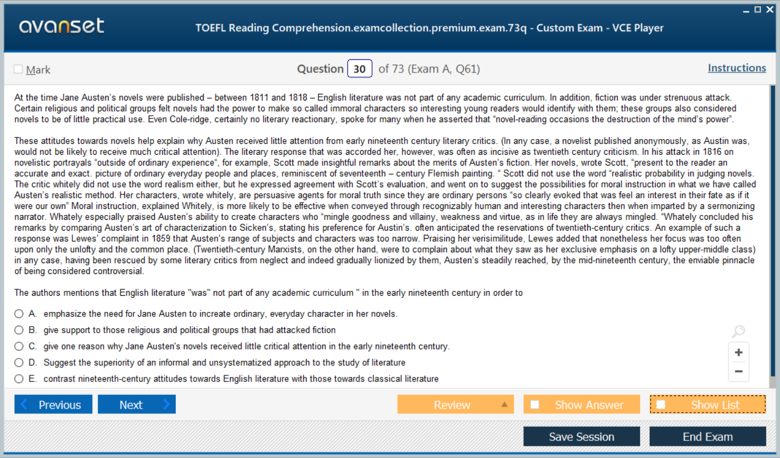
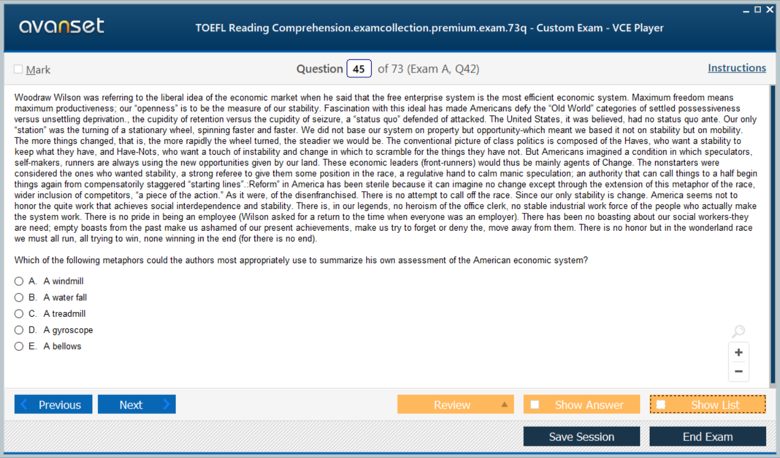
English Test Preparation TOEFL Reading Comprehension Practice Test Questions in VCE Format
| File | Votes | Size | Date |
|---|---|---|---|
File English Test Preparation.test-king.TOEFL Reading Comprehension.v2026-08-05.by.shadow.36q.vce |
Votes 1 |
Size 248.33 KB |
Date Aug 05, 2026 |
English Test Preparation TOEFL Reading Comprehension Practice Test Questions, Exam Dumps
English Test Preparation TOEFL Reading Comprehension (Test of English as a Foreign Language - Reading Comprehension) exam dumps vce, practice test questions, study guide & video training course to study and pass quickly and easily. English Test Preparation TOEFL Reading Comprehension Test of English as a Foreign Language - Reading Comprehension exam dumps & practice test questions and answers. You need avanset vce exam simulator in order to study the English Test Preparation TOEFL Reading Comprehension certification exam dumps & English Test Preparation TOEFL Reading Comprehension practice test questions in vce format.
TOEFL Reading changed significantly in January 2026. ETS now uses an adaptive Reading design and lists task types that include Complete the Words, Read in Daily Life, and Read an Academic Passage. The current TOEFL iBT also reports section and overall results on a 1–6 scale aligned with CEFR, while a comparable overall 0–120 score continues during the transition period. Candidates using older study material should therefore separate timeless reading skills from retired question formats.
TOEFL practice tests and English test preparation resources can help build speed, but the most important current adjustment is recognizing that Reading now mixes academic passages with shorter real-life material. A good study plan trains vocabulary in context, sentence parsing, paragraph purpose, inference, and rapid evidence-finding rather than relying on one passage style.
An adaptive section responds to performance, which makes it especially important to solve the item in front of you rather than speculate about difficulty. Candidates should not waste time trying to guess whether a question is “easy” or “hard” or what that means for scoring. The reliable strategy is still to identify what the question asks, locate the supporting text, and choose the answer that matches the evidence most precisely.
Pacing should be practiced with the current task mix. Shorter everyday texts may reward quick extraction of purpose, detail, and implied meaning, while academic passages require a more developed map of the argument. A single rigid pace for every item can be inefficient. Practice moving faster when the evidence is obvious and slowing down when a question depends on inference or structure.
The 2026 TOEFL design makes it even more important to stay mentally flexible. Candidates should not assume that every practice session must contain an identical number of items or that one difficult item means the whole section is going badly. The stable skill is evidence-based comprehension: understand the text in front of you, answer from what it supports, and move on without carrying uncertainty into the next task. Timed practice should therefore train composure as well as speed, especially when the mix of reading material feels different from older preparation books.
Word completion is not only spelling. The missing form has to fit the sentence grammatically and make sense in context. Candidates should use the surrounding clause, word family, tense, number, and common collocations to predict the answer. This favors vocabulary learned through real reading rather than isolated flashcards.
A useful drill is to take an academic paragraph, cover selected words, and reconstruct them from context. Then compare not only whether the word is correct but why. Was the clue grammatical, semantic, or collocational? Repeating that analysis builds the ability to recover meaning when a word is partially unfamiliar.
Word-completion work improves when vocabulary is studied in families and contexts. Knowing a noun but not its common verb or adjective form can make a partially presented word harder to recognize. Candidates should pay attention to prefixes, suffixes, roots, collocations, and the grammatical position of the missing form. After a mistake, reconstruct the whole sentence and explain why the completed word fits both meaning and grammar. This is more durable than memorizing the isolated answer because the same morphological pattern can appear in unfamiliar vocabulary.
Current TOEFL Reading includes material that reflects everyday academic life, such as notices, messages, websites, or short informational texts. These items often ask what the writer wants the reader to understand or do. Candidates should identify audience, purpose, deadline, exception, and action quickly instead of reading the text as if it were a dense journal article.
Practical reading is useful preparation outside test material. Read university announcements, course pages, library policies, event notices, and short institutional emails. Summarize each in one sentence: who is this for, what changed, and what action is required? That habit makes purpose and implication easier to recognize under time pressure.
Short practical texts should be read with a question in mind: who wrote this, for whom, and what action or information matters? Notices, messages, instructions, and other everyday material often use headings, formatting, dates, conditions, or exceptions to signal priority. Candidates who read them like academic essays may waste time. A better approach is to identify purpose first, locate the requested detail, and check any qualification that changes the obvious answer. This is the same real-world reading habit used when interpreting schedules, policies, and instructions.
For longer academic material, read the first pass for structure. Note the topic of each paragraph and how it relates to the previous one: example, cause, contrast, theory, evidence, or conclusion. This map reduces repeated rereading because the candidate knows where to look when a question asks about a specific idea.
The TOEFL exam structure provides a broader preparation frame, but reading improvement comes from active analysis. After every passage, write a one-line summary of each paragraph and a one-sentence summary of the whole text. If the summaries are vague, comprehension was probably too shallow.
Dense academic prose becomes manageable when each paragraph is reduced to a function. One paragraph may introduce a theory, another provide evidence, another challenge an assumption, and another describe consequences. Marking that structure mentally makes later questions easier because the candidate knows where to return. It also prevents a common error: choosing an answer that is factually related to the topic but does not match the author's actual claim. A passage map should be brief enough to preserve time while still capturing the logic of the text.
Academic English uses words with multiple meanings, so dictionary knowledge alone is not enough. The correct meaning is the one that fits the sentence and the author’s argument. Look at nearby examples, contrasts, definitions, and grammatical role. A familiar everyday meaning may be wrong in an academic context.
Build vocabulary notebooks around sentences rather than single words. Record the original phrase, a simple definition, a synonym, and one new sentence. This captures the way the word behaves. Reviewing word families also helps because noun, verb, adjective, and adverb forms can appear in different contexts.
Inference questions ask what must or reasonably can be concluded from the passage, not what is generally true in the world. Strong distractors often sound sensible but add a claim that the text never supports. The candidate should be able to point to the sentences that make the inference possible.
A practical method is to state the inference in cautious language before looking at the choices. Then eliminate any option that is stronger, broader, or more specific than the evidence allows. This reduces the temptation to choose an answer simply because it matches prior knowledge.
An inference is not an invitation to add outside knowledge. The best answer is the conclusion that follows with the fewest unsupported assumptions from the words, relationships, and examples in the passage. When two choices seem plausible, ask which one is directly constrained by the text and which one requires an extra belief. Practicing this distinction is especially useful for candidates with strong subject knowledge, because familiarity with a topic can tempt them to answer from what they know rather than from what the passage establishes.
Long sentences often contain a simple main clause wrapped in modifiers, relative clauses, examples, and contrast markers. When meaning becomes difficult, find the subject and main verb first, then attach the additional information. This is faster than translating every word individually.
Grammar knowledge supports reading because it reveals relationships. Contrast markers such as although, whereas, and however change the direction of an argument. Cause markers such as because, therefore, and consequently show logic. Relative clauses explain which noun is being described. Candidates who recognize these structures can follow complex passages even when some vocabulary is unfamiliar.
Finishing a practice set is only the beginning. For each wrong answer, identify whether the problem was vocabulary, missed evidence, inference, sentence structure, paragraph purpose, or time pressure. Then explain why the chosen option was attractive and what detail disproved it. That level of review is what prevents the same mistake from recurring.
The TOEFL preparation foundation is most valuable when it leads to this diagnostic routine. A candidate who understands ten mistakes deeply often improves more than one who completes another hundred questions without reviewing the reasoning.
A high-quality review includes the correct evidence and the failure mode of each tempting option. Common distractors reverse a relationship, exaggerate a claim, use the right vocabulary for the wrong paragraph, or state something true but irrelevant to the question. Naming the trap turns one missed question into a reusable lesson. Candidates should also note whether the error came from reading, vocabulary, time pressure, or answer-choice analysis. Those categories determine whether the next practice session should focus on passages, language, pacing, or decision-making.
Older TOEFL resources can still provide strong academic reading passages, vocabulary practice, and grammar work, but candidates must not assume that historical section timing or question labels describe the 2026 test. Use current ETS material to learn the live structure, then use older passages only as supplemental reading practice.
The durable skill is evidence-based comprehension. Read for structure, use context to recover vocabulary, make cautious inferences, parse difficult sentences, and move between short practical texts and longer academic passages. Those skills remain useful even as test design evolves, which makes them the safest foundation for current TOEFL Reading preparation.
Go to testing centre with ease on our mind when you use English Test Preparation TOEFL Reading Comprehension vce exam dumps, practice test questions and answers. English Test Preparation TOEFL Reading Comprehension Test of English as a Foreign Language - Reading Comprehension certification practice test questions and answers, study guide, exam dumps and video training course in vce format to help you study with ease. Prepare with confidence and study using English Test Preparation TOEFL Reading Comprehension exam dumps & practice test questions and answers vce from ExamCollection.
Purchase Individually
Top English Test Preparation Certifications
Top English Test Preparation Certification Exams
Site Search:

SPECIAL OFFER: GET 10% OFF

Pass your Exam with ExamCollection's PREMIUM files!
SPECIAL OFFER: GET 10% OFF
Use Discount Code:
MIN10OFF
A confirmation link was sent to your e-mail.
Please check your mailbox for a message from support@examcollection.com and follow the directions.

Download Free Demo of VCE Exam Simulator
Experience Avanset VCE Exam Simulator for yourself.
Simply submit your e-mail address below to get started with our interactive software demo of your free trial.