



Premium File
103 Q&A
$76.99$69.99
The Open Group OG0-023 Exam Questions & Answers, Accurate & Verified By IT Experts
Instant Download, Free Fast Updates, 99.6% Pass Rate
103 Questions & Answers
Last Update: Aug 31, 2026
$69.99
The Open Group OG0-023 Exam Screenshots
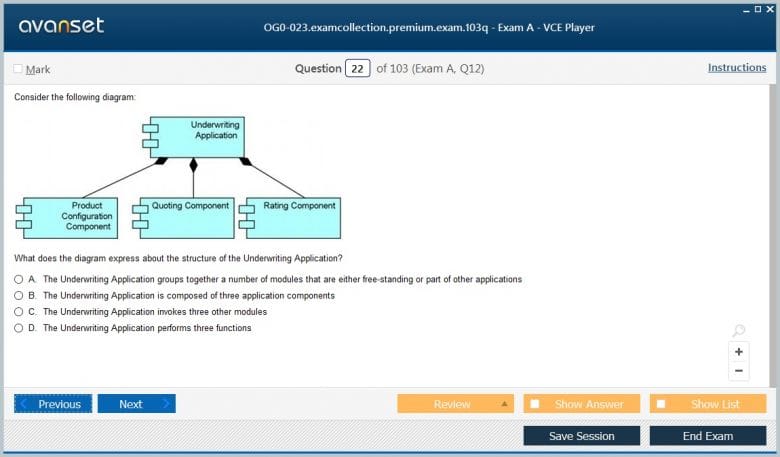
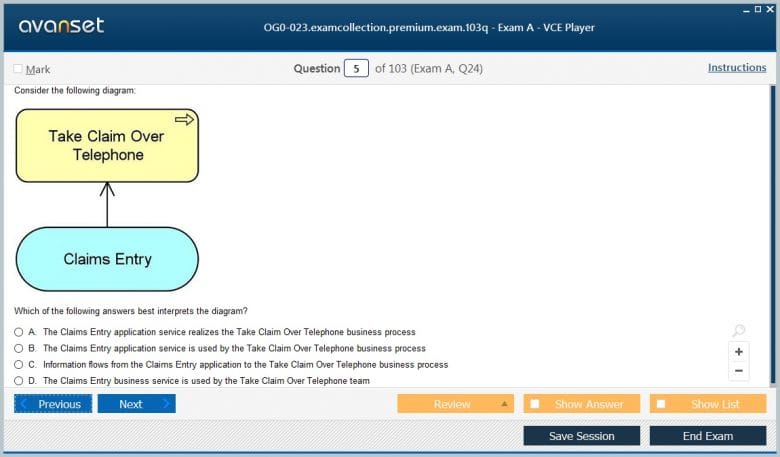
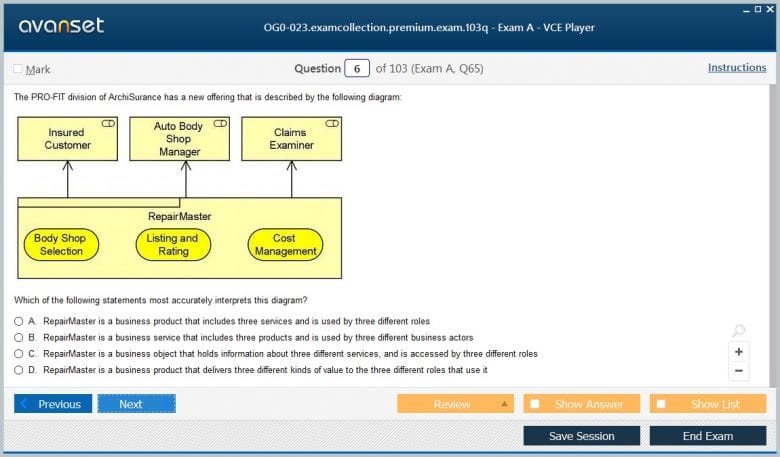
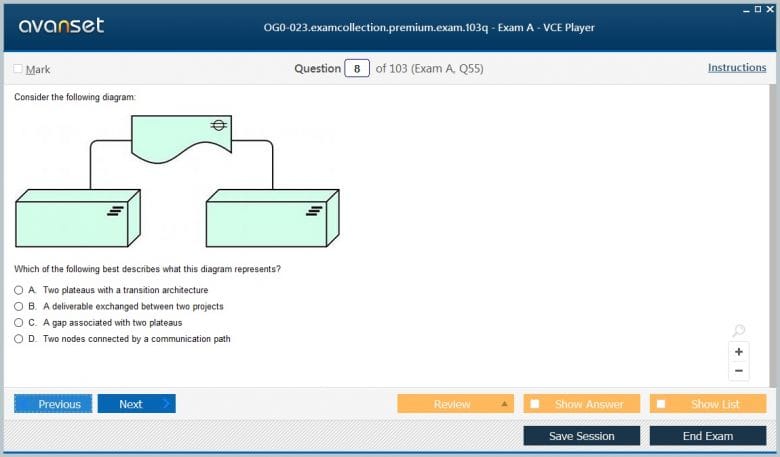
The Open Group OG0-023 Practice Test Questions in VCE Format
| File | Votes | Size | Date |
|---|---|---|---|
File The Open Group.braindumps.OG0-023.v2026-07-30.by.alice.53q.vce |
Votes 1 |
Size 869.39 KB |
Date Jul 30, 2026 |
The Open Group OG0-023 Practice Test Questions, Exam Dumps
The Open Group OG0-023 (ArchiMate 2 Combined Part 1 and 2) exam dumps vce, practice test questions, study guide & video training course to study and pass quickly and easily. The Open Group OG0-023 ArchiMate 2 Combined Part 1 and 2 exam dumps & practice test questions and answers. You need avanset vce exam simulator in order to study the The Open Group OG0-023 certification exam dumps & The Open Group OG0-023 practice test questions in vce format.
OG0-023 was the ArchiMate 2 Combined Part 1 and Part 2 exam. It compressed foundation knowledge and practitioner-level application into one legacy assessment. The modern ArchiMate program no longer uses that combined-exam route: The Open Group’s current ArchiMate 3 guidance requires the Foundation and Practitioner examinations to be taken separately.
That change matters when old search results are still visible. A learner can encounter OG0-023 material and assume it remains the fastest way to a current ArchiMate credential. It does not represent the present ArchiMate 3 structure. New candidates should plan against current exams and the ArchiMate 3.2 specification while treating OG0-023 as historical certification context.
The combined format is still useful for understanding the two different abilities ArchiMate certification is designed to develop: precise knowledge of the language and the ability to apply that language to realistic architecture situations.
The Part 1 side of ArchiMate certification focused on terminology, notation, structure, and basic concepts. The Part 2 side asked the learner to apply that knowledge in more complex situations. Combining them meant a candidate had to switch from exact recall to interpretation without treating those as unrelated abilities.
That distinction remains educationally useful. Architecture work fails when practitioners either know the notation but cannot use it, or draw plausible diagrams without respecting the semantics of the language. Strong preparation deliberately connects the two: first identify what each concept means, then decide how it should be used to communicate a stakeholder concern.
The Open Group’s 2025–2026 guidance states that there is no ArchiMate 3 Combined Part 1 and Part 2 exam. Candidates seeking current certification first take ArchiMate 3 Part 1 for Foundation and then use ArchiMate 3 Part 2 for the Practitioner level, subject to the current eligibility rules.
This separation lets learners build a stable language foundation before moving into applied scenario work. Someone coming from OG0-023 practice should therefore split the material mentally: which questions test definitions and notation, and which test judgment? That classification helps identify what can transfer to the current program and what needs to be relearned against ArchiMate 3.2.
In practitioner work, several models may look syntactically reasonable. The stronger answer is the one that represents the intended meaning most faithfully and supports the concern at hand. That requires understanding not only individual elements but also abstraction, layering, relationship semantics, and the purpose of the view.
Practice by explaining the tradeoff between candidate models. If two diagrams both contain familiar elements, why is one clearer or more semantically correct? Which relationship changes the interpretation? Which model exposes the dependency a stakeholder needs to see? Writing that explanation develops deeper skill than selecting an option and moving on.
Long architecture scenarios can contain more detail than is needed for the question. A disciplined reader first identifies the requested viewpoint or decision, then extracts the elements and relationships that matter. This prevents attractive but irrelevant details from dominating the answer.
Use a short annotation routine: stakeholder, concern, scope, required behavior, and disqualifying clue. Then evaluate each model or statement against those notes. This technique is valuable whether reviewing historical OG0-023 scenarios or preparing for modern practitioner-level questions because it turns a dense narrative into an architecture task.
ArchiMate has evolved since Version 2. Some fundamental ideas remain recognizable, while terminology and the language itself have been extended and refined. The Open Group now identifies ArchiMate 3.2 as the current specification for certification. Candidates should therefore avoid importing old definitions into current study without checking them.
Create a version-difference notebook if legacy material is being reused. Each time an OG0-023 question introduces an unfamiliar or differently defined concept, compare it with the current specification and note the result. This turns old content into a controlled migration exercise rather than allowing two versions to blur together.
Foundation knowledge benefits from fast retrieval: element names, relationship meanings, language structure, and core definitions should become precise enough that the learner does not spend unnecessary time reconstructing them. Practitioner judgment benefits from slower explanation, comparison, and scenario analysis. Mixing both modes in every session can make it hard to see which skill is actually weak.
Alternate them deliberately. Use short closed-book drills for terminology, then separate sessions for model interpretation and written reasoning. At the end, combine the modes so that precise definitions remain available under scenario pressure. That sequence reflects the underlying logic of the old combined exam without pretending the old booking route still exists.
The modeling language earns its place when it makes cross-domain relationships visible. A business capability can depend on application services; application behavior can depend on technology services; implementation and migration concepts can show how change moves from baseline to target. These connections help architects reason about impact and communicate across specialist teams.
When reviewing practice models, ask what decision the model enables. If removing a relationship does not change the reader’s understanding, perhaps it is unnecessary. If an important dependency is absent, the model may be formally tidy but operationally weak. Exam preparation becomes more transferable when it is anchored to these communication goals.
Anyone arriving through OG0-023 should check The Open Group certifications before planning a new exam attempt. Certification catalogs evolve, and old exam codes often remain visible on third-party sites long after their role has changed. The vendor-level context helps distinguish a historical page from the current pathway.
This habit generalizes beyond ArchiMate. When a code belongs to an older standard version, first identify the active certification program, then find the current exam codes, and only after that decide which legacy material is still useful. Search visibility is not evidence of current exam availability.
OG0-023 remains useful as a record of the ArchiMate 2 combined route and as a source of practice for durable architecture-modeling skills. It should not be the center of a current certification plan. Modern candidates should study ArchiMate 3.2, pass the current Foundation exam, and progress to Practitioner through the separate current assessment.
The best legacy-page outcome is clarity. Existing holders can place their credential in context; returning practitioners can identify what changed; and new candidates can avoid spending weeks on a path that no longer matches the certification structure they can book today.
The absence of a current combined ArchiMate 3 exam also changes scheduling strategy. A modern candidate can treat Foundation as a formal milestone, use the result to identify remaining weaknesses, and then move into Practitioner preparation. That separation can improve learning because the second phase can assume the basic language is stable. Someone using OG0-023 as historical practice should mimic that sequence even though the old exam joined the levels: classify foundation misses first, repair them, and only then evaluate scenario judgment.
Model quality should be reviewed at three levels. First, syntax: are the elements and relationships allowed? Second, semantics: does the model say what the author intends? Third, communication: will the intended stakeholder understand the concern without unnecessary detail? Many weak diagrams pass the first test and fail the other two. Practitioner-level thinking lives in those later tests, because a formally valid model can still be misleading, overly dense, or irrelevant to the decision it is supposed to support.
A good scenario review should therefore include a stakeholder rewrite. After selecting an answer, explain the architecture issue in language appropriate for a business executive, then again for an application architect or technology lead. If the same diagram is meant to serve all three audiences, ask whether that is realistic. This exercise reinforces the purpose of viewpoints and helps the learner see why ArchiMate is not simply a standardized icon set. The language supports communication by allowing different, related views of the same enterprise change.
Candidates returning to ArchiMate after years away should resist the urge to treat their old certification as proof that current study will be trivial. Architecture experience is an advantage, but notation drift and unused terminology can create blind spots. Take a fresh ArchiMate 3 Foundation diagnostic before planning Practitioner study. If current notation and definitions are no longer automatic, rebuilding that base will usually save time later when scenarios require fast, accurate interpretation.
Another useful legacy exercise is to separate model construction from model evaluation. First, create a small view from a written scenario without looking at answer choices. Then compare the result with several candidate models and identify what each candidate emphasizes or omits. This prevents the options from steering the learner’s interpretation of the scenario and more closely resembles real architecture work, where the practitioner must decide what to model before seeing a prebuilt solution.
The transition from ArchiMate 2 to ArchiMate 3 should also be reflected in tool practice. Modern modeling tools may enforce current element types and relationships, expose validation rules, and support exchange formats aligned with newer specifications. Rebuilding a legacy example in a current tool can reveal differences that static question review misses. It also ties certification study to the environment an architect is more likely to use professionally today.
Keeping the two levels distinct also makes progress measurable: Foundation accuracy can be tracked separately from Practitioner scenario quality instead of hiding both inside one combined practice score.
Go to testing centre with ease on our mind when you use The Open Group OG0-023 vce exam dumps, practice test questions and answers. The Open Group OG0-023 ArchiMate 2 Combined Part 1 and 2 certification practice test questions and answers, study guide, exam dumps and video training course in vce format to help you study with ease. Prepare with confidence and study using The Open Group OG0-023 exam dumps & practice test questions and answers vce from ExamCollection.
Purchase Individually
Top The Open Group Certifications



Top The Open Group Certification Exams
Site Search:

SPECIAL OFFER: GET 10% OFF

Pass your Exam with ExamCollection's PREMIUM files!
SPECIAL OFFER: GET 10% OFF
Use Discount Code:
MIN10OFF
A confirmation link was sent to your e-mail.
Please check your mailbox for a message from support@examcollection.com and follow the directions.

Download Free Demo of VCE Exam Simulator
Experience Avanset VCE Exam Simulator for yourself.
Simply submit your e-mail address below to get started with our interactive software demo of your free trial.