Pass Your F5-CA Certification Easy!
F5-CA Certification Exams Questions & Answers, Accurate & Verified By IT Experts
Instant Download, Free Fast Updates, 99.6% Pass Rate.

$69.99
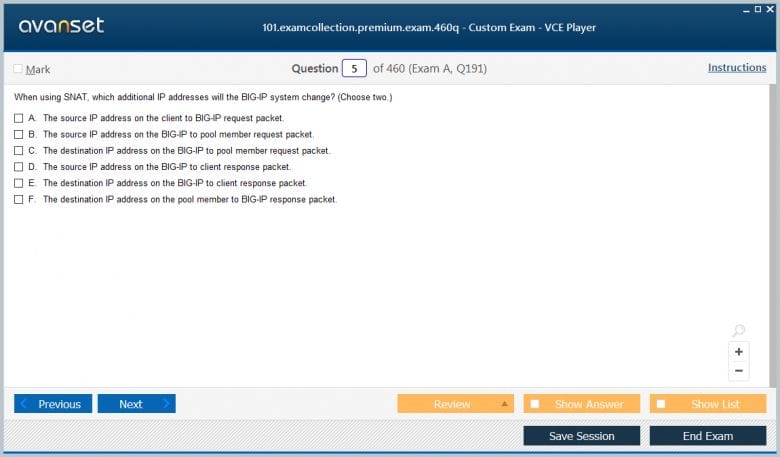
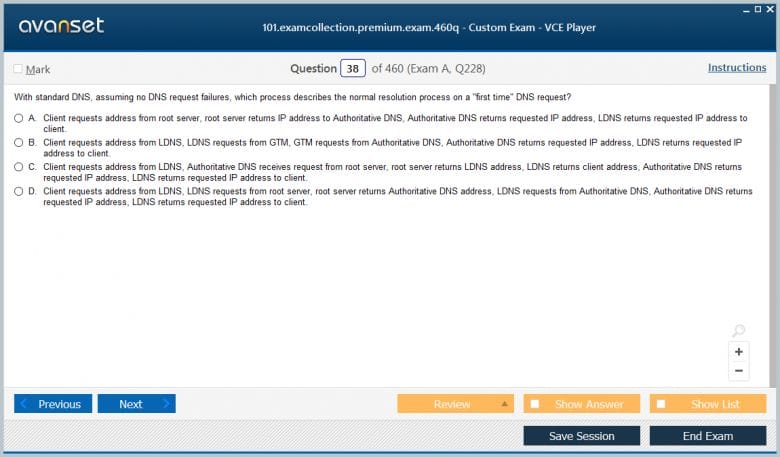
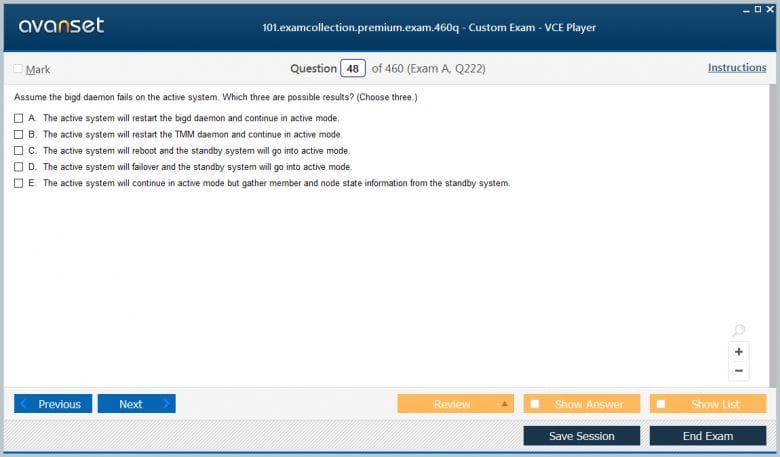
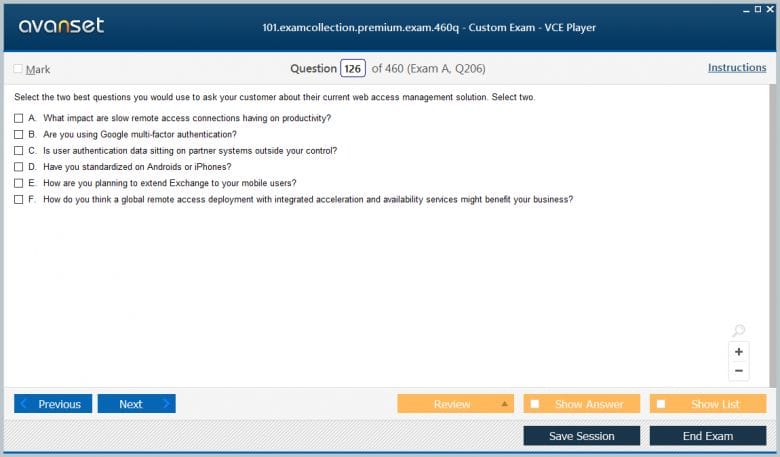
F5-CA Certification Exams Screenshots
F5-CA Product Reviews
Download Free F5-CA Practice Test Questions VCE Files
| Exam | Title | Files |
|---|---|---|
Exam 101 |
Title Application Delivery Fundamentals |
Files 21 |
Exam 201 |
Title TMOS Administration |
Files 1 |
F5-CA Certification Exam Dumps & Practice Test Questions
Prepare with top-notch F5-CA certification practice test questions and answers, vce exam dumps, study guide, video training course from ExamCollection. All F5-CA certification exam dumps & practice test questions and answers are uploaded by users who have passed the exam themselves and formatted them into vce file format.
F5 Certified Administrator BIG-IP: Understanding the New Five-Exam Path
The F5 Certified Administrator, BIG-IP credential changed materially in 2025. The old path based on the 101 Application Delivery Fundamentals and 201 TMOS Administration exams is no longer the normal route for new candidates. F5 retired 101 on April 30, 2025 and replaced the certification path with five modular exams covering installation and initial configuration, data-plane concepts, data-plane configuration, control-plane administration, and support and troubleshooting. Candidates preparing in 2026 should build their plan around that structure.
The certification belongs to the broader F5 certifications. It is intended for administrators who need to operate BIG-IP systems confidently, not merely identify networking terminology.
The old 101/201 route is now historical
For many years, F5-CA was associated with two exams: 101 Application Delivery Fundamentals and 201 TMOS Administration. That history still appears in older study plans and search results. F5 now states that 101 is retired, while 201 remains available only to candidates who already have active eligibility from the earlier path.
New candidates should not design a 2026 study plan around 101 and 201. The material can still teach networking and TMOS concepts, but the credential requirements have moved on.
The new path breaks administration into five focused exams
The current F5-CA route requires five exams that can be taken in any order: F5CAB1 for installation, initial configuration, and upgrade; F5CAB2 for data-plane concepts; F5CAB3 for data-plane configuration; F5CAB4 for control-plane administration; and F5CAB5 for support and troubleshooting. The modular structure makes each competency boundary clearer while still requiring candidates to understand how the five areas interact in one BIG-IP environment.
Candidates should resist the temptation to study the five exams as unrelated mini-tests. BIG-IP administration is one operational system. Installation choices affect networking, data-plane configuration affects application delivery, control-plane settings affect administration, and troubleshooting ties the whole environment together.
Installation and initial configuration establish the management foundation
F5CAB1 covers the work required to bring a BIG-IP system into a manageable state. Candidates should understand initial configuration, licensing concepts, management access, software and upgrade considerations, basic platform setup, and the administrative decisions made before application traffic is placed on the system.
Good initial configuration reduces later risk. Management interfaces should be protected, time and naming should be consistent, administrative access should be controlled, and the system should be placed into the intended network design deliberately.
Data-plane concepts and configuration explain how application traffic moves
F5CAB2 focuses on concepts behind the data plane. Candidates need to understand virtual servers, pools, pool members, nodes, profiles, traffic processing, and how BIG-IP makes forwarding and application-delivery decisions. That conceptual layer matters because the five exams form one operational certification rather than five unrelated topics. Administrators need to understand why traffic behaves a certain way before configuration and troubleshooting decisions become reliable.
Load balancing in modern architecture helps explain why distribution algorithms, health checks, persistence, capacity, and failure handling matter beyond one product interface. F5 candidates should connect those principles to BIG-IP objects and traffic behavior.
F5CAB3 moves from understanding traffic flow to configuring it. Candidates should be comfortable with virtual servers, pools, monitors, profiles, persistence, address translation, and the relationships that create a functioning application-delivery service.
Configuration should reflect application behavior. A health monitor that checks only whether a TCP port opens may be insufficient for an application that can return errors while the port remains available. An administrator needs to choose checks that represent service health accurately.
Profiles and TLS control protocol-specific application delivery
BIG-IP uses profiles to control behavior for protocols and application layers. Candidates should understand why HTTP, TCP, SSL/TLS, and other profiles exist and how inherited or customized settings affect traffic.
TCP/IP protocol behavior underpins BIG-IP profiles and sessions. Candidates should reason about transport, connection state, retransmission, resets, and application behavior rather than memorize profile fields without understanding the traffic they affect.
BIG-IP systems commonly terminate, bridge, or pass encrypted traffic. Administrators need to understand certificates, keys, trust, client-side and server-side TLS behavior, and the operational consequences of encryption settings.
TLS decisions affect both security and troubleshooting. A certificate mismatch, expired certificate, protocol restriction, or cipher incompatibility can appear to users as an application outage. Administrators should be able to separate network reachability from TLS negotiation problems.
Control-plane administration and high availability protect the service
F5CAB4 focuses on administrative and control-plane responsibilities. This includes user and role management, system services, high availability concepts, configuration management, software administration, and other functions that determine how BIG-IP is operated.
Least privilege is important because the control plane can change application behavior across many services. Administrative accounts should be scoped appropriately and changes should be auditable.
BIG-IP is often deployed where application availability matters. Candidates should understand device trust, synchronization, failover concepts, traffic groups, and the conditions required for a redundant pair to behave predictably.
High availability should be tested. A configuration can look synchronized while a dependency such as upstream routing, VLAN reachability, or monitor behavior prevents successful failover. Administrators should validate service continuity, not only device status.
Troubleshooting is the skill that integrates the whole certification
F5CAB5 focuses on support and troubleshooting. The most important habit is layer-based diagnosis. Is the client reaching the virtual server? Is the pool healthy? Can BIG-IP reach the pool members? Is DNS resolving correctly? Is TLS completing? Are profiles or policies changing traffic unexpectedly?
Network troubleshooting reinforces evidence-driven isolation. Random configuration changes can hide the original fault and create a second problem, so administrators should verify one layer at a time and preserve a known-good baseline.
DNS and application dependencies matter outside the appliance.
Application-delivery incidents are not always caused by BIG-IP itself. DNS can point clients to the wrong address, upstream routes can fail, back-end applications can return errors, and certificates can expire. Administrators need to understand the service chain around the device.
DNS analysis matters because name-resolution failures can mimic load-balancer outages. A disciplined administrator validates dependencies before changing a known-good BIG-IP configuration.
Recertification now has its own exam.
F5 introduced a dedicated F5 Certified Administrator BIG-IP recertification exam. That reinforces the move away from the historical 101/201 structure and gives credential holders a defined renewal route.
Candidates should check current F5 policy as their credential approaches renewal because certification programs can change. The important point is that current status and legacy exam history should not be blended together.
How to prepare for the five-exam route
Build a lab or use authorized training environments where you can perform the whole lifecycle: initial setup, basic networking, virtual-server configuration, pool and monitor creation, TLS configuration, administrative changes, high-availability exercises, backup and restore, and troubleshooting. For every configuration, understand both the expected traffic behavior and the evidence you would use if it failed.
Study the modules in a sequence that makes conceptual sense even though F5 allows any exam order. Foundations and data-plane understanding usually make configuration and troubleshooting easier. The goal is not five independent passes; it is one coherent administration skill set.
Configuration backup and change discipline should be part of lab practice. Before a major change, know how the configuration will be saved, how the previous state can be restored, and which device in a redundant pair should be changed first. Troubleshooting is safer when every experiment has a rollback path.
Packet captures are another essential bridge between theory and diagnosis. A capture can show whether a client reached the virtual server, whether BIG-IP opened a server-side connection, where a TCP reset occurred, and whether TLS negotiation progressed. Candidates do not need to become protocol-forensics specialists, but they should be able to use packet evidence to narrow the failing layer.
Health monitors also deserve scenario practice. Configure a monitor that checks only transport reachability, then compare it with an application-aware check. Break the back-end application while leaving the port open and observe the difference. That exercise makes the purpose of monitors much clearer than memorizing monitor types from a table.
Create a dependency map for every lab application: client, DNS, virtual server, profile, pool, monitor, back-end service, routing, and return path. When the application fails, test the map from one end to the other and record where evidence first diverges from the expected state. This habit turns troubleshooting from guesswork into a repeatable method and directly supports the current modular exam structure.
F5-CA now measures administration in smaller, clearer slices
The new structure makes current preparation more explicit. Instead of one fundamentals exam followed by one broad administration exam, candidates prove competency across installation, traffic concepts, traffic configuration, control-plane administration, and support.
That change should improve study discipline if candidates use it properly. Learn what BIG-IP is doing to traffic, understand how the system itself is managed, and troubleshoot from evidence. Those abilities remain useful even as individual exam codes and product versions continue to evolve.
Repeat the same failure with a different cause—DNS, monitor, TLS, routing, or pool-member state—and compare the evidence. That contrast builds the diagnostic instincts F5 administration requires.
For administrators, the most productive preparation connects configuration choices to observable traffic behavior. Build a small lab routine in which every change is followed by verification: inspect pool-member state, virtual-server behavior, persistence, health monitors, logs, and the client-visible result. That habit mirrors the operational reasoning the modular path is designed to test.
ExamCollection provides the complete prep materials in vce files format which include F5-CA certification exam dumps, practice test questions and answers, video training course and study guide which help the exam candidates to pass the exams quickly. Fast updates to F5-CA certification exam dumps, practice test questions and accurate answers vce verified by industry experts are taken from the latest pool of questions.

F5 F5-CA Video Courses

Top F5 Certifications

Site Search: