



Premium File
209 Q&A
$76.99$69.99
F5 301b Exam Questions & Answers, Accurate & Verified By IT Experts
Instant Download, Free Fast Updates, 99.6% Pass Rate
209 Questions & Answers
Last Update: Sep 09, 2026
$69.99
F5 301b Exam Screenshots
F5 301b Practice Test Questions in VCE Format
| File | Votes | Size | Date |
|---|---|---|---|
File F5.passcertification.301b.v2026-07-15.by.omar.125q.vce |
Votes 1 |
Size 4.51 MB |
Date Jul 15, 2026 |
F5 301b Practice Test Questions, Exam Dumps
F5 301b (BIG-IP Local Traffic Manager (LTM) Specialist: Maintain & Troubleshoot) exam dumps vce, practice test questions, study guide & video training course to study and pass quickly and easily. F5 301b BIG-IP Local Traffic Manager (LTM) Specialist: Maintain & Troubleshoot exam dumps & practice test questions and answers. You need avanset vce exam simulator in order to study the F5 301b certification exam dumps & F5 301b practice test questions in vce format.
F5 301b, BIG-IP LTM Specialist: Maintain and Troubleshoot, is an active specialist exam in the F5 certification program. It is the second exam required for the F5 Certified Technology Specialist, BIG-IP LTM credential. F5 currently lists 301b among the exams available through Pearson VUE, and its published prerequisite structure requires a valid F5 Certified Administrator, BIG-IP certification plus a valid passing score on Exam 301a. That makes 301b an advanced continuation of administrator knowledge rather than a standalone entry exam.
The certification expects candidates to design, implement, maintain, optimize, and troubleshoot BIG-IP Local Traffic Manager features in application delivery networks. The wider F5 certifications show where LTM specialization fits in the program. For candidates who first learned BIG-IP through the older TMOS Administration (201) route, 301b represents a substantial step up: problems are less likely to be solved by finding one incorrect object and more likely to require reasoning across traffic flow, profiles, high availability, application behavior, and system state.
At specialist level, BIG-IP LTM should be understood as a full proxy that participates in both client-side and server-side connections. The candidate needs to know what the application is trying to accomplish, how the virtual server matches traffic, which profiles govern each protocol layer, how the pool and monitor model backend health, and how translation and routing return traffic. Troubleshooting becomes the art of narrowing that path without assuming that the most visible device is the cause.
F5’s candidate description explicitly expects understanding through OSI Layer 7. The OSI model is useful here as a diagnostic structure rather than an academic diagram. A failed connection can be caused by link or routing issues, a transport problem, TLS negotiation, an HTTP behavior, or an application-specific response. Good troubleshooting identifies the lowest layer at which expected behavior stops.
That mindset also prevents configuration thrashing. If the TCP handshake never completes, changing an HTTP profile is unlikely to help. If the backend returns the wrong application response, replacing a route may be irrelevant. Evidence should determine which layer receives attention.
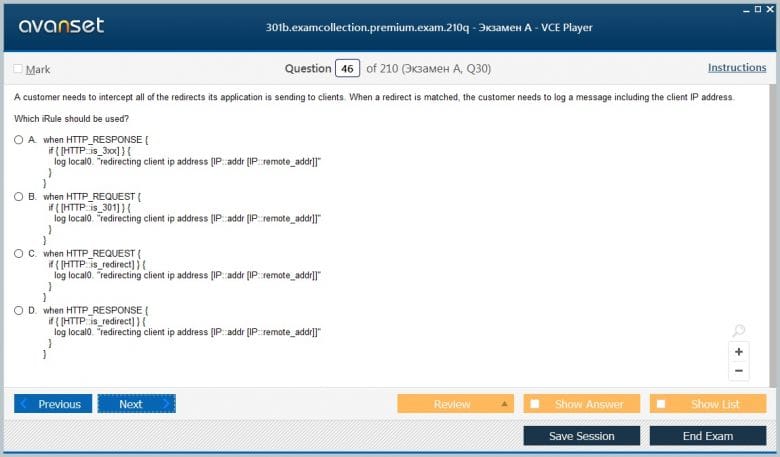
Specialist questions often involve a configuration that is technically valid but operationally inappropriate. A virtual server can match the desired address and port while a profile choice creates performance problems, protocol incompatibility, or an unexpected security outcome. Candidates need to understand how TCP, UDP, HTTP, SSL, persistence, compression, acceleration, and other profiles affect traffic on the client and server sides.
The important skill is choosing behavior based on application requirements. A high-latency client network may benefit from a different transport profile than a low-latency server segment. An HTTP application may need header manipulation or a local traffic policy. A stateful application may require persistence. TLS termination can provide visibility and central certificate management, while server-side encryption may still be needed to protect traffic to the application tier.
When troubleshooting, compare the configured profile with observed traffic. Packet captures, logs, statistics, and application tests can reveal whether a reset comes from a client, BIG-IP, or a server; whether TLS negotiation fails before HTTP exists; or whether a policy is selecting a different pool than expected.
F5 explicitly expects a 301b candidate to select an appropriate load-balancing method based on application requirements and server capabilities. That means moving beyond round robin as a default answer. Connection-based methods can be useful when active connection count reflects load. Ratio-based methods can reflect different server capacities. Observed or predictive behavior may be appropriate in other environments. The right choice depends on what “balanced” means for the service.
The conceptual foundation of load balancing remains the same: distribution only helps when destinations are healthy and the selection signal corresponds to real capacity. A heavily loaded server can remain technically reachable. A healthy web process can depend on a failed database. That is why application-specific monitors matter at specialist level.
A useful monitor should test the transaction that represents service health without creating excessive load or false failures. Candidates should understand send strings, receive conditions, aliases, intervals, timeouts, and the operational effect of marking a member down. They should also be able to distinguish a monitor problem from a real application problem by testing the same transaction independently.
F5 calls out the ability to determine when to use SNAT and when not to use it. The reason is architectural. If a server’s default route does not return through BIG-IP, translating the client source can keep the response path symmetric by making the server return to an address owned by BIG-IP. That can simplify deployment, but it also changes what source address the server sees.
Preserving client addresses can be important for logging, security policy, geolocation, or application logic. In such cases, the network may need to route server responses through BIG-IP instead of relying on source translation. Large-scale SNAT designs also need awareness of port availability and connection volume. The candidate should be able to evaluate the tradeoff instead of treating translation as purely a connectivity fix.
When troubleshooting intermittent failures, SNAT exhaustion, asymmetric routing, and address conflicts belong on the hypothesis list. Traffic captures on both sides of the device are often more informative than looking only at object status.
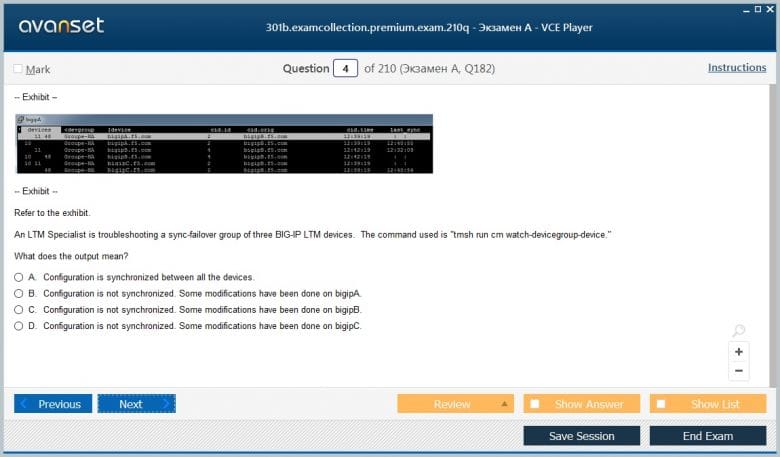
Advanced LTM operation requires understanding what happens when one device becomes unavailable or when traffic groups move. Device trust, configuration synchronization, failover communication, floating addresses, persistence state, connection mirroring, and network fail-safe behavior can all affect whether applications survive a fault as expected. A pair that appears synchronized is not necessarily ready for every failure scenario.
Candidates should be able to reason about planned failover as well as unplanned failure. During maintenance, an administrator wants predictable movement of application traffic and a clear validation path. During an outage, the question becomes which condition triggered failover, whether the peer is healthy, whether traffic groups moved, and whether external network devices recognize the new active path.
Configuration drift is particularly dangerous. If objects or certificates differ between devices, failover can expose a fault that was invisible while the preferred device was active. Good operations therefore pair synchronization with post-change verification rather than assuming that a green status icon proves equivalent runtime behavior.
Specialist troubleshooting often begins when an application is technically available but slow, intermittent, or unstable. CPU and memory can matter, but so can connection counts, SSL workload, persistence distribution, pool-member response time, packet loss, retransmission, congestion, and inefficient application behavior. The candidate should avoid jumping directly from “slow” to “BIG-IP capacity problem.”
Transport evidence can be especially useful. The mechanics discussed in TCP performance—latency, windowing, retransmissions, and congestion behavior—help explain why a connection can feel slow even when neither endpoint is saturated. BIG-IP statistics can then be correlated with packet captures and backend metrics to determine whether the bottleneck is on the client side, proxy, server network, or application tier.
Optimization should follow diagnosis. Changing profiles, enabling acceleration, or increasing limits without evidence can hide the symptom temporarily while creating new behavior elsewhere. Specialist-level judgment is shown by choosing the smallest technically justified change and measuring the result.
Specialist-level diagnosis also means correlating evidence across time. A connection reset seen in a packet trace, a spike in pool-member response time, and an LTM log entry are more useful when they can be placed on the same incident timeline. That correlation helps distinguish a persistent design problem from a brief backend event or maintenance change. It also improves escalation quality because another engineer can reproduce the reasoning instead of receiving only a snapshot of current statistics.
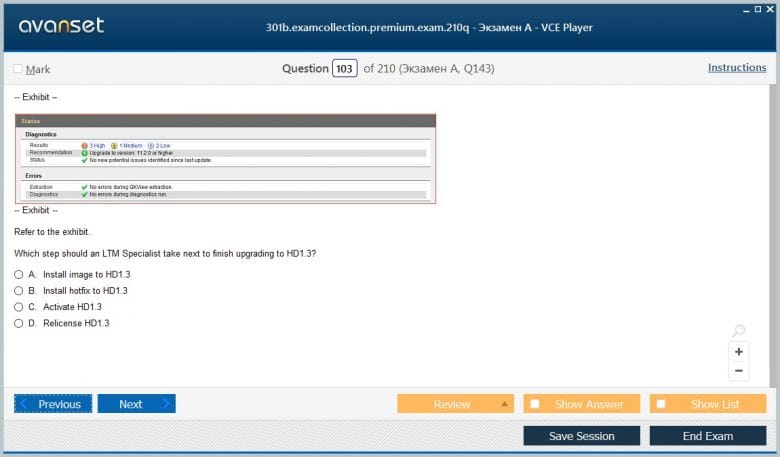
301b also expects candidates to reason about upgrade and recovery steps in LTM environments. A successful upgrade requires more than installing an image. Teams need a supported upgrade path, current licensing, recoverable configuration, capacity on the peer, and a plan for moving traffic. Device groups and traffic groups add sequencing requirements, because the objective is to maintain application availability while software changes occur.
Recovery questions test the same discipline. If an upgrade fails or a configuration becomes unusable, the administrator needs to know what can be restored, which boot location is available, and how a UCS archive or known-good configuration fits the rollback. The safest procedure is the one that preserves evidence, limits change, and provides a verified path back to service.
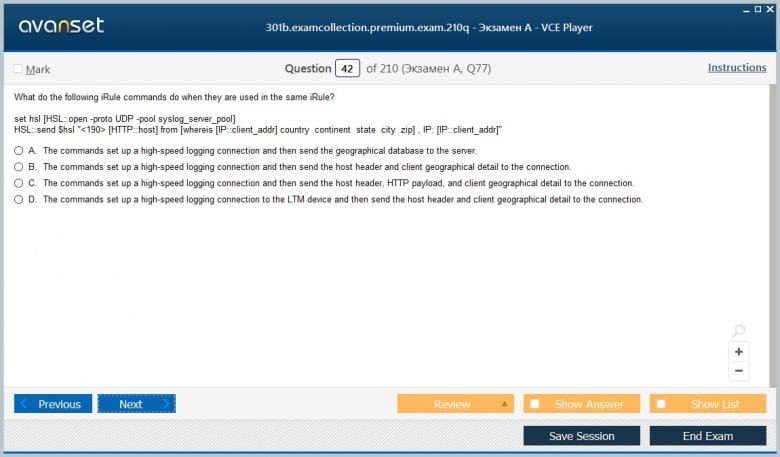
Custom alerting and log management also matter because operations should detect problems before users report them. SNMP, remote syslog, email notifications, and appropriate local logging levels can provide early visibility, but alerts have value only when they are actionable and tuned to the environment.
The strongest way to prepare for 301b is to create scenarios in which several plausible causes exist. Break a health monitor. Introduce an incorrect route. Change a profile. Remove a pool member. Create asymmetric return traffic. Fail over a traffic group. Perform a software change in a lab. For each scenario, write down the evidence you would expect before looking at the system. This turns configuration knowledge into a troubleshooting method.
Use the blueprint to ensure coverage, but spend equal time explaining why a change is appropriate and what evidence rules out alternatives. Specialist questions reward the ability to interpret symptoms in context. Candidates should be comfortable moving from application behavior to BIG-IP objects, then down to transport and network evidence, without losing sight of the end-to-end service.
301b remains a demanding exam because it validates professional judgment rather than basic familiarity. The candidate who can keep the traffic path, application requirements, high-availability state, and diagnostic evidence in one mental model is much better prepared than someone who has memorized isolated commands.
Go to testing centre with ease on our mind when you use F5 301b vce exam dumps, practice test questions and answers. F5 301b BIG-IP Local Traffic Manager (LTM) Specialist: Maintain & Troubleshoot certification practice test questions and answers, study guide, exam dumps and video training course in vce format to help you study with ease. Prepare with confidence and study using F5 301b exam dumps & practice test questions and answers vce from ExamCollection.
Purchase Individually
Top F5 Certifications

Site Search:

SPECIAL OFFER: GET 10% OFF

Pass your Exam with ExamCollection's PREMIUM files!
SPECIAL OFFER: GET 10% OFF
Use Discount Code:
MIN10OFF
A confirmation link was sent to your e-mail.
Please check your mailbox for a message from support@examcollection.com and follow the directions.

Download Free Demo of VCE Exam Simulator
Experience Avanset VCE Exam Simulator for yourself.
Simply submit your e-mail address below to get started with our interactive software demo of your free trial.