



Premium File
361 Q&A
$76.99$69.99
IAPP CIPM Exam Questions & Answers, Accurate & Verified By IT Experts
Instant Download, Free Fast Updates, 99.6% Pass Rate

CIPM Premium File: 361 Questions & Answers
Last Update: Oct 03, 2026
CIPM Training Course: 51 Video Lectures
CIPM PDF Study Guide: 244 Pages
$79.99
IAPP CIPM Exam Screenshots
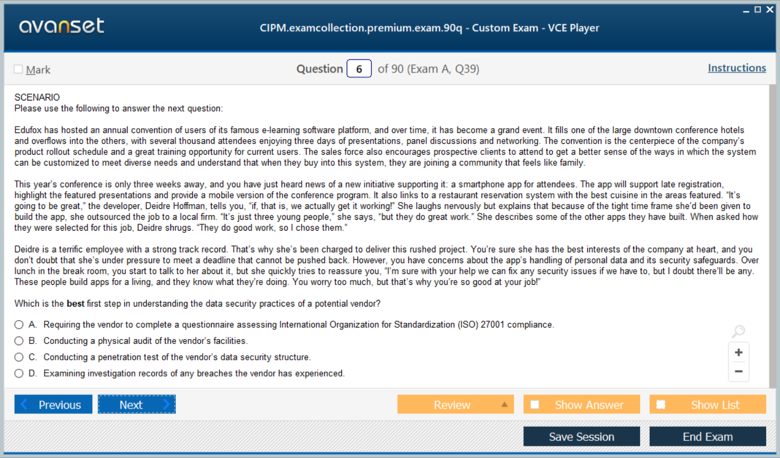


IAPP CIPM Practice Test Questions in VCE Format
| File | Votes | Size | Date |
|---|---|---|---|
File IAPP.selftestengine.CIPM.v2026-08-12.by.david.91q.vce |
Votes 1 |
Size 3.53 MB |
Date Aug 12, 2026 |
File IAPP.testking.CIPM.v2021-10-28.by.olivia.69q.vce |
Votes 1 |
Size 1.58 MB |
Date Oct 28, 2021 |
File IAPP.examlabs.CIPM.v2021-05-01.by.tamar.47q.vce |
Votes 1 |
Size 193.31 KB |
Date May 01, 2021 |
File IAPP.actualtests.CIPM.v2020-10-01.by.sienna.45q.vce |
Votes 2 |
Size 173.2 KB |
Date Oct 01, 2020 |
IAPP CIPM Practice Test Questions, Exam Dumps
IAPP CIPM (Certified Information Privacy Manager) exam dumps vce, practice test questions, study guide & video training course to study and pass quickly and easily. IAPP CIPM Certified Information Privacy Manager exam dumps & practice test questions and answers. You need avanset vce exam simulator in order to study the IAPP CIPM certification exam dumps & IAPP CIPM practice test questions in vce format.
CIPM, the Certified Information Privacy Manager credential from IAPP, focuses on building and operating a privacy program rather than memorizing one jurisdiction’s law. The certification is designed around translating privacy obligations and organizational commitments into governance, data understanding, controls, processes, measurement, and sustained accountability. That operating emphasis distinguishes it from regional CIPP credentials.
A useful way to approach the exam is to imagine that the privacy office has just been given responsibility for a complex organization. The candidate must decide what the program covers, who owns decisions, where personal data exists, which risks require treatment, how requests and incidents are handled, how vendors are governed, and how leadership knows the program is working. Every privacy concept should eventually connect to an operating mechanism.
The first design task is to define scope, objectives, stakeholders, legal and contractual drivers, risk appetite, and the relationship between privacy and other governance functions. A framework prevents the program from becoming a pile of disconnected notices, assessments, and training activities. It should establish how requirements become controls and how exceptions, escalations, and changes are managed.
The principles in organizational privacy standards and practices are useful when they are converted into accountable work. For example, data minimization should lead to collection reviews, retention decisions, product requirements, or deletion controls. A principle that cannot be connected to a decision point is difficult to operate or audit.
Privacy is distributed across legal, security, product, HR, marketing, procurement, data, customer service, and engineering teams. The privacy office rarely performs every control itself. It needs a governance model that assigns ownership, establishes escalation paths, and makes privacy responsibilities visible in business workflows. RACI-style thinking can help, but the quality of the decision matters more than the diagram.
Senior sponsorship is important when teams disagree about risk, budget, or launch timing. Operational committees can coordinate recurring issues, while specialist reviews handle high-risk processing. Internal audit or independent assurance may test whether controls work as designed. The candidate should understand these layers without assuming that one organizational structure fits every company.
An organization cannot protect or govern personal data it cannot locate. Data discovery should identify categories of personal information, sources, purposes, systems, recipients, transfers, retention, access, and lifecycle events. A useful inventory supports assessments, rights requests, incident response, vendor governance, and deletion; a static spreadsheet maintained only for audit season is much less valuable.
Build a data-flow exercise around a customer account. Follow data from collection through identity systems, analytics, marketing, support, payment, cloud providers, backups, and deletion. Note where the purpose changes or a new recipient appears. This exercise shows why privacy management is cross-functional and why a record of processing should be tied to real system behavior.
Assessments are most effective before a risky design is fixed. New products, data uses, vendors, AI systems, tracking technologies, cross-border transfers, and sensitive-data processing can all trigger review. The objective is to identify harms and compliance exposures early enough to change the design, not to produce a form that justifies a decision already made.
Connect privacy assessment to broader risk-management roles. Security may quantify threat likelihood, legal may interpret obligations, product may understand user impact, and privacy may evaluate purpose, proportionality, transparency, and rights. A strong program combines those perspectives while preserving clear accountability for the final decision.
Privacy controls can include minimization, purpose limitation, access restrictions, encryption, pseudonymization, obfuscation, retention schedules, deletion, consent or preference management, logging, and separation of duties. The right control depends on the processing context. A technical safeguard cannot compensate for collecting data with no legitimate need, and a policy cannot protect a dataset if access is uncontrolled.
Technology specialists studying CIPT go deeper into engineering patterns, but a CIPM candidate still needs enough technical fluency to ask whether a control is actually implemented. Data-loss prevention, for example, can support a privacy program only when sensitive information is classified, monitoring scope is appropriate, alerts have owners, and exceptions are governed.
Organizations routinely share personal data with processors, service providers, affiliates, and other third parties. Privacy management should classify vendors by risk, perform appropriate diligence, establish contractual requirements, understand subprocessing, and monitor meaningful changes. The program must also know where data moves so cross-border transfer obligations can be assessed under the applicable legal framework.
A vendor questionnaire is not the end of the process. Review the actual service, data fields, purpose, security model, retention, incident obligations, deletion mechanism, and exit plan. High-risk suppliers may require deeper evidence or recurring review. The privacy team should be able to explain why a vendor was approved and what would cause that approval to be reconsidered.
Individual rights processes require identity verification, request intake, system search, exception analysis, response coordination, and auditable completion. The difficult part is often operational: data exists in many systems, ownership is fragmented, and a legal deadline continues while teams investigate. Mature programs rehearse the workflow and measure bottlenecks before request volume becomes a crisis.
Privacy incidents likewise require coordination with security, legal, communications, regulators, customers, and leadership. The privacy manager should understand triage, facts, affected data, jurisdictional obligations, risk assessment, notification decision-making, remediation, and lessons learned. A security event is not automatically a reportable privacy breach, but privacy cannot wait until the technical investigation is finished to begin assessing obligations.
Counting training completions or assessments completed can show activity but not necessarily effectiveness. Useful privacy metrics include aged risks, unresolved assessment actions, request completion time, incident trends, vendor review status, retention compliance, control failures, and repeated causes of exceptions. The chosen measures should help management decide where the program needs attention.
Audit and assurance should test evidence against stated requirements. If policy says access is reviewed quarterly, verify that reviews occurred and that inappropriate access was removed. If retention schedules exist, test actual deletion. This evidence-based approach is why policy and procedure design matters: documented expectations have value only when operational processes make them repeatable.
Privacy requirements evolve because laws, business models, technology, vendors, and user expectations change. A durable program tracks external developments, reviews policies and controls, updates training, re-assesses high-risk processing, and uses incidents or audit findings to improve. Privacy maturity is not a one-time implementation project.
Regional legal knowledge from credentials such as CIPP/E or CIPP/US can deepen the legal layer, but CIPM tests whether those obligations can be operationalized. Within IAPP certifications, think of CIPM as the management bridge between legal requirements, technical controls, and business execution.
For final preparation, build a miniature privacy program around a fictional company. Create its governance model, data inventory, assessment triggers, vendor process, rights workflow, incident path, training plan, and metrics dashboard. Then introduce a new AI product, acquisition, or international vendor and update the program. That exercise forces every CIPM topic to interact and exposes gaps that isolated memorization can hide.
Privacy notices and consent mechanisms should be managed as program assets rather than one-time legal documents. Product changes, new vendors, new purposes, and new jurisdictions can make old disclosures inaccurate. The privacy manager needs ownership for review, versioning, localization, and evidence that user choices are honored in downstream systems. A notice that describes a control which engineering no longer enforces is a governance failure, not merely a drafting problem.
Training should be role-specific. Every employee may need baseline privacy awareness, but developers, recruiters, marketers, customer-support staff, security responders, procurement teams, and executives make different privacy decisions. Tailor examples, escalation paths, and required behaviors to those decisions. Measure whether people can recognize and route a privacy issue, not only whether they completed an annual module. Repeated operational mistakes are a signal that training or process design needs to change.
Retention programs are a useful test of cross-functional maturity because they touch legal holds, business need, system capability, backups, analytics, archives, and vendor contracts. A schedule on paper does not prove deletion. Map retention rules to actual repositories, assign system owners, define exceptions, and test disposal. When deletion cannot occur immediately, document the technical constraint and the compensating restrictions until the architecture can be corrected.
Acquisitions, divestitures, and major platform migrations should trigger structured privacy work. Data may move to a new controller, purposes may change, systems can be consolidated, and old consent or notice assumptions may no longer fit. The privacy manager should participate early enough to inventory the data, identify incompatible uses, preserve rights workflows, review contracts, and plan deletion of redundant copies. Transaction deadlines do not eliminate privacy obligations.
A strong CIPM review also distinguishes program design from program assurance. Design asks whether the right policy, process, or control exists; assurance asks whether it operates consistently and produces reliable evidence. Use sampling, metrics, audits, control testing, incident trends, and stakeholder feedback to assess effectiveness. Mature privacy management is visible in the gap between written expectations and real behavior—and in the process used to close that gap.
Privacy budgets should be connected to risk rather than divided evenly across activities. A high-volume sensitive-data platform may justify deeper assessment and control testing than a low-risk internal process. Use inventories, incidents, audit results, regulatory change, and business growth to prioritize resources. This risk-based allocation helps a privacy program remain credible when staffing and engineering capacity are finite.
Go to testing centre with ease on our mind when you use IAPP CIPM vce exam dumps, practice test questions and answers. IAPP CIPM Certified Information Privacy Manager certification practice test questions and answers, study guide, exam dumps and video training course in vce format to help you study with ease. Prepare with confidence and study using IAPP CIPM exam dumps & practice test questions and answers vce from ExamCollection.
Purchase Individually


IAPP CIPM Video Course

Top IAPP Certifications

Site Search:

SPECIAL OFFER: GET 10% OFF

Pass your Exam with ExamCollection's PREMIUM files!
SPECIAL OFFER: GET 10% OFF
Use Discount Code:
MIN10OFF
A confirmation link was sent to your e-mail.
Please check your mailbox for a message from support@examcollection.com and follow the directions.

Download Free Demo of VCE Exam Simulator
Experience Avanset VCE Exam Simulator for yourself.
Simply submit your e-mail address below to get started with our interactive software demo of your free trial.