



Premium File
160 Q&A
$76.99$69.99
GAQM CBAF-001 Exam Questions & Answers, Accurate & Verified By IT Experts
Instant Download, Free Fast Updates, 99.6% Pass Rate
160 Questions & Answers
Last Update: Sep 30, 2026
$69.99
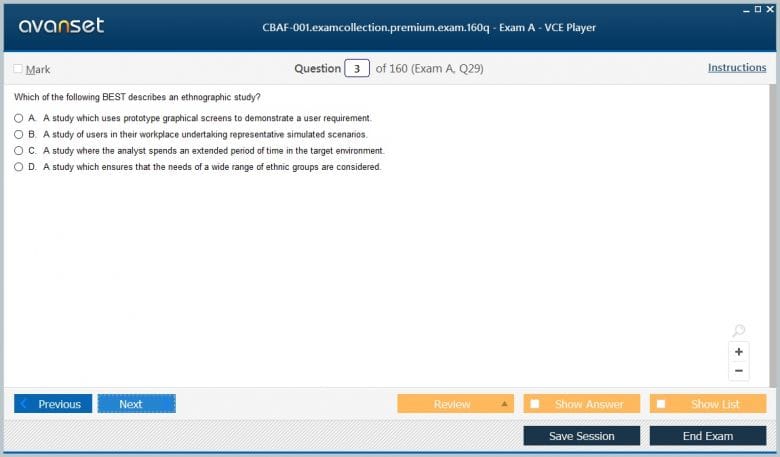
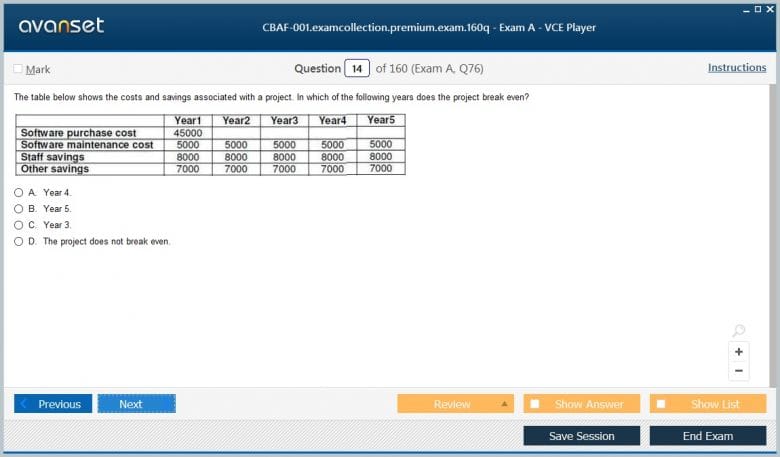
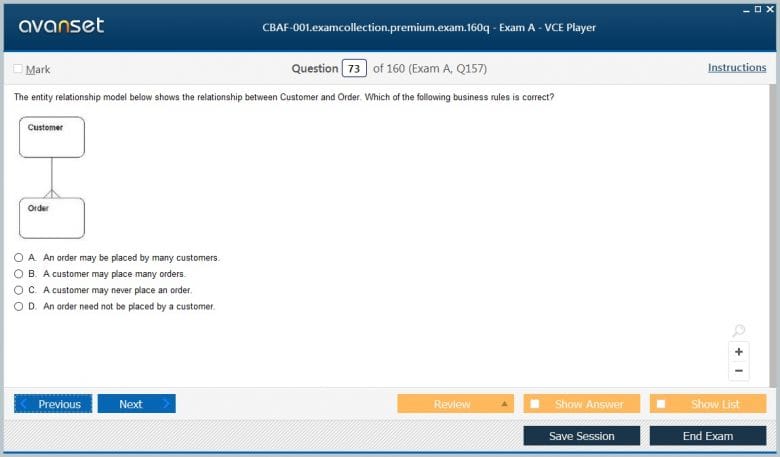
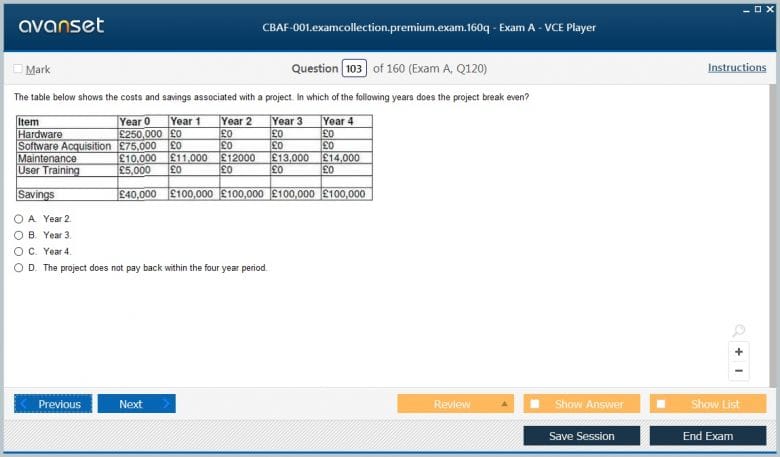
GAQM CBAF-001 Exam Screenshots
GAQM CBAF-001 Practice Test Questions in VCE Format
| File | Votes | Size | Date |
|---|---|---|---|
File GAQM.Test4prep.CBAF-001.v2026-07-10.by.Aurora.94q.vce |
Votes 3 |
Size 172.43 KB |
Date Jul 13, 2026 |
GAQM CBAF-001 Practice Test Questions, Exam Dumps
GAQM CBAF-001 (Certified Business Analyst - Foundation) exam dumps vce, practice test questions, study guide & video training course to study and pass quickly and easily. GAQM CBAF-001 Certified Business Analyst - Foundation exam dumps & practice test questions and answers. You need avanset vce exam simulator in order to study the GAQM CBAF-001 certification exam dumps & GAQM CBAF-001 practice test questions in vce format.
CBAF-001 is GAQM’s Certified Business Analyst (CBA) Foundation exam. GAQM’s current Diploma in Business Research and Analysis material still identifies CBAF-001 as one of its component exams and describes a 40-question, 60-minute assessment with an 80 percent passing requirement in an AI-proctored online format. Those mechanics matter for planning, but the larger value of the exam is its focus on a repeatable way to understand business needs and translate them into solution requirements.
The foundation level is broad by design. It covers business process analysis, planning and stakeholder management, requirements management, organizational analysis, solution evaluation and implementation, business analyst competencies, and critical thinking. Candidates should resist the temptation to reduce that breadth to terminology. A business analyst earns trust by producing evidence that a proposed change solves the right problem and can be understood by both business and technical teams.
Organizations often begin change initiatives with a preferred product already in mind: replace the CRM, automate onboarding, build a dashboard, or move a workflow to the cloud. The analyst’s first responsibility is to separate the desired technology from the business need. What outcome is failing today? Who experiences the failure? How is it measured? What constraints must a solution respect?
That distinction protects the project from solution bias. If the real problem is inconsistent data ownership, buying a new reporting platform may create a more expensive way to display the same inconsistency. If the problem is an unclear approval policy, automation may simply make conflicting rules execute faster.
Practice turning vague requests into problem statements with observable evidence. A well-formed problem statement establishes the current condition, impact, affected stakeholders, and boundary without preselecting the answer.
Stakeholders differ in authority, expertise, incentives, and exposure to the process. The person who uses a system every day may understand the operational exceptions better than the executive sponsor, while the sponsor may control funding and policy. The analyst needs both perspectives and must know which stakeholder can approve which type of decision.
Planning should therefore identify who supplies requirements, who validates them, who owns policy, who accepts risk, and who signs off the implemented solution. Treating every stakeholder as an equal source of truth creates conflict late in the project because unresolved authority questions surface during acceptance.
Good elicitation varies by context. Interviews reveal individual reasoning, workshops expose disagreement, observation shows what people actually do, document analysis reveals formal policy, and data analysis shows frequency and impact. The analyst chooses the technique that reduces uncertainty rather than using the same workshop for every problem.
Requirements are not valuable because they are written in a template. They are valuable because they express a need clearly enough to design, build, test, and accept a solution. A useful requirement is specific, feasible, testable, unambiguous, and traceable to a stakeholder need or business objective.
Traceability is especially important when scope changes. If a requirement is removed, the analyst should be able to show which objective, process, control, test, and stakeholder are affected. Without that chain, teams can cut apparently small features that were carrying regulatory or operational significance.
The Certified Business Analyst material provides a broader business-analysis reference, but CBAF-001 should be prepared at foundation depth: understand the purpose of requirements, how they are elicited and validated, and how they guide solution design.
Many functional requirements are symptoms of the current process. A request for another status field may exist because teams cannot see ownership. A request for a notification may exist because handoffs are unreliable. Process analysis helps the analyst decide whether the requirement should change the system, the workflow, the policy, or the role definition.
Use current-state and future-state process models to expose handoffs, decision points, wait states, rework, and data dependencies. The related BPM-001 Business Process Manager exam goes deeper into the full process lifecycle, but the business analyst needs enough process thinking to connect requirements with operational behavior.
When a proposed future state is drafted, validate it with the people who perform the work. A diagram built only from policy documents may miss exception handling, workarounds, and unofficial controls that keep the current process functioning.
A requirement can be locally sensible and strategically wrong. Organizational analysis asks whether the proposed change supports the business model, operating priorities, capabilities, and constraints. It also asks whether the organization can absorb the change.
Capability gaps are broader than software gaps. A solution may require new skills, roles, data governance, vendor relationships, controls, or support processes. If those dependencies are ignored, the technical implementation may finish while the business outcome remains unrealized.
This is where analysts should distinguish benefit from output. A deployed portal is an output. Reduced onboarding time, fewer data errors, and higher completion rates are benefits. Requirements and acceptance criteria should remain connected to the benefits the sponsor expects.
Business analysis does not end when development begins. The analyst supports clarification, evaluates change requests, prepares acceptance criteria, helps users understand the future process, and compares delivered behavior with the original need. A technically complete feature can still fail if it does not fit the business workflow.
Evaluation should include both functional fit and operational effect. Does the solution perform the required action? Does it reduce the targeted delay or error? Does it create new work elsewhere? Are the controls sufficient? These questions protect against declaring success merely because a system passed a technical test.
Implementation planning also needs transition thinking: data migration, training, communications, cutover, support, and rollback. The analyst may not own every task, but should identify dependencies that could prevent the solution from producing value.
GAQM includes critical thinking and research because analysts work in environments where people present opinions as facts. Strong analysis asks what evidence supports a claim, whether the sample is representative, what alternative explanation exists, and what information is still missing.
Research quality matters when external sources influence a business case or requirement. Vendor claims, industry benchmarks, regulatory summaries, and user surveys all have limits. The analyst should understand source credibility, recency, definitions, and whether the evidence actually applies to the organization’s population.
Critical thinking also improves meetings. Instead of arguing for one stakeholder’s preferred answer, the analyst can restate the decision, list assumptions, identify evidence, and define what would falsify each option. That turns disagreement into a testable analysis problem.
Prepare by creating a small case study and producing the artifacts an analyst would need: problem statement, stakeholder map, process model, requirements set, traceability links, solution options, acceptance criteria, and evaluation measures. The act of connecting those artifacts is more valuable than memorizing isolated definitions.
The broader set of GAQM certifications helps place CBAF-001 alongside management and process credentials. For candidates moving into delivery roles, APM-001 adds project-management context, while CBAF-001 remains centered on discovering and validating what the business actually needs.
Before test day, recheck GAQM’s current exam instructions because online proctoring, voucher, identity, and attempt policies can change. For content, anchor preparation in the source curriculum: needs, stakeholders, processes, requirements, organizational context, solution evaluation, implementation, and evidence-based reasoning.
A business case should be revisited as new information appears. Early estimates may rely on uncertain demand, implementation cost, productivity gains, or risk assumptions. The analyst should make those assumptions visible and update them when evidence changes. This is better than protecting an outdated business case simply because it helped secure initial approval.
Requirements prioritization also needs a clear rationale. “Must have” cannot mean “the stakeholder who speaks loudest wants it.” Priorities can reflect legal necessity, safety, business value, dependency, time criticality, and implementation risk. Techniques such as MoSCoW are useful only when the team agrees on what each category means in the specific initiative.
Nonfunctional requirements deserve the same care as functional ones. Performance, security, availability, accessibility, auditability, privacy, scalability, and supportability can determine whether a solution is acceptable even when the visible features work. These qualities are frequently missed because stakeholders describe what the system should do more readily than how well or under what constraints it should do it.
Analysts should maintain a distinction between requirement validation and solution verification. Validation asks whether the requirement expresses the right need; verification asks whether the delivered solution meets the specified requirement. A perfectly implemented wrong requirement is still a business failure. Keeping both questions visible reduces late-stage acceptance disputes.
For practice, write acceptance criteria that can be observed. “The system should be user friendly” cannot be tested consistently. A criterion tied to completion steps, response time, error handling, or another measurable outcome creates a shared basis for developers, testers, and business stakeholders to decide whether the solution is ready.
Change control should protect requirements from silent drift without making the project inflexible. When a new requirement appears, identify its source, benefit, urgency, dependencies, cost, and effect on previously accepted scope. The decision can then be made consciously rather than being smuggled into implementation as a “small change.”
Analysts should also separate facts, assumptions, constraints, and risks in their notes. A legal deadline is a constraint; the belief that users will adopt a new workflow without training is an assumption; uncertain data quality is a risk. Mixing these categories makes decisions harder to review later.
Finally, practice summarizing a complex issue for different audiences. Executives may need the decision, impact, options, and risk; developers need precise behavior and data rules; users need workflow implications. The underlying analysis should remain consistent even when the communication changes.
Go to testing centre with ease on our mind when you use GAQM CBAF-001 vce exam dumps, practice test questions and answers. GAQM CBAF-001 Certified Business Analyst - Foundation certification practice test questions and answers, study guide, exam dumps and video training course in vce format to help you study with ease. Prepare with confidence and study using GAQM CBAF-001 exam dumps & practice test questions and answers vce from ExamCollection.
Purchase Individually
Top GAQM Certifications
Site Search:

SPECIAL OFFER: GET 10% OFF

Pass your Exam with ExamCollection's PREMIUM files!
SPECIAL OFFER: GET 10% OFF
Use Discount Code:
MIN10OFF
A confirmation link was sent to your e-mail.
Please check your mailbox for a message from support@examcollection.com and follow the directions.

Download Free Demo of VCE Exam Simulator
Experience Avanset VCE Exam Simulator for yourself.
Simply submit your e-mail address below to get started with our interactive software demo of your free trial.