



Premium File
69 Q&A
$76.99$69.99
GAQM BPM-001 Exam Questions & Answers, Accurate & Verified By IT Experts
Instant Download, Free Fast Updates, 99.6% Pass Rate
69 Questions & Answers
Last Update: Sep 20, 2026
$69.99
GAQM BPM-001 Exam Screenshots
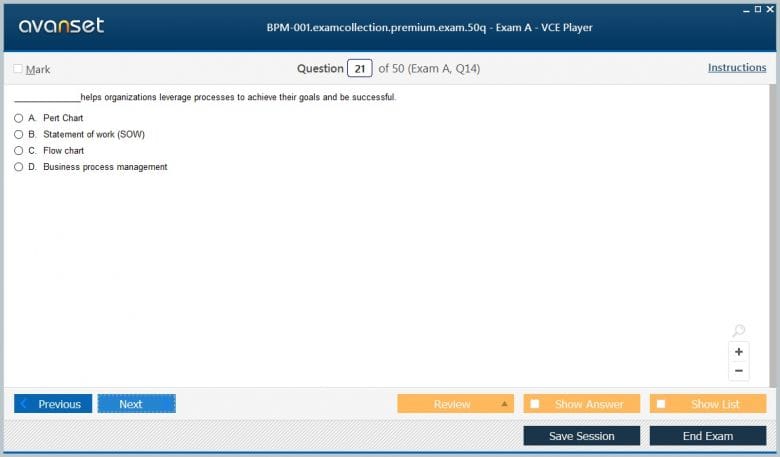
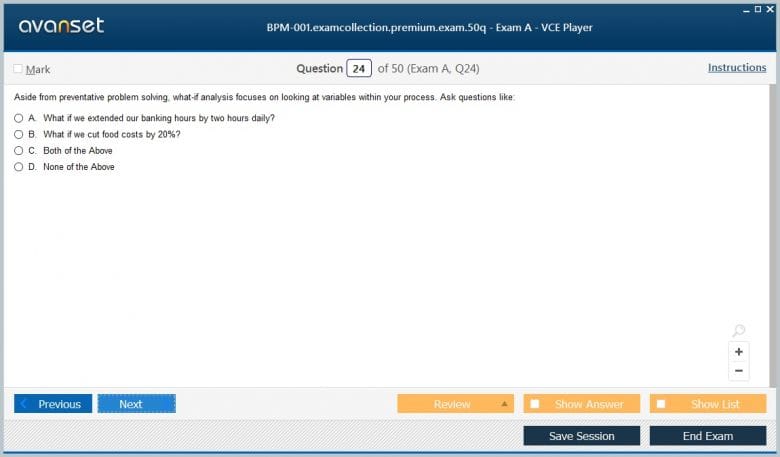
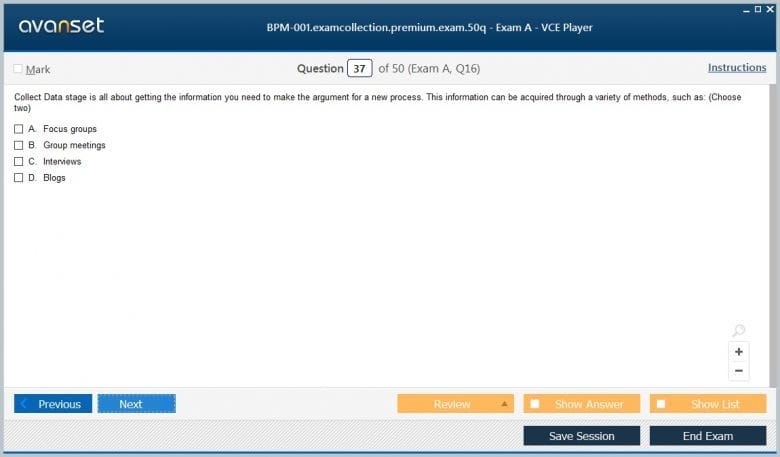
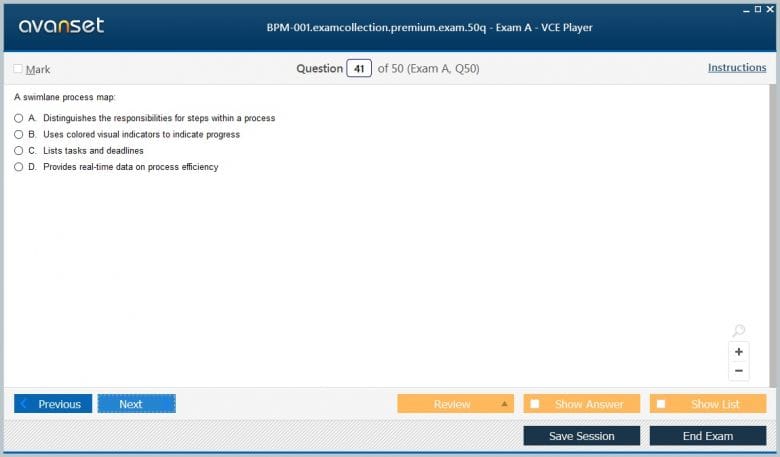
GAQM BPM-001 Practice Test Questions in VCE Format
| File | Votes | Size | Date |
|---|---|---|---|
File GAQM.Train4sure.BPM-001.v2026-09-22.by.Vincent.39q.vce |
Votes 4 |
Size 32.06 KB |
Date Sep 29, 2026 |
GAQM BPM-001 Practice Test Questions, Exam Dumps
GAQM BPM-001 (Business Process Manager) exam dumps vce, practice test questions, study guide & video training course to study and pass quickly and easily. GAQM BPM-001 Business Process Manager exam dumps & practice test questions and answers. You need avanset vce exam simulator in order to study the GAQM BPM-001 certification exam dumps & GAQM BPM-001 practice test questions in vce format.
BPM-001 is GAQM’s Business Process Manager examination, built around the idea that a business process should be understood as an operating system for work rather than a diagram kept in a procedure manual. GAQM’s published BPM curriculum moves from the fundamentals of business process management through vision, design, modeling, execution, monitoring, and optimization, then connects those stages to information systems, systems analysis, design, implementation, and operations. The breadth explains why the exam is more managerial than a narrow process-mapping test.
That scope also makes BPM-001 useful for candidates who sit between operations, technology, and change. A process manager has to understand what the business is trying to accomplish, how work actually moves across teams, where information is created or lost, which controls protect quality, and where automation can reduce friction without hiding a bad process. The strongest preparation therefore treats the syllabus as one lifecycle. GAQM certifications provide the broader context, while BPM-001 itself is best studied through the decisions that connect one phase to the next.
Process improvement starts by identifying a repeatable flow that produces a result for a customer, user, regulator, or internal stakeholder. The useful unit of analysis is not simply a department. A customer request may move through sales, finance, operations, security, and support before it is complete. If each department optimizes only its own task, the end-to-end process can still be slow, expensive, or error-prone.
GAQM’s BPM material places business analysis, enterprise content management, and business process re-engineering near the foundation. Those topics belong together. Information is often the object moving through the process, and redesign frequently requires changing both the sequence of work and the way information is captured, approved, stored, and reused. A process map that ignores data handoffs is therefore incomplete.
For exam preparation, practice describing a process in terms of trigger, inputs, activities, decisions, roles, outputs, controls, and measures. Then ask what problem the process is meant to solve. This prevents a common mistake: improving an activity that should have been eliminated or radically redesigned.
Before a team redraws workflows, it needs a shared view of the outcome. The vision phase creates that direction. A useful vision is specific enough to guide trade-offs but broad enough to survive implementation detail. “Reduce order-to-cash delay without increasing credit losses” is more actionable than “make finance faster” because it connects speed with a business constraint.
Stakeholder alignment is part of the same phase. Senior leaders may care about margin, customers about response time, frontline employees about rework, and auditors about traceability. A process initiative becomes unstable when one measure is treated as the only measure. The process manager has to surface competing objectives before the design is locked.
This is where BPM overlaps naturally with project management. The APM-001 Associate in Project Management material helps frame scope, ownership, risk, and delivery, while BPM asks a different question: what operating process should exist after the project is finished? Keeping those two questions separate makes both disciplines clearer.
The design phase is where assumptions become visible. GAQM’s outline emphasizes gathering information, defining the problem, identifying existing and future processes, process mapping, flowcharts, swimlane diagrams, improvements, and function ownership. The aim is not to make a beautiful chart. It is to show where work waits, loops, changes hands, branches, and depends on information or approval.
Swimlanes are especially useful because they reveal responsibility boundaries. A delay may not exist inside any task; it may exist between teams. Similarly, a control may be duplicated because each department does not trust the previous department’s validation. Those patterns are easier to see when the map shows roles and handoffs rather than only boxes connected by arrows.
When comparing the current state with a future state, state the design hypothesis explicitly. If the proposal removes an approval, what risk was that approval controlling and what will replace it? If two steps are combined, what data must be available at the new point? A defensible design explains both efficiency and control.
GAQM separates modeling from basic mapping because a process can look logical and still perform poorly. What-if analysis asks how the design behaves when volume rises, a resource becomes unavailable, work arrives unevenly, or an exception path is triggered. Even a simple model can reveal bottlenecks that are not obvious in a static diagram.
Test driving a process means challenging the assumptions behind capacity, timing, queues, decision rules, and ownership. Imagine a service desk that can close normal tickets quickly but requires a single specialist for every exception. Average cycle time may appear healthy until exception volume increases. The process manager should identify that dependency before automation scales it.
Use scenario questions to practice the distinction between local and system optimization. Adding staff to one activity does not improve the process if the next activity becomes the new bottleneck. A good answer looks for the constraint that controls end-to-end performance.
The execution phase covers implementing processes, exploring automation, business rules, system connections, and workflow engines. The most important principle is that automation should enforce a deliberate process, not substitute for process analysis. A poorly designed approval chain becomes faster at producing the same unnecessary waits when it is automated.
Business rules deserve separate attention because they convert policy into operational decisions. A credit threshold, entitlement rule, escalation condition, or exception path should be explicit, testable, and owned. If rules are hidden inside code or individual judgment, the process becomes difficult to audit and change.
Integration is also part of execution. Modern processes often cross CRM, ERP, identity, ticketing, document, and analytics systems. The process manager does not need to be the developer of every integration, but should understand what information is authoritative, how failures are handled, and what evidence proves the handoff completed.
A process cannot be managed from occasional anecdotes. GAQM’s BPM curriculum includes measures, business activity monitoring, and the balanced scorecard because management needs a way to distinguish normal variation from meaningful deterioration. Measures should connect operational behavior with the outcome the process exists to create.
Cycle time, first-pass yield, backlog, error rate, rework, cost, and customer experience can all be useful, but they answer different questions. A team can reduce average cycle time while the worst cases become much slower. It can improve throughput by accepting more defects. Measures must therefore be read as a set rather than as isolated targets.
The enterprise project management perspective is useful when improvement work spans multiple initiatives, yet ongoing BPM requires operational measures after the projects close. That is the point at which process ownership replaces project governance.
The optimization phase in GAQM’s outline introduces business process improvement, Lean, waste reduction, and Six Sigma. These methods add discipline after a process has been made visible. Lean asks where work consumes time or resources without creating value. Six Sigma adds a stronger emphasis on variation, measurement, and evidence about causes.
The connection is practical. BPM defines the end-to-end system, Lean exposes unnecessary movement, waiting, inventory, overprocessing, and other waste, while Six Sigma helps test whether the apparent cause of a defect actually explains the variation. The Lean Six Sigma pathway is therefore a natural extension for candidates who want deeper improvement methods.
Optimization should remain tied to the process objective. Cutting a control that prevents costly errors may make a flow look leaner while increasing total business risk. The best improvement removes effort that does not protect or create value and strengthens the feedback that shows whether the change worked.
A strong study plan begins by drawing one real process from experience. Use it repeatedly as you study vision, design, modeling, execution, monitoring, and optimization. That creates continuity across the syllabus. When you reach systems analysis and implementation, ask what information system changes would be required to support the redesigned flow and how those changes would be tested.
The CBAF-001 business analysis foundation is closely related but not identical. Business analysis concentrates more heavily on needs, requirements, stakeholders, and solution evaluation; BPM concentrates on the managed lifecycle of work. Candidates who understand the boundary can answer scenario questions with more precision.
GAQM currently lists BPM-001 as a 50-question multiple-choice exam with a 60-minute limit and a 70 percent passing requirement. The exam is AI-proctored, and GAQM states that Business Process Manager certification requires completion of its e-course before the assessment. Candidates should still recheck live voucher and policy details before booking, but the published mechanics now support a concrete preparation plan alongside the BPM body of knowledge.
For BPM-001 scenarios, distinguish a process symptom from a process cause. A growing backlog may be caused by insufficient capacity, but it may also come from unstable demand, unnecessary approvals, poor first-pass quality, or work entering the process without complete information. The process manager should inspect the flow before prescribing resources. Adding people to a badly designed process can raise cost without changing the constraint.
Change management should also be treated as part of process implementation rather than an announcement after the design is complete. New workflows alter responsibilities, measures, and sometimes status. People need to understand what changes, why it changes, how exceptions will be handled, and how the organization will know whether the new process is better. Resistance can reveal a genuine design weakness as well as simple reluctance.
When reviewing systems analysis topics, connect logical requirements with physical implementation choices. The business may require reliable case routing, but the technical solution could use different platforms or architectures. BPM governance should preserve the business rule while allowing technology to evolve. That separation makes future redesign easier and prevents one application’s current structure from becoming the permanent definition of the process.
Go to testing centre with ease on our mind when you use GAQM BPM-001 vce exam dumps, practice test questions and answers. GAQM BPM-001 Business Process Manager certification practice test questions and answers, study guide, exam dumps and video training course in vce format to help you study with ease. Prepare with confidence and study using GAQM BPM-001 exam dumps & practice test questions and answers vce from ExamCollection.
Purchase Individually
Top GAQM Certifications
Site Search:

SPECIAL OFFER: GET 10% OFF

Pass your Exam with ExamCollection's PREMIUM files!
SPECIAL OFFER: GET 10% OFF
Use Discount Code:
MIN10OFF
A confirmation link was sent to your e-mail.
Please check your mailbox for a message from support@examcollection.com and follow the directions.

Download Free Demo of VCE Exam Simulator
Experience Avanset VCE Exam Simulator for yourself.
Simply submit your e-mail address below to get started with our interactive software demo of your free trial.