



Premium File
227 Q&A
$76.99$69.99
CyberArk CAU302 Exam Questions & Answers, Accurate & Verified By IT Experts
Instant Download, Free Fast Updates, 99.6% Pass Rate
227 Questions & Answers
Last Update: Sep 18, 2026
$69.99
CyberArk CAU302 Exam Screenshots
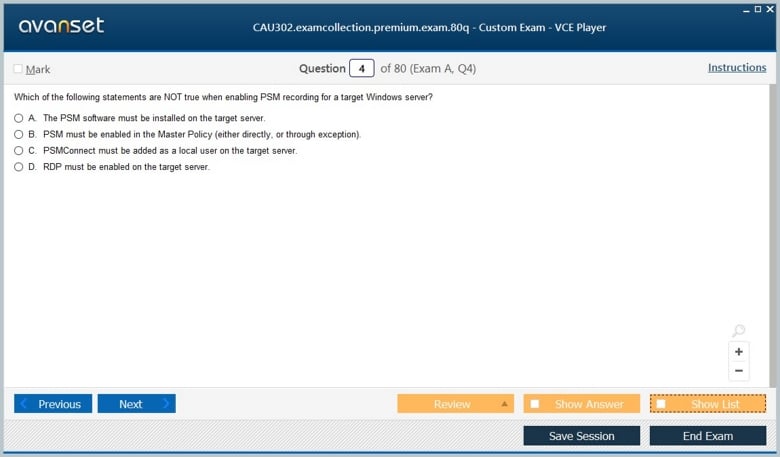
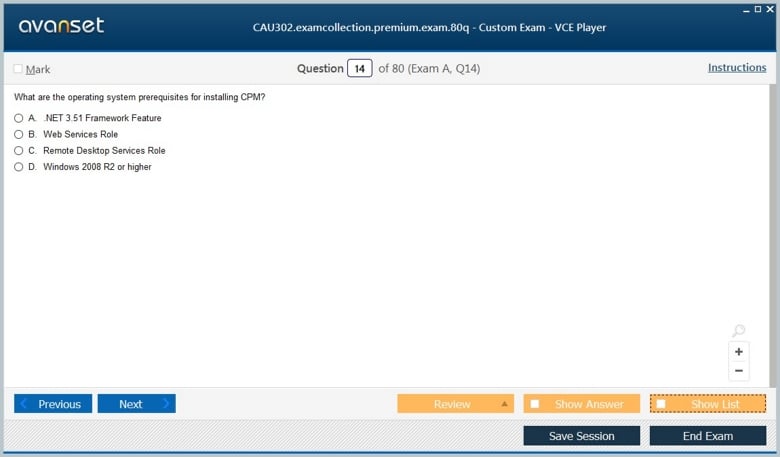
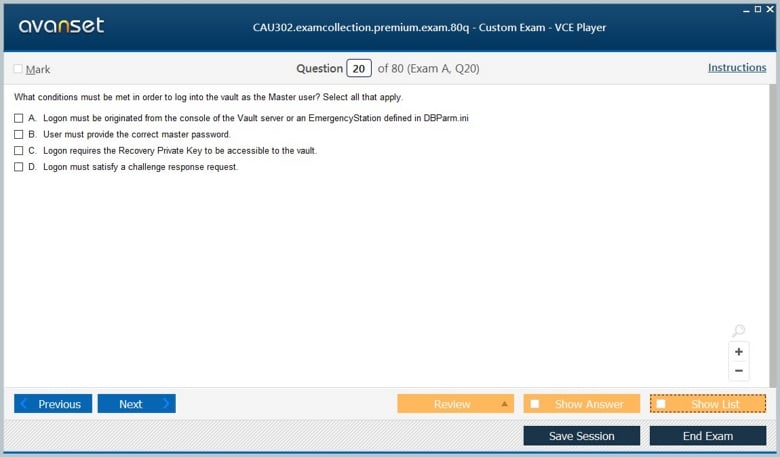
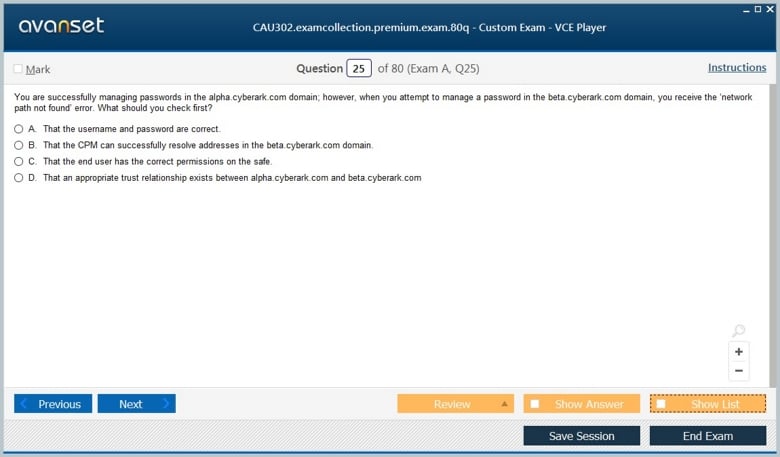
CyberArk CAU302 Practice Test Questions in VCE Format
| File | Votes | Size | Date |
|---|---|---|---|
File CyberArc.vceplayer.CAU302.v2026-07-16.by.louie.125q.vce |
Votes 1 |
Size 126.2 KB |
Date Jul 18, 2026 |
File CyberArc.selftestengine.CAU302.v2020-08-01.by.bonnie.62q.vce |
Votes 2 |
Size 53.92 KB |
Date Aug 01, 2020 |
File CyberArc.train4sure.CAU302.v2020-03-02.by.david.44q.vce |
Votes 2 |
Size 38.15 KB |
Date Mar 02, 2020 |
File CyberArc.Test-king.CAU302.v2019-05-03.by.Aurora.37q.vce |
Votes 5 |
Size 36.77 KB |
Date May 13, 2019 |
CyberArk CAU302 Practice Test Questions, Exam Dumps
CyberArk CAU302 (CyberArk Defender + Sentry) exam dumps vce, practice test questions, study guide & video training course to study and pass quickly and easily. CyberArk CAU302 CyberArk Defender + Sentry exam dumps & practice test questions and answers. You need avanset vce exam simulator in order to study the CyberArk CAU302 certification exam dumps & CyberArk CAU302 practice test questions in vce format.
CAU302 is a legacy CyberArk exam identified in older preparation material as CyberArk Defender + Sentry. CyberArk’s current Pearson VUE lineup no longer lists CAU302 as a live exam. Instead, current Privileged Access Management certification separates operational and deployment responsibilities into PAM-DEF and PAM-SEN.
That separation is useful for interpreting older CAU302 content. The combined exam expected candidates to understand both how a CyberArk PAM environment is configured and how it is operated. Those skills are still complementary, but candidates should not assume the legacy combined blueprint maps one-for-one to either current exam.
The best way to reuse CAU302 material is to classify each topic. Architecture, installation, platform configuration, and integration fit the Sentry side. Account onboarding, credential management, session operations, troubleshooting, monitoring, and routine administration fit the Defender side. Topics that rely on old interface behavior or product naming need current verification.
Security platforms often fail when implementation teams hand over an environment without considering how it will be operated. PAM is particularly sensitive because daily work includes onboarding accounts, rotating credentials, investigating failures, managing sessions, reviewing access, applying upgrades, and recovering from outages. A design that ignores those tasks creates pressure for exceptions and bypasses.
Combined Defender and Sentry thinking asks whether the architecture is operable. Can support staff identify ownership? Are platform rules understandable? Is monitoring sufficient? Are failure modes documented? Can routine changes be made without broad administrative privilege? Can the team recover when dependencies fail? These questions connect configuration choices to long-term security.
The risk-management approach is useful because every design decision creates operational consequences. A tighter control that administrators cannot use may lead to workarounds; an easy workflow with weak authorization may create unacceptable exposure.
A privileged account must be discovered, classified, assigned an owner, placed under policy, tested for credential management, and made accessible to the correct users. Service accounts and application credentials require additional dependency analysis because password changes can interrupt systems that still use the old secret.
From the Sentry perspective, platforms and policy should support the account type. From the Defender perspective, the onboarding process must be repeatable and diagnosable. A good onboarding record includes purpose, target, owner, access group, rotation expectations, dependencies, session method, validation result, and rollback plan.
This is closely related to secrets-management lifecycle control. A credential is not secured merely because it is stored centrally; it must also be delivered safely, rotated appropriately, monitored, and removed when no longer needed.
Automated password change reduces the useful life of a stolen secret, but it depends on target connectivity, account permissions, platform settings, and application compatibility. Operators need to know what a successful rotation looks like and what evidence indicates failure. Engineers need to configure the policy so the rotation behavior matches the account’s technical constraints.
Reconciliation addresses the case where the stored credential and target credential diverge. Because reconciliation may use an identity with powerful reset rights, it deserves strong protection and clear ownership. The organization should know when reconciliation is invoked, who can trigger it, and how the event is logged.
Candidates should practice failure scenarios instead of studying only the happy path. Change the target password outside the vault, disable the account, block the network path, alter a platform property, or remove a dependency. Then reason about which component detects the problem and what recovery step restores controlled state.
Privileged session management can isolate users from target credentials, broker connections, record activity, and enforce restrictions. That security value depends on correct deployment and reliable daily operation. Sentry skills establish the session infrastructure; Defender skills keep it usable and investigate failures.
A troubleshooting model should move from user authorization to session broker health, network path, target configuration, credential validity, and policy. The team should avoid disabling session controls simply because the first connection attempt failed. Bypasses that begin as temporary workarounds have a habit of becoming permanent.
Recorded sessions can support incident investigation, but only if timestamps are accurate, retention is appropriate, recordings are protected, and investigators can retrieve them. Auditability has to be designed into the system.
A person who administers target servers does not automatically need authority to change PAM security policy. A help-desk operator who assists users should not require unrestricted access to safes or platform configuration. Separation of duties reduces the chance that one account compromise can both obtain privileged credentials and weaken the controls protecting them.
The principles behind role-based access control are a useful cross-vendor model. Define the task, grant the minimum permission required, review assignments, and use stronger controls for high-impact administration.
Combined CAU302 preparation should include mapping roles for vault administration, platform configuration, account onboarding, password management, session operations, audit review, and emergency access. If every role collapses into one broad administrator identity, the architecture has lost an important security boundary.
A PAM platform can fail silently in ways that weaken security: password rotations stop, session recording is unavailable, a directory integration fails, certificates approach expiration, a connector loses reachability, or privileged accounts remain unmanaged. Operational monitoring should detect these conditions before users create workarounds.
Security monitoring also matters. Repeated access failures, unusual privileged sessions, policy changes, emergency access, new administrators, and unexpected credential retrieval can all deserve review. The SIEM analysis mindset helps candidates connect platform events to an investigation timeline.
The combined lesson is that availability and security are not opposing concerns. A reliable platform encourages administrators to use the control path; an unreliable one creates pressure to bypass it. Good engineering makes the secure workflow the dependable workflow.
Upgrades, new target platforms, policy changes, certificate renewals, network changes, and new integrations can all affect PAM operation. Sentry-level knowledge helps engineers understand architectural impact, while Defender-level knowledge helps operators detect and manage the real production consequences.
Changes should be scoped, tested, approved, documented, monitored, and reversible. Before changing a policy that affects hundreds of accounts, identify representative test cases. Before upgrading session infrastructure, confirm capacity and rollback. Before changing an integration credential, know which components depend on it.
The habits behind security auditing and change traceability matter because privileged-access systems need an accountable record of high-impact administrative changes.
Current candidates should not look for a direct one-code replacement for CAU302. CyberArk’s live program separates PAM Defender and PAM Sentry exams, and the responsibilities are clearer when studied that way. Use older combined material to see how design and operations influence each other, but map every topic to the current credential that now owns it.
A practical exercise is to take one PAM feature and describe it twice. First explain how a Sentry engineer would design and configure it. Then explain how a Defender operator would monitor, troubleshoot, and maintain it. The difference reveals why the current role split makes sense.
CAU302 is best treated as a historical bridge. Its value lies in showing that PAM security is not finished at deployment and is not sustainable through operations alone. Strong privileged access requires both: sound architecture and disciplined daily control.
The older combined model is particularly useful for understanding upgrade planning. A Sentry engineer may know which components and prerequisites change, while a Defender operator knows which daily workflows are sensitive to interruption. Combining those perspectives produces a safer upgrade plan: inventory dependencies, confirm compatibility, back up configuration, test representative accounts and sessions, schedule rollback, and monitor the environment after the change.
Audit requests also expose the value of combined knowledge. An auditor may ask who can access a privileged account, how the password is controlled, whether the session was recorded, who changed the policy, and how long the evidence is retained. Answering well requires both configuration knowledge and operational records. A platform that is securely designed but poorly evidenced can still create governance problems; a well-documented platform with weak technical controls creates the opposite risk.
Another strong practice exercise is to follow one privileged identity from discovery through retirement. Identify how it is found, classified, onboarded, assigned policy, rotated, requested, used in a session, monitored, reviewed, transferred to a new owner, and ultimately removed. At each stage, decide whether the responsibility is primarily Sentry, Defender, or shared. This lifecycle view prevents the old combined material from becoming a collection of disconnected product features.
Current study should therefore preserve the integration between roles without preserving the obsolete exam structure. PAM-DEF and PAM-SEN are separate credentials, but organizations still need their practitioners to understand one another. Good Sentry engineering reduces Defender workload, and good Defender feedback reveals where architecture needs improvement. That feedback loop is one of the most durable lessons from CAU302.
Combined-role thinking also helps with service-level expectations. A deployment team may consider a component healthy because the service is running, while operators know that password changes are delayed or sessions intermittently fail. Define health from the user and control outcome, not merely process status, so monitoring reflects whether privileged access is actually being protected.
Go to testing centre with ease on our mind when you use CyberArk CAU302 vce exam dumps, practice test questions and answers. CyberArk CAU302 CyberArk Defender + Sentry certification practice test questions and answers, study guide, exam dumps and video training course in vce format to help you study with ease. Prepare with confidence and study using CyberArk CAU302 exam dumps & practice test questions and answers vce from ExamCollection.
Purchase Individually
Top CyberArk Certifications

Top CyberArk Certification Exams
Site Search:

SPECIAL OFFER: GET 10% OFF

Pass your Exam with ExamCollection's PREMIUM files!
SPECIAL OFFER: GET 10% OFF
Use Discount Code:
MIN10OFF
A confirmation link was sent to your e-mail.
Please check your mailbox for a message from support@examcollection.com and follow the directions.

Download Free Demo of VCE Exam Simulator
Experience Avanset VCE Exam Simulator for yourself.
Simply submit your e-mail address below to get started with our interactive software demo of your free trial.
Does this exam contain a .vce player, or just the file?