



Premium File
40 Q&A
$76.99$69.99
CyberArk CAU301 Exam Questions & Answers, Accurate & Verified By IT Experts
Instant Download, Free Fast Updates, 99.6% Pass Rate
40 Questions & Answers
Last Update: Sep 20, 2026
$69.99
CyberArk CAU301 Exam Screenshots
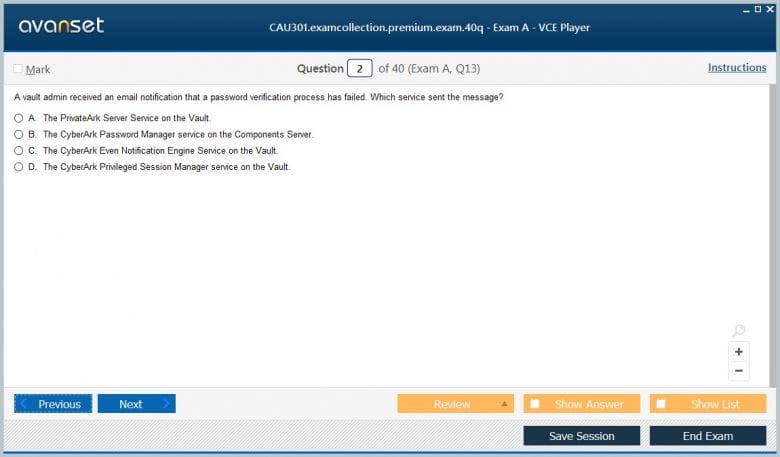
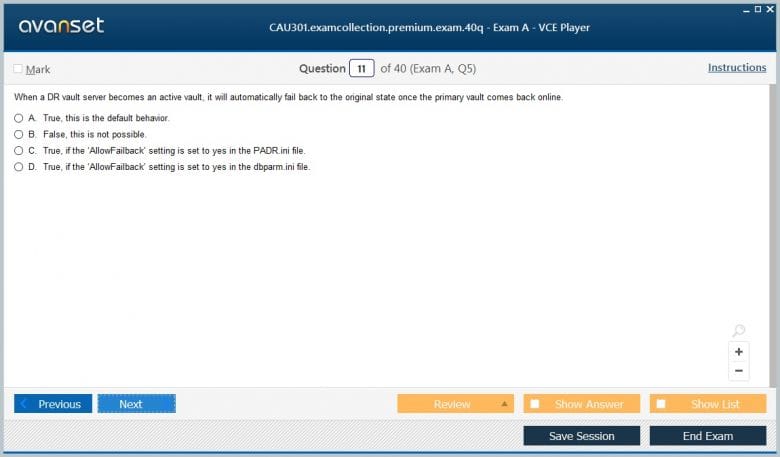
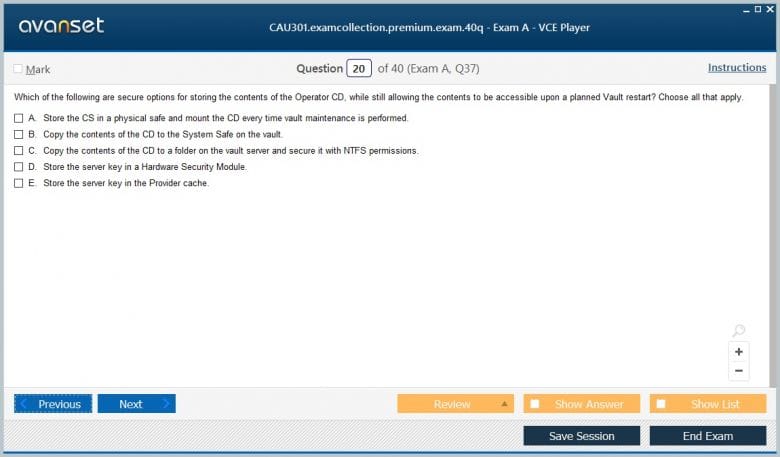
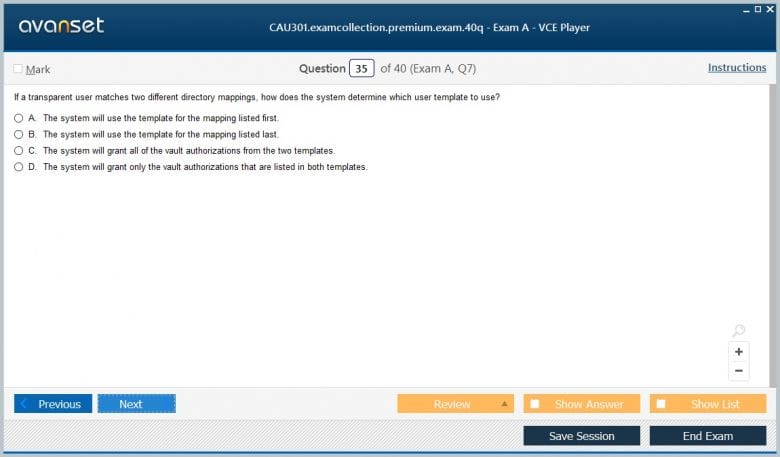
CyberArk CAU301 Practice Test Questions in VCE Format
| File | Votes | Size | Date |
|---|---|---|---|
File CyberArc.testking.CAU301.v2026-08-11.by.lana.24q.vce |
Votes 1 |
Size 27.27 KB |
Date Aug 11, 2026 |
File CyberArc.Prep4sure.CAU301.v2019-05-05.by.Selene.19q.vce |
Votes 3 |
Size 21.07 KB |
Date May 09, 2019 |
CyberArk CAU301 Practice Test Questions, Exam Dumps
CyberArk CAU301 (CyberArk Sentry) exam dumps vce, practice test questions, study guide & video training course to study and pass quickly and easily. CyberArk CAU301 CyberArk Sentry exam dumps & practice test questions and answers. You need avanset vce exam simulator in order to study the CyberArk CAU301 certification exam dumps & CyberArk CAU301 practice test questions in vce format.
CAU301 is an older CyberArk Sentry exam identifier associated with deployment and configuration of privileged access security. It is not part of CyberArk’s current Pearson VUE exam list. The live Privileged Access Management Sentry exam is PAM-SEN, so CAU301 should be treated as legacy study material rather than a current booking code.
The Sentry role is still recognizable. CyberArk describes Sentry certification as validating practical skills in deploying, installing, and configuring the relevant solution. For PAM, that means turning an architectural requirement into a working privileged-access service: core components, connectivity, authentication, credential management, session brokering, policy, resilience, and integrations all have to work together.
Candidates using older CAU301 resources should separate durable architecture from version-specific procedure. Network flows, security boundaries, dependency planning, service accounts, certificates, high availability, onboarding, and validation remain useful. Product screens, installer steps, naming, and default settings are more likely to have changed and should be checked against current CyberArk material.
A good PAM deployment starts by understanding what the organization is trying to protect. How many privileged identities exist? Which systems are critical? Which administrators need access? Are targets on premises, in cloud environments, or both? Which sessions need recording? What recovery expectations apply? Which integrations are mandatory? These answers shape topology, sizing, network placement, and operational ownership.
Skipping this step creates brittle architecture. A platform can be installed successfully and still fail the business because a firewall path was missed, session capacity is inadequate, disaster recovery is untested, or credential-management rules conflict with application dependencies. Sentry-level work requires thinking beyond the installer and treating the platform as a security service.
The broader risk-management perspective helps because privileged access should be prioritized by consequence. Root access to a production database, local administration on a test workstation, and a service identity with domain-wide rights do not present the same operational or security risk.
Privileged access platforms include components that store credentials, provide user interfaces, rotate passwords, broker sessions, integrate with identity systems, and communicate with target infrastructure. A candidate should understand which connections are required, which credentials each component uses, what certificates protect, and what happens if a dependency is unavailable.
Draw the architecture and annotate the trust boundaries. Mark administrator access, user access, directory integration, target connections, password-management paths, session paths, backup flows, and monitoring. The exercise reveals where firewall rules, DNS, certificates, time synchronization, service identities, and high availability can affect the deployment.
This also supports troubleshooting. When a session fails, the answer is rarely “CyberArk is broken.” The failure may be authentication, policy, network reachability, target configuration, a certificate, a service account, a connector, or a dependency. Architecture gives the engineer a map for isolating the problem.
A PAM platform is itself highly privileged. Installation and configuration should minimize unnecessary accounts, services, firewall exposure, local administrator use, and shared credentials. Hardening should be treated as part of deployment rather than a cleanup task after go-live.
Administrative separation is particularly important. The people who operate target systems do not automatically need unrestricted control of the PAM platform. Likewise, platform administrators should use protected administrative identities and should not perform ordinary work with the same credentials. Separation reduces the chance that one compromise defeats the entire control layer.
The ideas behind zero-trust architecture are relevant because privileged access should be explicitly authenticated, authorized, monitored, and scoped. Network location alone is not sufficient evidence that an administrator or component should be trusted.
Credentials must be organized so ownership and authorization remain understandable. A safe or equivalent logical container should have a clear purpose, defined administrators, controlled membership, and access rules that match business responsibilities. Creating large catch-all containers may be convenient initially but makes later review and incident analysis harder.
Policy also determines password rotation, reconciliation, access approval, dual control, session handling, and other behavior. Sentry engineers need to understand how these settings interact because one change can influence many accounts. Before changing a platform-wide rule, identify the population affected and test the result on representative accounts.
The role-based access-control model is useful for reviewing privileges: map users and groups to business functions, grant only the permissions required, and periodically verify that assignments still match the role.
Automated rotation is powerful, but service accounts and application credentials can fail when dependencies are unknown. Sentry work should identify how each credential is used before enabling aggressive management. Application teams may need integrations that retrieve updated secrets automatically so rotation improves security without creating outages.
Reconciliation must also be designed. If the stored secret and target secret no longer match, the organization needs a controlled recovery path with sufficient authority to reset the account. That recovery identity is sensitive and should be protected accordingly. A poorly governed reconciliation account can become a hidden master key.
The principles in secrets management reinforce the architecture: secret storage, delivery, rotation, logging, and application integration should reduce human exposure and avoid long-lived credentials embedded in code or configuration.
Brokering privileged sessions can prevent users from seeing credentials, record activity, and enforce connection workflows. The architecture needs enough capacity, network reachability, and target compatibility to support real operations. If session infrastructure is unreliable, administrators will pressure the organization to bypass it.
Sentry engineers should test common and failure scenarios before production use. Can the user connect? Is the correct target identity used? Is the session recorded? Are file transfer or clipboard controls behaving as intended? What happens when the target is slow, the broker restarts, or a certificate expires? Security controls become credible only when they survive operational stress.
Session records can later support incident response. That makes retention, time synchronization, access to recordings, and audit protection part of the deployment rather than optional reporting features.
Privileged access is often required during outages, which means the PAM service must remain available when other infrastructure is degraded. High availability, backups, disaster recovery, emergency access, and documented recovery procedures all deserve explicit design. A theoretical recovery architecture is not enough if no one has tested failover or restoration.
Engineers should define which components are redundant, what data must be replicated, what recovery time is acceptable, how DNS or load balancing changes during failover, and how administrators access critical credentials if normal interfaces are unavailable. Emergency procedures should be controlled and audited so resilience does not create a permanent bypass.
Testing should include partial failure. A complete disaster is easy to imagine, but real incidents often involve one failed node, a network partition, an expired certificate, a directory outage, or a damaged integration. Sentry-level skill is the ability to predict those dependencies and recover without weakening controls.
Older CAU301 material can still explain CyberArk Sentry architecture, but the current certification structure is more explicitly product aligned. Compare legacy topics with current PAM-SEN objectives and remove assumptions that depend on obsolete interfaces or component behavior. Keep the architectural reasoning; refresh the implementation details.
The relationship with PAM-DEF is also useful. Defender operators maintain the deployed environment; Sentry engineers design and configure it. Studying both perspectives exposes practical deployment mistakes because a design that is difficult to operate will eventually become a security problem.
Treat CAU301 as historical preparation material and PAM-SEN as the live destination. The lasting Sentry skill is the ability to convert security requirements into a deployable, resilient PAM architecture whose trust relationships, credential flows, policies, and recovery paths are understood rather than accidental.
Integration planning deserves the same care as core installation. Directory services, SIEM platforms, ticketing systems, multifactor providers, cloud environments, and target-management tools may all exchange identity or event data with the PAM service. Engineers should define authentication methods, service identities, certificates, API permissions, network paths, ownership, and failure behavior for each integration. A successful API test during deployment does not prove the integration will remain secure and supportable after credentials or certificates change.
Sentry engineers should also prepare a handover package for operations. Architecture diagrams, component inventories, firewall flows, certificate ownership, service-account details, backup procedures, monitoring thresholds, common failure modes, escalation contacts, and change procedures reduce dependence on the original implementer. Documentation is most valuable when it helps the Defender team diagnose a real incident months after the project closes.
Capacity is part of security architecture because overloaded components create pressure for bypass. Session concurrency, credential-management workload, log volume, storage, network bandwidth, and growth expectations should be estimated and monitored. A design that supports today’s privileged population but has no margin for acquisitions, cloud growth, or new administrators can become fragile long before anyone recognizes it as a security risk.
Deployment validation should finish with acceptance criteria that operations can repeat. Instead of recording only that installation succeeded, confirm authentication, password change, reconciliation, session launch, recording, audit events, failover, backup, and representative target access. Those checks become a baseline the operations team can use later when upgrades or incidents change the environment.
Go to testing centre with ease on our mind when you use CyberArk CAU301 vce exam dumps, practice test questions and answers. CyberArk CAU301 CyberArk Sentry certification practice test questions and answers, study guide, exam dumps and video training course in vce format to help you study with ease. Prepare with confidence and study using CyberArk CAU301 exam dumps & practice test questions and answers vce from ExamCollection.
Purchase Individually
Top CyberArk Certifications

Top CyberArk Certification Exams
Site Search:

SPECIAL OFFER: GET 10% OFF

Pass your Exam with ExamCollection's PREMIUM files!
SPECIAL OFFER: GET 10% OFF
Use Discount Code:
MIN10OFF
A confirmation link was sent to your e-mail.
Please check your mailbox for a message from support@examcollection.com and follow the directions.

Download Free Demo of VCE Exam Simulator
Experience Avanset VCE Exam Simulator for yourself.
Simply submit your e-mail address below to get started with our interactive software demo of your free trial.