



Premium File
144 Q&A
$76.99$69.99
IBM C2010-555 Exam Questions & Answers, Accurate & Verified By IT Experts
Instant Download, Free Fast Updates, 99.6% Pass Rate
144 Questions & Answers
Last Update: Oct 21, 2026
$69.99
IBM C2010-555 Exam Screenshots
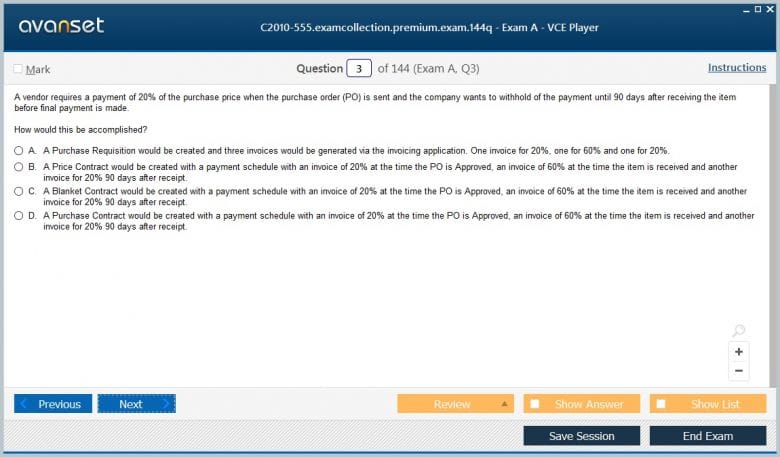
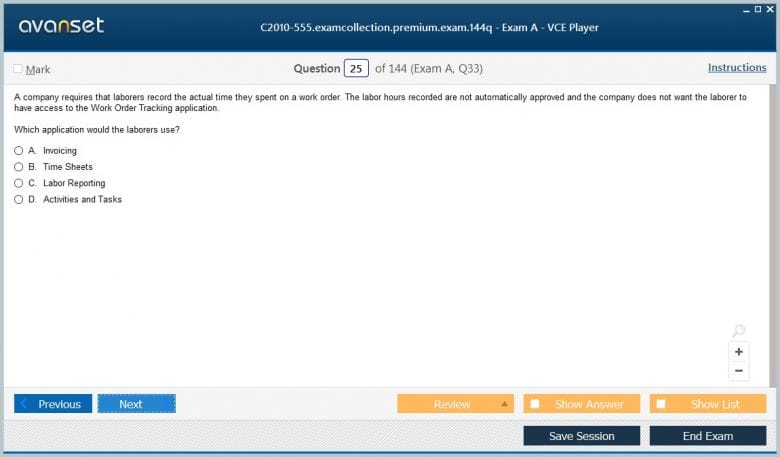
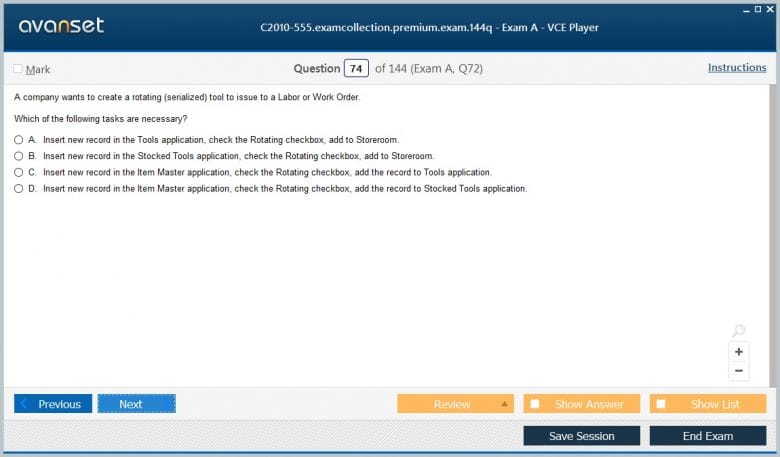
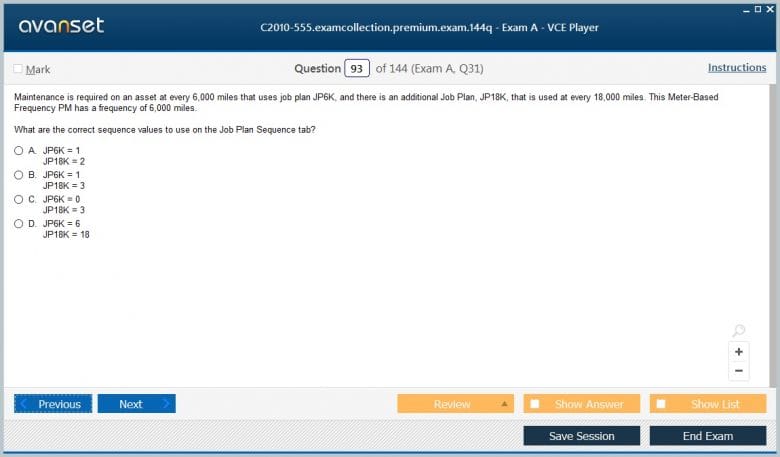
IBM C2010-555 Practice Test Questions in VCE Format
| File | Votes | Size | Date |
|---|---|---|---|
File IBM.selftestengine.C2010-555.v2026-09-03.by.victoria.79q.vce |
Votes 1 |
Size 102.11 KB |
Date Sep 05, 2026 |
File IBM.Pass4sure.C2010-555.v2019-02-03.by.James.60q.vce |
Votes 2 |
Size 81.15 KB |
Date Feb 05, 2019 |
IBM C2010-555 Practice Test Questions, Exam Dumps
IBM C2010-555 (IBM Maximo Asset Management v7.6 Functional Analyst) exam dumps vce, practice test questions, study guide & video training course to study and pass quickly and easily. IBM C2010-555 IBM Maximo Asset Management v7.6 Functional Analyst exam dumps & practice test questions and answers. You need avanset vce exam simulator in order to study the IBM C2010-555 certification exam dumps & IBM C2010-555 practice test questions in vce format.
C2010-555, IBM Maximo Asset Management v7.6 Functional Analyst, belongs to an older Maximo certification generation, but the exam remains useful as a map of how maintenance organizations translate policy into day-to-day system behavior. Its real subject was not memorizing screens. It was understanding how assets, locations, work orders, job plans, inventory, purchasing, contracts, labor, preventive maintenance, security, reporting, and financial controls fit together in one operating model.
That distinction matters because Maximo 7.6 is now legacy technology. IBM ended regular base support for the 7.6.1 line in 2025, while the product family has moved into Maximo Application Suite and Maximo Manage v9.0. A candidate reading C2010-555 today should therefore treat the blueprint as historical functional architecture. The durable skill is learning to reason from a maintenance requirement to the records, statuses, workflows, controls, and downstream effects that make the requirement work.
A functional analyst begins by understanding how the organization actually maintains assets. What creates demand for work? Which work is planned, corrective, emergency, inspection-driven, or preventive? Who approves it? Which craft, crew, tool, material, vendor, permit, and financial account is involved? Maximo applications represent pieces of that operating model, so studying by menu name alone hides the relationships the exam was designed to test. Build scenarios that begin with an operational need and follow it through to execution and closeout.
This is also the best way to distinguish C2010-555 from the infrastructure emphasis of C2010-530. The functional analyst is concerned with whether the configured process expresses the maintenance policy correctly; the infrastructure specialist is more concerned with platform architecture, middleware, installation, and technical operation. Real projects need both perspectives, but they solve different classes of problem and should not be collapsed into one generic Maximo study plan.
Assets answer what is being maintained; locations answer where operational responsibility is organized. Systems and hierarchies let the organization roll information upward without losing detail at the equipment level. A weak implementation creates duplicate locations, ambiguous asset moves, or inconsistent classification. A strong one makes it possible to ask questions such as which pumps in a process train consume the most labor, which buildings generate recurring corrective work, or where a failure pattern is spreading across similar equipment.
Functional analysis therefore includes governance. Define naming rules, status behavior, move and swap procedures, meter use, parent-child relationships, and the meaning of classification attributes before mass loading records. Once history accumulates, structural changes become expensive because reports, preventive maintenance, inventory reservations, warranties, and financial analysis depend on the same master data. The broader lesson in the article on Maximo 7.6 functional analysis is that product knowledge only becomes valuable when it is tied to the business process that consumes it.
The work order is the central record for turning maintenance intent into accountable execution. Candidates should understand status progression, ownership, assignments, planned versus actual labor, material and service use, related records, safety context, failure reporting, and how child or task work orders change control and costing. The most important question is often not which button performs an action, but what should be true before that action is allowed and what evidence should exist after it occurs.
Job plans and work plans make repeatable work more reliable, yet reuse creates governance requirements. A job plan can standardize tasks, crafts, tools, materials, services, and sequencing, but revisions must be controlled so planners know which version applies. Functional analysts should also know when a plan is only a starting template and when field conditions require an authorized change. If every technician edits the work differently, planning loses value; if no one can adapt a plan, the system stops reflecting operational reality.
Route-based and condition-driven maintenance also expose the difference between generating work and managing reliability. When several assets can be inspected in one route, the configuration should reduce travel and duplicated administration without hiding asset-specific findings. Meter readings, condition observations, and failure codes need disciplined entry because they influence future maintenance decisions. Functional analysts should test what happens when readings are late, assets are unavailable, or a PM is intentionally deferred, and make sure the record still explains the operational decision.
Preventive maintenance appears simple when described as work generated every thirty days, but production behavior is more subtle. Time-based, meter-based, seasonal, and route-related requirements can interact with job plan sequencing and lead time. Forecasts matter because labor, materials, access windows, and shutdown coordination often need to be arranged before the due date. A well-designed PM setup balances reliability risk against the cost of unnecessary work and avoids creating huge backlogs through unrealistic frequencies.
Candidates should trace the full cycle: a PM record determines when work should be generated; the generated work order inherits planning information; scheduling and assignment convert that plan into field action; actuals and failure information return operational evidence. If those final steps are weak, the organization keeps generating work but learns little from it. The same principle applies in modern Maximo Manage: automated generation is useful only when the resulting work remains connected to planning quality and trustworthy completion data.
Maintenance stores are not merely bins of parts. Reorder settings, balances, reservations, issues, transfers, rotating items, condition-enabled items, vendors, lead times, and costing methods influence whether planned work can actually start and what the work ultimately costs. Functional analysts should understand the difference between stocking policy and purchasing policy, and why a part that is technically available somewhere in the enterprise may still be unavailable to a specific storeroom or work order.
Study with shortage and replenishment scenarios rather than isolated definitions. Ask what happens when a reserved part is unavailable, when lead time exceeds the maintenance window, when a rotating asset is issued, when a vendor changes, or when an item is moved between storerooms. Those scenarios expose the relationship among inventory, purchasing, work planning, and GL accounting. They also show why data quality in item masters and storeroom balances is critical to maintenance credibility.
Purchase requisitions, purchase orders, receipts, invoices, contracts, vendors, and service procurement form a control chain. The functional requirement is to buy what operations needs while maintaining authorization, pricing, receiving evidence, and financial traceability. Approval limits and security groups matter because the same person should not necessarily be able to request, approve, receive, and financially close every transaction. Study the process as a sequence of business controls rather than a list of purchasing screens.
Emergency maintenance introduces tension: equipment may need immediate external labor or material before the normal purchasing cycle finishes. A good configuration defines the exception path rather than encouraging users to bypass the system. Functional analysts should know how workflow, status rules, approval limits, contracts, and later reconciliation can support urgency while still producing an audit trail. That logic connects naturally to broader policy and risk management: controls should shape behavior under pressure, not only under ideal conditions.
People, labor records, crafts, qualifications, calendars, shifts, availability, and assignments turn a work backlog into a capacity problem that can be managed. The exam’s functional questions often reward understanding of where availability is maintained and how work is assigned, but the deeper concept is that resource planning depends on correct calendars and skills. A plan that calls for two electricians during a shutdown is meaningless if the system does not know who is qualified and available in that window.
Functional analysts should validate the reporting consequences as well. Planned labor is a forecast; actual labor is evidence. Variance can reveal poor estimating, emergency interruptions, training gaps, or scope changes. When organizations use crews, contractors, or multiple shifts, the model needs enough detail to support scheduling without becoming so complex that supervisors avoid maintaining it. The right design makes constraints visible while keeping field updates practical.
GL accounts, cost components, charge stores, work order actuals, contracts, purchase transactions, and asset-related spending create the financial story of maintenance. Analysts need to know which transactions create costs and where those costs are recorded. The operational goal may be to restore equipment, but management also needs to compare planned versus actual spending, understand cost by asset or location, distinguish labor from materials and services, and support capitalization or other accounting rules where required.
A useful test scenario follows one work order from planning through procurement, issue, labor reporting, completion, and financial reporting. If a candidate can explain which master data and transaction records support each step, the exam becomes much less arbitrary. It also prepares the analyst for migration work, because finance is one of the areas where old Maximo configurations cannot simply be copied into a newer platform without validating the business assumptions behind them.
Treat the legacy blueprint as a process map for modern Maximo work. C2010-555 should not be presented as a current certification path. Its value today is historical and architectural: it captures the functional concerns that made enterprise asset management coherent in Maximo 7.6. Organizations moving forward still have to model assets, plan work, manage preventive maintenance, control inventory and procurement, allocate labor, and produce trustworthy operational and financial evidence. Product interfaces change faster than those responsibilities.
Use the old exam page as a structured checklist, then validate modern execution in the current Maximo documentation and environment. The broader IBM certifications also helps distinguish old codes from newer product generations. The strongest preparation outcome is not remembering an obsolete dialog path; it is being able to explain why a maintenance process is configured a certain way, how records move through it, and which controls make the resulting history reliable.
Go to testing centre with ease on our mind when you use IBM C2010-555 vce exam dumps, practice test questions and answers. IBM C2010-555 IBM Maximo Asset Management v7.6 Functional Analyst certification practice test questions and answers, study guide, exam dumps and video training course in vce format to help you study with ease. Prepare with confidence and study using IBM C2010-555 exam dumps & practice test questions and answers vce from ExamCollection.
Purchase Individually
Site Search:

SPECIAL OFFER: GET 10% OFF

Pass your Exam with ExamCollection's PREMIUM files!
SPECIAL OFFER: GET 10% OFF
Use Discount Code:
MIN10OFF
A confirmation link was sent to your e-mail.
Please check your mailbox for a message from support@examcollection.com and follow the directions.

Download Free Demo of VCE Exam Simulator
Experience Avanset VCE Exam Simulator for yourself.
Simply submit your e-mail address below to get started with our interactive software demo of your free trial.