



Premium File
73 Q&A
$76.99$69.99
IBM C2010-530 Exam Questions & Answers, Accurate & Verified By IT Experts
Instant Download, Free Fast Updates, 99.6% Pass Rate
73 Questions & Answers
Last Update: Nov 14, 2026
$69.99
IBM C2010-530 Exam Screenshots
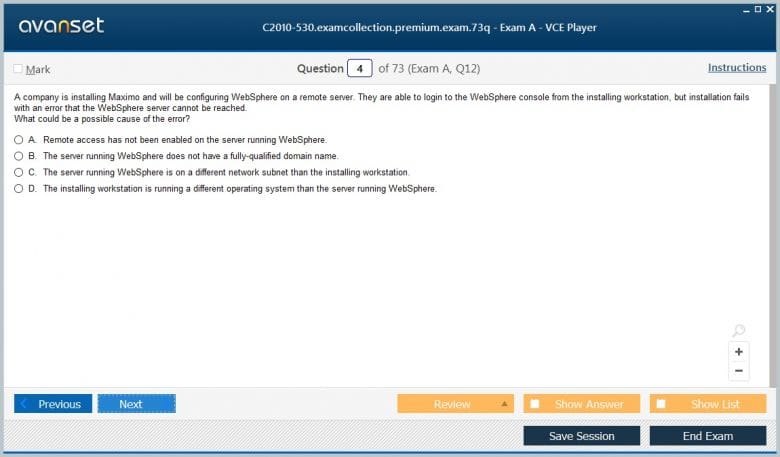
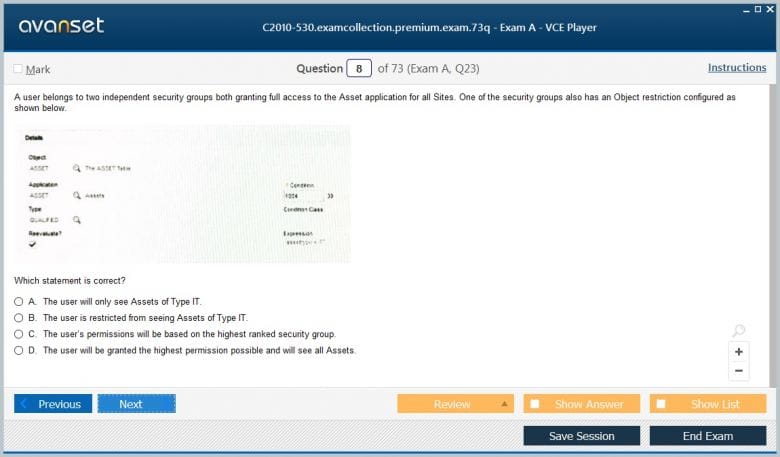
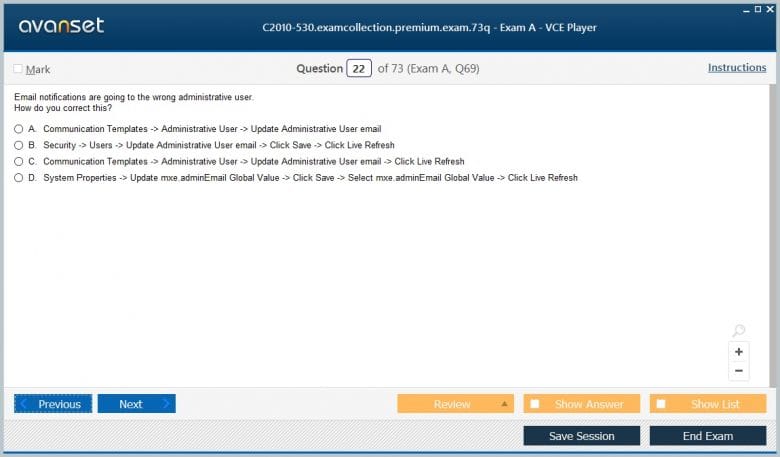
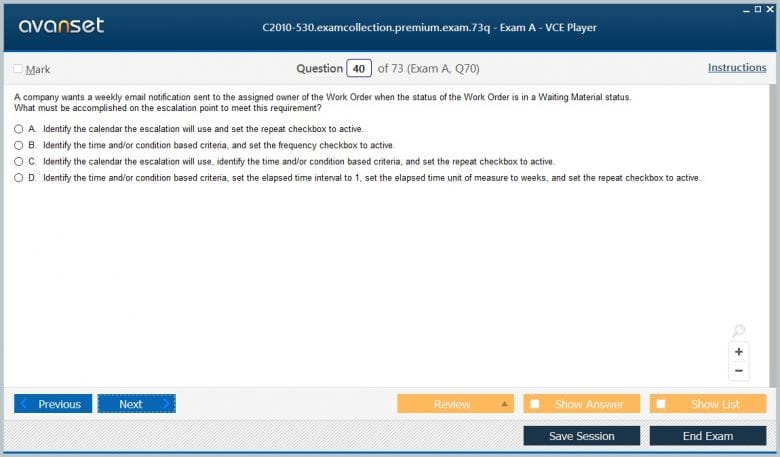
IBM C2010-530 Practice Test Questions in VCE Format
| File | Votes | Size | Date |
|---|---|---|---|
File IBM.practicetest.C2010-530.v2026-09-28.by.juan.40q.vce |
Votes 1 |
Size 149.1 KB |
Date Sep 30, 2026 |
File IBM.Certkiller.C2010-530.v2019-03-04.by.Hollyn.44q.vce |
Votes 3 |
Size 155.74 KB |
Date Mar 10, 2019 |
IBM C2010-530 Practice Test Questions, Exam Dumps
IBM C2010-530 (IBM Maximo Asset Management V7.6 Infrastructure and Implementation) exam dumps vce, practice test questions, study guide & video training course to study and pass quickly and easily. IBM C2010-530 IBM Maximo Asset Management V7.6 Infrastructure and Implementation exam dumps & practice test questions and answers. You need avanset vce exam simulator in order to study the IBM C2010-530 certification exam dumps & IBM C2010-530 practice test questions in vce format.
C2010-530, IBM Maximo Asset Management V7.6 Infrastructure and Implementation, belongs to an earlier Maximo generation. IBM ended base support for Maximo 7.6.1 on September 30, 2025, and the current product direction is Maximo Application Suite and Maximo Manage v9. The page is therefore most useful as a historical implementation blueprint: it captures infrastructure, installation, integration, security, migration, reporting, and performance concerns that explain how traditional Maximo environments were built and why modernization projects still encounter those dependencies.
Candidates and operators working with an existing 7.6 estate should separate two questions. First, what did the C2010-530-era architecture require to run reliably? Second, what is the supported destination for the organization now? Treating the old environment as if nothing changed creates lifecycle risk, but treating it as disposable history is equally dangerous when current business processes, integrations, customizations, and data still depend on it.
A typical deployment combined Maximo application components with WebSphere Application Server, a relational database, HTTP or web-server routing, integration endpoints, reporting components, shared files, directories, and supporting operating-system services. Each tier had its own capacity, security, patching, backup, and availability requirements. Infrastructure design therefore started with user load, integration volume, report workload, topology, and recovery expectations rather than simply installing the application on the largest available server.
Dependencies must be mapped because failures propagate across tiers. A slow database can appear as application-server thread pressure; a certificate or LDAP problem can look like a Maximo login defect; a web-server routing issue can make healthy JVMs unreachable. Historical implementations remain easier to support when operators preserve diagrams, host roles, ports, service accounts, filesystem locations, JVM settings, database connections, and ownership for every external dependency.
Enterprise environments typically separated development, test, training, and production. Configuration needed to move through those environments without rebuilding critical settings manually. Installation records, middleware versions, fix packs, database configuration, deployment properties, and application artifacts formed part of the operational baseline. The biggest risk in an old estate is often not age itself but undocumented divergence accumulated through emergency fixes.
A baseline should let a team answer what is installed, why a setting differs, and whether the change can be recreated after recovery. The change-control principles are especially important for legacy systems because vendor updates, security patches, custom code, and middleware dependencies may have narrow compatibility windows. Back up configuration before change and verify the business transaction path afterward.
Maximo 7.6 depended heavily on application-server and database health. JVM heap, garbage collection, thread pools, connection pools, cluster members, session behavior, and deployment configuration influenced user response time and stability. Database indexes, statistics, locking, storage, and query behavior could have an equally large effect. Tuning one layer without evidence from the other often moved the bottleneck rather than removing it.
High availability also required more than clustering JVMs. Database recovery, shared storage, HTTP routing, integration endpoints, DNS, and authentication services all had to survive the failure scenario the organization claimed to support. Test failover with real user and integration transactions. A page loading successfully after a node failure does not prove that scheduled jobs, message-driven work, reports, and interfaces continued correctly.
Security groups and application permissions controlled what users could do inside Maximo, while LDAP or other directories could provide enterprise identity. WebSphere administrative access, database accounts, integration credentials, certificates, and service accounts added separate privilege layers. Least privilege required understanding each layer rather than assigning broad access simply because a functional task crossed several components.
Certificate and credential lifecycle was an operational concern as well. Expired TLS certificates or rotated directory credentials could disrupt integrations and user access even when Maximo configuration itself had not changed. Maintain ownership, expiration monitoring, protected storage, and recovery procedures. The broader principles in PKI and digital certificates remain relevant to any legacy estate that still exposes authenticated or encrypted services.
Maximo Integration Framework connected external systems through object structures, enterprise services, publish channels, endpoints, queues, and related processing. The important question was not merely how to move a record but which system owned it. Asset, vendor, inventory, labor, financial, and work data could become inconsistent if multiple systems updated the same entity without authority or conflict rules.
The core concepts in data integration apply directly: identifiers, transformations, validation, error queues, retries, ordering, and reconciliation determine whether interfaces are reliable. Existing 7.6 integrations should be inventoried before modernization because they often encode years of business assumptions that are not captured in a single design document.
BIRT or other reporting, escalations, cron tasks, integrations, and background processing could consume substantial resources even when interactive user counts were modest. Infrastructure planning therefore needed workload windows and concurrency assumptions. A nightly integration burst combined with preventive-maintenance generation and large reports could produce contention that never appeared during daytime testing.
Operators should monitor business scheduling as well as CPU and memory. Know which tasks are expected to run, their normal duration, what downstream systems they depend on, and how failures are retried. When a batch process slows, compare it with database load, JVM health, queue depth, storage latency, and recent configuration change rather than repeatedly restarting services and erasing useful evidence.
Maximo configurations such as workflows, domains, application definitions, database configuration, security settings, and other metadata often needed to move between environments. Migration mechanisms were valuable because they provided a controlled package and history rather than relying entirely on manual recreation. Teams still needed dependency planning, sequencing, validation, and rollback because a technically importable configuration could conflict with local data or customizations.
Before migration, document prerequisites and affected objects; after migration, test the specific business functions the package was meant to change. Keep emergency production edits exceptional and reconcile them back into the governed source environment. This lesson survives the product generation: configuration is software-like operational state, and unmanaged drift makes both incident recovery and future modernization harder.
Capacity tuning should use representative data volumes, integrations, scheduled jobs, concurrent users, and reports. JVM changes, database indexes, connection pools, and cron configuration need before-and-after measurements. Avoid permanent tuning based on one unusual incident. First identify whether the constraint is compute, memory, database, storage, network, lock contention, custom code, or external service latency.
Recovery testing must restore more than application binaries. Database state, attachments or document stores, configuration, integration state, certificates, custom code, reports, and middleware settings may all be required for a consistent service. Define recovery order and business validation. A successful database restore is incomplete if the application cannot authenticate, integrations replay transactions incorrectly, or critical documents are missing.
The modern path is Maximo Manage v9, but legacy knowledge still matters. For organizations still carrying 7.6 history, the current Maximo Manage v9.0 functional deployment path provides the clearest internal bridge to the modern product generation. The intermediate Maximo Manage v8.0 implementation blueprint also helps show how the product moved into the Maximo Application Suite era. These links should not be read as proof that C2010-530 is a current booking exam; they explain lineage and the continuing maintenance concepts.
Among related IBM certifications, C2010-530 should now be read as historical Maximo infrastructure context rather than the forward-looking path. Its durable lessons are architecture dependency mapping, repeatable installation, security layering, integration ownership, controlled configuration migration, performance evidence, and recoverable operations. Those are exactly the details a modernization team must understand before replacing or migrating a legacy Maximo environment; otherwise the new platform can reproduce old hidden dependencies in a less familiar form.
Inventory the existing estate before proposing migration: product and middleware versions, customizations, integrations, reports, cron tasks, data volume, document stores, identities, certificates, infrastructure dependencies, and business-critical workflows. Classify what can be retired, what must be rebuilt, what can be transformed, and what requires a temporary coexistence strategy. Capture owners and acceptance criteria so migration is governed by business continuity rather than only technical completion.
The older Maximo 7.6 functional material provides additional historical context, while the current Maximo Manage path should guide future skills. The right takeaway from C2010-530 is neither to preserve an unsupported generation indefinitely nor to ignore its architecture. Understand it well enough to operate remaining risk safely and to move data, processes, integrations, and controls into a supported platform with fewer surprises.
Transition testing should compare business outcomes across old and new platforms: preventive work generation, inventory balances, purchasing commitments, security roles, integrations, reports, and critical custom logic. Reconcile counts and values rather than relying only on screen-by-screen similarity. Some legacy behavior may be intentionally retired, but that should be an explicit business decision with an owner, not an accidental omission discovered after cutover.
Support planning should also recognize that extended or legacy environments carry increasing operational risk. Track unsupported middleware, security findings, expiring certificates, scarce specialist knowledge, and interfaces that depend on obsolete protocols. These risks help sequence migration work. The goal is to reduce exposure methodically while protecting the maintenance processes that still depend on the environment until their replacement is proven.
A transition plan should include knowledge transfer before legacy specialists leave. Capture customizations, unusual operational procedures, restart order, known failure signatures, integration contacts, and the rationale behind nonstandard configuration. Documentation reduces the risk that modernization deadlines are driven by disappearing institutional knowledge rather than a controlled business plan.
Go to testing centre with ease on our mind when you use IBM C2010-530 vce exam dumps, practice test questions and answers. IBM C2010-530 IBM Maximo Asset Management V7.6 Infrastructure and Implementation certification practice test questions and answers, study guide, exam dumps and video training course in vce format to help you study with ease. Prepare with confidence and study using IBM C2010-530 exam dumps & practice test questions and answers vce from ExamCollection.
Purchase Individually
Site Search:

SPECIAL OFFER: GET 10% OFF

Pass your Exam with ExamCollection's PREMIUM files!
SPECIAL OFFER: GET 10% OFF
Use Discount Code:
MIN10OFF
A confirmation link was sent to your e-mail.
Please check your mailbox for a message from support@examcollection.com and follow the directions.

Download Free Demo of VCE Exam Simulator
Experience Avanset VCE Exam Simulator for yourself.
Simply submit your e-mail address below to get started with our interactive software demo of your free trial.