



Premium File
145 Q&A
$76.99$69.99
Axis Communications AX0-100 Exam Questions & Answers, Accurate & Verified By IT Experts
Instant Download, Free Fast Updates, 99.6% Pass Rate
145 Questions & Answers
Last Update: Nov 05, 2026
$69.99
Axis Communications AX0-100 Exam Screenshots
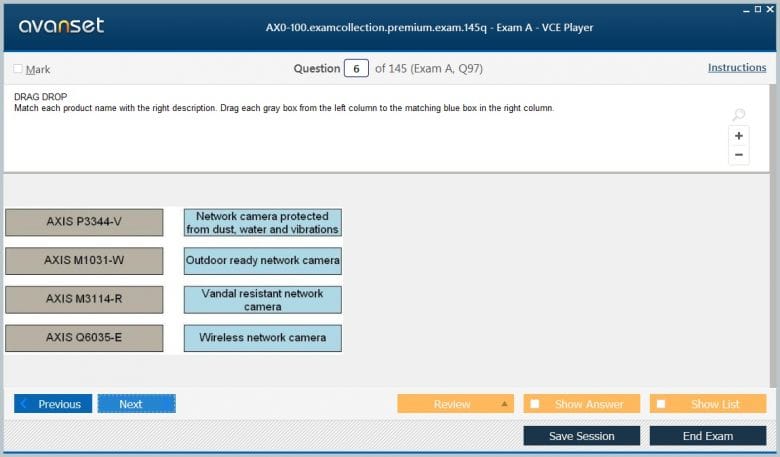
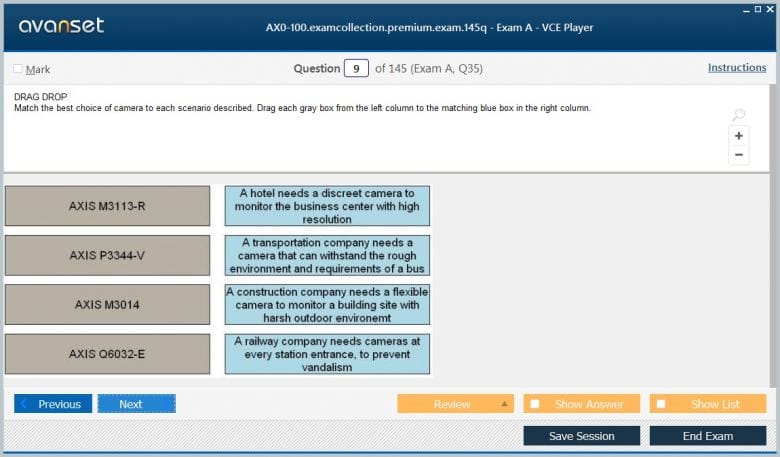
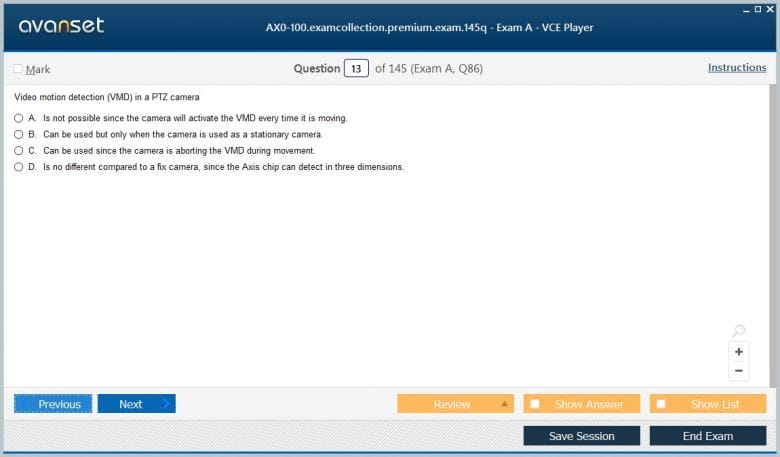
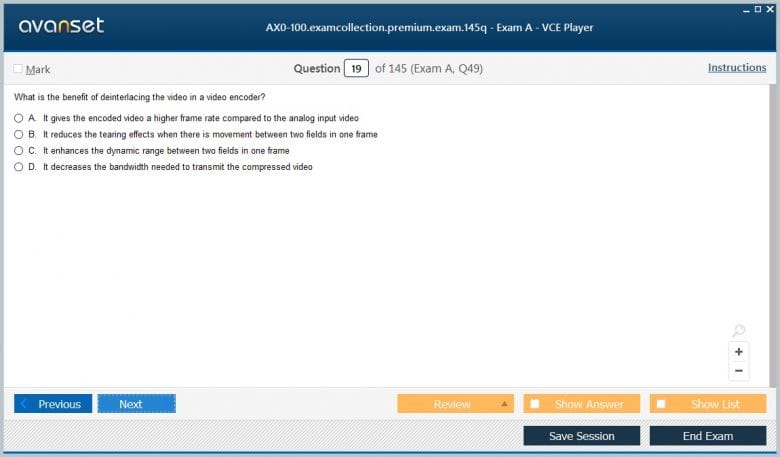
Axis Communications AX0-100 Practice Test Questions in VCE Format
| File | Votes | Size | Date |
|---|---|---|---|
File Axis Communications.examquestions.AX0-100.v2026-09-17.by.freya.80q.vce |
Votes 1 |
Size 124.91 KB |
Date Sep 16, 2026 |
File Axis Communications.Pass4sureexam.AX0-100.v2019-04-02.by.Betty.87q.vce |
Votes 3 |
Size 145.95 KB |
Date Apr 03, 2019 |
File Axis Communications.Pass4sure.AX0-100.v2015-03-12.by.Matt.145q.vce |
Votes 9 |
Size 577.17 KB |
Date Mar 12, 2015 |
Axis Communications AX0-100 Practice Test Questions, Exam Dumps
Axis Communications AX0-100 (Axis Network Video) exam dumps vce, practice test questions, study guide & video training course to study and pass quickly and easily. Axis Communications AX0-100 Axis Network Video exam dumps & practice test questions and answers. You need avanset vce exam simulator in order to study the Axis Communications AX0-100 certification exam dumps & Axis Communications AX0-100 practice test questions in vce format.
AX0-100 is an older exam code associated with the Axis Network Video certification lineage. It appears in long-running certification catalogs as the Axis Network Video Exam for the Axis Certified Professional credential, but Axis's current public program presents the assessment simply as the Axis Network Video Exam and does not center the AX0-100 code in its current registration guidance. Candidates should therefore treat AX0-100 as historical catalog context rather than assume the code is still the active booking identifier.
The underlying subject remains highly relevant. Axis still certifies professionals on network-video system design, network video technology, networking, Axis product knowledge, and installation. Those categories explain why older AX0-100 material can still teach useful fundamentals while being unsafe as a source for current exam logistics, product details, or registration procedures.
For current planning, start with the Axis Communications certification context and the live Axis program. AX0-100 is most useful for people who encounter AX0-100 in older training records, resumes, archived study plans, or legacy certification databases and need to understand what knowledge that code represented.
AX0-100 was associated with a professional credential for people who design and work with network-video systems. The required knowledge therefore extended beyond navigating a camera interface. Candidates needed to understand image formation, networking, system design, installation, storage, and the interaction between devices and video-management systems.
That breadth is still visible in the current Axis program. A technician who only knows one product menu may solve routine configuration tasks but struggle when image quality, bandwidth, PoE capacity, storage, and network architecture collide. Certification aims to test the system-level judgment behind those choices.
Lens choice, focal length, field of view, aperture, focus, and mounting distance establish what the camera can capture before digital processing begins. If the scene is too wide for the required detail, later enhancement cannot recreate information that the sensor never received.
Historical preparation should therefore be refreshed with practical observation. Compare wide and narrow fields of view, test how depth of field changes, watch how focus behaves in low light, and relate lens choices to the surveillance objective. These concepts survive product generations because they are rooted in imaging physics.
Shutter speed, aperture, gain, illumination, and sensor behavior interact. A longer exposure may brighten a dark scene but blur movement. More gain may reveal a subject but increase noise. Infrared illumination can improve night visibility while changing color rendering and scene contrast. Wide dynamic range can help when bright and dark regions coexist.
The valuable skill is not memorizing one preferred setting. It is recognizing which tradeoff explains the observed image and choosing the setting that protects the actual evidence the customer needs. That reasoning remains relevant whether the camera is from the AX0-100 era or the current product line.
Network video must be encoded, transported, and retained. Resolution, frame rate, codec behavior, motion, scene complexity, and compression settings determine how much data is produced. Multiple streams can be configured for different consumers, but every stream has resource implications.
A design should estimate bandwidth and storage using realistic assumptions, then monitor actual behavior after deployment. Older fixed-bitrate rules of thumb can be misleading when modern compression adapts aggressively to scene content. The principle remains: image quality, retention, network capacity, and storage cost must be balanced together.
Every network camera depends on addressing, switching, routing, power, time, name resolution, and security policy. The technician should understand how to assign or discover addresses, how subnets affect reachability, how VLANs separate traffic, how PoE supplies devices, and how network congestion or misconfiguration can affect streaming.
Troubleshooting should use normal network methods before blaming the camera. Verify link, power, address, gateway, reachability, and the path to the VMS. A correct camera configuration on the wrong VLAN is still unreachable, while a healthy network cannot fix a lens that is out of focus.
A professional design begins with what the customer needs to see and how long the evidence must be retained. From there come camera count, placement, lens choice, resolution, lighting, network capacity, storage, recording policy, VMS functions, redundancy, and operator workflow. Each decision creates constraints for the others.
This is why certification preparation benefits from complete scenarios. Designing a small retail store, a parking area, and a large campus forces different choices. There is no single camera or architecture that is 'best' without a requirement to optimize for.
Field conditions regularly challenge the design. Mounting height may change, sunlight may enter from an unexpected angle, cable routes may be longer, network cabinets may have limited PoE capacity, and the intended scene may contain more motion than the design sample. The installer must recognize when those differences require adjustment rather than simply completing the original checklist.
Commissioning should verify focus, framing, exposure, event behavior, recording, time, network stability, and image quality under the conditions that matter. Good documentation records final settings and positions so later service work has a baseline.
Older AX0-100 notes can still explain fundamentals, but product names, firmware behavior, management tools, compression capabilities, cybersecurity guidance, and exam delivery can change substantially. Candidates should not assume an archived practice bank represents the present exam simply because the underlying concepts sound familiar.
The current ANVE Network Video Exam provides the modern certification context, while Axis's current guide identifies the live exam as ANVE-001. More importantly, Axis's live certification and preparation materials define the current knowledge model. Use legacy AX0-100 material to understand the lineage, then refresh every time-sensitive detail from the current program.
Start by separating timeless concepts from time-sensitive facts. Optics, exposure tradeoffs, basic IP networking, bandwidth reasoning, storage planning, and installation discipline remain useful. Specific camera models, firmware interfaces, codec options, cybersecurity defaults, VMS capabilities, registration codes, and exam-delivery rules can age quickly and should be revalidated.
Next, compare the older topic list with the current Axis five-area knowledge model. If an archived resource spends little time on system design, product strategy, or modern installation concerns, do not assume it is complete simply because it once targeted AX0-100. Use current Axis materials to fill the gaps.
Working with a live device is the quickest way to expose stale assumptions. Configure a current Axis device, review the available image and stream controls, check its security and management options, and observe how modern compression behaves. Differences between the old notes and the current interface become obvious when theory is tested against a live device.
Pay particular attention to cybersecurity. Network cameras are managed IP endpoints and need current credential, firmware, certificate, network-segmentation, and exposure practices. Older study guides may understate these concerns or describe defaults that no longer exist. Security guidance should always come from current vendor documentation.
Also refresh terminology. Industry standards evolve, products are renamed, and Axis may change how it describes features while preserving the underlying function. Candidates should be able to recognize the concept even when the label in a legacy note differs from the current interface.
The best outcome is not to discard historical material, but to use it as a foundation that is actively reconciled with the present program. AX0-100 can explain where the certification came from; the current Axis Network Video Exam defines what a candidate must know now.
Older exam banks may also overemphasize discrete product facts because those are easy to turn into multiple-choice questions. Modern professional work demands more synthesis: select a camera for a scene, justify the lens and placement, estimate the network and storage effect, and explain how the design will be installed and supported. Use legacy questions as checks, not as the structure of the entire study plan.
Where an old note references a discontinued feature or product family, identify the underlying concept and find its modern equivalent. A legacy analytics function may now be delivered at the edge in a different way; an old management workflow may have moved to a newer application. Preserving the concept while updating the implementation keeps the study relevant.
Be cautious with old security advice. Recommendations that were normal years ago may now be unacceptable, especially around default accounts, unencrypted management, exposed services, firmware maintenance, and certificate handling. Current vendor security hardening guidance should override convenience-based habits from older material.
Finally, document what you update. If you are using an old AX0-100 study set for a team, mark sections as current, revised, or obsolete and attach the present Axis source that replaces them. This turns a legacy resource into a maintained knowledge base instead of allowing stale assumptions to circulate indefinitely.
For employers evaluating an old AX0-100 credential, the safest interpretation is historical evidence of network-video knowledge at the time it was earned, not proof that every current Axis technology is understood today. Recertification and continuing hands-on work matter because camera capabilities, cybersecurity expectations, management tools, and design standards keep evolving. The credential lineage is meaningful, but current competence still needs current knowledge.
If an organization still has staff records tied to AX0-100, consider documenting the mapping from the old credential to the current Axis certification program. That helps HR and technical managers understand the lineage without assuming equivalence to today's exam. It also gives the credential holder a clear path for refresh training or recertification instead of treating an old code as either permanently current or completely meaningless.
Go to testing centre with ease on our mind when you use Axis Communications AX0-100 vce exam dumps, practice test questions and answers. Axis Communications AX0-100 Axis Network Video certification practice test questions and answers, study guide, exam dumps and video training course in vce format to help you study with ease. Prepare with confidence and study using Axis Communications AX0-100 exam dumps & practice test questions and answers vce from ExamCollection.
Purchase Individually
Site Search:

SPECIAL OFFER: GET 10% OFF

Pass your Exam with ExamCollection's PREMIUM files!
SPECIAL OFFER: GET 10% OFF
Use Discount Code:
MIN10OFF
A confirmation link was sent to your e-mail.
Please check your mailbox for a message from support@examcollection.com and follow the directions.

Download Free Demo of VCE Exam Simulator
Experience Avanset VCE Exam Simulator for yourself.
Simply submit your e-mail address below to get started with our interactive software demo of your free trial.