



Premium File
123 Q&A
$76.99$69.99
Exin ASF Exam Questions & Answers, Accurate & Verified By IT Experts
Instant Download, Free Fast Updates, 99.6% Pass Rate
123 Questions & Answers
Last Update: Sep 17, 2026
$69.99
Exin ASF Exam Screenshots
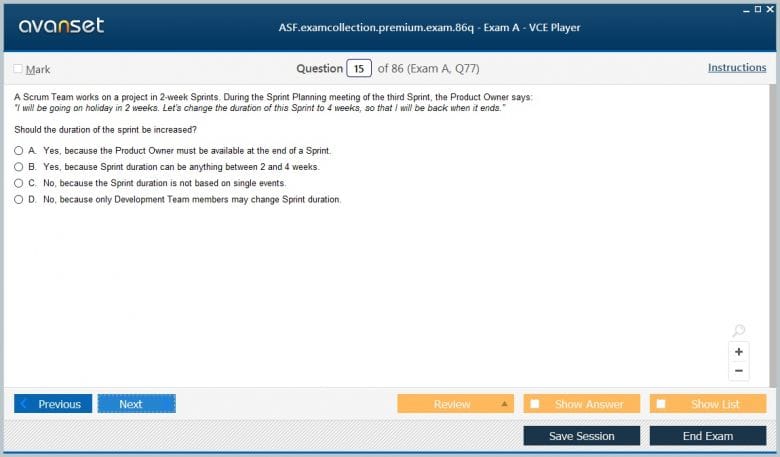
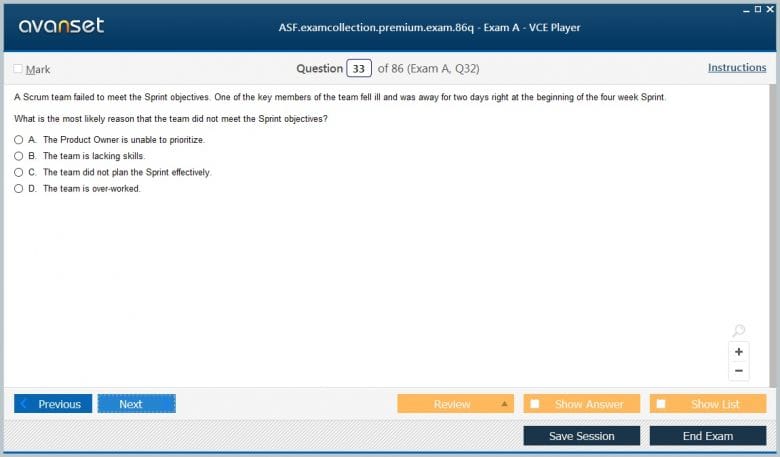
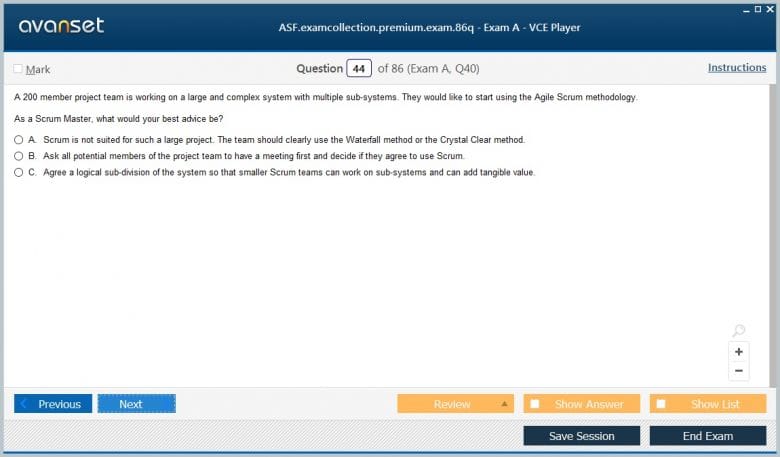
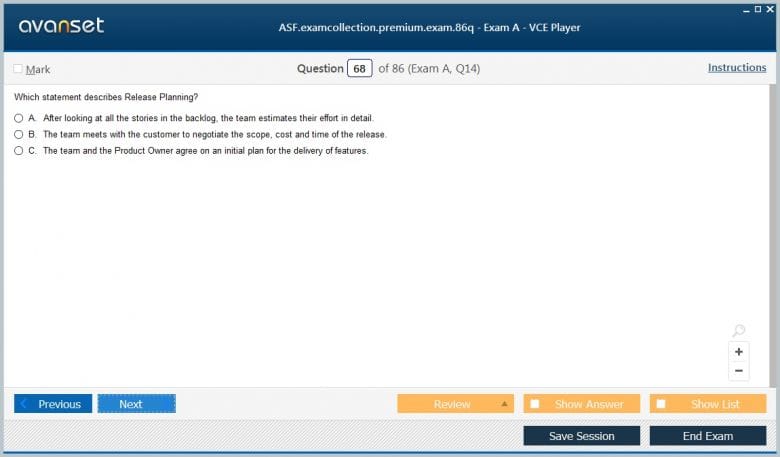
Exin ASF Practice Test Questions in VCE Format
| File | Votes | Size | Date |
|---|---|---|---|
File Exin.passguide.ASF.v2026-09-15.by.wangli.49q.vce |
Votes 1 |
Size 52.75 KB |
Date Sep 15, 2026 |
File Exin.Train4sure.ASF.v2019-06-25.by.Connor.48q.vce |
Votes 3 |
Size 50.47 KB |
Date Jun 28, 2019 |
File Exin.Test-king.ASF.v2015-03-08.by.Vance.59q.vce |
Votes 10 |
Size 66.57 KB |
Date Mar 08, 2015 |
Exin ASF Practice Test Questions, Exam Dumps
Exin ASF (EXIN Agile Scrum Foundation (EX0-008)) exam dumps vce, practice test questions, study guide & video training course to study and pass quickly and easily. Exin ASF EXIN Agile Scrum Foundation (EX0-008) exam dumps & practice test questions and answers. You need avanset vce exam simulator in order to study the Exin ASF certification exam dumps & Exin ASF practice test questions in vce format.
ASF is the EXIN Agile Scrum Foundation certification. EXIN’s current page describes it as a foundation-level qualification that combines Agile’s emphasis on adaptability and collaboration with Scrum’s structured practices. The main subjects are the Agile way of thinking, Scrum practices, Scrum planning and estimation, monitoring Scrum projects, and advanced Scrum concepts. The current exam is 40 multiple-choice questions in 60 minutes with a 65% pass mark, and EXIN lists the 2020 Scrum Guide and the third edition of the Agile Scrum Handbook among the required reading.
The certification is intended for professionals who need a practical understanding of Agile and Scrum in project management, software development, IT service management, or business work. That breadth is important: ASF is not merely about memorizing Scrum vocabulary. It tests whether a candidate understands how iterative delivery, transparency, inspection, adaptation, self-managing teams, prioritization, and feedback work together. The broader EXIN certifications provide vendor context, while the sections below focus on the reasoning that makes the framework coherent.
Agile approaches assume that complex work cannot always be planned accurately from the beginning. Requirements evolve, users learn after seeing working outcomes, and technical constraints emerge during delivery. Instead of treating change as a failure of planning, Agile teams build shorter cycles in which they create something useful, inspect the result, gather feedback, and adjust. This does not eliminate planning; it changes planning from a one-time forecast into a continuous decision process.
The mindset therefore values working outcomes, collaboration, and responsiveness while still respecting discipline. A team that changes direction every day without clear priorities is not demonstrating agility; it is creating instability. Agile work needs a visible goal, an ordered backlog, agreed quality expectations, and a cadence for reviewing progress. The ability to respond to evidence is valuable only when the team can distinguish meaningful learning from random interruption.
Scrum uses a small set of accountabilities, events, and artifacts so teams can focus on value instead of process overhead. The Product Owner is accountable for maximizing product value and managing the Product Backlog. The Scrum Master helps the team and organization use Scrum effectively and remove impediments to improvement. Developers create the usable Increment and manage how the work is completed within the Sprint.
These accountabilities are not conventional job descriptions. A Product Owner is not simply a requirements writer, the Scrum Master is not the team’s task manager, and Developers are not limited to people with a software-engineering title. The framework intentionally keeps accountability clear while allowing the people doing the work to organize themselves. Candidates should be able to recognize scenarios where a role is being distorted into command-and-control behavior.
A Sprint establishes a fixed-length period during which the Scrum Team pursues a Sprint Goal and creates a usable Increment. The value of the timebox is predictability. Stakeholders know when they will inspect progress, the team knows how long it can focus before a major review point, and learning from one Sprint can influence the next. Shorter Sprints increase the frequency of feedback; longer Sprints may allow more work before review but can increase risk if assumptions are wrong.
The Sprint Goal provides coherence when individual Product Backlog Items change. The team can negotiate scope with the Product Owner as more is learned, but changes should not undermine the goal. This distinction prevents the Sprint from becoming either rigid scope commitment or uncontrolled daily reprioritization. Preparation should focus on why the goal matters and how it supports adaptation without sacrificing focus.
Sprint Planning establishes why the Sprint is valuable, what can be done, and how the selected work will be approached. The Daily Scrum helps Developers inspect progress toward the Sprint Goal and adapt their plan. The Sprint Review examines the Increment and the product’s direction with stakeholders. The Sprint Retrospective focuses on the team’s effectiveness, quality, interactions, tools, and process. Each event has a different inspection target.
Candidates should avoid reducing the events to meeting templates. A Daily Scrum is not a status report to a manager; it is an opportunity for Developers to coordinate. A Sprint Review is not merely a demonstration; it is a working session about what was achieved and what should happen next. A Retrospective is useful only when the team identifies meaningful improvements and follows through. The purpose of each event is more important than a memorized agenda.
The Product Backlog is an ordered, evolving list of what may improve the product, with the Product Goal providing its longer-term commitment. The Sprint Backlog contains the Sprint Goal, selected Product Backlog Items, and the plan for delivering them. The Increment is the integrated, usable outcome that meets the Definition of Done. These artifacts make work and progress visible enough to inspect honestly.
Transparency depends on quality. A backlog full of vague items, an unrealistic Sprint plan, or an Increment that does not meet the Definition of Done creates false visibility. Teams should refine items enough to understand them, keep priorities current, and define quality in operational terms. When the artifacts accurately reflect reality, inspection can lead to useful adaptation; when they are cosmetic, Scrum becomes ceremony without control.
ASF includes Scrum planning and estimation because teams need a way to reason about what fits within a Sprint and how future delivery may unfold. Estimates are not guarantees. Story points, relative sizing, ideal days, or other techniques are tools for comparing effort, complexity, or uncertainty. Their value comes from helping the team make decisions and improve forecasting over time, not from converting estimates into individual performance targets.
Velocity and other historical measures should therefore be interpreted carefully. A team can use its own past throughput to guide future planning, but comparing velocities across teams is usually misleading because scales and contexts differ. Estimates can also become less useful when work is too large or poorly understood. Refinement reduces uncertainty by splitting work, clarifying acceptance conditions, and identifying dependencies before the Sprint begins.
The Product Owner orders the Product Backlog to maximize value, manage risk, and support the Product Goal. Value is contextual: it may involve revenue, customer benefit, compliance, learning, technical risk reduction, or operational improvement. A good backlog reflects those trade-offs instead of treating every request as equally urgent. Stakeholder input matters, but the Product Owner retains accountability for ordering the work.
Prioritization also makes opportunity cost visible. Choosing one item means delaying another. Techniques such as value-versus-effort thinking, risk-based ordering, or economic prioritization can support discussion, but the framework does not prescribe a single formula. The exam is more likely to reward understanding of accountability and feedback than rigid adherence to one ranking technique. The goal is a backlog that helps the team make the best next investment of its limited capacity.
The Definition of Done is a shared description of the state the Increment must meet to be considered complete. It prevents teams from hiding unfinished testing, integration, documentation, or other quality work behind the word “done.” When an item does not meet the Definition of Done, it is not part of the usable Increment. This makes product quality transparent and reduces the accumulation of work that appears complete but still requires hidden effort.
Quality also connects Agile to technical practices and organizational standards. Automated testing, continuous integration, peer review, security checks, and deployment automation can help teams meet their Definition of Done consistently, although Scrum does not mandate specific engineering tools. The related EXIN DevOps Foundation path explores a complementary body of practices for improving flow, collaboration, and delivery across development and operations.
Burn-down charts, burn-up charts, cumulative flow diagrams, release forecasts, and other visualizations can make progress easier to understand, but Scrum does not require a specific chart. The useful question is whether the information helps the team and stakeholders inspect reality. A perfect-looking chart built from stale or manipulated data is less valuable than a simple measure that exposes a genuine problem.
Teams should monitor progress toward goals, flow of work, quality, and impediments while avoiding metrics that reward harmful behavior. Counting tasks completed can encourage fragmentation, and using velocity as a target can encourage estimate inflation. The strongest monitoring system is one that supports better decisions, not one that produces the most dashboards. For broader context on Agile credentials, Agile certifications can help show how foundational Scrum knowledge relates to wider professional development.
Exam preparation should also include the difference between empirical control and predictive certainty. Scrum relies on transparency, inspection, and adaptation because complex work cannot be fully specified in advance. That means a team should expose problems early instead of hiding them until a milestone. When a forecast changes, the important question is whether new evidence explains the change and whether the team is adapting responsibly. Candidates who understand this logic are less likely to choose answers that sound efficient but undermine feedback, self-management, or product value.
A practical final review can be built around short scenarios: a stakeholder demands mid-Sprint scope changes; the Product Owner is unavailable; the Daily Scrum becomes a manager status meeting; unfinished work is presented as done; or a team manipulates estimates to meet a velocity target. For each case, identify which Scrum principle or accountability is being violated and what response restores transparency and learning. This approach prepares for application questions more effectively than memorizing isolated definitions because it requires the candidate to connect framework rules to the reason those rules exist.
Go to testing centre with ease on our mind when you use Exin ASF vce exam dumps, practice test questions and answers. Exin ASF EXIN Agile Scrum Foundation (EX0-008) certification practice test questions and answers, study guide, exam dumps and video training course in vce format to help you study with ease. Prepare with confidence and study using Exin ASF exam dumps & practice test questions and answers vce from ExamCollection.
Purchase Individually
Site Search:

SPECIAL OFFER: GET 10% OFF

Pass your Exam with ExamCollection's PREMIUM files!
SPECIAL OFFER: GET 10% OFF
Use Discount Code:
MIN10OFF
A confirmation link was sent to your e-mail.
Please check your mailbox for a message from support@examcollection.com and follow the directions.

Download Free Demo of VCE Exam Simulator
Experience Avanset VCE Exam Simulator for yourself.
Simply submit your e-mail address below to get started with our interactive software demo of your free trial.