



Premium File
40 Q&A
$76.99$69.99
Exin DEVOPSF Exam Questions & Answers, Accurate & Verified By IT Experts
Instant Download, Free Fast Updates, 99.6% Pass Rate
40 Questions & Answers
Last Update: Oct 21, 2026
$69.99
Exin DEVOPSF Exam Screenshots
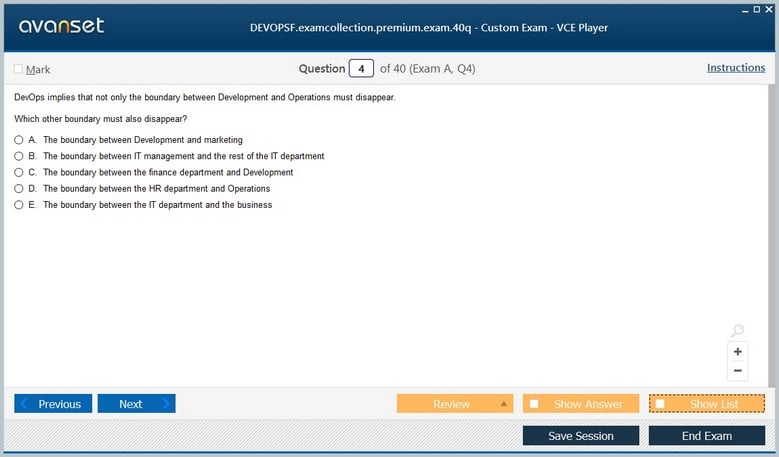
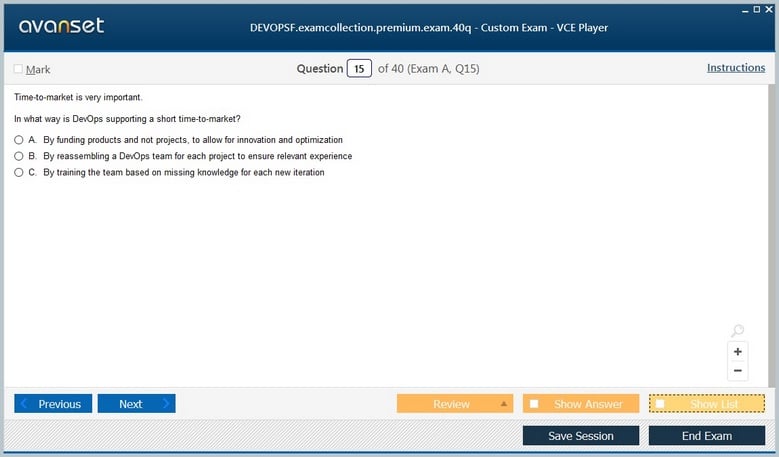
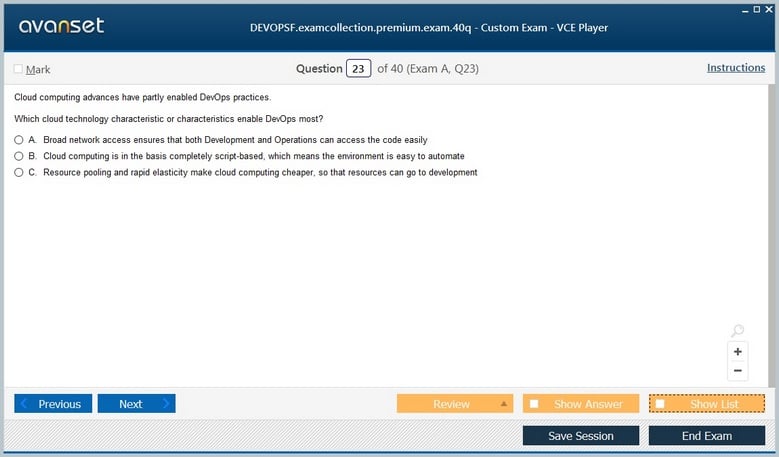
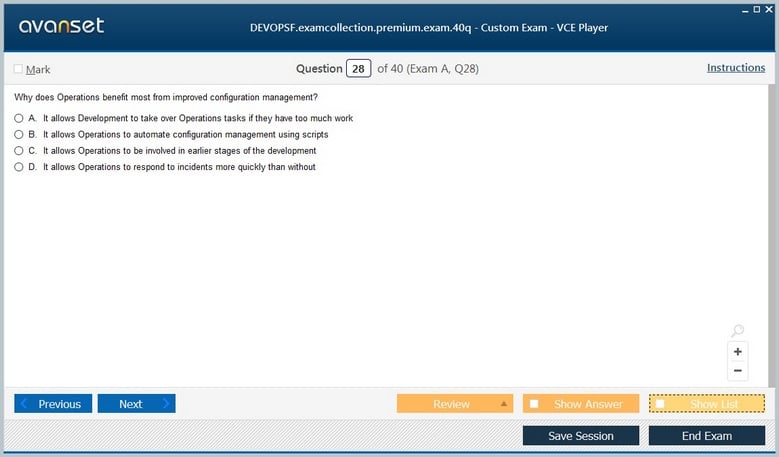
Exin DEVOPSF Practice Test Questions in VCE Format
| File | Votes | Size | Date |
|---|---|---|---|
File Exin.certkey.DEVOPSF.v2026-08-31.by.albie.15q.vce |
Votes 1 |
Size 22.81 KB |
Date Aug 31, 2026 |
File Exin.Testking.DEVOPSF.v2019-12-12.by.Leon.18q.vce |
Votes 3 |
Size 24.54 KB |
Date Dec 17, 2019 |
Exin DEVOPSF Practice Test Questions, Exam Dumps
Exin DEVOPSF (EXIN DevOps Foundation) exam dumps vce, practice test questions, study guide & video training course to study and pass quickly and easily. Exin DEVOPSF EXIN DevOps Foundation exam dumps & practice test questions and answers. You need avanset vce exam simulator in order to study the Exin DEVOPSF certification exam dumps & Exin DEVOPSF practice test questions in vce format.
DEVOPSF is the EXIN DevOps Foundation certification. EXIN currently lists it as a foundation-level qualification for IT and business professionals who want to understand DevOps principles, key practices, and their practical application. Its current assessment uses 40 multiple-choice questions, allows 60 minutes, and requires a 65% score to pass. EXIN positions the credential as a stepping-stone toward deeper DevOps study and as a way to understand how organizations can improve flow, collaboration, quality, and feedback across technology delivery.
DevOps is often misrepresented as a job title, a collection of automation tools, or simply the combination of development and operations teams. The certification’s value comes from understanding the operating model underneath the tools: smaller changes, fast feedback, shared responsibility, automation where it reduces delay and error, learning from failures, and measuring the system rather than optimizing one silo. The EXIN certifications provide vendor context, and the related Agile Scrum Foundation helps connect DevOps to the iterative delivery mindset that often precedes it.
Traditional delivery models can separate development, testing, security, operations, and business stakeholders into queues. Each team optimizes its own work, then transfers responsibility to the next group. The result can be long lead times, late discovery of defects, ambiguous ownership, and conflict when production problems occur. DevOps tries to improve the whole value stream so that teams share goals and feedback instead of treating successful handoff as the endpoint.
The cultural change is important because automation cannot repair incentives that reward local optimization. If developers are measured only on feature output and operations is measured only on change avoidance, the organization creates predictable tension. Shared measures such as lead time, deployment reliability, service health, recovery time, and customer outcomes encourage collaboration because both groups are judged by the performance of the delivered service.
Large batches hide risk. A release containing months of changes is difficult to review, test, deploy, and troubleshoot because many variables move at once. Smaller batches reduce the amount of change per deployment and shorten the time between an idea and real feedback. This makes defects easier to isolate and allows the organization to learn before investing heavily in the wrong direction.
Work-in-progress limits support the same objective. When teams start more work than they can finish, tasks wait in queues and context switching increases. Visual management through boards or value-stream maps can expose where work accumulates. The objective is not to keep every person maximally busy; it is to move valuable work through the system with less waiting, rework, and uncertainty.
Continuous integration encourages developers to merge changes frequently into a shared codebase, supported by automated builds and tests. Frequent integration reduces the gap between branches and exposes compatibility problems earlier. A healthy CI process gives fast feedback so developers know whether a change compiles, passes tests, meets quality checks, and can proceed to the next stage.
CI is not simply running a build server. Teams need version control, reliable automated tests, clear failure ownership, and a habit of fixing broken builds quickly. If pipelines are routinely red for hours, developers stop trusting them. The goal is a dependable feedback mechanism that makes integration problems visible while the change is still fresh in the author’s mind.
Continuous delivery means keeping software in a deployable state through automated build, test, packaging, and environment processes. Continuous deployment goes further by automatically releasing every qualifying change to production. Organizations can adopt continuous delivery without continuous deployment, especially where regulatory or business approval requires a controlled release decision. The important foundation concept is repeatability rather than one mandatory release frequency.
Deployment pipelines should progressively increase confidence. Early stages run fast checks; later stages may include integration, security, performance, or acceptance testing. Environment configuration should be managed consistently so that the same artifact moves through the pipeline. The automated delivery pipeline example is provider-specific, but it illustrates the broader idea of connecting source, build, test, and deployment into a traceable flow.
When environments are built manually, small undocumented differences accumulate. One server receives an emergency change, another has a different package version, and a third is created from an outdated checklist. Infrastructure as code and configuration automation make desired state explicit, versioned, and reviewable. This improves repeatability and allows environments to be rebuilt instead of carefully preserved as unique artifacts.
Automation still requires engineering discipline. Templates can contain insecure defaults, destructive mistakes, or assumptions that fail at scale. Changes should be reviewed, tested, and applied through controlled pipelines. Secrets should not be embedded in source code, and state management must be protected. The value of automation comes from making good practices repeatable, not from making every action automatic regardless of risk.
Monitoring answers whether known conditions are within expected bounds, while observability helps teams explore unfamiliar behavior through metrics, logs, traces, and events. DevOps teams need visibility into both technical health and user experience so that deployments can be evaluated quickly. A change that passes pre-production tests may still create latency, errors, or resource pressure under real traffic, making production feedback essential.
Alerts should point to conditions that require action rather than every metric fluctuation. Excessive alert noise teaches teams to ignore the system. Dashboards should connect service-level symptoms with underlying dependencies so responders can move from impact to cause. The DevOps observability dashboards example provides supporting context for how visual telemetry can help teams reason about distributed systems.
Complex systems fail, and DevOps practices try to reduce the impact and recurrence of those failures. Blameless post-incident reviews focus on conditions, decisions, signals, and system design rather than searching for one person to punish. This encourages honest reporting and helps teams discover why the system made an error possible or difficult to detect. Accountability remains important, but learning is weakened when people hide mistakes to protect themselves.
Resilience practices can include automated rollback, feature flags, canary releases, blue-green deployment, chaos experiments, backups, and tested recovery. The specific technique depends on context. The principle is to design for failure and reduce recovery time rather than assume prevention can eliminate every incident. Teams should measure how quickly they can restore service and whether corrective actions actually reduce repeated failure patterns.
DevSecOps extends shared responsibility to security by moving checks earlier and integrating them with build and deployment processes. Static analysis, dependency scanning, secret detection, container scanning, infrastructure-policy checks, and dynamic testing can provide faster feedback than waiting for a separate security review at the end. Automation does not replace security expertise; it helps common controls run consistently and exposes issues sooner.
Teams should also secure the pipeline itself. Build systems often hold privileged credentials and can modify production environments, making them attractive targets. Access should be least-privilege, artifacts should be traceable, secrets protected, and changes auditable. A compromised delivery pipeline can turn a normal deployment mechanism into a distribution channel for malicious code, so pipeline security is part of production security.
DevOps programs often track deployment frequency, lead time for changes, change failure rate, and time to restore service, along with product and reliability measures. These metrics help teams identify bottlenecks and assess whether improvement efforts are working. They are most useful as trends and diagnostic signals, not as isolated scores that determine individual performance.
Good measurement combines delivery speed with quality and outcomes. Increasing deployment frequency while customer incidents rise is not improvement. Likewise, very low change failure can reflect excellent engineering or an organization that changes too rarely. The DevOps practices checklist can support final review, but exam readiness comes from understanding why practices work together: flow enables feedback, automation supports consistency, observability supports learning, and culture determines whether teams use the information constructively.
Architecture choices influence DevOps flow because tightly coupled systems make small independent changes harder. Modular services, stable interfaces, automated contracts, and clear ownership can let teams deploy with less coordination, while a monolith with hidden dependencies may require larger synchronized releases. DevOps does not mandate microservices, however. A well-structured monolith with reliable automation can outperform a poorly governed microservice estate. The foundation principle is to reduce avoidable coupling and make dependencies visible enough that teams can change the system safely.
Collaboration with the business is equally important. Fast deployment has little value if teams are delivering features that customers do not need. Product feedback, usage analytics, experiments, support data, and stakeholder conversations should influence priorities. DevOps strengthens the technical feedback loop, but the organization also needs a product feedback loop connecting releases to outcomes. This prevents teams from measuring success only by pipeline speed while ignoring whether the delivered capability improves revenue, cost, compliance, experience, or another intended result.
A useful maturity question is whether the organization can make a small change and understand its effect quickly. That capability depends on version control, automated testing, reproducible environments, clear ownership, observable production systems, and a culture that responds to evidence. Improvement can begin anywhere in the value stream, but teams should avoid adopting tools simply because another company uses them. The best next practice is the one that removes a real constraint while preserving security and reliability. That makes constraint identification more important than copying a fashionable pipeline, platform, or organizational pattern without understanding the problem it is supposed to solve.
Go to testing centre with ease on our mind when you use Exin DEVOPSF vce exam dumps, practice test questions and answers. Exin DEVOPSF EXIN DevOps Foundation certification practice test questions and answers, study guide, exam dumps and video training course in vce format to help you study with ease. Prepare with confidence and study using Exin DEVOPSF exam dumps & practice test questions and answers vce from ExamCollection.
Purchase Individually
Site Search:

SPECIAL OFFER: GET 10% OFF

Pass your Exam with ExamCollection's PREMIUM files!
SPECIAL OFFER: GET 10% OFF
Use Discount Code:
MIN10OFF
A confirmation link was sent to your e-mail.
Please check your mailbox for a message from support@examcollection.com and follow the directions.

Download Free Demo of VCE Exam Simulator
Experience Avanset VCE Exam Simulator for yourself.
Simply submit your e-mail address below to get started with our interactive software demo of your free trial.