



Premium File
78 Q&A
$76.99$69.99
Avaya 71200X Exam Questions & Answers, Accurate & Verified By IT Experts
Instant Download, Free Fast Updates, 99.6% Pass Rate
78 Questions & Answers
Last Update: Sep 05, 2026
$69.99
Avaya 71200X Exam Screenshots
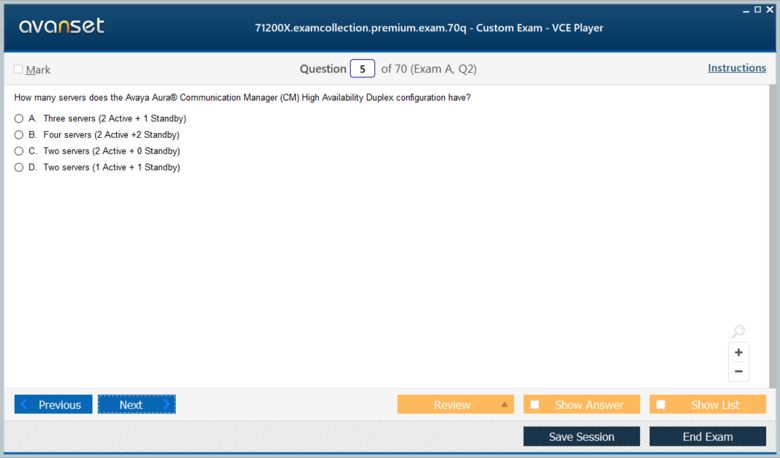
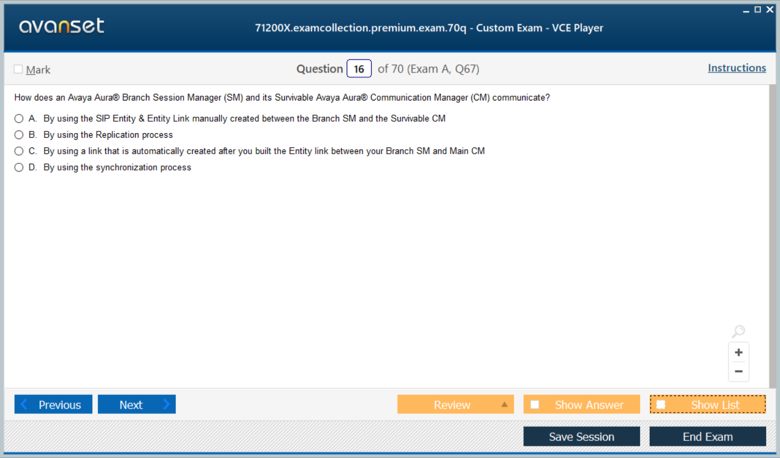
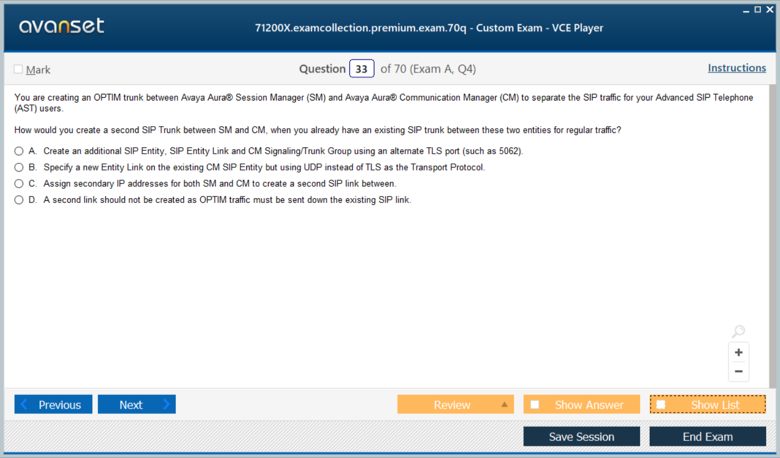
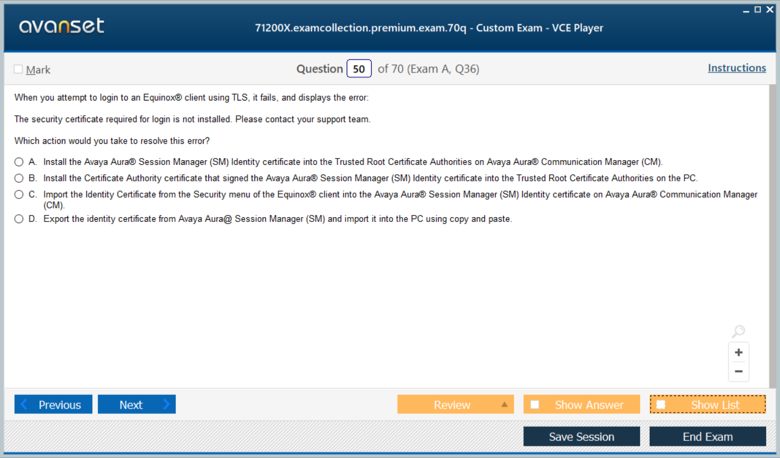
Avaya 71200X Practice Test Questions in VCE Format
| File | Votes | Size | Date |
|---|---|---|---|
File Avaya.pass4sureexam.71200X.v2026-08-20.by.ali.42q.vce |
Votes 1 |
Size 50.5 KB |
Date Aug 20, 2026 |
File Avaya.examquestions.71200X.v2021-04-27.by.matthew.44q.vce |
Votes 1 |
Size 49.51 KB |
Date Apr 27, 2021 |
File Avaya.braindumps.71200X.v2020-12-11.by.finley.37q.vce |
Votes 1 |
Size 43.27 KB |
Date Dec 11, 2020 |
Avaya 71200X Practice Test Questions, Exam Dumps
Avaya 71200X (Avaya Aura Core Components Integration) exam dumps vce, practice test questions, study guide & video training course to study and pass quickly and easily. Avaya 71200X Avaya Aura Core Components Integration exam dumps & practice test questions and answers. You need avanset vce exam simulator in order to study the Avaya 71200X certification exam dumps & Avaya 71200X practice test questions in vce format.
71200X was the Avaya Aura Core Components Integration Exam used in the ACIS-7120 Core Components implementation path. It is a legacy exam. Avaya Learning announced new Core Components exams in 2022 and retired 71200X on April 30, 2022, replacing it with 71201X for the updated implementation certification. The transition did not stop there: Avaya later retired the 71201X proctored exam after February 28, 2025 and introduced the 71201T Avaya Aura Core Components Implement Online Test.
That two-step history is important. A 2026 learner should not jump from 71200X to 71201X and assume the newer X-code is current. Both proctored exams are now historical. The useful reason to study 71200X is to understand the integration model of Avaya Aura core components: System Manager, Session Manager, Communication Manager, media and branch elements, routing, user provisioning, and the trust relationships that make the platform operate as one system.
Within the older Avaya certifications, the direct successor was 71201X. The corresponding historical support side was 72200X. Those links help reconstruct the old implementation/support structure, while current candidates should verify today's online-test requirements directly with Avaya.
Avaya Aura is not one application. Current Avaya documentation still describes core components such as System Manager, Communication Manager, Session Manager, Application Enablement Services, media servers, branch gateways, Presence Services, and WebLM. The precise releases have changed since 71200X, but the architectural lesson remains: each component has a role and depends on the others through routing, management, identity, licensing, and media relationships.
An integrator should be able to explain why System Manager is the central management layer, why Session Manager handles enterprise SIP routing, and why Communication Manager provides call-control and telephony features. If those roles are not clear, configuration becomes a sequence of copied steps with little ability to diagnose a failure.
The most effective historical study method is therefore to draw the architecture and annotate every connection. Which system administers which object? Which component routes SIP signaling? Where are endpoints registered? Where does a user profile live? Which application handles media? What must be trusted or synchronized? Integration questions become much easier when those responsibilities are explicit.
Avaya documentation describes System Manager as the central administration component for Avaya Aura. It provides common interfaces for users, roles, routing, managed elements, Session Manager administration, Communication Manager integration, messaging, media, and other platform functions. That centralization reduces the need to treat every application as an isolated management island.
For an implementer, central management introduces both convenience and dependency. A managed element has to be added correctly, credentials and trust relationships must work, synchronization has to complete, and administrators need appropriate roles. A change made directly on a component may not appear centrally if synchronization or notification is wrong.
Historical 71200X preparation should therefore include scenarios where an element exists but is not behaving as a managed part of the solution. Check reachability, credentials, trust, inventory state, and synchronization before assuming the application itself is broken. This habit also helps with upgrades and migrations because management relationships are often among the first dependencies to verify.
Session Manager's role is central to understanding Avaya Aura integration. Avaya describes it as a SIP routing tool that integrates SIP devices and communications systems across the enterprise, supports centralized routing, connects with Communication Manager and other systems, and is administered through System Manager. It is therefore more than a SIP endpoint registrar; it is a policy and routing layer.
Implementation requires a coherent set of SIP entities, entity links, locations, routing policies, dial patterns, application sequences, and user communication profiles. A route can fail even when every server is online if one of those relationships is incorrect. The integrator should trace the signaling decision from the originating user through the relevant routing policy to the target entity.
When troubleshooting, resist the temptation to change several routing objects at once. Start with the Request-URI or dialed digits, identify the originating location and user context, determine which pattern should match, confirm the routing policy and entity link, and then inspect the receiving system. That preserves a chain of evidence.
Communication Manager remains the telephony feature engine in many Aura designs. It handles stations, trunks, dial plans, feature access codes, call routing, coverage, hunt behavior, and a large set of enterprise voice functions. Session Manager can route SIP signaling toward Communication Manager, but Communication Manager still needs the correct telephony objects to process the call.
This creates an integration boundary that historical exam candidates had to understand. A SIP route can be correct while the Communication Manager trunk, signaling group, route pattern, station, network region, or dial-plan configuration is wrong. Conversely, Communication Manager can be correctly administered while Session Manager sends the request to the wrong destination.
Good lab work separates the layers. Prove basic connectivity, then prove the SIP entity and link, then prove the route, then prove Communication Manager call processing. Use traces and status commands to identify the layer where behavior diverges from the design.
An enterprise user in Aura can have an identity, communication addresses, endpoint assignments, feature-server relationships, application sequences, and telephony attributes. System Manager helps centralize that provisioning, but the objects still have to align. A user can exist in the directory and still fail to register or receive calls if the communication profile is incomplete.
This is why implementation scenarios often revolve around "everything looks configured" problems. The integrator should verify the user identity, SIP address, profile assignment, home or feature server, endpoint settings, and synchronization into the relevant applications. Small inconsistencies in extension, domain, or server assignment can produce registration or routing failures.
Role-based provisioning rules and directory synchronization can reduce repetitive work, but automation magnifies mistakes as well as successes. Before applying a rule broadly, test it with a controlled user and confirm the resulting objects in every dependent component.
Call signaling is only part of a communications solution. Media has to travel between endpoints and media resources with acceptable quality and with policies that reflect bandwidth, codec, and topology constraints. Avaya Aura uses concepts such as locations and network regions to connect user or device placement with routing and media behavior.
An integration design should therefore match logical locations to real network structure. Incorrect location assignment can affect routing, bandwidth management, emergency-calling behavior, or media path selection. Similarly, a codec or network-region mismatch can create a call that signals successfully but has poor or missing media.
Historical 71200X study is stronger when it pairs signaling traces with media diagnosis. If a call establishes but audio fails, the next questions should involve IP reachability, RTP path, firewall/NAT, media resources, codec negotiation, and network policy rather than continuing to edit dial patterns.
Enterprise communications rarely operate in one data center with perfect connectivity. Branch offices may need local gateways, survivable call processing, or local connectivity when WAN paths fail. Current Avaya documentation still includes Branch Session Manager and branch gateway components, illustrating the continued importance of distributed architecture.
The implementer should know what normally controls a branch and what changes during an outage. Which endpoints re-register? Which calls remain possible? Which central services become unavailable? Which local trunks or gateways continue to operate? A survivability feature is useful only if the design and testing match the business continuity requirement.
Failure testing should be planned, not improvised. Record the normal registration state, simulate one controlled loss, observe re-registration and call behavior, restore connectivity, and confirm the system returns cleanly. This is more informative than simply checking that a redundant server exists.
Avaya first replaced 71200X with 71201X in 2022 as part of updated Core Components curricula. Avaya then changed its broader certification delivery model in 2025: the 71201X proctored exam retired after February 28, 2025 and the vendor listed 71201T as the new online test. That makes 71200X two generations removed from the current assessment code.
The transition history is therefore 71200X to 71201X and then to the 71201T online test. Current candidates should verify 71201T directly with Avaya rather than assuming an older X-coded page reflects today's assessment.
This is also why current-looking study-vendor timestamps are unreliable evidence of exam status. Content can be "updated" long after the vendor has retired an exam. Avaya's own transition notices should control the status wording.
A practical historical study plan starts with the architecture diagram, then moves through System Manager managed elements, Session Manager routing, Communication Manager integration, users and communication profiles, locations and media, branch behavior, and operational validation. For every configuration object, write down which component owns it and what failure it can cause.
Then build troubleshooting exercises. A user will not register, a call routes to the wrong trunk, media is one-way, a managed element will not synchronize, or a branch loses central connectivity. Trace the problem layer by layer and document the evidence before making a change. This turns old exam knowledge into durable support skill.
71200X itself retired in 2022, its successor 71201X retired in 2025, and current candidates should check Avaya's present 71201T requirements. The historical exam remains valuable only when its status is kept clear and its technical content is used to understand how the Aura core fits together.
Go to testing centre with ease on our mind when you use Avaya 71200X vce exam dumps, practice test questions and answers. Avaya 71200X Avaya Aura Core Components Integration certification practice test questions and answers, study guide, exam dumps and video training course in vce format to help you study with ease. Prepare with confidence and study using Avaya 71200X exam dumps & practice test questions and answers vce from ExamCollection.
Purchase Individually
Site Search:

SPECIAL OFFER: GET 10% OFF

Pass your Exam with ExamCollection's PREMIUM files!
SPECIAL OFFER: GET 10% OFF
Use Discount Code:
MIN10OFF
A confirmation link was sent to your e-mail.
Please check your mailbox for a message from support@examcollection.com and follow the directions.

Download Free Demo of VCE Exam Simulator
Experience Avanset VCE Exam Simulator for yourself.
Simply submit your e-mail address below to get started with our interactive software demo of your free trial.