



Premium File
62 Q&A
$76.99$69.99
Avaya 72200X Exam Questions & Answers, Accurate & Verified By IT Experts
Instant Download, Free Fast Updates, 99.6% Pass Rate
62 Questions & Answers
Last Update: Sep 12, 2026
$69.99
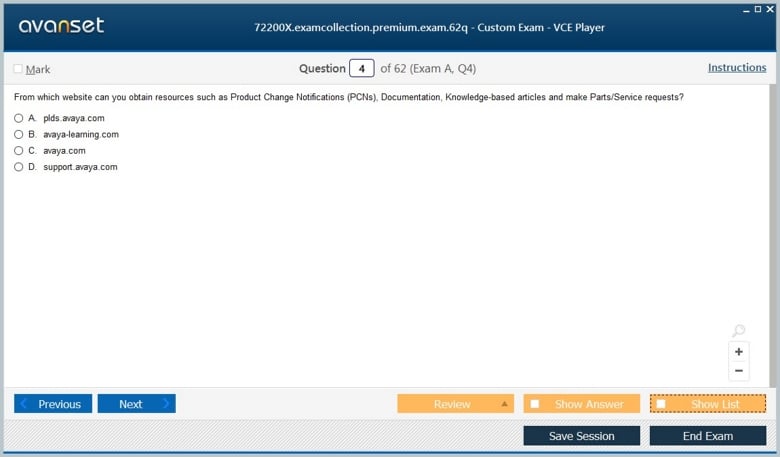
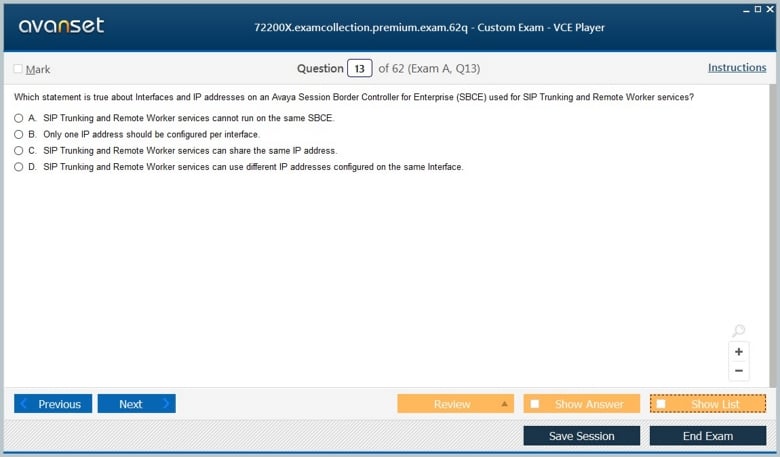
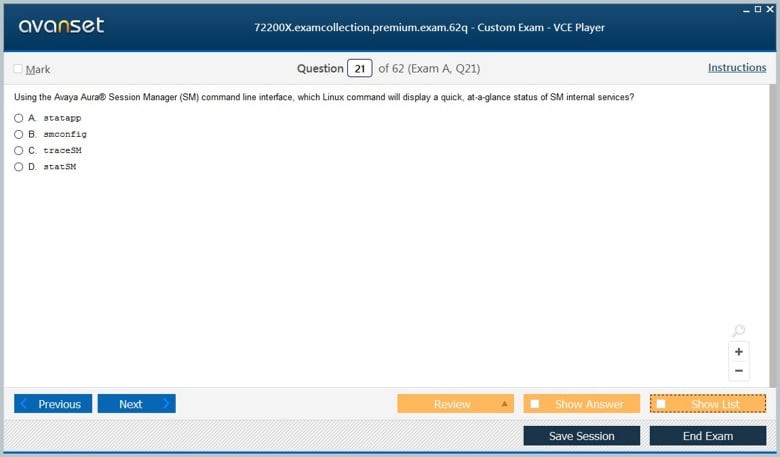
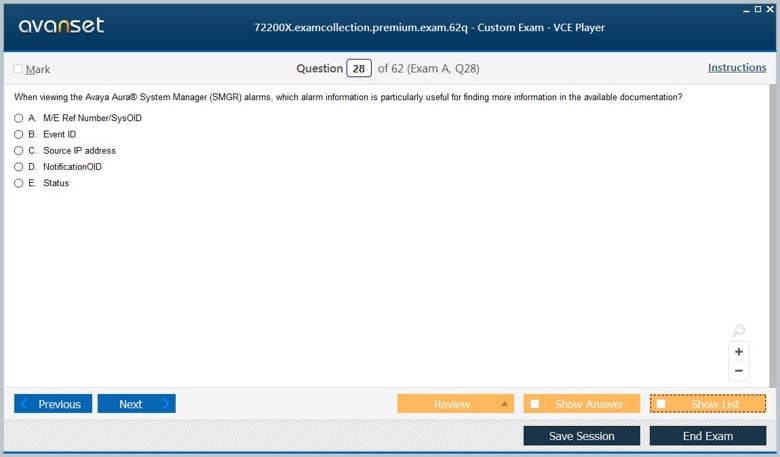
Avaya 72200X Exam Screenshots
Avaya 72200X Practice Test Questions in VCE Format
| File | Votes | Size | Date |
|---|---|---|---|
File Avaya.testking.72200X.v2026-07-22.by.annie.34q.vce |
Votes 1 |
Size 187.05 KB |
Date Jul 21, 2026 |
File Avaya.certkiller.72200X.v2020-04-04.by.julia.32q.vce |
Votes 2 |
Size 42.68 KB |
Date Apr 04, 2020 |
File Avaya.Test-king.72200X.v2019-08-05.by.Matty.30q.vce |
Votes 4 |
Size 41.25 KB |
Date Aug 08, 2019 |
Avaya 72200X Practice Test Questions, Exam Dumps
Avaya 72200X (Avaya Aura Core Components Support Exam) exam dumps vce, practice test questions, study guide & video training course to study and pass quickly and easily. Avaya 72200X Avaya Aura Core Components Support Exam exam dumps & practice test questions and answers. You need avanset vce exam simulator in order to study the Avaya 72200X certification exam dumps & Avaya 72200X practice test questions in vce format.
72200X was the Avaya Aura Core Components Support Exam associated with the ACSS-7220 support credential. It retired on April 30, 2022 when Avaya introduced 72201X for the updated Core Components support curriculum. That successor has also since retired as a proctored exam: Avaya's 2025 program transition lists 72201T as the current online-test successor after February 28, 2025.
In other words, 72200X is two generations removed from today's assessment code. Its continuing value is technical rather than credentialing. The exam represented support of the Aura core after implementation: monitoring System Manager, Session Manager and Communication Manager relationships, diagnosing registration and routing problems, interpreting alarms and logs, maintaining services, protecting backups, and restoring predictable call behavior.
Historically, the support path depended on implementation knowledge represented by 71200X, and 72200X was later replaced by 72201X. Those relationships are useful for reconstructing the structure of older Avaya certifications, but none of those X-coded exams should be presented as current in 2026.
Troubleshooting is difficult when the engineer does not know what healthy looks like. Aura core support therefore begins with baselines: which servers are active, which Session Managers are in service, how users register, what trunk and entity-link states are normal, which alarms are expected, and what call paths represent critical business functions.
System Manager, Session Manager, and Communication Manager each expose different evidence. A support engineer should know where to check application health, service state, synchronization, registrations, routing, trunks, stations, and alarms. The goal is to identify the first layer that differs from baseline rather than reacting to the loudest symptom.
Document known-good outputs for important checks. During an incident, comparing current state with a baseline is often faster than interpreting an unfamiliar status screen from memory.
A SIP endpoint registration can fail because of DHCP or network configuration, DNS, certificates, Session Manager reachability, user communication profile, domain, endpoint settings, or policy. The endpoint symptom is simple—"not registered"—but the cause can exist at several layers.
Support should proceed in order. Confirm the endpoint received the expected network configuration, verify it can reach the relevant services, confirm the user and SIP address exist, check Session Manager service state, inspect registration evidence, and compare the account with a known-good user. Each step should eliminate a category of causes.
This is more efficient than deleting and recreating users or restarting servers. Those actions may change the symptom while removing evidence. A support certification should reward diagnosis that can be explained and repeated.
Session Manager provides enterprise SIP routing through entities, links, locations, dial patterns, and routing policies. When a call goes to the wrong place or fails to route, the support engineer should reconstruct the decision using the originating user, called address, matching pattern, selected policy, and target entity.
Trace data is valuable because it shows what the system actually received and sent. The digits a user believes they dialed may not be identical to the Request-URI seen by the routing layer. Adaptation, number normalization, or upstream behavior can change the address before the route is selected.
A disciplined workflow captures the failing trace, identifies the first unexpected decision, and changes only the object responsible for that decision. Broad routing edits made without evidence can fix one call while breaking many others.
Communication Manager is where many telephony features, stations, trunks, route patterns, signaling groups, coverage paths, hunt groups, and dial-plan rules are administered. Even in a SIP-centric Aura design, a large class of incidents originates in Communication Manager configuration or service state.
Support engineers should separate signaling reachability from call-processing logic. If Session Manager routes a request to Communication Manager but the call fails there, inspect the relevant station, trunk, signaling group, route pattern, COR/COS, dial plan, or feature configuration. If Communication Manager never sees the call, move back toward Session Manager and the network.
Known-good test numbers are extremely useful. They let support compare a failing destination with one that uses a similar route and identify which object differs.
One-way audio, no audio, poor quality, or dropped media can occur after the call is technically established. Those symptoms point toward RTP path, network-region policy, codec negotiation, firewall or NAT behavior, media resources, or bandwidth rather than basic dial-pattern selection.
Support needs both signaling and media evidence. Determine the negotiated media addresses and codecs, verify reachability, identify any border or gateway devices, and check whether the problem is limited to one site or one direction. Site-specific patterns often reveal routing or firewall boundaries.
Do not confuse "call connected" with "service healthy." Voice quality is part of the user transaction and should be included in baseline and post-change testing.
System Manager centralizes administration and synchronizes data with managed elements, but that relationship can fail. A change made directly on a component may not appear centrally, or central provisioning may not reach the target system. Support must determine whether the issue is data, connectivity, credentials, trust, or the synchronization process itself.
Check the managed-element relationship before re-entering configuration. Verify inventory state, reachability, credentials, scheduled or incremental synchronization, and any alarms or logs associated with the job. A stale management database can mislead an engineer into believing the live component has different settings than it actually does.
After correcting synchronization, compare both sides and document whether any direct changes need reconciliation. Restoring the management relationship is not the same as proving all configuration is consistent.
Aura can include redundant or survivable components, but support staff need to know what should happen during failure. Which Session Manager should accept service? How do endpoints choose an alternative? What does a branch use if the central path fails? Which features are reduced during survivable operation?
During an outage, distinguish failover that is working as designed from failover that did not occur. A user may report different behavior even when the survivability mechanism succeeded because not every central feature is available in the degraded mode. The support engineer should compare actual behavior with the documented failure model.
Recovery deserves equal attention. When the primary service returns, verify registrations, routing, alarms, and replication or synchronization. A system that "came back" may still have users or branches stranded on an unintended path.
Distributed communications platforms generate evidence in several places. Session Manager traces, Communication Manager logs and status, System Manager events, gateways, endpoints, and network devices may all contribute to one incident. Accurate time synchronization is what lets the support team line those records up.
Start with a narrow incident window and a reproducible test. Record calling and called identities, time, location, endpoint, and expected result. Then collect only the logs relevant to that transaction. This produces a much stronger escalation package than sending large unfiltered log bundles.
Alarm severity also needs interpretation. A critical alarm may be unrelated to the user's symptom, while a less dramatic warning can be the real clue. Correlate alarms with the affected service rather than treating severity as proof of cause.
Support also had a configuration-management dimension. In an Aura environment, an emergency fix can touch routing, stations, user profiles, network-region assignments, certificates, or server relationships. The engineer should capture the before-state, record the reason for the change, validate the intended transaction, and test one or two adjacent services that could share the same object. This reduces the chance that a local repair becomes a delayed enterprise-wide regression.
Capacity symptoms deserve a different mindset from binary outages. Registration limits, trunk usage, media resources, CPU, memory, disk, and network bandwidth can degrade gradually. A platform may pass a health check while users experience intermittent failures during peak periods. Historical support preparation is stronger when it includes trend review and load-related hypotheses, not only hard-down scenarios.
Escalation quality is another practical skill. When a problem needs vendor or higher-tier support, provide a concise topology, affected scope, exact timestamps, calling and called identities, trace identifiers, relevant alarms, recent changes, and the tests already performed. A precise evidence package shortens diagnosis and avoids repeating disruptive troubleshooting steps.
Avaya's 2022 Core Components transition retired 72200X on April 30, 2022 and introduced 72201X as the updated support certification exam. Avaya's 2025 program transition then retired 72201X after February 28, 2025 and listed 72201T as the new online test.
That history should be stated in one place so readers do not mistake a recently updated third-party 72200X or 72201X page for evidence that the exam is current. Vendor transition notices establish status; study-product timestamps do not.
The current successor code is 72201T. The historical 72201X generation remains important because it was the documented replacement for 72200X before Avaya moved the program to online tests.
Build a support matrix with rows for endpoint/network, System Manager, Session Manager, Communication Manager, media, gateways, certificates/trust, and resiliency. For each layer, list a health check, a log or trace source, a known-good test, and the symptoms most likely to originate there.
Then work through incidents without skipping layers. A phone will not register, calls fail only between two sites, audio is one-way, central provisioning does not update a component, or a branch behaves differently after a WAN outage. Predict which evidence will change before making configuration edits.
72200X is a retired exam, but disciplined Aura Core support remains valuable. Use the old scope to learn systematic diagnosis, keep the multi-stage retirement history explicit, and verify the present 72201T requirements with Avaya for any 2026 certification plan.
Go to testing centre with ease on our mind when you use Avaya 72200X vce exam dumps, practice test questions and answers. Avaya 72200X Avaya Aura Core Components Support Exam certification practice test questions and answers, study guide, exam dumps and video training course in vce format to help you study with ease. Prepare with confidence and study using Avaya 72200X exam dumps & practice test questions and answers vce from ExamCollection.
Purchase Individually
Site Search:

SPECIAL OFFER: GET 10% OFF

Pass your Exam with ExamCollection's PREMIUM files!
SPECIAL OFFER: GET 10% OFF
Use Discount Code:
MIN10OFF
A confirmation link was sent to your e-mail.
Please check your mailbox for a message from support@examcollection.com and follow the directions.

Download Free Demo of VCE Exam Simulator
Experience Avanset VCE Exam Simulator for yourself.
Simply submit your e-mail address below to get started with our interactive software demo of your free trial.