



Premium File
102 Q&A
$76.99$69.99
Citrix 1Y0-440 Exam Questions & Answers, Accurate & Verified By IT Experts
Instant Download, Free Fast Updates, 99.6% Pass Rate
102 Questions & Answers
Last Update: Sep 09, 2026
$69.99
Citrix 1Y0-440 Exam Screenshots
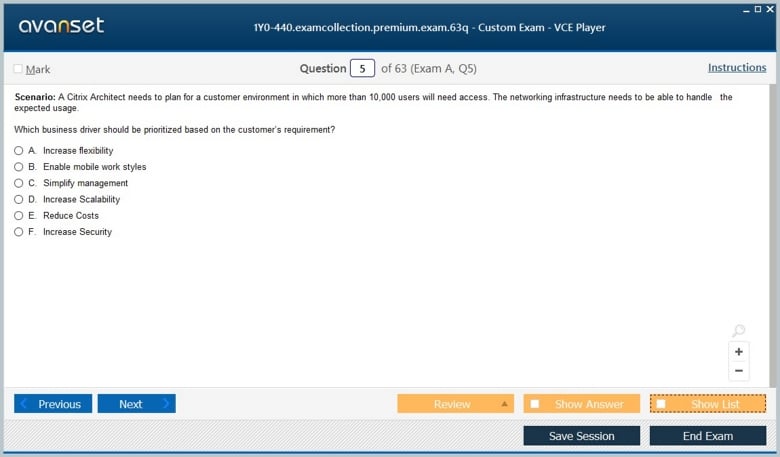
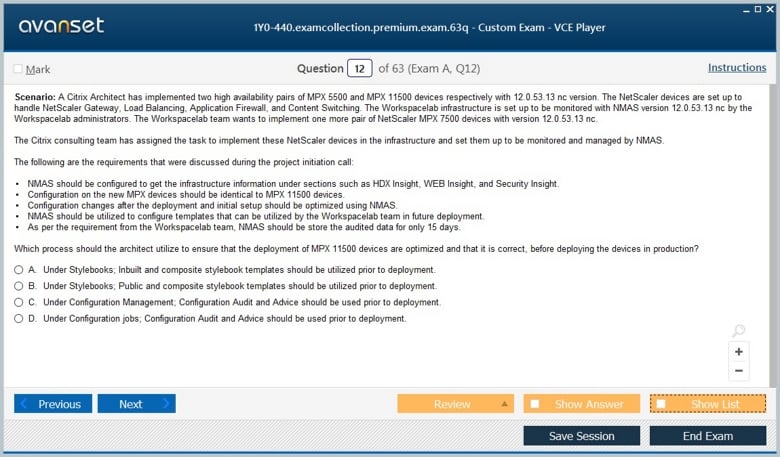
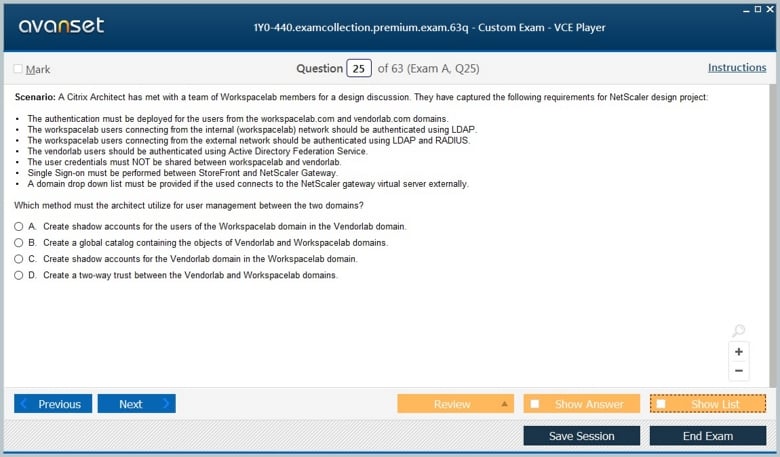
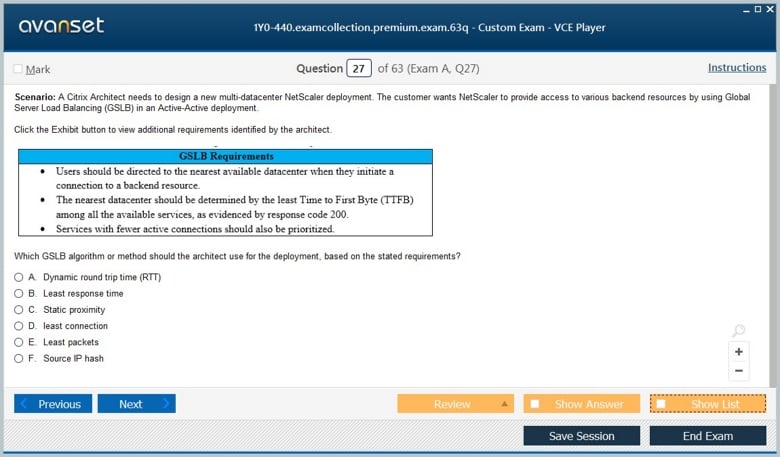
Citrix 1Y0-440 Practice Test Questions in VCE Format
| File | Votes | Size | Date |
|---|---|---|---|
File Citrix.selftesttraining.1Y0-440.v2026-05-21.by.thomas.30q.vce |
Votes 1 |
Size 802.73 KB |
Date May 20, 2026 |
File Citrix.Actualtests.1Y0-440.v2019-07-19.by.Olivia.30q.vce |
Votes 2 |
Size 781.72 KB |
Date Jul 20, 2019 |
Citrix 1Y0-440 Practice Test Questions, Exam Dumps
Citrix 1Y0-440 (Architecting a Citrix Networking Solution) exam dumps vce, practice test questions, study guide & video training course to study and pass quickly and easily. Citrix 1Y0-440 Architecting a Citrix Networking Solution exam dumps & practice test questions and answers. You need avanset vce exam simulator in order to study the Citrix 1Y0-440 certification exam dumps & Citrix 1Y0-440 practice test questions in vce format.
Citrix 1Y0-440, Architecting a Citrix Networking Solution, is an architecture-focused exam whose preparation guide remains hosted by Citrix. The blueprint spans advanced traffic management, GSLB, authentication, security, application delivery, and design decisions across multiple sites. At the same time, Citrix’s current public certification page now presents associate and professional App Delivery and Security tiers rather than the older expert-style networking structure, so candidates should verify live availability in the current certification platform before treating 1Y0-440 as a schedulable 2026 target.
Its design content remains valuable because application delivery architecture is not a version-specific problem. Organizations still need to decide where NetScaler appliances sit, how they provide local and global resiliency, how they authenticate users, how certificates and WAF policy are governed, how applications are segmented, and what happens when a site or dependency fails. The exam is therefore best approached as an architecture study rather than a collection of advanced configuration facts.
Administrators coming from 1Y0-342 already know many security and optimization features; 1Y0-440 asks the higher-level question of where those features belong in a complete application-delivery design. The distinction is important because expert design work is judged by architecture, tradeoffs, resilience, and operational fit rather than by isolated feature configuration.
Before choosing appliances, virtual servers, or policies, the architect needs to understand the applications being delivered. Requirements include expected users, traffic volume, protocols, authentication, geographic distribution, availability targets, regulatory constraints, maintenance windows, and dependency relationships. A low-volume internal application may justify a simple design, while a customer-facing service with strict uptime and multi-region users may require several layers of redundancy.
The architect should separate mandatory requirements from preferences. If every stakeholder request is treated as mandatory, the design can become unnecessarily complex. Documenting priorities makes tradeoffs visible: stronger isolation may increase cost, active-active sites may require application and database changes, and aggressive security policy may need application remediation. Architecture is the process of resolving these constraints coherently.
A NetScaler HA pair can survive an appliance failure, but only if upstream switches, routing, ARP behavior, links, power, and back-end services also support the failover model. The architect should map which addresses move, which sessions or states are synchronized, and what external devices need to learn after a role change.
Failure testing should include more than shutting down the primary node. Link failure, partial service loss, management-network isolation, back-end application failure, and maintenance should all have expected outcomes. The design should distinguish component availability from application availability. A pair of healthy appliances cannot make an unavailable database or identity provider into a working service.
Load-balancing methods, persistence, monitors, spillover, content switching, and traffic policies let the architect shape how requests reach application servers. The right choice depends on statefulness, server capacity, session behavior, and application dependencies. Persistence can protect user workflow, but excessive or poorly scoped persistence can create imbalance and reduce the value of adding capacity.
Health monitoring should test the function the business depends on. A server that answers TCP may still return application errors. Conversely, a monitor that performs an expensive transaction too frequently can create unnecessary load. Architects should work with application teams to define a health signal that is meaningful, fast enough to detect failure, and safe to execute repeatedly. The broader concept of load-balancing architecture reinforces why service health and traffic distribution need to be designed together.
Global server load balancing directs users among sites, often through DNS-based decisions. The architect must decide which sites are authoritative for which applications, how site health is measured, what persistence or proximity logic applies, and how quickly clients can move after a failure. DNS TTLs and caching behavior become part of the recovery-time model.
GSLB cannot compensate for an application that is not truly multi-site capable. Databases, identity, data replication, external integrations, and session state may limit how traffic can move. The design should therefore validate the whole application stack before presenting GSLB as disaster recovery. A successful DNS answer is only the beginning of a successful transaction.
Remote application access may use LDAP, RADIUS, SAML, certificates, multifactor authentication, or combinations of these. An architect should show where credentials are presented, which system validates them, what attributes are returned, and how those attributes influence authorization. Identity-provider availability and certificate trust become dependencies that belong in the resilience model.
Complex authentication flows should also account for user experience. Extra factors may be justified for privileged access but unnecessary for low-risk internal use. Session duration, reauthentication, device context, and federation behavior should reflect risk rather than arbitrary consistency. Good architecture protects sensitive access without creating a workflow that users are motivated to bypass.
A Web App Firewall policy needs tuning during initial deployment and continued review as the application changes. New URLs, APIs, frameworks, and request formats can alter normal behavior. Architects should define who owns WAF policy, how learning is reviewed, how changes are tested, and how false positives are escalated.
The security model should also define segmentation and management access. Administrative interfaces should not be exposed like public application VIPs, and centralized management should use least privilege. WAF protection is most effective when application teams and security teams share enough context to distinguish expected behavior from attack traffic.
Large application-delivery environments can contain many certificates across front-end and back-end services. Without inventory, expiry monitoring, standard naming, and renewal ownership, certificate management becomes an outage risk. The architect should define where private keys are generated and stored, which certificate authorities are trusted, and how replacement occurs without disrupting service.
SSL policy also changes over time as protocols and cipher recommendations evolve. A design should allow security settings to be updated without redesigning every application. Exceptions for legacy systems need a documented owner and retirement plan. That is an architectural concern because compatibility decisions can determine which applications can share a front-end policy and which require isolation.
Multiple data centers create coordination questions: where configuration is mastered, how changes propagate, how certificates remain consistent, which site handles maintenance, and how operators recognize a partial failure. A diagram can show redundant appliances while leaving these operational questions unanswered.
Runbooks should identify the evidence used to declare a site unhealthy and the authority required to shift traffic. Planned failover tests should measure actual user impact. After recovery, teams need a controlled failback process rather than simply restoring the old state. These procedures turn architectural redundancy into a service the organization can actually operate.
Capacity and platform choice should be part of architecture, not postponed until procurement. MPX, VPX, SDX, and cloud-hosted deployment options can differ in throughput, SSL capacity, multi-tenancy, elasticity, and operational model. The architect should size for connection rate, encrypted traffic, peak concurrency, and failure conditions, then leave enough headroom for maintenance and growth.
Cloud deployment also changes network assumptions. Route tables, security groups, public and private addressing, cloud load balancers, and availability-zone behavior can affect how a virtual NetScaler instance receives and returns traffic. Designs should follow the packet path through the cloud provider rather than assume the same Layer 2 behavior as an on-premises appliance pair.
Observability needs architecture-level definition as well. Decide which events go to a SIEM, which application metrics go to operations dashboards, how certificate expiry is monitored, and what thresholds indicate saturation. A multi-site design is difficult to operate if each location reports health differently or if logs cannot be correlated across time zones and systems.
Finally, automation should reduce configuration drift without removing review. Templates and APIs can standardize virtual servers, monitors, policies, and certificates, but the automation itself becomes production infrastructure. Version control, peer review, scoped credentials, and test environments allow repeatability without turning a script error into a fleet-wide outage.
Licensing and service ownership can influence architecture as directly as throughput. Features needed for GSLB, advanced security, analytics, or multi-tenancy may depend on edition or platform, and cloud deployments may add provider costs around data transfer and public addressing. The architect should verify commercial constraints before making a feature a critical dependency.
Architecture review should also challenge unnecessary complexity. Multiple tiers of load balancing, overlapping security products, and duplicated policies can create failure modes that are difficult to diagnose. Every additional control should have a clear purpose and an owner. Simpler designs are not always possible, but unexplained complexity should never survive only because it appeared in an earlier diagram.
Operational ownership should extend to vendor and cloud dependencies. The architecture should record which team opens support cases, which telemetry must be preserved, and how service-provider incidents change traffic strategy. Recovery is faster when those responsibilities are known before the first major outage.
The 1Y0-440 blueprint is valuable because it forces practitioners to connect individual NetScaler features into a complete architecture. Study by taking one application and designing local availability, global availability, authentication, TLS, WAF policy, monitoring, management, and recovery. Then explain how the design changes if cost, latency, regulation, or recovery targets change.
Whether the old exam remains available is a separate question that should be checked in Citrix’s current platform. The architectural reasoning remains current: understand the workload, define the trust and failure boundaries, choose controls that address real requirements, and make operations part of the design from the beginning.
Go to testing centre with ease on our mind when you use Citrix 1Y0-440 vce exam dumps, practice test questions and answers. Citrix 1Y0-440 Architecting a Citrix Networking Solution certification practice test questions and answers, study guide, exam dumps and video training course in vce format to help you study with ease. Prepare with confidence and study using Citrix 1Y0-440 exam dumps & practice test questions and answers vce from ExamCollection.
Purchase Individually
Top Citrix Certifications
Site Search:

SPECIAL OFFER: GET 10% OFF

Pass your Exam with ExamCollection's PREMIUM files!
SPECIAL OFFER: GET 10% OFF
Use Discount Code:
MIN10OFF
A confirmation link was sent to your e-mail.
Please check your mailbox for a message from support@examcollection.com and follow the directions.

Download Free Demo of VCE Exam Simulator
Experience Avanset VCE Exam Simulator for yourself.
Simply submit your e-mail address below to get started with our interactive software demo of your free trial.