
Pass Your Citrix CCP-V Certification Easy!
Citrix CCP-V Certification Exams Questions & Answers, Accurate & Verified By IT Experts
Instant Download, Free Fast Updates, 99.6% Pass Rate.

Citrix Virtual Apps and Desktops 7 Advanced Administration
Includes 159 Questions & Answers
$69.99
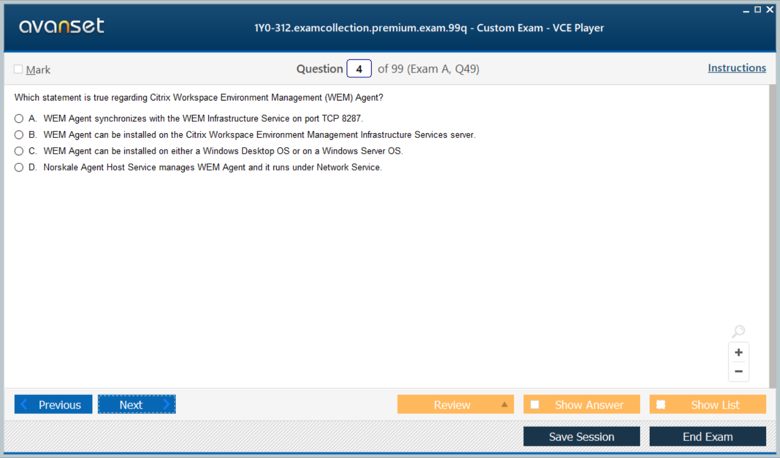
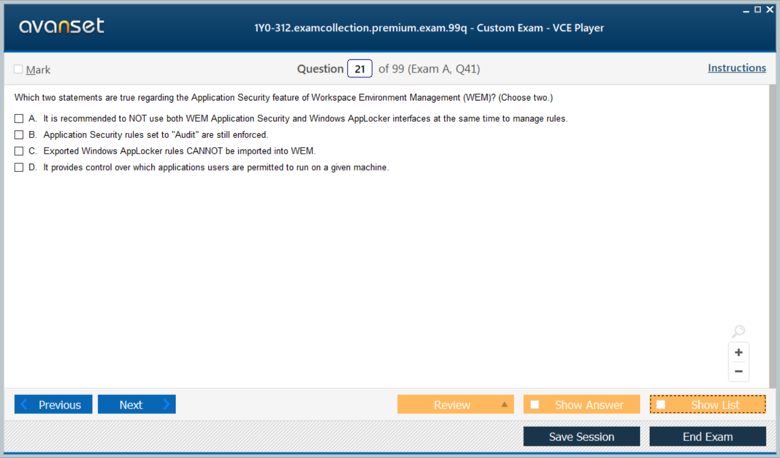
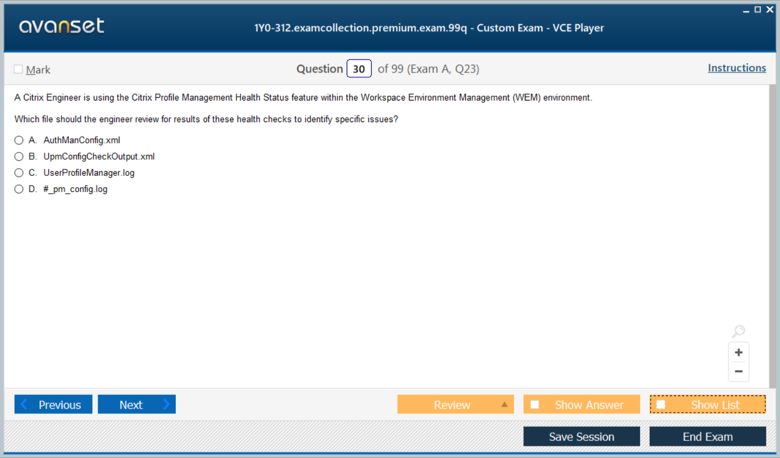
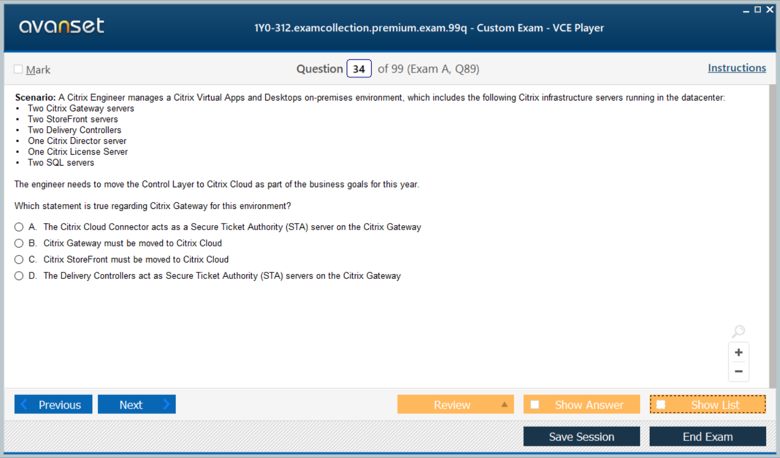
Citrix CCP-V Certification Exams Screenshots
CCP-V Product Reviews
Download Free CCP-V Practice Test Questions VCE Files
| Exam | Title | Files |
|---|---|---|
Exam 1Y0-312 |
Title Citrix Virtual Apps and Desktops 7 Advanced Administration |
Files 4 |
Citrix CCP-V Certification Exam Dumps & Practice Test Questions
Prepare with top-notch Citrix CCP-V certification practice test questions and answers, vce exam dumps, study guide, video training course from ExamCollection. All Citrix CCP-V certification exam dumps & practice test questions and answers are uploaded by users who have passed the exam themselves and formatted them into vce file format.
CCP-V: Advanced Citrix Administration for Complex Environments
Citrix Certified Professional – Virtualization remains part of Citrix’s current Virtual Apps and Desktops certification structure. Citrix’s September 2025 preparation guide identifies the current assessment as the Citrix Virtual Apps and Desktops 7 Advanced Administration exam and requires candidates to first earn the associate-level CCA-V credential.
Older resources often refer to 1Y0-312. That material can still provide valuable architecture and administration practice, but candidates should not assume the old exam number defines the current test. The active professional path is organized around today’s Citrix Virtual Apps and Desktops platform, current training, and current exam guidance.
Within Citrix certifications, CCP-V marks the move from routine site administration into more complex availability, policy, performance, security, and troubleshooting work.
CCP-V assumes the associate foundation is already operational
The professional exam does not make sense if a candidate is still learning what a Delivery Controller, StoreFront, VDA, machine catalog, delivery group, or Citrix policy does. That is why CCA-V is a prerequisite in Citrix’s current path.
At professional level, questions become less about identifying a component and more about designing or troubleshooting its behavior under real constraints. How should controller availability be handled? Why is one group of sessions slow? Which policy is winning? What happens if a database or hosting connection fails? How should a hybrid resource location be monitored?
The candidate needs to think across components rather than treating each one as an isolated feature.
High availability has to cover dependencies, not just Citrix services
A resilient environment needs more than multiple Delivery Controllers. Database services, DNS, Active Directory, StoreFront or access layers, network paths, hosting platforms, profile storage, licensing dependencies, certificates, and cloud connectivity can all become failure points.
Professional administrators should know how a site behaves when specific components are unavailable and which features support continued operation. They should also understand where redundancy is meaningful and where duplicated components still share a hidden dependency.
Availability should be tested deliberately. Disable a controller in a lab. Interrupt a resource-location connection. Simulate a profile-share issue. Observe what fails immediately, what degrades, and what continues working.
Growth can add users, applications, machines, sites, geographic regions, and administrative teams. A configuration model that works for 50 sessions may become difficult to operate at 5,000.
Professional administration therefore emphasizes standardization, delegation, automation, capacity visibility, and clear policy scope. Machine catalogs, delivery groups, tags, policy filters, naming standards, and image processes should make the environment easier to reason about as it expands.
Scale is not only a performance question. It is a management question: can the team make a change confidently without unintended effects across the estate?
Advanced access design combines identity, gateways, and policy
Remote and hybrid access introduces authentication, multifactor requirements, Citrix Gateway, StoreFront behavior, certificates, network routes, and session policy. Administrators need to understand the entire path from endpoint to published resource.
Security improves when access decisions reflect identity and context rather than merely network location. The ideas in zero-trust endpoint management are relevant because unmanaged or high-risk devices may deserve different access controls from managed corporate endpoints.
Good access design also considers failure. If a certificate expires, an identity provider is unavailable, or a gateway loses reachability to a resource location, the team should know what users will see and where to investigate.
Citrix policies can tune graphics, printing, bandwidth, session behavior, security controls, peripherals, and user experience. In a large environment, the difficulty is no longer creating a setting; it is determining which settings apply to which users and machines and in what order.
Use filtering intentionally. Avoid creating layers of exceptions that depend on institutional memory. Document why a policy exists, which population it affects, and what problem it solves.
When troubleshooting, verify the effective policy. An administrator may spend hours inspecting the intended configuration while the session is receiving a different setting because of precedence or scope.
Workspace Environment Management adds another optimization layer
Workspace Environment Management can influence resource usage, user environment settings, and performance. Professional candidates need to understand why an organization might use WEM and how it interacts with other Citrix policies and Windows configuration.
Optimization should be evidence-driven. CPU management, process behavior, environment actions, and user settings can improve experience, but aggressive tuning can also create unpredictable application behavior.
Measure before and after. A setting that sounds efficient is not automatically beneficial for every workload.
Profiles become more challenging as environments grow and user populations diversify. Administrators should understand storage location, synchronization, exclusions, profile bloat, corruption, cross-site behavior, and the relationship between profile design and logon performance.
A slow login may involve profile size, group policy, application initialization, network access, or other dependencies. Director and related tools help break the process into stages so the administrator can identify where time is actually being spent.
Professional troubleshooting avoids changing profile settings until evidence shows that the profile layer is responsible.
Security includes session protection as well as infrastructure hardening
Citrix’s current CCP-V preparation material includes advanced security topics such as TLS, application protection policies, and session recording. The goal is to protect both the delivery infrastructure and the data users interact with through sessions.
Security design should consider administrative privilege, service accounts, certificate lifecycle, network segmentation, gateway exposure, endpoint risk, session controls, and audit evidence.
Controls also need to be supportable. If security policy blocks a business workflow, the organization needs a governed exception process rather than an undocumented workaround.
Advanced troubleshooting is about narrowing scope quickly
Complex Citrix incidents become manageable when the administrator asks structured questions. Is the issue one user, one machine, one delivery group, one site, or everyone? Did it begin at a particular time? Is resource enumeration affected, session launch, in-session performance, or only one application? What changed recently?
Then collect evidence from Director, event logs, services, network telemetry, hosting platforms, and dependency systems. The concept is similar to network logging: timestamps and correlated observations are more useful than isolated screenshots.
A professional administrator should be able to build a timeline and eliminate entire classes of causes efficiently.
Hybrid and cloud environments change responsibility boundaries
Citrix Cloud can move portions of the management plane out of customer-operated infrastructure while resource locations, VDAs, applications, identity, and networking remain the customer’s responsibility. Professional administrators need to know where that boundary sits.
A cloud-managed control plane does not eliminate troubleshooting. It changes which evidence is available locally and which dependencies require external service connectivity. Cloud Connectors become important links between the control plane and resource location.
Design and operations should therefore document ownership: what Citrix operates, what the customer operates, and how incidents crossing the boundary are escalated.
Automation becomes more valuable as administrative scope expands
PowerShell can make inventory, reporting, configuration checks, and repeatable changes more consistent. The professional administrator should be comfortable moving beyond point-and-click work when a task affects many objects.
Use automation with safeguards. Query and export current state before bulk changes. Test filters carefully. Make the target population explicit. Record outputs. Where possible, validate results after execution.
General PowerShell practice can help candidates strengthen shell skills before applying them to Citrix administration.
The old CCE-V path should no longer be assumed to be current
Historically, CCP-V progressed to CCE-V through architecture-focused expert study and the 1Y0-403 exam. Citrix’s current public certification page no longer lists that expert credential alongside CCA-V and CCP-V.
That makes current-status checking important. A CCP-V candidate interested in architecture should absolutely study design, assessment, capacity, and recovery, but should not assume that the legacy expert exam remains available without verifying Citrix’s latest catalog.
Change management separates professional administration from firefighting
Complex Citrix environments need controlled change. Image updates, policy changes, VDA upgrades, certificate renewals, StoreFront adjustments, and hosting modifications should have a defined test population, rollback plan, maintenance window, and validation step. A technically correct change can still be operationally poor if it is introduced without understanding which users and applications it affects.
Use telemetry before and after significant changes. Compare logon duration, registration health, session failures, resource consumption, and support volume. This turns change control into evidence rather than ceremony and makes it easier to identify regressions before they spread across the environment.
A feature is only valuable when the team can monitor, document, and troubleshoot it. Before enabling an advanced policy or optimization, define who owns it, how success will be measured, what symptoms a failure would create, and how the change can be reversed. This keeps technical sophistication from becoming hidden operational debt.
Prepare by operating failure scenarios, not only building the happy path
A professional lab should include deliberate breakage. Stop a service. Mis-scope a policy. Break DNS resolution. Remove access to a profile location. Create a VDA registration issue. Introduce a certificate or gateway problem. Then use evidence to isolate the fault.
Practice documenting the incident in a way another administrator could follow: symptom, scope, evidence, hypothesis, action, result, and root cause. That habit improves both exam readiness and real operational performance.
CCP-V is valuable because mature Citrix administration is about control under complexity. The professional administrator must keep the environment available, secure, observable, and understandable as user needs and infrastructure change.
ExamCollection provides the complete prep materials in vce files format which include Citrix CCP-V certification exam dumps, practice test questions and answers, video training course and study guide which help the exam candidates to pass the exams quickly. Fast updates to Citrix CCP-V certification exam dumps, practice test questions and accurate answers vce verified by industry experts are taken from the latest pool of questions.

Top Citrix Certifications
Site Search:




Valid as of March 2021. Good study guide as well. Make sure to learn the exam study guide as well as just this brain dump. Also research all questions.