


Premium File
233 Q&A
$76.99$69.99
Citrix 1Y0-204 Exam Questions & Answers, Accurate & Verified By IT Experts
Instant Download, Free Fast Updates, 99.6% Pass Rate
233 Questions & Answers
Last Update: Sep 18, 2026
$69.99
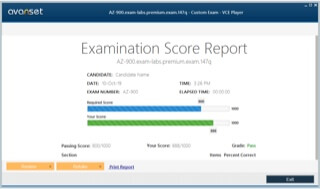
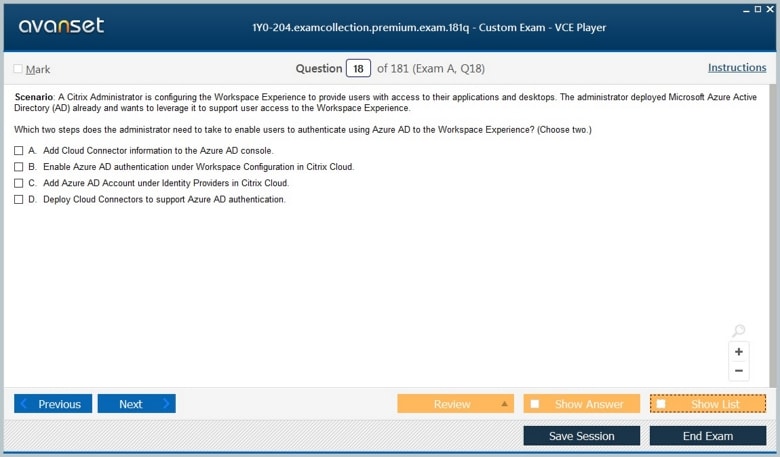
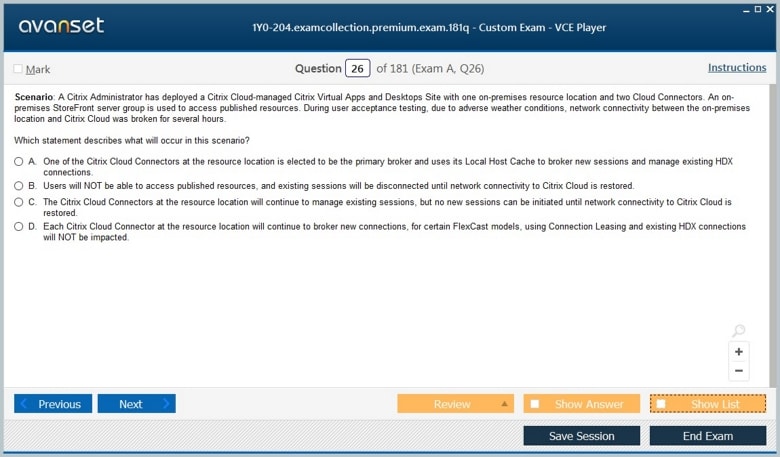
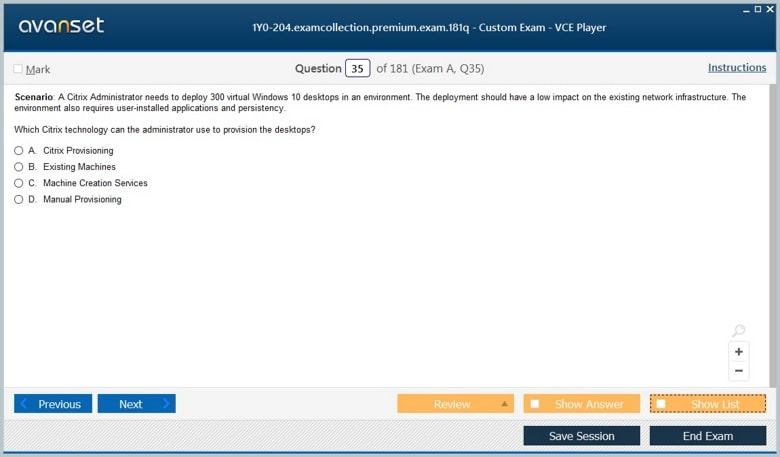
Citrix 1Y0-204 Exam Screenshots
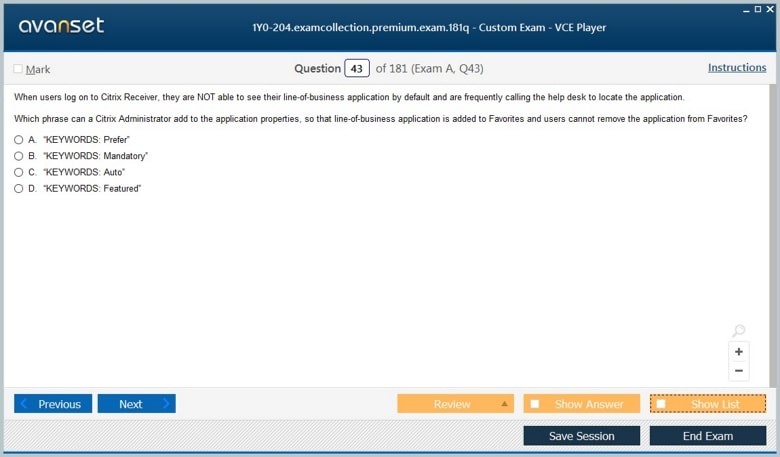
Citrix 1Y0-204 Practice Test Questions in VCE Format
| File | Votes | Size | Date |
|---|---|---|---|
File Citrix.test-king.1Y0-204.v2026-07-26.by.carter.91q.vce |
Votes 1 |
Size 3.05 MB |
Date Jul 26, 2026 |
File Citrix.examquestions.1Y0-204.v2021-11-10.by.max.107q.vce |
Votes 1 |
Size 1.58 MB |
Date Nov 10, 2021 |
File Citrix.selftesttraining.1Y0-204.v2021-05-01.by.john.100q.vce |
Votes 1 |
Size 1.77 MB |
Date May 01, 2021 |
File Citrix.test4prep.1Y0-204.v2020-08-28.by.albie.98q.vce |
Votes 2 |
Size 1.34 MB |
Date Aug 28, 2020 |
File Citrix.braindumps.1Y0-204.v2020-06-30.by.zhangtao.93q.vce |
Votes 2 |
Size 1.19 MB |
Date Jun 30, 2020 |
File Citrix.practicetest.1Y0-204.v2020-02-24.by.emilia.85q.vce |
Votes 2 |
Size 1.02 MB |
Date Feb 24, 2020 |
File Citrix.Prep4sure.1Y0-204.v2019-12-08.by.Oscar.65q.vce |
Votes 3 |
Size 1.15 MB |
Date Dec 10, 2019 |
File Citrix.Testking.1Y0-204.v2019-10-14.by.Ray.32q.vce |
Votes 3 |
Size 210.96 KB |
Date Oct 20, 2019 |
Citrix 1Y0-204 Practice Test Questions, Exam Dumps
Citrix 1Y0-204 (Citrix Virtual Apps and Desktops 7 Administration) exam dumps vce, practice test questions, study guide & video training course to study and pass quickly and easily. Citrix 1Y0-204 Citrix Virtual Apps and Desktops 7 Administration exam dumps & practice test questions and answers. You need avanset vce exam simulator in order to study the Citrix 1Y0-204 certification exam dumps & Citrix 1Y0-204 practice test questions in vce format.
Citrix 1Y0-204, Citrix Virtual Apps and Desktops 7 Administration, is a retired exam. Citrix’s current CCA-V preparation material explicitly describes the present Citrix Virtual Apps and Desktops Administration exam as the replacement for 1Y0-204. That makes the old code valuable for historical study, but not as the endpoint of a current certification plan.
The architecture behind the exam still provides a useful foundation. Citrix Virtual Apps and Desktops environments depend on Delivery Controllers or cloud control services, Virtual Delivery Agents, machine provisioning, user access, policies, profiles, monitoring, and secure connectivity. The current curriculum has evolved, but administrators still need to understand how those components work together and where to look when a session fails.
Candidates planning the active path should use the CCA-V certification and Citrix’s current exam title, Citrix Virtual Apps and Desktops Administration, rather than treating 1Y0-204 as bookable. The 1Y0-205 administration page can be used as topic-oriented current-generation material, but the exact live registration identity should be verified with Citrix. For deeper administration, 1Y0-312 advanced administration develops the operational scope further.
In a traditional on-premises deployment, Delivery Controllers broker connections, maintain site state, communicate with databases and hypervisors, and decide which machine can accept a user session. The user’s application or desktop session itself runs on a Virtual Delivery Agent. Understanding that separation is essential for troubleshooting because a broker failure and a VDA failure create different symptoms.
Cloud-managed deployments alter where some control-plane services live, but the conceptual distinction remains. Administrators should ask which component owns identity, brokering, resource enumeration, provisioning, monitoring, and session traffic rather than assuming one server performs every function.
A machine catalog groups machines that share an operating model, provisioning method, and resource characteristics. Citrix environments can use Machine Creation Services, Citrix Provisioning, or manually provisioned machines depending on the use case. Each choice affects image management, storage behavior, update procedures, and operational complexity.
Image-based management is powerful because one change can update many machines, but that scale also increases risk. Administrators need clear version control, testing, maintenance windows, and rollback procedures. A master image should not become a place for undocumented manual fixes that cannot be reproduced.
A catalog answers what machines exist; a delivery group answers how resources are presented to users. Administrators assign machines, published applications, desktops, and user access according to the service design. Problems can occur when the infrastructure is healthy but entitlements, application configuration, or group membership do not match the intended user population.
Troubleshooting should therefore follow the delivery path. Confirm that the user is entitled to the resource, the application or desktop is published, an appropriate machine is registered and available, and policy does not prevent launch. This layered approach is faster than changing random settings.
StoreFront traditionally enumerates resources and presents them to Citrix Workspace app or a browser. Authentication, store configuration, beacons, and delivery-controller relationships all affect whether users can see and launch their resources. A blank application list can therefore reflect identity, enumeration, or backend communication rather than a VDA problem.
The current Citrix ecosystem increasingly uses cloud services and Workspace experiences, but the old 1Y0-204 emphasis on understanding the access path remains useful. Administrators should be able to trace what happens from sign-in through resource enumeration, ticket generation, gateway traversal, and final session establishment.
Citrix policies can control graphics, printing, clipboard behavior, drive mapping, session reliability, bandwidth use, and many other aspects of the HDX experience. Because several policies can apply at once, administrators need to understand priority, filtering, and effective-result tools rather than assume the last policy they edited is the one in force.
User-experience tuning should also start with evidence. A complaint about “slow Citrix” may be caused by endpoint conditions, network latency, server resource pressure, profile delay, storage, or application behavior. Policy changes can help, but they should target the measured bottleneck.
User profiles carry settings across sessions and can become a major source of logon problems when they grow, corrupt, or conflict with application behavior. Citrix Profile Management and related tools aim to make user state predictable across nonpersistent machines and multiple sessions.
Administrators should understand which data needs to roam, which should be excluded, how profile containers or redirection interact with the environment, and how to troubleshoot one user without disrupting many others. Profile design is a balance between personalization, performance, and manageability.
Citrix Director provides a support-oriented view of sessions, machines, logon stages, failures, resource utilization, and trends. It helps administrators move from a user complaint to the affected session and then to evidence about where delay or failure occurred. The tool is most effective when teams know what each metric actually represents.
Historical trends can reveal problems that are invisible during a single help-desk call. Repeated registration failures, rising logon duration, machine load, or application faults can indicate systemic issues. Monitoring should therefore support both incident response and proactive capacity or configuration decisions.
Remote users often reach Citrix resources through NetScaler Gateway, which introduces certificates, DNS, authentication, Secure Ticket Authority configuration, routing, firewall rules, and session policy into the access path. An external launch problem that does not occur internally should immediately focus attention on the components unique to remote access.
The 1Y0-231 Gateway material represents the older ADC 13 generation of that networking discipline. Current Citrix Gateway training has moved to NetScaler 14.x, so administrators should reuse the enduring architecture concepts while checking present product terminology, feature behavior, and procedures.
Database availability was another important administrative dependency in the 1Y0-204 era. Site configuration and monitoring information depended on SQL services, so administrators needed to understand what functions continued during a database outage and which did not. Features such as Local Host Cache were designed to preserve brokering under defined conditions, but they were not substitutes for a resilient database strategy. The broader lesson remains current: know which control-plane data is required for normal operation and what degraded mode looks like.
Licensing could also create misleading symptoms. A site might be technically healthy while users receive warnings or launches fail because product edition, license allocation, or connectivity to the license service is wrong. Administrators should confirm both entitlement and communication, especially after migrations or license-server changes. This illustrates why Citrix troubleshooting needs a dependency checklist that includes infrastructure services outside the VDA itself.
Printing is another area where the user symptom can hide several technical paths. Client printers, session printers, universal drivers, print servers, and policy can all affect how a job is rendered and routed. Administrators should know whether the session is using a native driver, universal printing, or a server-hosted queue and then troubleshoot the corresponding path. Printing problems often become expensive when every VDA accumulates unmanaged drivers or when policy creates inconsistent mappings.
Capacity management belongs beside troubleshooting. Machine registration and successful launches do not guarantee good user experience if CPU, memory, storage, or session density is exhausted during peak periods. Administrators should correlate Director trends with delivery-group capacity and application demand, then plan headroom before performance becomes a recurring incident. The current exam may use newer product versions, but this operational reasoning carries forward directly from the retired blueprint.
Application layering and compatibility also influence image strategy. Organizations may package applications separately from the base operating-system image, use application groups, or maintain multiple catalogs because one application conflicts with another. The administrator should understand why consolidation has limits. A single enormous image may appear easy to manage until one application update forces testing across every user population.
Disaster recovery planning should consider both configuration and user access. Backing up a database or master image is not enough if DNS, certificates, identity, gateway configuration, or hosting capacity cannot be restored in the recovery site. Teams should define the order in which dependencies return and test whether users can actually launch a resource, not only whether individual servers boot.
The retired exam also provides a useful lesson about version-bound knowledge. Console labels, supported operating systems, licensing models, and cloud integrations change faster than concepts such as brokering, provisioning, profiles, and policy. Candidates using old material should mark which statements describe architecture and which describe a specific release. That habit prevents legacy screenshots from being mistaken for current operational guidance.
Administrators should also separate platform health from application health. A desktop can launch successfully while one published application fails because of permissions, dependencies, profile state, or application configuration. Conversely, an application outage may be blamed on Citrix when the underlying service is unavailable for every access method. Effective support verifies the layer where failure begins before changing the delivery platform.
That layered diagnosis is one of the most transferable lessons from the old exam: first identify the failing service boundary, then choose the tool and team that own it.
The retired blueprint remains useful because it organizes the administrative problem into architecture, provisioning, delivery, policies, user access, monitoring, and maintenance. Those categories help new administrators build a mental model of the platform instead of memorizing console clicks.
Certification planning, however, should follow Citrix’s current CCA-V material. The replacement exam reflects newer product versions and administration practice. Treat 1Y0-204 as a historical foundation, reconcile every procedure with current documentation, and use the active exam objectives for the final preparation plan.
Go to testing centre with ease on our mind when you use Citrix 1Y0-204 vce exam dumps, practice test questions and answers. Citrix 1Y0-204 Citrix Virtual Apps and Desktops 7 Administration certification practice test questions and answers, study guide, exam dumps and video training course in vce format to help you study with ease. Prepare with confidence and study using Citrix 1Y0-204 exam dumps & practice test questions and answers vce from ExamCollection.
Purchase Individually
Top Citrix Certifications
Site Search:

SPECIAL OFFER: GET 10% OFF

Pass your Exam with ExamCollection's PREMIUM files!
SPECIAL OFFER: GET 10% OFF
Use Discount Code:
MIN10OFF
A confirmation link was sent to your e-mail.
Please check your mailbox for a message from support@examcollection.com and follow the directions.

Download Free Demo of VCE Exam Simulator
Experience Avanset VCE Exam Simulator for yourself.
Simply submit your e-mail address below to get started with our interactive software demo of your free trial.
Premium Valid 100%. i passed the exam.
Hi, Could someone validate if this Premium Dump is valid?
Any lab into the exam? Dods premium dumps is enough tp passed the exam?
I passed as well, pretty easy. Just disregard all the Netscaler/ADC questions in the premium.
I passed this morning! Used the premium file 181 questions to study but also did some labs. Good luck to you all!
On this moment premium contains 181 questions. ;-) My exam starts on the 15th of June: will inform you after I have the final outcome that day!
A lot of the questions in the premium are valid, but it also contains a bunch of ADC questions that are not part of the subject matter.
Hi, Could someone validate if this Dump is valid?
Citrix.practicetest.1Y0-204.v2020-02-24.by.emilia.85q.vce
Best regards
Thank you
Guys
is there any one passed? recently
is 1Y0-204 Premium VCE File including the Citrix.Prep4sure.1Y0-204.v2019-12-08.by.Oscar.65q.vce and Citrix.Testking.1Y0-204.v2019-10-14.by.Ray.32q.vce ?
@Paulo,
Thanks for contacting us.
The current version of premium contains 133 questions.
Hi, how many question for the premium file?
Did it on Jan 2020. passed. Make sure you study questions and review answers.
Has anybody already pass the Citrix Virtual App and Desktops Service on Citrix Cloud Exam.
I need advices.
Passed the exam today.
Premium file is valid.
Did any one passed this exam by using this dump???
is there anyone passed?
@King,
Thanks for contacting us.
The free file from Ray contains 32 questions. To have more questions you need a premium file. The current premium file contains 65 questions.
only 32 questions when the exam is 65 questions...