

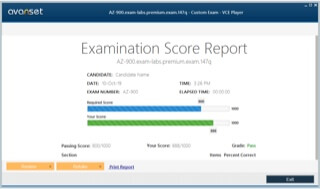

Premium File
118 Q&A
$76.99$69.99
Citrix 1Y0-371 Exam Questions & Answers, Accurate & Verified By IT Experts
Instant Download, Free Fast Updates, 99.6% Pass Rate
118 Questions & Answers
Last Update: Sep 06, 2026
$69.99
Citrix 1Y0-371 Exam Screenshots
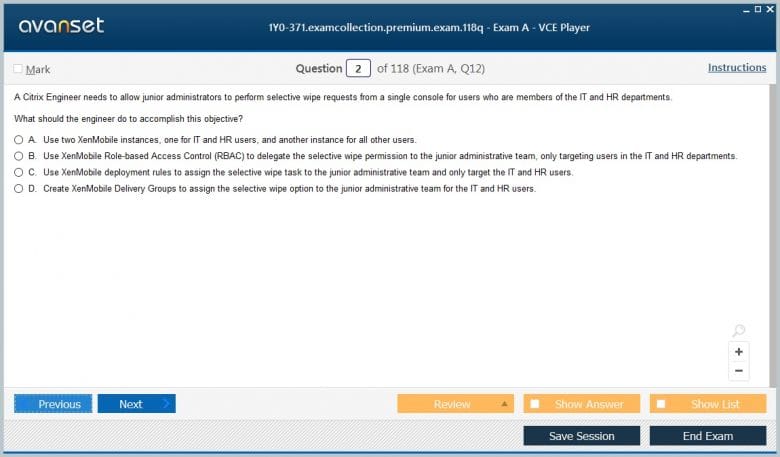
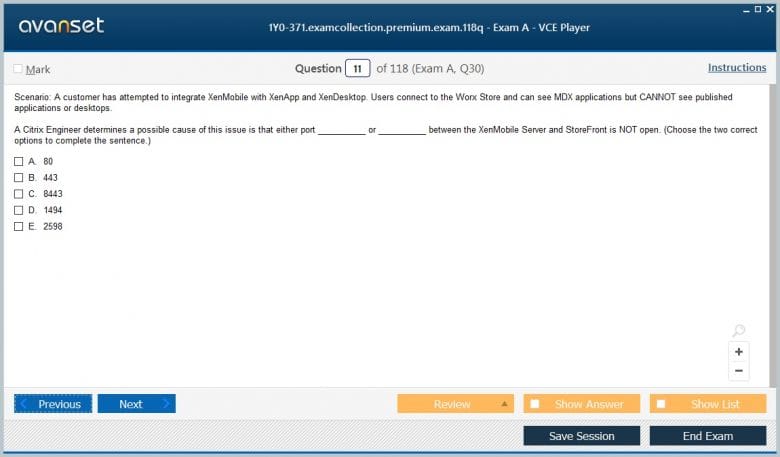
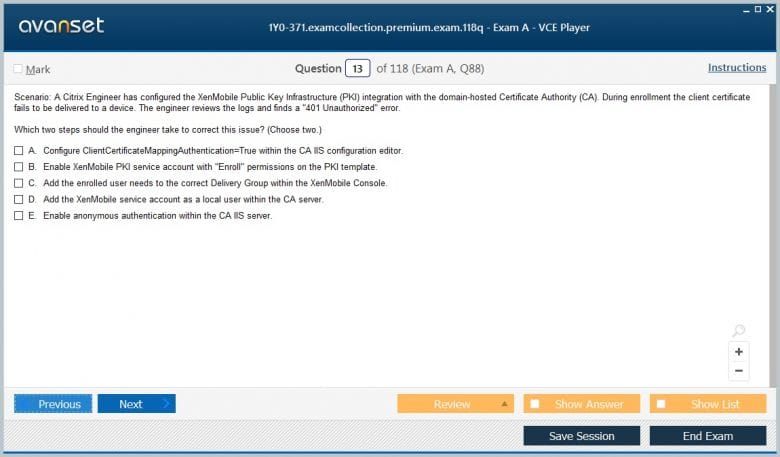
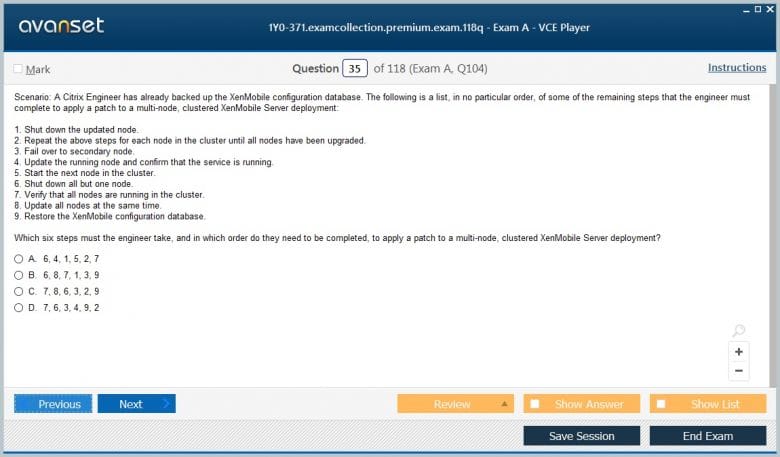
Citrix 1Y0-371 Practice Test Questions in VCE Format
| File | Votes | Size | Date |
|---|---|---|---|
File Citrix.Prepaway.1Y0-371.v2026-07-07.by.Isaac.73q.vce |
Votes 2 |
Size 97.9 KB |
Date Jul 12, 2026 |
File Citrix.Testking.1Y0-371.v2016-06-28.by.Ray.77q.vce |
Votes 8 |
Size 97.08 KB |
Date Jun 30, 2016 |
Citrix 1Y0-371 Practice Test Questions, Exam Dumps
Citrix 1Y0-371 (Designing, Deploying and Managing Citrix XenMobile 10 Enterprise Solutions) exam dumps vce, practice test questions, study guide & video training course to study and pass quickly and easily. Citrix 1Y0-371 Designing, Deploying and Managing Citrix XenMobile 10 Enterprise Solutions exam dumps & practice test questions and answers. You need avanset vce exam simulator in order to study the Citrix 1Y0-371 certification exam dumps & Citrix 1Y0-371 practice test questions in vce format.
Citrix 1Y0-371, Designing, Deploying and Managing Citrix XenMobile 10 Enterprise Solutions, belongs to an earlier Citrix mobility era. The exam focused on building enterprise mobility management around XenMobile Server, NetScaler Gateway, mobile applications, certificates, policies, delivery groups, and supporting infrastructure. Citrix’s current public certification page no longer presents a XenMobile certification track, so a 2026 reader should treat the exam as historical rather than assume that an old page represents a currently schedulable credential.
The blueprint remains useful because mobile-management problems did not disappear when product branding and delivery models changed. Organizations still need to enroll devices, separate corporate from personal data, distribute applications, enforce policy, protect credentials, provide secure access to internal resources, and remove enterprise data when a device or employee leaves. 1Y0-371 is therefore best understood as a structured record of how those responsibilities were implemented in the XenMobile 10 generation.
Readers can place the exam inside the broader Citrix certifications. Older editorial coverage such as Citrix mobility certification changes also illustrates how quickly the mobility program evolved, which is exactly why current status should be verified rather than inferred from a legacy code.
A mobile-management platform has to decide which devices can enroll, which applications and data they can access, and what controls apply after enrollment. Those decisions may depend on ownership, operating system, security posture, user group, geography, or business role. A corporate-owned device can justify stronger controls than a personally owned device, while a high-risk application may require additional restrictions regardless of ownership.
The design challenge is balance. Excessive restrictions encourage users to work around the platform; weak restrictions expose corporate data. Policies should therefore be tied to actual risk and communicated clearly. The historical XenMobile model is useful because it forces the architect to think in layers: device policy, application policy, identity, network access, and data protection are separate controls that need to work together.
Enrollment is not merely adding a device to a console. The platform has to associate a device with an identity, establish management authority, install or provision certificates and profiles, and assign the device to the correct policy set. Failures can come from DNS, certificates, identity providers, network reachability, licensing, platform configuration, or the device operating system itself.
Troubleshooting enrollment should follow the sequence. Confirm that the user reaches the expected service, authenticates successfully, receives the intended enrollment configuration, and completes the device-side actions. Compare a failing device with a known-good device of the same platform and ownership model. Grouping failures by operating system version, user group, network, or enrollment method often reveals the common dependency faster than inspecting devices one at a time.
XenMobile delivery groups allowed administrators to target resources and policies to defined populations. That sounds simple, but targeting becomes complex when users belong to multiple groups or when device ownership and platform conditions affect assignment. A reliable design should document why a group exists and what business requirement it represents.
Changes should be staged because one policy can affect many devices quickly. If a new restriction blocks a business application or changes device behavior unexpectedly, the organization needs a way to identify the affected group and reverse the assignment. The same principle appears in modern endpoint management: grouping is powerful because it scales administration, and risky for exactly the same reason.
Enterprise mobility platforms often apply application-level controls such as managed data exchange, network access restrictions, copy-and-paste rules, encryption, authentication, and secure browsing. These controls are especially important in BYOD environments where the organization may not fully manage the device itself.
Application policy should reflect data sensitivity. Blocking all interaction between managed and unmanaged applications can protect data but may also make legitimate workflows impractical. Administrators should test real user tasks, including opening attachments, sharing approved data, using internal links, and authenticating to back-end services. Security is strongest when the intended workflow remains usable without exposing enterprise information to uncontrolled applications.
XenMobile commonly depended on NetScaler Gateway for remote access to internal applications and services. That introduced familiar networking and identity dependencies: certificates, DNS, authentication, session policy, routing, and back-end reachability. A mobile application could be healthy while access failed because the secure tunnel or gateway policy was wrong.
The related 1Y0-231 Gateway exam shows the networking side of that relationship in more depth. For mobility administrators, the key lesson is to distinguish device management from application connectivity. Enrollment may succeed while internal access fails, and troubleshooting should identify whether the problem is on the device, in the mobility platform, at the gateway, or at the target application.
Mobile environments use certificates for device trust, user authentication, secure communications, and access to protected services. Certificate issuance, renewal, revocation, and chain trust therefore become part of routine operations. A certificate profile that works for initial enrollment can still create a future outage if renewal is not designed correctly.
Administrators should understand which component issues each certificate, where the private key resides, what identity the certificate represents, and what happens when a device is retired. Revocation matters because wiping enterprise data without invalidating credentials can leave another access path open. Certificate troubleshooting should also account for time synchronization and intermediate trust, which can create failures that appear unrelated to mobility management.
When a personally owned device leaves management, the organization may need to remove corporate applications, profiles, certificates, and data without destroying personal content. A corporate-owned device may justify a stronger reset. The management platform therefore needs clear ownership data and administrators need permission boundaries around destructive actions.
Role-based administration is essential. Help-desk staff may need to lock a device or issue a selective wipe but should not necessarily have authority to erase every enrolled device or change global policy. Audit records should show who initiated sensitive actions and why. These governance controls are as important as the technical wipe command because mistakes can affect employee data and business operations.
Mobile operating systems change rapidly. Enrollment APIs, security restrictions, application-signing requirements, certificate behavior, and device-management capabilities can evolve between releases. A XenMobile 10 procedure that was correct years ago should not be assumed appropriate for a current iOS or Android environment. The same caution applies to server versions and gateway integrations.
That is why 1Y0-371 should be used as a conceptual architecture map rather than a current deployment manual. Preserve the durable ideas—identity, enrollment, policy targeting, secure application access, data protection, lifecycle management, and evidence-based troubleshooting—while verifying current product capabilities and supported platforms from present-day Citrix documentation.
Application distribution was another major XenMobile responsibility. Administrators needed to decide whether an application came from a public store, an enterprise package, or a managed Citrix application, then control who received it and under what policy. Version changes could affect device compatibility or managed-data behavior, so staged rollout and the ability to withdraw an application were important operational controls.
Compliance policy also connected device state with access. Jailbroken or rooted devices, disabled passcodes, unsupported operating-system versions, or other posture conditions could justify restricted access. The difficulty is choosing a response proportionate to the risk. Automatically blocking every noncompliant device can protect data but may also interrupt legitimate work if detection is noisy, so organizations need remediation messaging and a clear path back to compliance.
Support teams benefit from separating inventory data from enforcement. Knowing the device model, OS version, ownership, and enrollment status helps diagnose issues even when no security action is required. Historical mobility platforms demonstrated the value of this centralized inventory long before modern unified endpoint management made it a standard expectation.
Decommissioning should be planned as carefully as enrollment. Certificates, managed applications, profiles, device records, and back-end access may all need cleanup. A device that disappears from the console without revoking associated credentials can leave orphaned trust, while deleting records too early can remove evidence needed to investigate a loss or policy failure.
Mobile support also depends on clear ownership of application and device problems. A user may report that “email is broken” when the cause is an expired certificate, a device-compliance block, an application policy, or ordinary mail-server failure. Tiered troubleshooting should identify whether the symptom affects managed apps only, one operating system, one delivery group, or the underlying service for every client.
Reporting and audit data are valuable for more than compliance. Enrollment trends, failed deployments, noncompliant devices, and repeated application-install errors can reveal systemic issues before they become major incidents. A mobility team that reviews patterns can fix the policy or infrastructure cause instead of repeatedly resolving the same device-level ticket.
Instead of asking how to reproduce an old console workflow, ask what control the workflow was designed to provide. What establishes device trust? How is corporate data isolated? Which policy determines application network access? How are credentials removed when a user leaves? What evidence proves that a device received the expected configuration? Those questions remain relevant even when the product name changes.
Candidates studying Citrix today should follow the active certification tracks shown on Citrix’s current training site rather than attempting to reconstruct the retired mobility path. For historical readers, 1Y0-371 still offers a detailed picture of enterprise mobility engineering at a time when XenMobile combined device management, application management, and secure access into one architecture.
Go to testing centre with ease on our mind when you use Citrix 1Y0-371 vce exam dumps, practice test questions and answers. Citrix 1Y0-371 Designing, Deploying and Managing Citrix XenMobile 10 Enterprise Solutions certification practice test questions and answers, study guide, exam dumps and video training course in vce format to help you study with ease. Prepare with confidence and study using Citrix 1Y0-371 exam dumps & practice test questions and answers vce from ExamCollection.
Purchase Individually
Top Citrix Certifications
Site Search:

SPECIAL OFFER: GET 10% OFF

Pass your Exam with ExamCollection's PREMIUM files!
SPECIAL OFFER: GET 10% OFF
Use Discount Code:
MIN10OFF
A confirmation link was sent to your e-mail.
Please check your mailbox for a message from support@examcollection.com and follow the directions.

Download Free Demo of VCE Exam Simulator
Experience Avanset VCE Exam Simulator for yourself.
Simply submit your e-mail address below to get started with our interactive software demo of your free trial.