



Premium File
89 Q&A
$76.99$69.99
Veritas VCS-279 Exam Questions & Answers, Accurate & Verified By IT Experts
Instant Download, Free Fast Updates, 99.6% Pass Rate
89 Questions & Answers
Last Update: Sep 18, 2026
$69.99
Veritas VCS-279 Exam Screenshots
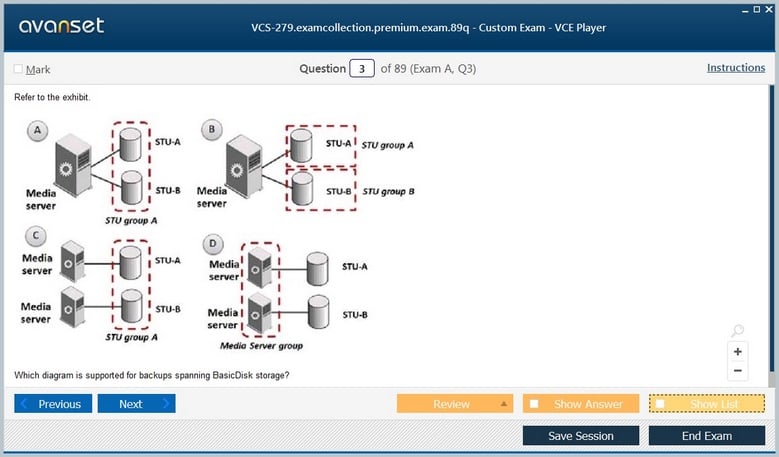
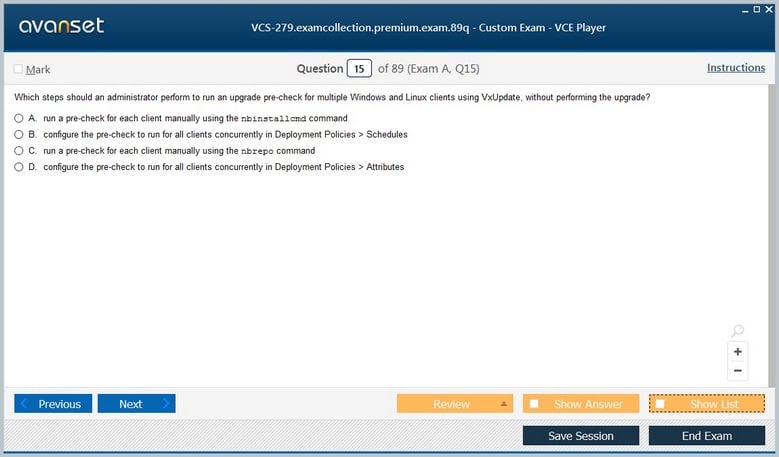
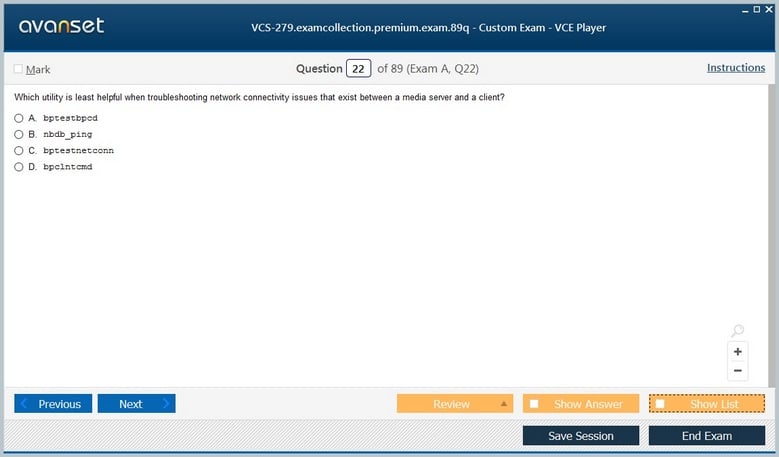
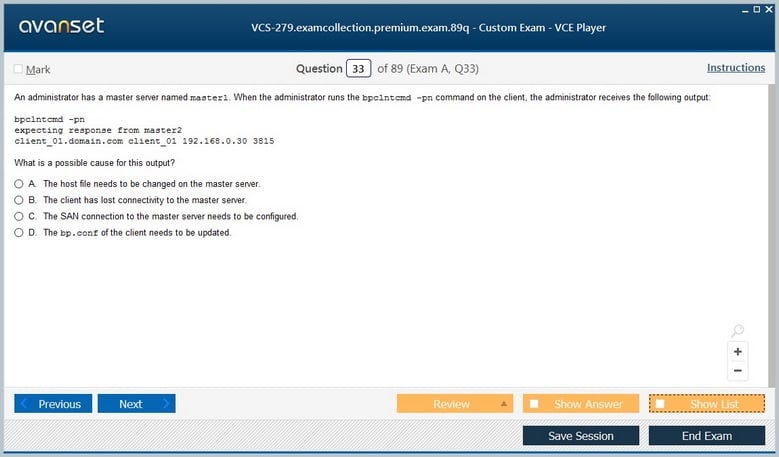
Veritas VCS-279 Practice Test Questions in VCE Format
| File | Votes | Size | Date |
|---|---|---|---|
File Veritas.braindumps.VCS-279.v2026-07-24.by.arthur.49q.vce |
Votes 1 |
Size 245.11 KB |
Date Jul 25, 2026 |
File Veritas.Test-king.VCS-279.v2020-01-17.by.David.43q.vce |
Votes 4 |
Size 195.52 KB |
Date Jan 18, 2020 |
Veritas VCS-279 Practice Test Questions, Exam Dumps
Veritas VCS-279 (Administration of Veritas NetBackup 8.1.2 and NetBackup Appliances 3.1.2) exam dumps vce, practice test questions, study guide & video training course to study and pass quickly and easily. Veritas VCS-279 Administration of Veritas NetBackup 8.1.2 and NetBackup Appliances 3.1.2 exam dumps & practice test questions and answers. You need avanset vce exam simulator in order to study the Veritas VCS-279 certification exam dumps & Veritas VCS-279 practice test questions in vce format.
VCS-279 covered Administration of Veritas NetBackup 8.1.2 and NetBackup Appliances 3.1.2. It extended the software-only administration scope by requiring candidates to understand the appliance as an integrated data-protection platform: configuration, storage, health, hardware monitoring, appliance management interfaces, updates, and the way appliance services participate in ordinary NetBackup backup and recovery operations.
That specific exam is now legacy. NetBackup moved into Cohesity when the company completed its combination with Veritas’ enterprise data-protection business in December 2024. Cohesity Academy now offers Cohesity Certified Protection Professional – NetBackup Appliances as exam COH-285. The current credential still tests many of the same operational themes, but it is aligned to today’s NetBackup and appliance environment rather than the 8.1.2/3.1.2 generation.
For learners, this creates a useful continuity story. The old exam teaches how software and purpose-built backup hardware fit together; the current exam continues that professional role with newer security, management, and platform capabilities. The right approach is to keep the architecture and troubleshooting lessons while replacing old version details with current product documentation.
Purpose-built NetBackup appliances package compute, storage, software, and management into a controlled platform. This can simplify deployment and support because many compatibility decisions are made by the vendor. However, the appliance still participates in the same backup lifecycle: jobs are scheduled, data is transported and processed, backup images are stored, copies may be duplicated or replicated, and restores must be served reliably.
Administrators should therefore avoid treating the appliance as a black box. They need to understand its role in the NetBackup architecture, how clients and other servers communicate with it, what storage it provides, and how resource limits affect jobs. A hardware platform can reduce integration work, but operating it well still requires visibility into the data path.
The operational advantage of an appliance is that hardware, operating environment, storage services, and NetBackup roles arrive as a more integrated platform. The trade-off is that administrators must understand the supported lifecycle of that integrated stack. Firmware, appliance software, NetBackup compatibility, expansion hardware, certificates, and remote-management components cannot be upgraded independently without considering the tested combinations. A successful appliance administrator therefore spends as much time on compatibility and change planning as on creating backup policies.
This also changes escalation. A failed backup may originate in NetBackup policy logic, the client, media services, deduplication, an appliance disk, a network interface, or the underlying hardware platform. The fastest path to resolution is to preserve evidence and identify the failing layer before making broad changes. Appliance integration reduces deployment choices, but it does not remove the need to distinguish application symptoms from platform faults.
Integrated storage can create the impression that sizing is simple, yet retention, daily change rate, deduplication behavior, duplication policies, growth, and restore activity still determine how much usable capacity is required. Appliances also have model-specific expansion options and performance characteristics. An environment that begins comfortably can become constrained as protected workloads or retention requirements grow.
A good capacity model includes normal growth and abnormal operating periods. What happens if a secondary copy cannot be created for several days? What if an outage causes many backups to run at once? What space is needed during upgrades or maintenance? Planning for these scenarios reduces the chance that the protection platform itself becomes a bottleneck during an incident.
Capacity planning should include protected front-end data, change rate, retention, deduplication behavior, replication, staging requirements, growth, and the operational headroom needed for maintenance. Running an appliance near its usable limit can affect more than the ability to accept one additional backup. Cleanup, image expiration, replication, and recovery operations may all need working space, while a sudden workload change can consume forecast capacity much faster than a simple annual-growth percentage suggests.
Administrators should therefore monitor trends rather than only threshold alerts. A daily view of used capacity says what is happening; a rolling rate of change helps explain when action will be required. Correlating that growth with policy changes, new clients, retention changes, or deduplication efficiency makes the forecast actionable. This is the kind of practical reasoning that remains useful long after the exact storage sizes and appliance generations from VCS-279 have aged out.
The VCS-279 generation required familiarity with appliance administration through the shell menu and web interfaces as well as ordinary NetBackup management tools. These layers exist because operating-system and hardware tasks are different from backup-policy tasks. An administrator may need one interface to examine appliance hardware and another to diagnose a failed backup or storage-unit configuration.
That separation remains relevant in current platforms. Candidates should know which interface owns networking, storage, appliance health, NetBackup configuration, software updates, and low-level troubleshooting. When a problem crosses boundaries, the ability to identify the correct management layer prevents random changes and shortens escalation.
A backup job may fail because a disk, controller, network interface, fan, power component, or other appliance subsystem is degraded. The job log can show the consequence without making the physical cause obvious. Appliance administrators therefore need to monitor hardware health and understand which alerts require immediate intervention, which indicate reduced redundancy, and which can be investigated without stopping service.
This is one reason purpose-built appliances do not eliminate infrastructure knowledge. They concentrate responsibility. A capable operator can move from a NetBackup error to appliance health, then back to the backup service after the hardware issue is resolved. The same cross-layer troubleshooting is expected in modern Cohesity NetBackup appliance roles.
Appliances often participate in deduplicated storage pools, optimized duplication, Auto Image Replication, or other mechanisms that move protected data between systems and sites. These features can save bandwidth and automate secondary-copy creation, but they also create dependencies on network connectivity, target capacity, storage-server configuration, and replication policy.
Administrators should diagram where each authoritative copy exists and how it is created. If the primary appliance is lost, which copy can be used? If replication stops, how quickly will the recovery posture fall outside policy? This kind of topology thinking connects the appliance to broader data-protection design without assuming that one product or storage location can satisfy every recovery objective.
Replication design needs an explicit failure model. If a primary site is unavailable, determine how the receiving environment discovers the replicated images, which control-plane services must already exist, what network identities change, and who has authority to initiate recovery. Replicating backup data without rehearsing those dependencies can create a false sense of geographic resilience. A second appliance is useful only when the organization can convert its stored copies into working recoveries under outage conditions.
Security separation should be mapped with the same care. Management interfaces, remote hardware controllers, operating access, NetBackup administration, and replication credentials may represent different trust surfaces. Restricting access, monitoring privileged changes, and avoiding unnecessary credential reuse helps prevent one compromised account from controlling every layer. Current cyber-recovery practice puts even more emphasis on those boundaries, but the architecture can be understood clearly through the appliance responsibilities VCS-279 introduced.
The appliance may contain large amounts of protected data, but successful recovery also depends on the NetBackup catalog and the configuration information needed to rebuild services. VCS-279 included catalog protection for this reason. Administrators should know how disaster-recovery information is preserved and what sequence is required if management services must be restored before client data can be recovered.
A credible runbook should cover more than hardware replacement. It should identify credentials, networking, DNS, certificates, catalog recovery, storage visibility, media or disk resources, and validation of the restored control plane. Backup infrastructure is itself a critical application and deserves the same recovery design discipline as the workloads it protects.
The related VCS-278 exam covered NetBackup 8.1.2 without the appliance component. Comparing the two makes the certification design clear: core policy, storage, monitoring, restore, and troubleshooting knowledge belonged to NetBackup administration, while VCS-279 added the integrated appliance platform and its operational responsibilities.
That distinction is still useful when assigning team responsibilities. Some organizations have backup administrators who operate NetBackup logically while a smaller infrastructure group owns appliance hardware and upgrades. Others expect one engineer to handle both. Understanding the boundary helps define runbooks, permissions, escalation paths, and training requirements.
The later VCS-285 moved the Veritas exam to NetBackup 10.x and Appliance 5.x. Cohesity Academy now uses COH-285 for its current Protection Professional – NetBackup Appliances certification. The current scope still includes architecture, backup and restore configuration, storage settings, specialized protection, appliance interaction, monitoring, optimization, maintenance, and basic troubleshooting.
The continuity means old study can be repurposed carefully. Keep concepts such as policy design, storage units, catalog recovery, hardware health, appliance interfaces, replication, deduplication, and failure diagnosis. Replace old commands, screens, supported platforms, security assumptions, and version-specific behavior with current material. The goal is not to preserve an obsolete exam; it is to preserve a useful operations model.
A strong lab should include more than successful backup jobs. Simulate a repository-capacity warning, disable a network path, create a failed job, inspect appliance health, restore a file, and document how the evidence differs between NetBackup and appliance-management layers. Even when physical hardware is unavailable, a detailed scenario exercise can force the same diagnostic sequence.
For someone arriving from the older Veritas certifications, the final step is to rebuild the plan around Cohesity Academy and current NetBackup releases. VCS-279 is a historical milestone in the product’s certification lineage. Its value today comes from the durable engineering idea that backup software, storage, hardware, network, security, and recovery operations have to be managed as one service.
Build the lab record as an operator runbook rather than as exam notes. For each failure, capture the symptom, the authoritative status source, the evidence that identifies the affected layer, the safe corrective action, and the validation that proves protection has resumed. Include at least one hardware-health event, one storage or capacity condition, one network interruption, and one restore from a replicated or alternate copy. That format creates reusable operational knowledge while exposing whether the candidate truly understands the appliance as a system.
Go to testing centre with ease on our mind when you use Veritas VCS-279 vce exam dumps, practice test questions and answers. Veritas VCS-279 Administration of Veritas NetBackup 8.1.2 and NetBackup Appliances 3.1.2 certification practice test questions and answers, study guide, exam dumps and video training course in vce format to help you study with ease. Prepare with confidence and study using Veritas VCS-279 exam dumps & practice test questions and answers vce from ExamCollection.
Purchase Individually
Top Veritas Certification Exams
Site Search:

SPECIAL OFFER: GET 10% OFF

Pass your Exam with ExamCollection's PREMIUM files!
SPECIAL OFFER: GET 10% OFF
Use Discount Code:
MIN10OFF
A confirmation link was sent to your e-mail.
Please check your mailbox for a message from support@examcollection.com and follow the directions.

Download Free Demo of VCE Exam Simulator
Experience Avanset VCE Exam Simulator for yourself.
Simply submit your e-mail address below to get started with our interactive software demo of your free trial.