



Premium File
220 Q&A
$76.99$69.99
Veritas VCS-278 Exam Questions & Answers, Accurate & Verified By IT Experts
Instant Download, Free Fast Updates, 99.6% Pass Rate
220 Questions & Answers
Last Update: Oct 30, 2026
$69.99
Veritas VCS-278 Exam Screenshots
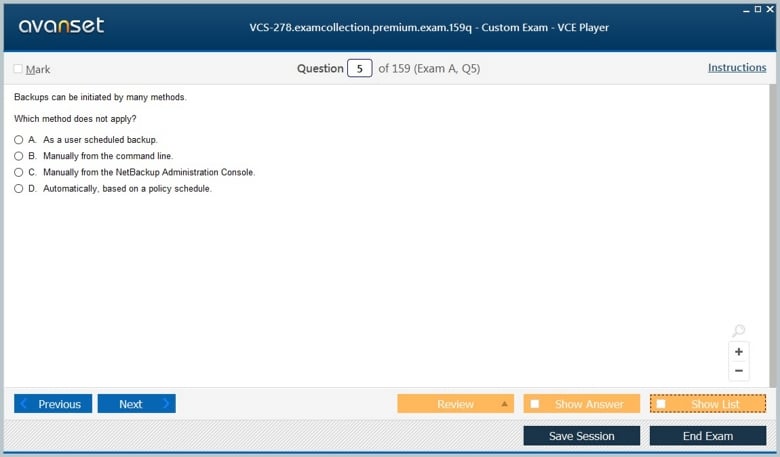
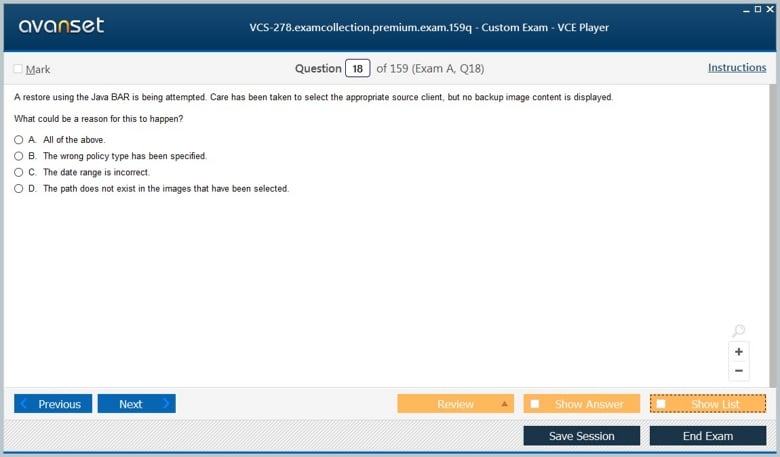
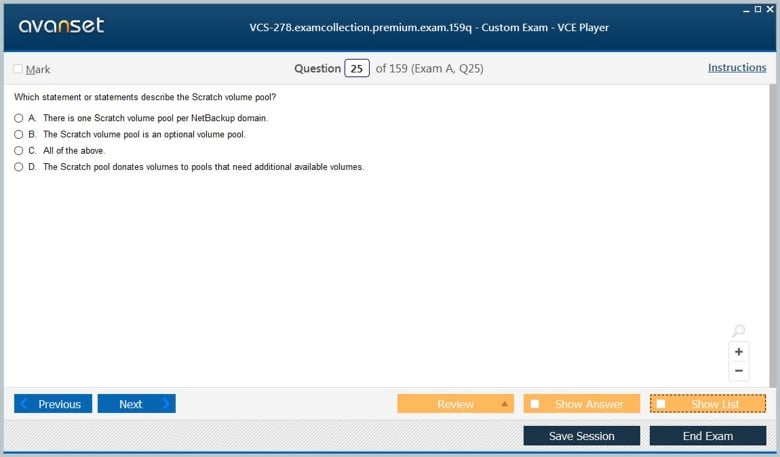
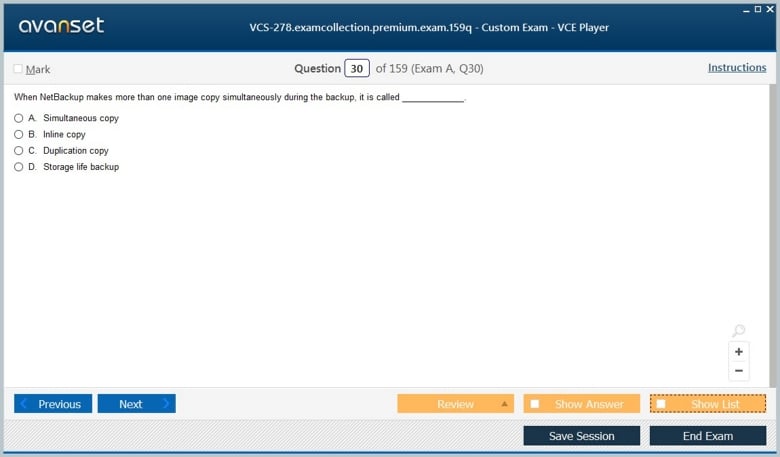
Veritas VCS-278 Practice Test Questions in VCE Format
| File | Votes | Size | Date |
|---|---|---|---|
File Veritas.practicetest.VCS-278.v2026-10-03.by.jaxon.121q.vce |
Votes 1 |
Size 1.4 MB |
Date Oct 04, 2026 |
File Veritas.examanswers.VCS-278.v2020-05-15.by.lucia.109q.vce |
Votes 2 |
Size 1.31 MB |
Date May 15, 2020 |
File Veritas.Testking.VCS-278.v2019-11-24.by.Philip.75q.vce |
Votes 3 |
Size 1.08 MB |
Date Nov 27, 2019 |
Veritas VCS-278 Practice Test Questions, Exam Dumps
Veritas VCS-278 (Administration of Veritas NetBackup 8.1.2) exam dumps vce, practice test questions, study guide & video training course to study and pass quickly and easily. Veritas VCS-278 Administration of Veritas NetBackup 8.1.2 exam dumps & practice test questions and answers. You need avanset vce exam simulator in order to study the Veritas VCS-278 certification exam dumps & Veritas VCS-278 practice test questions in vce format.
VCS-278 was the Veritas Certified Specialist exam for Administration of Veritas NetBackup 8.1.2. It validated the day-to-day work of a NetBackup administrator: understanding architecture, configuring storage and backup policies, running restores, monitoring jobs, maintaining media and disk resources, protecting the catalog, and troubleshooting common failures. The exam is no longer part of the current certification path and should be treated as a legacy NetBackup version exam.
NetBackup itself remains very much alive. Cohesity completed its combination with Veritas’ enterprise data-protection business in December 2024, and current NetBackup certification now sits in Cohesity Academy. The closest current non-appliance credential is Cohesity Certified Protection Professional – NetBackup, identified as COH-284. That means older VCS-278 material can still provide useful technical grounding, but it should not be used to infer current exam registration, branding, or product-version coverage.
The distinction between version knowledge and operational knowledge is important. A NetBackup administrator still needs to understand policies, clients, media servers, storage units, deduplication, catalog protection, restores, replication, monitoring, and failure diagnosis. What changes over time are interfaces, security controls, supported workloads, automation features, appliance generations, and the way the vendor packages certification around those capabilities.
Administrators need a mental model of the control plane and data path. The primary or master role coordinates policy, catalog, scheduling, and much of the environment’s configuration. Media servers move and process data, clients or protected workloads supply it, and storage targets retain it. When a job fails, the component that reports the error is not always the component that caused it.
VCS-278 preparation is therefore strongest when candidates trace a job end to end. Identify who initiates it, how the client is contacted, which server reads the data, where deduplication may occur, which storage unit receives the backup, and which catalog records are updated. The same map can be reversed for a restore. That habit remains relevant in current NetBackup environments because troubleshooting still depends on locating the failed stage.
A policy defines more than a list of clients. It brings together what is protected, when protection runs, how the data is selected, where it goes, what backup type is used, and how the resulting images are retained. Small configuration errors can create large operational consequences: a schedule may never open, a selection list may miss data, or a retention level may conflict with business requirements.
Candidates should learn to read a policy as an operating contract. What workload is in scope? What recovery points will exist after one week or one month? Which storage resources are consumed? How does the policy interact with maintenance or replication? This reasoning is more durable than remembering where a particular option appeared in the 8.1.2 administration console.
Policy design should begin with the protected service rather than with the scheduler. A database, file share, virtual machine, and infrastructure server can have different change rates, recovery granularity, maintenance windows, and business priorities. Those differences affect backup frequency, retention, client selection, storage targets, and the type of restore that must be rehearsed. Grouping workloads only because they are on the same subnet or owned by the same team can produce convenient administration while hiding incompatible recovery requirements.
Schedules also need to be evaluated as a system. Full and incremental activity, duplication, catalog work, maintenance, and restore demand may compete for the same media servers, disk pools, or networks. A design that looks feasible one job at a time can fail when concurrency peaks. Candidates should practice drawing the daily and weekly load on shared components, then ask which queueing is expected, which delay threatens an RPO, and where additional capacity or a policy change would actually improve protection.
NetBackup can abstract storage, but administrators still need to understand the devices and pools underneath that abstraction. Disk storage, deduplication storage, tape, and other targets behave differently under concurrency, retention, duplication, and restore load. A design that is fast for backup may be slow for restore, while a low-cost retention tier may have operational constraints that matter during an incident.
The useful question is not simply “where can this backup be written?” but “what service level can this target deliver through the whole data lifecycle?” Capacity, throughput, failure domains, media management, and the ability to duplicate or replicate data all matter. That perspective prepares a learner for both old VCS-278 objectives and modern multi-tier protection designs.
Media-server and client-side deduplication can reduce the amount of repeated data transmitted or stored, but the savings depend on workload characteristics and architecture. Deduplication also introduces its own processing, database, cache, and recovery considerations. Administrators should understand where deduplication occurs and what happens when the deduplication service is constrained or unavailable.
A common mistake is to treat deduplication ratio as guaranteed capacity. Real environments change as workloads, encryption, compression, databases, and retention patterns change. Capacity forecasts should use measured behavior and include headroom. The general lesson remains applicable to current data-protection platforms: efficiency technologies improve economics, but they do not remove the need to observe actual growth and recovery performance.
The NetBackup catalog contains the information needed to understand what has been backed up and where that data is located. Losing protected data while keeping the catalog is bad; keeping protected data while losing the catalog can also make recovery extremely difficult. VCS-278 therefore included catalog backup and recovery as a core administrative responsibility.
A mature environment treats catalog protection as a tested recovery dependency. Administrators should know where catalog backups are written, how required disaster-recovery information is preserved, and what sequence is used to rebuild the environment. This connects naturally to broader disaster-recovery planning: the backup platform itself must be recoverable before it can recover everyone else.
The catalog is operational metadata about protected clients, images, policies, media, and the history needed to locate recoverable data. Losing it can turn intact backup storage into a much harder recovery problem. Catalog backup should therefore have its own schedule, retention, location, and recovery documentation, and administrators should know which credentials, host identity, and infrastructure dependencies are required to rebuild the control plane. A disaster-recovery procedure that assumes the master server still exists has not tested the difficult case.
Security belongs in the same recovery plan. Backup administrators often hold privileges that can read large amounts of enterprise data and change retention or storage behavior. Protecting administrative credentials, certificate trust, service access, and privileged workflows reduces the chance that a production compromise immediately becomes a recovery-platform compromise. Even in an 8.1.2-era exam, the transferable lesson is clear: the backup control plane is part of the organization’s security boundary and should be managed accordingly.
Large NetBackup environments can contain many simultaneous jobs, storage operations, duplications, replications, and maintenance tasks. Not every queued job is a failure, and not every successful status means the protection service is healthy. Administrators need to understand normal throughput, job priorities, concurrency limits, storage availability, and recurring warning patterns so that unusual behavior stands out.
A useful operating practice is to define health at the service level: which critical workloads completed, which recovery points are available, whether secondary copies were created, whether storage is approaching a threshold, and whether failures are increasing. That view is more meaningful than counting green job icons and remains central to current enterprise backup operations.
VCS-278 included file-system and virtual-machine recovery because restore methods differ by workload and failure. A single deleted file, a damaged server, an application-consistency problem, and a site outage are not the same recovery event. Administrators should know which recovery method provides the required granularity and which infrastructure dependencies must be available first.
The best preparation is to perform restores in a lab and document the sequence. Restore to an alternate path, recover a complete system, validate permissions and application access, and measure how long each operation takes. Recovery practice reveals dependencies that backup configuration alone cannot show, including DNS, authentication, network reachability, staging space, and the performance limits of the chosen storage tier.
A useful lab matrix includes a single file, an application-aware workload, an entire system, and a recovery that must use an alternate location or different infrastructure. Record the prerequisites for each case and the point at which the restored service becomes usable to its owner. This exposes an important difference between data transfer and service recovery: a restore job can complete successfully while DNS, credentials, application configuration, transaction state, or downstream dependencies still prevent the business service from operating.
Testing should also include imperfect conditions. Limit bandwidth, make a normal target unavailable, rotate a credential, or create a capacity constraint and observe which NetBackup component reports the failure. Controlled fault injection teaches the relationship among primary server, media services, clients, storage, and policy more effectively than a long list of status codes. The specific VCS-278 code is legacy, but that diagnostic model remains useful in the current NetBackup lineage.
The old VCS-279 added NetBackup Appliances 3.1.2 to the same 8.1.2 generation, while later VCS-285 advanced the combined NetBackup-and-appliance path to NetBackup 10.x and Appliance 5.x. In 2026, Cohesity Academy uses the COH-284 and COH-285 exam numbers for its current NetBackup professional certifications. The lineage is clear even though the credential branding has changed.
Candidates should therefore use VCS-278 as historical product administration material, not as a current exam blueprint. Rebuild the same topics with current NetBackup documentation and Cohesity training, paying special attention to modern security, anomaly detection, malware detection, newer workload support, automation, and the current product release. The Veritas certifications still provides useful internal context for the older certification family.
Go to testing centre with ease on our mind when you use Veritas VCS-278 vce exam dumps, practice test questions and answers. Veritas VCS-278 Administration of Veritas NetBackup 8.1.2 certification practice test questions and answers, study guide, exam dumps and video training course in vce format to help you study with ease. Prepare with confidence and study using Veritas VCS-278 exam dumps & practice test questions and answers vce from ExamCollection.
Purchase Individually
Site Search:

SPECIAL OFFER: GET 10% OFF

Pass your Exam with ExamCollection's PREMIUM files!
SPECIAL OFFER: GET 10% OFF
Use Discount Code:
MIN10OFF
A confirmation link was sent to your e-mail.
Please check your mailbox for a message from support@examcollection.com and follow the directions.

Download Free Demo of VCE Exam Simulator
Experience Avanset VCE Exam Simulator for yourself.
Simply submit your e-mail address below to get started with our interactive software demo of your free trial.