



Premium File
251 Q&A
$76.99$69.99
FINRA Series 63 Exam Questions & Answers, Accurate & Verified By IT Experts
Instant Download, Free Fast Updates, 99.6% Pass Rate
251 Questions & Answers
Last Update: Sep 21, 2026
$69.99
FINRA Series 63 Exam Screenshots
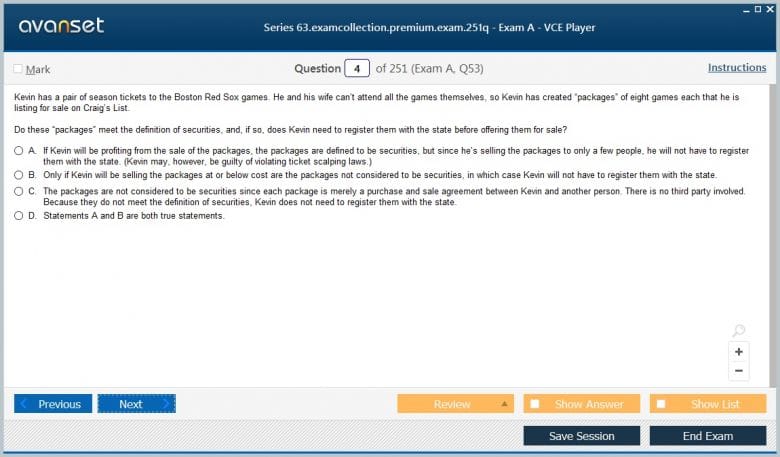
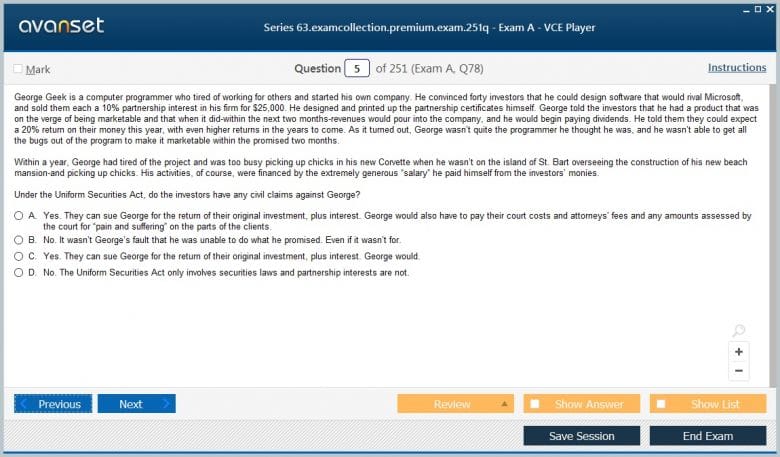

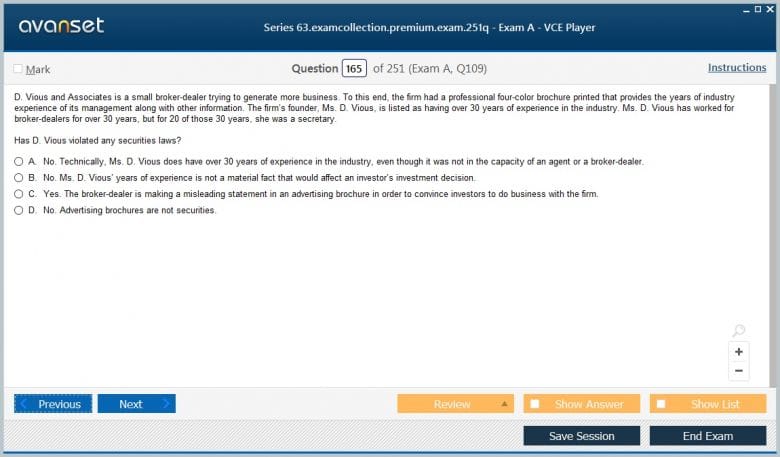
FINRA Series 63 Practice Test Questions in VCE Format
| File | Votes | Size | Date |
|---|---|---|---|
File FINRA.braindumps.Series 63.v2026-09-08.by.harry.151q.vce |
Votes 1 |
Size 373.4 KB |
Date Sep 08, 2026 |
File FINRA.Test4prep.Series 63.v2019-03-16.by.Bella.148q.vce |
Votes 3 |
Size 363.19 KB |
Date Mar 18, 2019 |
FINRA Series 63 Practice Test Questions, Exam Dumps
FINRA Series 63 (Uniform Securities State Law Examination) exam dumps vce, practice test questions, study guide & video training course to study and pass quickly and easily. FINRA Series 63 Uniform Securities State Law Examination exam dumps & practice test questions and answers. You need avanset vce exam simulator in order to study the FINRA Series 63 certification exam dumps & FINRA Series 63 practice test questions in vce format.
Series 63, the Uniform Securities Agent State Law Examination, is the NASAA qualification exam focused on the state-law responsibilities of broker-dealer agents. It is current, widely used, and structurally different from FINRA representative exams such as Series 6 and Series 7. NASAA develops the examination, while FINRA administers it. A candidate can open an enrollment window independently rather than needing a member firm to sponsor the test, although passing the exam alone does not create authority to transact securities business in a state.
The exam is built around the Uniform Securities Act, NASAA model rules and statements of policy, and ethical obligations that state securities administrators expect agents to understand. The key word is state. Federal securities law and FINRA rules remain relevant to a registered representative, but Series 63 asks whether the candidate can recognize when a person, security, transaction, communication, or practice triggers state registration or conduct requirements.
State securities law defines several categories of market participants, including broker-dealers, agents, investment advisers, investment adviser representatives, issuers, and other persons. Exam questions often turn on a definition because the applicable registration rule depends on the role. A person who represents a broker-dealer in securities transactions may be an agent, while someone giving advice for compensation may fall under investment adviser concepts. Issuer representatives can be treated differently depending on the security and activity.
Candidates should avoid learning those definitions as isolated vocabulary. The useful question is what the person is doing, for whom, for compensation or on whose behalf, and whether an exclusion or exemption changes the result. A scenario may deliberately include familiar job titles that are legally irrelevant. The regulatory definition controls.
This distinction also helps separate Series 63 from the Series 6 or Series 7. Those FINRA exams test competence for particular representative registration categories. Series 63 adds the state-law layer that many broker-dealer agents must satisfy in the jurisdictions where they do business.
The Uniform Securities Act framework asks whether broker-dealers, agents, investment advisers, and investment adviser representatives must register in a state. The answer can depend on whether the person has a place of business in the state, the nature and number of clients, the type of customer, and whether a statutory exclusion or exemption applies. The exam expects candidates to distinguish an exemption from registration from a complete absence of regulatory responsibility.
Administrators also have authority over registration applications, renewals, denials, suspensions, revocations, and other actions. Candidates should understand the basic procedural logic: states can require information, investigate conduct, and take action when statutory standards are met. Registration is not permanent permission detached from ongoing conduct.
State requirements also interact with federal preemption and federally covered advisers or securities. Series 63 does not require a law-school treatment of federalism, but it does require candidates to know that the state administrator's authority can differ depending on whether federal law limits state registration requirements while preserving notice filing, fee, antifraud, or enforcement powers.
A common source of confusion is the difference between registering a security and registering a person. A broker-dealer or agent may be properly registered while a security transaction still raises questions about whether the security is registered, exempt, or involved in an exempt transaction. Conversely, an exempt security does not automatically mean that every person selling it is exempt from agent registration.
Series 63 therefore requires a working understanding of exempt securities and exempt transactions. Government securities, certain bank-related instruments, nonprofit issues, private transactions, institutional transactions, unsolicited orders, and other categories may receive different treatment under the model act. The details matter because an exemption often applies to a particular security or transaction, not to all future activity by the participant.
The exam rewards careful reading. A question may change one fact—who initiates the transaction, the nature of the customer, the number of offerees, or the issuer type—and thereby change the regulatory result. Candidates should identify the legal trigger before choosing an answer.
Series 63 is heavily concerned with dishonest or unethical business practices. That includes misrepresentations, unsuitable recommendations, unauthorized trading, improper use of customer funds or securities, excessive trading, misleading communications, sharing in accounts improperly, borrowing or lending in prohibited circumstances, and failures to disclose conflicts. The exam treats ethics as enforceable conduct standards rather than personal preference.
The most useful way to analyze an ethics scenario is to ask what the customer knows, what authority the representative has, what conflict exists, and whether the action puts the representative's interests ahead of the customer or the rules. A transaction can be profitable and still unethical. A customer can agree to an arrangement that the rules nevertheless prohibit. Good intentions do not substitute for required authorization or disclosure.
Cybersecurity and data protection have also become more visible in modern Series 63 specifications. Protecting customer information, handling electronic communications responsibly, and recognizing the compliance implications of digital business are now part of the professional environment state regulators oversee.
Advertising and correspondence are important because investor harm can begin with a misleading statement long before an order is placed. Claims about guarantees, risk, performance, qualifications, or regulatory approval can mislead customers even if the underlying product is legitimate. Series 63 candidates should understand that antifraud principles apply to material omissions as well as explicit false statements.
Social media does not eliminate those responsibilities. A public post, direct message, testimonial, or digital advertisement can still be a business communication subject to supervisory and regulatory expectations. The medium changes, but the requirement for fair and non-misleading communication does not.
State securities administrators have investigative and enforcement authority. Candidates should understand the broad tools available: investigations, subpoenas, cease-and-desist actions, registration proceedings, and referrals or actions involving civil or criminal consequences where applicable. The exam is not asking candidates to become litigators, but it does expect them to recognize that state securities law has real enforcement mechanisms.
Jurisdiction is important here. Conduct involving an offer made in, directed into, or accepted within a state can create state-law consequences depending on the statutory rules. A modern securities business can cross state lines electronically, so representatives cannot assume that physical office location is the only relevant fact.
NASAA currently states that the Series 63 contains 65 multiple-choice questions, of which 60 are scored and five are unidentified pretest items. Candidates have 75 minutes, and a passing result requires at least 43 correct answers among the 60 scored questions. Because the test is relatively short, each conceptual distinction carries weight. Misunderstanding the difference between an exempt security and exempt transaction, or between an agent and an investment adviser representative, can affect several questions.
The exam can be taken through FINRA's enrollment process even by someone who is not associated with a member firm. That makes Series 63 procedurally different from representative-level FINRA qualification exams. It is also important to distinguish exam passage from state registration. NASAA explicitly notes that passing may satisfy only part of a jurisdiction's requirements and does not itself grant the right to conduct business.
The Securities Industry Essentials exam covers general securities-industry knowledge and serves as the co-requisite foundation for FINRA representative registrations such as Series 6 and Series 7. Series 63 is not a substitute for the SIE, and the SIE is not a substitute for state law qualification. They address different layers of the registration framework.
For a prospective broker-dealer representative, the practical path often combines the SIE, an appropriate representative-level exam, and the state-law exam required by the jurisdictions involved. The exact combination depends on the role and state. Candidates should learn that architecture rather than assume that one passing score creates a universal securities license.
Retake timing deserves particular attention because NASAA has announced a rule change that is close enough to affect candidates planning attempts across the end of 2026. Under the rules still in effect during 2026, a candidate who fails a state law exam twice within two years generally waits 30 days after each of the first two failures and 180 days after a third or subsequent failure. NASAA has announced that beginning January 4, 2027, the waiting period after a third or subsequent failure will be reduced to 60 days. Candidates should therefore check the rule that applies to the date of an actual attempt rather than relying on an old study site's blanket statement.
The exam's lack of a sponsorship requirement can also create confusion about what a passing score accomplishes. Individuals can enroll for Series 63 without first being hired by a broker-dealer, which makes the exam accessible for career preparation. But a passing result is only one element of agent registration. A jurisdiction can impose filing, fee, background, and firm-association requirements, and an individual's authority to conduct business depends on the applicable state and the registration status maintained there. The exam tests knowledge of the Uniform Securities Act framework; it is not itself a license to solicit transactions.
Series 63 becomes easier when candidates build a decision tree. Identify the person or security, determine whether registration is generally required, test for exclusions or exemptions, examine the transaction and communication, and then apply ethical and enforcement principles. This approach mirrors the way the Uniform Securities Act is structured and reduces reliance on memorizing disconnected exceptions.
The broader landscape of FINRA qualification exams includes overlapping federal, SRO, and state requirements. Series 63 has a specific purpose within that system: it measures whether a broker-dealer agent understands the state-law framework that protects investors and governs local registration and conduct. That focus makes the exam compact, but not superficial.
Go to testing centre with ease on our mind when you use FINRA Series 63 vce exam dumps, practice test questions and answers. FINRA Series 63 Uniform Securities State Law Examination certification practice test questions and answers, study guide, exam dumps and video training course in vce format to help you study with ease. Prepare with confidence and study using FINRA Series 63 exam dumps & practice test questions and answers vce from ExamCollection.
Purchase Individually
Site Search:

SPECIAL OFFER: GET 10% OFF

Pass your Exam with ExamCollection's PREMIUM files!
SPECIAL OFFER: GET 10% OFF
Use Discount Code:
MIN10OFF
A confirmation link was sent to your e-mail.
Please check your mailbox for a message from support@examcollection.com and follow the directions.

Download Free Demo of VCE Exam Simulator
Experience Avanset VCE Exam Simulator for yourself.
Simply submit your e-mail address below to get started with our interactive software demo of your free trial.