



Premium File
325 Q&A
$76.99$69.99
FINRA Series 6 Exam Questions & Answers, Accurate & Verified By IT Experts
Instant Download, Free Fast Updates, 99.6% Pass Rate
325 Questions & Answers
Last Update: Sep 20, 2026
$69.99
FINRA Series 6 Exam Screenshots
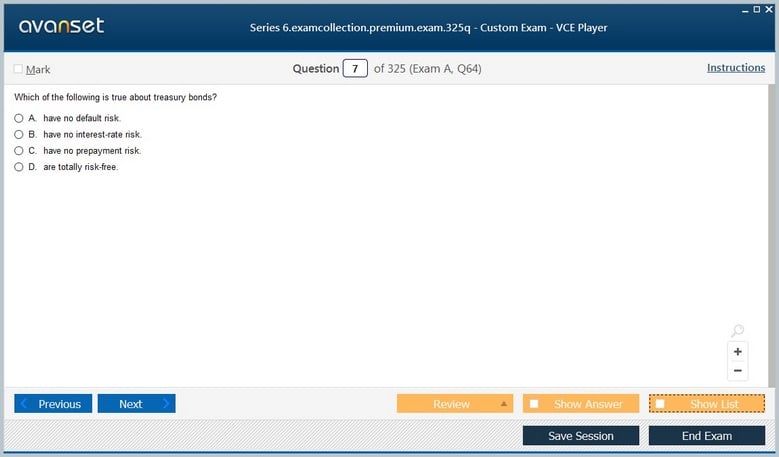
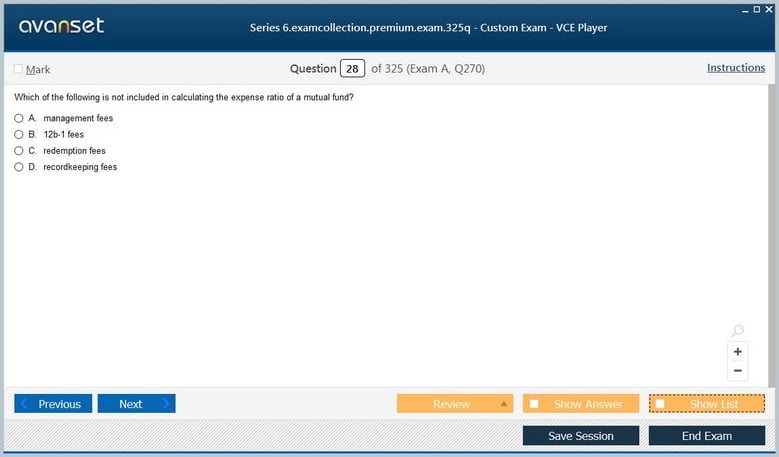
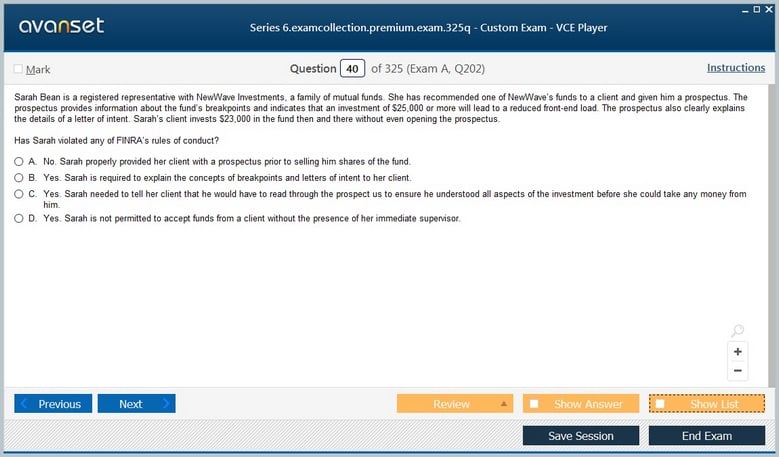
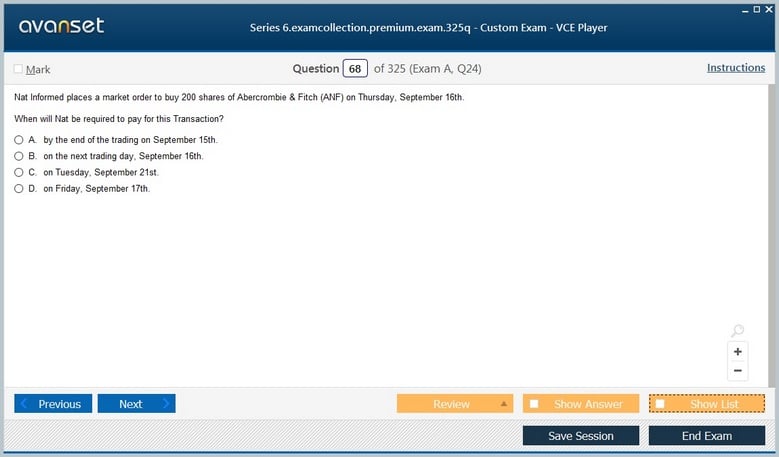
FINRA Series 6 Practice Test Questions in VCE Format
| File | Votes | Size | Date |
|---|---|---|---|
File FINRA.realtests.Series 6.v2026-06-05.by.max.179q.vce |
Votes 1 |
Size 396.11 KB |
Date Jun 06, 2026 |
File FINRA.practicetest.Series 6.v2020-10-30.by.dylan.190q.vce |
Votes 2 |
Size 447.25 KB |
Date Oct 30, 2020 |
FINRA Series 6 Practice Test Questions, Exam Dumps
FINRA Series 6 (Investment Company and Variable Contracts Products Representative Qualification Examination (IR)) exam dumps vce, practice test questions, study guide & video training course to study and pass quickly and easily. FINRA Series 6 Investment Company and Variable Contracts Products Representative Qualification Examination (IR) exam dumps & practice test questions and answers. You need avanset vce exam simulator in order to study the FINRA Series 6 certification exam dumps & FINRA Series 6 practice test questions in vce format.
Series 6 is the FINRA qualification exam for the Investment Company and Variable Contracts Products Representative registration. It is a current representative-level exam, but its scope is deliberately narrower than the General Securities Representative role covered by Series 7. A candidate pursuing Series 6 should therefore understand the business activities the registration supports before memorizing products or calculations. The exam is designed around a limited representative who works with investment company securities, variable contracts, and related customer activity rather than the full range of securities transactions.
Under the post-2018 FINRA structure, Series 6 is paired with the Securities Industry Essentials exam. The SIE supplies general industry knowledge, while Series 6 tests the job-specific knowledge required for this representative category. A candidate must be associated with and sponsored by an appropriate FINRA member firm to take the representative-level qualification exam. Passing the exams is part of registration; it does not by itself authorize someone to conduct securities business without the required firm and regulatory registrations.
The easiest way to understand Series 6 is to begin with registration scope. Investment Company and Variable Contracts Products Representatives work with products such as mutual funds, variable annuities, variable life insurance, unit investment trusts, and certain municipal fund securities. That scope creates a distinct knowledge profile. Candidates must understand pooled investment structures, insurance-linked securities, customer suitability, account handling, sales practices, and transaction processing within the products the registration permits.
The limited scope is also why Series 6 should not be described as a smaller version of Series 7. The two exams overlap in customer protection, communications, account procedures, and basic securities concepts, but Series 7 supports a much broader General Securities Representative registration. Series 6 concentrates on the products and tasks of a representative whose business is intentionally restricted. The correct choice of registration depends on the activities the employer expects the person to perform.
This role-first framing helps with exam questions because many scenarios are really asking whether the representative recognizes the boundaries of permitted business. Knowing product facts is necessary, but the professional question is often whether a recommendation, communication, account action, or transaction is appropriate for the representative and the customer.
Mutual funds are central to Series 6, so candidates need to understand the structure of open-end investment companies and how their shares are issued, priced, purchased, and redeemed. Net asset value connects the underlying portfolio to the per-share value, while public offering price reflects the applicable sales charge structure. The exam expects candidates to distinguish share classes, fees, breakpoints, rights of accumulation, letters of intent, exchanges, distributions, and tax consequences.
Those mechanisms matter because they affect real customer outcomes. A breakpoint is not simply a percentage table; it can determine whether a customer receives the sales-charge reduction to which the purchase is entitled. A letter of intent can allow a customer to qualify for a lower charge based on planned purchases, but it carries conditions. Fund exchanges can be operationally convenient while still creating tax consequences. Series 6 questions commonly connect those rules to a customer scenario rather than ask for isolated definitions.
Investment objectives and portfolio composition also matter. Money market, bond, balanced, equity, sector, international, and other funds expose investors to different combinations of market, credit, interest-rate, currency, concentration, and liquidity risk. A representative needs enough product knowledge to explain those differences accurately and to avoid reducing a recommendation to recent performance.
Variable annuities and variable life insurance are more complex than conventional mutual funds because they combine securities features with insurance contracts. Premiums or purchase payments may be allocated among separate-account investment options, and the value can vary with underlying performance. Contract terms can include mortality and expense charges, surrender charges, riders, death benefits, annuitization choices, and tax-deferred accumulation.
That hybrid structure creates suitability and disclosure issues. A customer considering a variable annuity may have a long time horizon and a need for tax-deferred accumulation, but the representative still has to evaluate liquidity needs, existing tax-advantaged accounts, fees, surrender periods, investment objectives, age, and other circumstances. Replacing one variable contract with another requires particular care because a new surrender schedule or charges can offset the apparent benefit.
Series 6 preparation should therefore connect the insurance wrapper to the underlying securities exposure. The contract does not remove market risk from variable subaccounts, and tax deferral does not automatically make a variable product suitable for every retirement investor. Product structure, customer profile, and recommendation rationale have to fit together.
FINRA's Series 6 outline places substantial weight on opening accounts, evaluating financial profiles, making recommendations, maintaining records, and processing transactions. That reflects the daily work of a representative. Candidates need to understand customer identification information, investment objectives, risk tolerance, tax status, time horizon, liquidity needs, account registrations, beneficiaries, and the distinction between customer instructions and representative discretion.
Account types change how ownership and authority work. Individual, joint, custodial, trust, retirement, and business accounts can involve different documentation and decision makers. A representative should recognize when additional records or approvals are required and when an instruction falls outside the authority granted on the account. These operational details are part of investor protection because a technically correct trade can still be improper if the person giving the instruction lacks authority.
Recommendations require more than finding a product that could work. The representative must have a reasonable basis for the recommendation and use the customer's profile rather than a sales target as the starting point. Costs, liquidity, risk, concentration, tax implications, and alternatives can all matter. Series 6 is limited in product range, but the obligation to understand the customer is not limited.
A representative's explanation can influence the customer's understanding just as much as the prospectus or contract. Series 6 therefore tests communications, advertising, correspondence, disclosures, and prohibited practices. Statements about performance must be balanced and not misleading. Risks cannot be minimized because a product is professionally managed. A variable contract cannot be presented as though its separate-account value is guaranteed when it is not.
Sales incentives create another risk area. Representatives must not let compensation arrangements, contests, or firm priorities override the customer's interests or applicable conduct standards. Switching funds or replacing variable contracts simply to generate commissions is a classic example of activity that can harm customers while appearing superficially active or helpful.
Understanding these rules is easier when candidates ask what information a reasonable customer would need to make an informed decision. Clear disclosure of costs, restrictions, risks, and conflicts supports that decision. Omitting a material limitation can make an otherwise accurate statement misleading.
Series 6 also follows the customer instruction through order handling and recordkeeping. Representatives need to know how purchases, redemptions, exchanges, and other permitted transactions are initiated, verified, documented, and confirmed. Cutoff times and pricing rules matter for investment-company products because orders are processed using the applicable forward price rather than negotiated intraday like an exchange-traded stock.
Good operational practice includes confirming the customer's intent, entering instructions accurately, recognizing unusual activity, and preserving required documentation. Errors in amount, fund selection, registration, or account coding can have financial and compliance consequences even when the recommendation itself was appropriate. The representative should know when a correction or escalation is necessary rather than attempting to hide an error.
Many Series 6 representatives also encounter state qualification requirements. The Series 63 is a NASAA state securities law examination commonly required for broker-dealer agents by individual jurisdictions. It is administered by FINRA but is not the same kind of exam as Series 6. Series 6 qualifies the representative for a FINRA registration category; Series 63 addresses state-law knowledge and can be taken without firm sponsorship.
That distinction prevents a common study error: treating all numbered securities exams as interchangeable licenses. Registration is layered. Federal and self-regulatory organization requirements, state law, firm association, and product authority can all matter. Passing one exam does not automatically satisfy the others.
Series 6 registration also sits inside a continuing compliance framework. Passing the qualification exam is not a permanent substitute for maintaining registration through the employing firm, completing required regulatory education, and keeping personal and professional information current. That matters for study because exam scenarios frequently connect product knowledge to supervision, books and records, communications review, and escalation. The representative does not operate independently from the broker-dealer's procedures; the firm supplies the supervisory system within which recommendations, account changes, and customer communications are reviewed.
Candidates should also keep the SIE relationship straight when planning their sequence. A person may pass the SIE before joining a member firm, but the Series 6 qualification exam itself requires the appropriate association and sponsorship. Studying the two as complementary layers is useful: the SIE establishes the market, product, trading, and regulatory vocabulary, while Series 6 asks how a limited representative applies that foundation in the investment-company and variable-contract business. That distinction prevents candidates from spending too much Series 6 study time relearning broad industry definitions at the expense of job-specific customer and product decisions.
FINRA currently lists Series 6 as a 50-scored-question exam with 90 minutes of testing time, plus unidentified pretest items. The content is organized around four job functions: seeking business, opening accounts and evaluating customers, providing investment information and recommendations while maintaining records, and processing customer transactions. The largest share centers on recommendations and customer-facing investment activity, which reflects the actual responsibilities of the registration.
A productive preparation method therefore starts with the job workflow. Learn how a customer enters the relationship, how the representative gathers the profile, how permitted products work, how a recommendation is evaluated, what disclosures are required, how an order is processed, and what records remain afterward. Facts become easier to retain when each one belongs to a professional decision.
The FINRA qualification exams are built around those role distinctions. Series 6 is valuable precisely because it is limited: it measures whether an entry-level representative can competently perform a defined set of securities activities. Candidates who understand that boundary are better prepared both for the exam and for the responsibilities that follow registration.
Go to testing centre with ease on our mind when you use FINRA Series 6 vce exam dumps, practice test questions and answers. FINRA Series 6 Investment Company and Variable Contracts Products Representative Qualification Examination (IR) certification practice test questions and answers, study guide, exam dumps and video training course in vce format to help you study with ease. Prepare with confidence and study using FINRA Series 6 exam dumps & practice test questions and answers vce from ExamCollection.
Purchase Individually
Site Search:

SPECIAL OFFER: GET 10% OFF

Pass your Exam with ExamCollection's PREMIUM files!
SPECIAL OFFER: GET 10% OFF
Use Discount Code:
MIN10OFF
A confirmation link was sent to your e-mail.
Please check your mailbox for a message from support@examcollection.com and follow the directions.

Download Free Demo of VCE Exam Simulator
Experience Avanset VCE Exam Simulator for yourself.
Simply submit your e-mail address below to get started with our interactive software demo of your free trial.