



Premium File
76 Q&A
$76.99$69.99
SOA S90.01 Exam Questions & Answers, Accurate & Verified By IT Experts
Instant Download, Free Fast Updates, 99.6% Pass Rate
76 Questions & Answers
Last Update: Aug 31, 2026
$69.99
SOA S90.01 Exam Screenshots
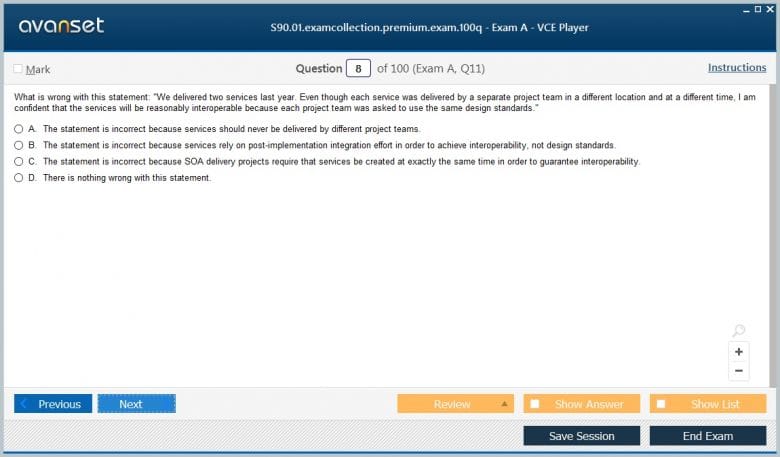
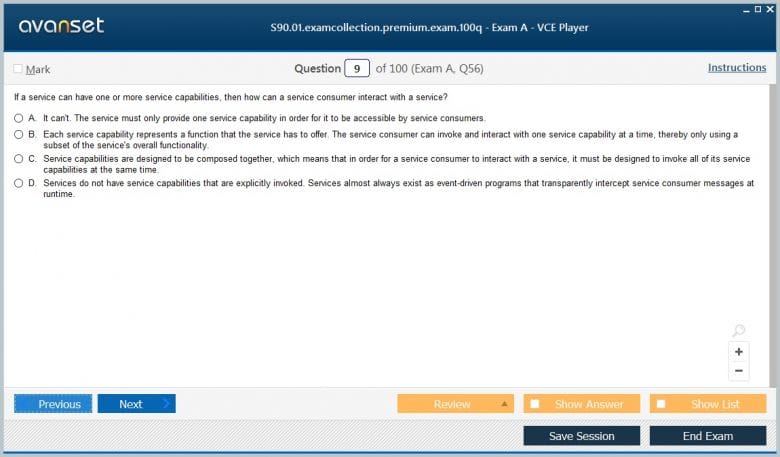
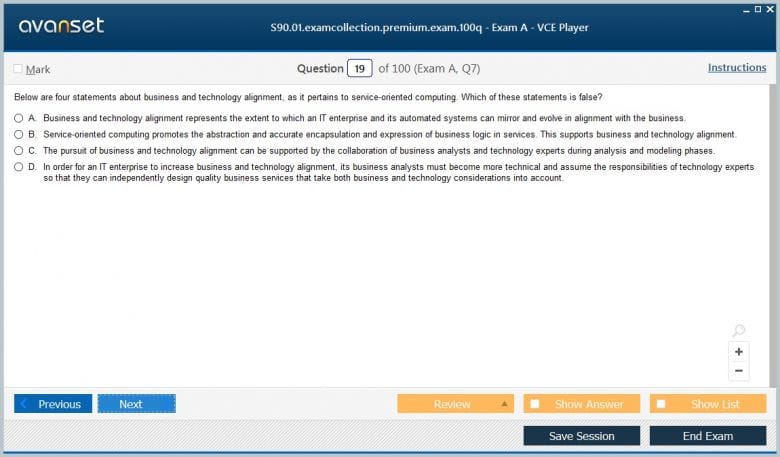
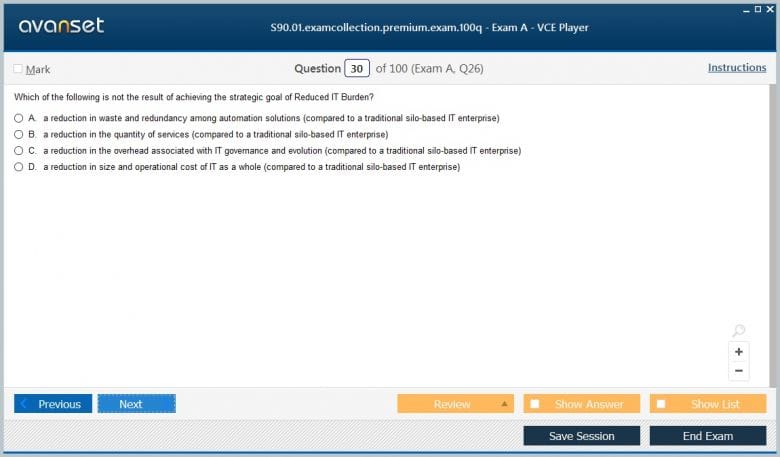
SOA S90.01 Practice Test Questions in VCE Format
| File | Votes | Size | Date |
|---|---|---|---|
File SOA.test4prep.S90.01.v2026-05-05.by.zara.35q.vce |
Votes 1 |
Size 48.28 KB |
Date May 05, 2026 |
SOA S90.01 Practice Test Questions, Exam Dumps
SOA S90.01 (Fundamental SOA & Service-Oriented Computing (S90-01A)) exam dumps vce, practice test questions, study guide & video training course to study and pass quickly and easily. SOA S90.01 Fundamental SOA & Service-Oriented Computing (S90-01A) exam dumps & practice test questions and answers. You need avanset vce exam simulator in order to study the SOA S90.01 certification exam dumps & SOA S90.01 practice test questions in vce format.
S90-01 Fundamental SOA & Service-Oriented Computing is a legacy Arcitura exam code for the vocabulary and architectural ideas behind service-oriented systems. Arcitura’s current Service Technology School has modernized the program around services, microservices, and APIs, but the foundation remains recognizable: define clear service boundaries, apply service-orientation principles, compose capabilities deliberately, and understand the infrastructure that allows independently managed software components to communicate.
The value of this material extends beyond organizations that use “SOA” as an explicit architecture label. REST APIs, microservices, event-driven systems, integration platforms, and cloud applications still wrestle with coupling, contracts, autonomy, discoverability, state, reuse, and composition. The current SOA certifications preserves several of those historical pathways, while Arcitura’s modern curriculum reframes them for present-day service technology.
Candidates should therefore learn the principles as design reasoning, not as nostalgia for an enterprise architecture era. A service is useful when its contract, responsibility, and interaction model make change manageable. The deeper objective is to create systems whose capabilities can evolve without forcing every consumer and implementation to change at the same time.
A service exposes a capability through an agreed contract. The implementation behind that contract may use a monolith, a microservice, packaged software, a serverless function, or something else entirely. Separating capability from implementation is what allows consumers to depend on a stable interface while providers change internal technology. This distinction is one of the most durable ideas in service-oriented computing.
It also explains why interface design deserves architectural attention. A poorly chosen contract can couple consumers to internal data structures or workflow details even if the network protocol is standardized. Good service boundaries represent meaningful business or technical capabilities and hide implementation decisions that consumers should not need to know.
This separation is also what enables multiple consumers to use the same capability through different channels. A web application, mobile client, batch process, and partner system can all depend on the same service contract while the provider evolves its implementation. Reuse comes from a stable capability boundary, not from exposing a large generic endpoint that tries to satisfy every possible consumer.
Loose coupling, standardized contracts, autonomy, reusability, statelessness where practical, discoverability, abstraction, and composability are often taught as service-orientation principles. They should not be memorized as independent virtues. Each addresses a cost of distributed change: consumers need stable expectations, services need control over their own logic, and compositions need components that can participate without exposing unnecessary internals.
The principles can also conflict. Maximizing reuse may enlarge a service until it becomes difficult to change. Pursuing statelessness may move state into another dependency that now needs scaling and resilience. Candidates should understand the intent of each principle and recognize when a design applies it thoughtfully rather than mechanically.
Autonomy has an operational dimension as well as a code-design dimension. A service that owns its logic but cannot be deployed without coordinating five other teams is not very autonomous in practice. Separate release pipelines, clear dependency contracts, independent scaling where justified, and explicit ownership make the principle observable in day-to-day engineering.
A service contract can include operation semantics, data schemas, protocol expectations, errors, security requirements, and quality-of-service assumptions. Consumers build against these expectations, which means contract changes can have wide impact. Versioning, backward compatibility, and explicit deprecation are therefore part of architecture, not afterthoughts for documentation teams.
Modern APIs make this especially visible. The API as an integration boundary succeeds when consumers can understand and use it without knowing how the provider is implemented. A contract that leaks internal database tables or orchestration steps weakens that separation and makes future change expensive.
Schema design should distinguish required meaning from accidental representation. If consumers need a customer identifier and eligibility status, exposing every column of an internal table invites dependencies on fields the provider never intended to guarantee. Contract-first thinking asks what the consumer needs to accomplish its work and publishes only the semantics the service is prepared to maintain.
Service-oriented systems become valuable when independently useful capabilities can participate in larger workflows. Composition may be coordinated by orchestration, choreography, an application layer, or event interactions. Candidates should understand the difference between calling several services and designing a composition with explicit responsibility for sequencing, failure, state, and transaction boundaries.
A composition also creates new coupling. If ten services must all respond synchronously for one user request, the end-to-end availability and latency depend on the chain. Good architecture minimizes unnecessary dependencies and decides where asynchronous behavior, retries, compensation, or cached data can reduce fragility.
Orchestration and choreography offer different coordination styles. Orchestration places process knowledge in a coordinating component, which can make state and recovery visible. Choreography lets services react to events with less central control, but complex flows can become difficult to trace. The choice depends on process ownership, visibility, coupling, and the importance of understanding end-to-end state.
Synchronous request-response interactions are easy to understand but can make callers wait for every dependency. Asynchronous messaging allows producers and consumers to operate at different times and can absorb bursts, but it introduces queues, delivery guarantees, ordering, duplicate handling, and eventual consistency. Neither style is inherently more service-oriented; the right choice follows business timing and reliability needs.
Messages should carry enough context to be processed without hidden shared state, while avoiding oversized contracts that make every consumer dependent on irrelevant fields. Idempotency is especially valuable when a message may be delivered more than once. A consumer that can safely recognize or repeat work is easier to operate than one that assumes perfect single delivery.
Event design deserves the same care as request contracts. A useful event states something meaningful that has happened and carries enough context for intended consumers without becoming a copy of an entire database row. Events also need versioning because producers and consumers rarely upgrade simultaneously. Durable asynchronous systems are built on compatible evolution, not only reliable brokers.
Cloud computing supplies elastic infrastructure and managed services; service orientation supplies design principles for modular capabilities and contracts. A system can be service-oriented without running in a public cloud, and a cloud-hosted application can be tightly coupled and poorly modular. The two ideas reinforce one another when cloud resources host services that are independently deployable, governed, and scalable.
Understanding that distinction prevents architecture by buzzword. The broader cloud paradigm changes provisioning and economics, while service orientation changes how software responsibilities interact. Candidates should be able to describe which problem each concept solves and where their mechanisms meet.
Independent teams can move quickly, but complete freedom can produce incompatible contracts, duplicated capabilities, inconsistent security, and services nobody can discover or trust. Governance establishes policies, ownership, lifecycle expectations, naming, security baselines, versioning, and review where coordination is valuable. The objective is not central approval of every code change; it is preserving interoperability and organizational intent.
A useful governance model is proportionate. High-risk shared services may require stronger contract and security controls than a small internal component. Registries, catalogs, automated policy checks, CI/CD gates, and API-management tooling can make standards visible without relying solely on manual committees. Governance is effective when it enables safe reuse rather than merely adding paperwork.
Discoverability supports governance by making existing capabilities visible before teams build duplicates. A service catalog can record ownership, contracts, versions, health, dependencies, and lifecycle status. The catalog is useful only when it reflects deployed reality, so automated registration and pipeline integration are stronger than a manually maintained spreadsheet that drifts away from the system.
Lifecycle governance should include retirement. A service that is no longer strategic can remain in production for years because consumers are unknown or migration has no owner. Publish deprecation dates, identify consumers, provide a replacement path, and measure remaining traffic. Removing obsolete capabilities is part of keeping a service inventory understandable and supportable.
S90-01 becomes most useful when it prepares candidates for deeper design. S90-02 SOA Technology Concepts adds technology mechanisms, while S90-03 SOA Design & Architecture moves further into structural decisions. The foundation supplies the language needed to judge those technologies rather than allowing infrastructure products to dictate the architecture.
A strong final exercise is to take one business capability—customer registration, payment authorization, document conversion, or identity verification—and define a service boundary for it. Specify the contract, autonomy, state, consumers, failure behavior, reuse expectations, and security needs. Then change one business requirement and observe which design choices isolate the change and which spread it across the system. That is service-oriented thinking in practice.
Candidates should also practice recognizing anti-patterns. A “service” that shares one database schema with many peers, requires coordinated deployment, exposes internal tables directly, and contains no stable contract may be distributed physically while remaining tightly coupled architecturally. Service-oriented computing is about managing dependencies, not merely increasing the number of network endpoints.
The same exercise should include non-functional expectations. Specify availability, latency, auditability, privacy, and expected change rate for the capability. These qualities influence contract style, deployment independence, and composition choices just as much as the business operation itself. Service-oriented computing becomes architecture when functional boundaries and operational qualities are considered together.
The test is simple: if removing the network boundary leaves the design principles unchanged, those principles are genuinely architectural.
Go to testing centre with ease on our mind when you use SOA S90.01 vce exam dumps, practice test questions and answers. SOA S90.01 Fundamental SOA & Service-Oriented Computing (S90-01A) certification practice test questions and answers, study guide, exam dumps and video training course in vce format to help you study with ease. Prepare with confidence and study using SOA S90.01 exam dumps & practice test questions and answers vce from ExamCollection.
Purchase Individually
Site Search:

SPECIAL OFFER: GET 10% OFF

Pass your Exam with ExamCollection's PREMIUM files!
SPECIAL OFFER: GET 10% OFF
Use Discount Code:
MIN10OFF
A confirmation link was sent to your e-mail.
Please check your mailbox for a message from support@examcollection.com and follow the directions.

Download Free Demo of VCE Exam Simulator
Experience Avanset VCE Exam Simulator for yourself.
Simply submit your e-mail address below to get started with our interactive software demo of your free trial.