



Premium File
40 Q&A
$76.99$69.99
BCS RE18 Exam Questions & Answers, Accurate & Verified By IT Experts
Instant Download, Free Fast Updates, 99.6% Pass Rate
40 Questions & Answers
Last Update: Sep 11, 2026
$69.99
BCS RE18 Exam Screenshots
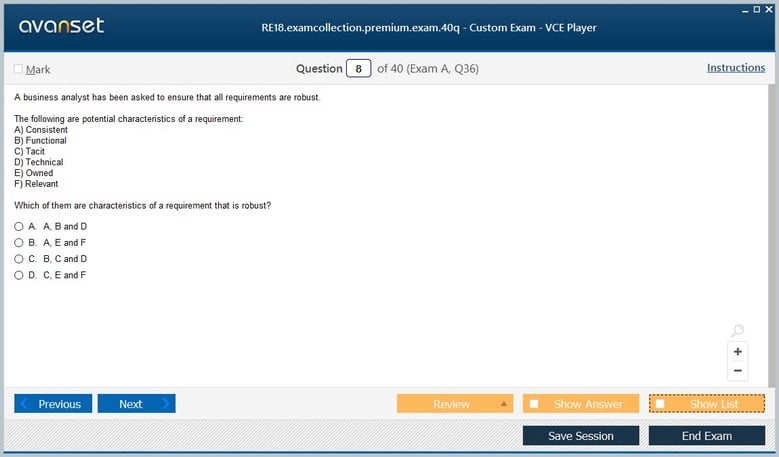
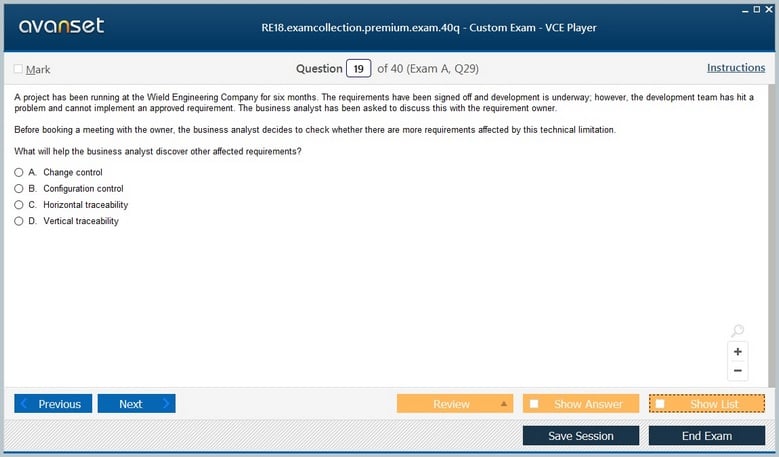
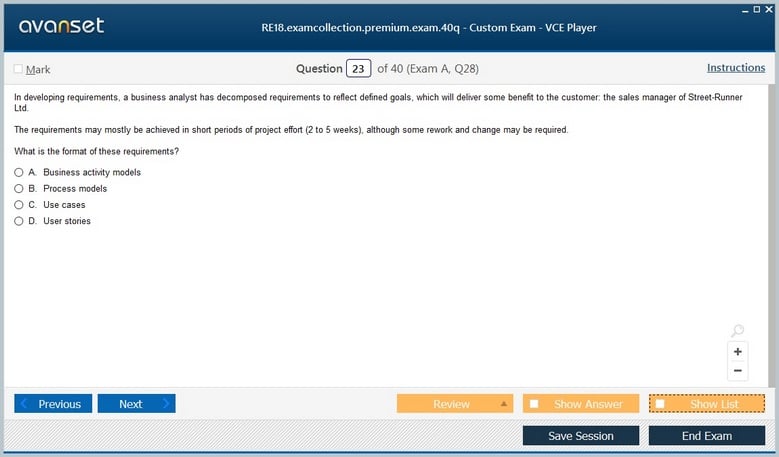
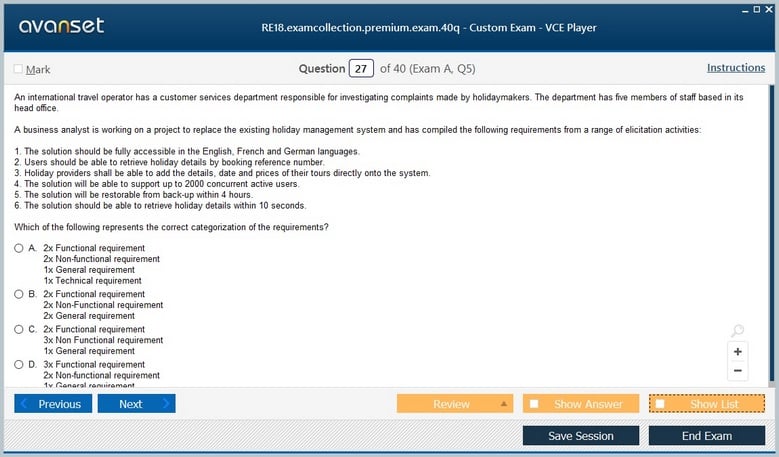
BCS RE18 Practice Test Questions in VCE Format
| File | Votes | Size | Date |
|---|---|---|---|
File BCS.certkey.RE18.v2026-08-29.by.wangxiulan.15q.vce |
Votes 1 |
Size 30.25 KB |
Date Aug 30, 2026 |
File BCS.Testking.RE18.v2019-11-20.by.Owen.18q.vce |
Votes 3 |
Size 33.26 KB |
Date Nov 21, 2019 |
BCS RE18 Practice Test Questions, Exam Dumps
BCS RE18 (BCS Practitioner Certificate in Requirements Engineering 2018) exam dumps vce, practice test questions, study guide & video training course to study and pass quickly and easily. BCS RE18 BCS Practitioner Certificate in Requirements Engineering 2018 exam dumps & practice test questions and answers. You need avanset vce exam simulator in order to study the BCS RE18 certification exam dumps & BCS RE18 practice test questions in vce format.
Re18 is ExamCollection’s identifier for the BCS Practitioner Certificate in Requirements Engineering 2018. The date in that name matters. BCS has continued to maintain the Practitioner Certificate and updated it after the 2018 version, so RE18 should be treated as a legacy syllabus code rather than as the label for the current exam. The underlying discipline remains highly relevant, but candidates planning a new attempt should work from the live BCS syllabus and booking information.
The current BCS Practitioner Certificate still focuses on eliciting, defining, analysing, validating, documenting, prioritising, and managing requirements. BCS says the certificate was updated in July 2021, and its current page now distinguishes the latest syllabus from the older V5.1 materials; the last booking date for V5.1 was 31 May 2026. That transition is a useful reminder that requirements-engineering techniques can remain durable even when the assessment version changes.
Within the broader pathway, BCS certifications provide the vendor-level context. Candidates building a business-analysis foundation can also connect requirements work with the BCS Foundation Certificate in Business Analysis and the more practice-oriented Business Analysis Practice v5. Those relationships matter because requirements engineering is strongest when it is tied to business objectives, stakeholder analysis, and change outcomes rather than reduced to writing specifications.
The safest way to use RE18 material is to separate the subject from the version. The subject is requirements engineering: understanding a problem, discovering stakeholder needs, defining what a solution must achieve, checking quality, controlling change, and preserving traceability. The version is the particular BCS syllabus and assessment design associated with the 2018 code. A learner can retain sound concepts from the older material while still rebuilding the exam map from today’s official syllabus.
This distinction prevents a common preparation error. Historical notes may use different terminology, place more or less emphasis on a technique, or describe an exam format that no longer applies. Studying them as if they were current can create false confidence because the learner may know the topic but not the present learning outcomes. The correct approach is to use current first-party objectives as the boundary and legacy material only where it remains compatible.
A requirement is meaningful only when its purpose is understood. A stakeholder might ask for a dashboard, an approval button, a new field, or an automated notification, but the analyst must investigate the business problem behind the request. The real need may be faster exception handling, stronger control, better evidence, fewer manual handoffs, or a reduction in customer effort. Starting with purpose helps prevent solution ideas from being mistaken for requirements.
Business context also exposes constraints. Regulation, policy, existing contracts, data ownership, legacy systems, service levels, accessibility obligations, security rules, and operational capacity can all shape what is feasible. Requirements work therefore sits between strategy and delivery. It translates goals into testable expectations while preserving enough context for designers, developers, testers, and decision-makers to understand why those expectations exist.
Effective elicitation combines techniques because stakeholders hold different pieces of the picture. Interviews can uncover individual goals and frustrations; workshops can surface disagreements and build shared understanding; observation can reveal workarounds that people no longer mention; document analysis can expose policy and regulatory constraints; prototypes can turn abstract discussion into concrete feedback. The analyst selects techniques according to risk, access, complexity, and the maturity of the problem.
Preparation matters as much as the meeting itself. The analyst should know what is already understood, what decisions are needed, which participants hold relevant knowledge, and what evidence can confirm statements. During elicitation, open questions are useful for discovery, while focused questions help resolve ambiguity. Afterward, captured information should be checked with the people who supplied it. Otherwise, a detailed set of notes may preserve the analyst’s interpretation rather than the stakeholder’s actual need.
Projects rarely have one stakeholder voice. Sponsors, users, operations teams, security specialists, finance, legal functions, support staff, suppliers, and customers can want different outcomes. Some stakeholders have authority to make decisions; others have deep operational knowledge; still others may be heavily affected while holding little formal power. Requirements work has to account for these differences rather than treating every opinion as interchangeable.
The analyst therefore needs a communication strategy as well as a list of names. Senior decision-makers may need concise trade-offs and business impact, while operational users may need process detail and realistic examples. Technical specialists may focus on interfaces, data, performance, or controls. Understanding influence, interest, expertise, and impact helps the analyst choose the right engagement and prevents late surprises from groups that were initially overlooked.
A well-formed requirement should be clear enough that two readers reach substantially the same interpretation. Ambiguous words such as fast, user-friendly, adequate, secure, or flexible need context and measurable criteria. Functional requirements describe behaviour or capability, while non-functional requirements describe qualities and constraints such as performance, availability, accessibility, security, recoverability, or capacity. Both types are essential because a solution can perform the correct function and still fail operationally.
Traceability connects each requirement to its origin, business objective, dependent requirements, design elements, tests, and eventual implementation evidence. This is not clerical overhead when change occurs. If a regulation changes or a stakeholder withdraws a need, traceability helps identify what else is affected. It also exposes orphan requirements that have no business justification and business objectives that have no corresponding delivery requirement.
Not every requirement can be delivered first, and not every desirable capability is equally valuable. Prioritisation provides a disciplined way to discuss value, risk, urgency, dependency, cost, and obligation. MoSCoW is a familiar approach, but the labels are only useful when participants agree on what they mean. If every item becomes a Must, the exercise has failed to create a usable order of importance.
Priorities may also change as evidence improves. A prototype can show that a feature once considered essential delivers little benefit, while a technical spike can reveal that a seemingly minor requirement controls a major architectural dependency. Requirements engineering therefore treats prioritisation as a continuing decision process. The analyst should record assumptions and the reason behind significant choices so that later changes can be understood rather than debated from memory.
Validation asks whether the requirement reflects a genuine stakeholder need and contributes to the intended outcome. Quality assurance asks whether the requirement is sufficiently complete, consistent, feasible, unambiguous, testable, and appropriately detailed. Reviews, walkthroughs, models, examples, prototypes, and acceptance criteria can reveal defects before implementation turns them into expensive rework.
The strongest validation uses realistic scenarios. A process requirement may look correct in isolation but fail when a customer changes channels midway through a transaction or when an exception requires manual intervention. Data requirements may appear complete until retention, privacy, reconciliation, or migration is considered. Testing the logic of the requirement against real operational situations gives stakeholders something concrete to challenge.
Requirements do not stay still because organisations and projects do not stay still. New regulation, market changes, technical discoveries, budget constraints, supplier limitations, user feedback, and shifting priorities can all trigger change. Requirements management provides controlled versioning, impact analysis, decision ownership, status tracking, and communication so that the baseline evolves deliberately rather than through informal edits.
Change control should be proportional. A small agile team does not need the same governance as a safety-critical programme, but both need to understand what changed and why. The analyst’s role is not to prevent change; it is to make consequences visible. A change to one requirement can alter test effort, interface contracts, data structures, training, support, benefits, and delivery dates. Good management keeps these connections visible.
The current Practitioner Certificate is designed for people involved in business analysis, projects, product work, systems analysis, and business change. BCS lists no prerequisite for the certificate and continues to position it as one of the modules that can contribute toward the International Diploma in Business Analysis. That wider route explains why the subject combines practical analysis techniques with disciplined communication and documentation.
For a 2026 candidate, the preparation sequence should start with the current BCS syllabus and specimen material, then use exercises to apply the techniques. Practice should include messy scenarios rather than only definitions: incomplete stakeholder statements, conflicting priorities, non-functional constraints, traceability questions, requirement-quality defects, and change-impact decisions. Those exercises reveal whether the learner can reason with the techniques instead of merely naming them.
RE18 remains useful as a historical identifier because it points to an important body of requirements-engineering knowledge. It should not, however, freeze the learner in the 2018 assessment generation. Preserve the discipline, verify the current syllabus, and connect requirements to the broader business-analysis pathway. That combination turns preparation from memorising an old code into developing a professional skill that remains valuable across delivery methods and technologies.
One practical way to study requirements quality is to rewrite weak statements. “The system must be easy to use” becomes more useful when the analyst identifies the target users, the task, the observable success condition, and the constraints. “Reports must be fast” becomes testable when the relevant report, data volume, response threshold, and operating conditions are defined. The exercise teaches candidates to recognize that precision is not verbosity; a short requirement can be strong when its meaning and acceptance basis are clear.
Models can also expose questions that prose hides. A process model can reveal handoffs and exception paths, a data model can uncover missing entities or ownership, a state model can show transitions that stakeholders forgot to mention, and a context diagram can clarify interfaces beyond the project boundary. The analyst should choose a model because it helps resolve uncertainty. Producing diagrams that nobody uses creates documentation volume without improving requirements.
Requirements also need a sensible level of detail. Writing implementation design into a business requirement can constrain solution options too early, while leaving a requirement at the level of “improve customer service” gives delivery teams too little direction. The appropriate level depends on the decision being made. Good analysts move between business, user, functional, non-functional, and detailed acceptance views while maintaining the relationships between them.
The strongest exam preparation therefore mixes recall with judgement. Candidates should be able to define elicitation, validation, traceability, and prioritisation, but they should also be able to recognize which technique fits a scenario and why. When two options sound plausible, return to the purpose of the activity: discovery, analysis, agreement, quality control, or change management. That habit mirrors the professional work and is more reliable than memorising keywords.
Go to testing centre with ease on our mind when you use BCS RE18 vce exam dumps, practice test questions and answers. BCS RE18 BCS Practitioner Certificate in Requirements Engineering 2018 certification practice test questions and answers, study guide, exam dumps and video training course in vce format to help you study with ease. Prepare with confidence and study using BCS RE18 exam dumps & practice test questions and answers vce from ExamCollection.
Purchase Individually
Top BCS Certification Exams
Site Search:

SPECIAL OFFER: GET 10% OFF

Pass your Exam with ExamCollection's PREMIUM files!
SPECIAL OFFER: GET 10% OFF
Use Discount Code:
MIN10OFF
A confirmation link was sent to your e-mail.
Please check your mailbox for a message from support@examcollection.com and follow the directions.

Download Free Demo of VCE Exam Simulator
Experience Avanset VCE Exam Simulator for yourself.
Simply submit your e-mail address below to get started with our interactive software demo of your free trial.