



Premium File
63 Q&A
$76.99$69.99
BCS FCBA Exam Questions & Answers, Accurate & Verified By IT Experts
Instant Download, Free Fast Updates, 99.6% Pass Rate
63 Questions & Answers
Last Update: Oct 20, 2026
$69.99
BCS FCBA Exam Screenshots
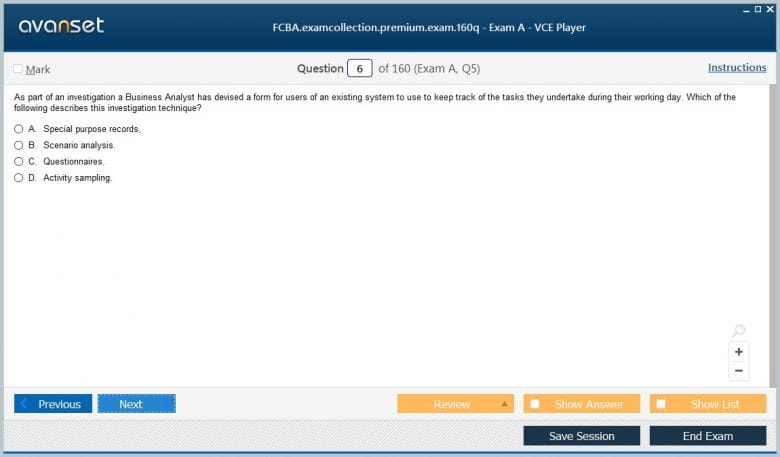
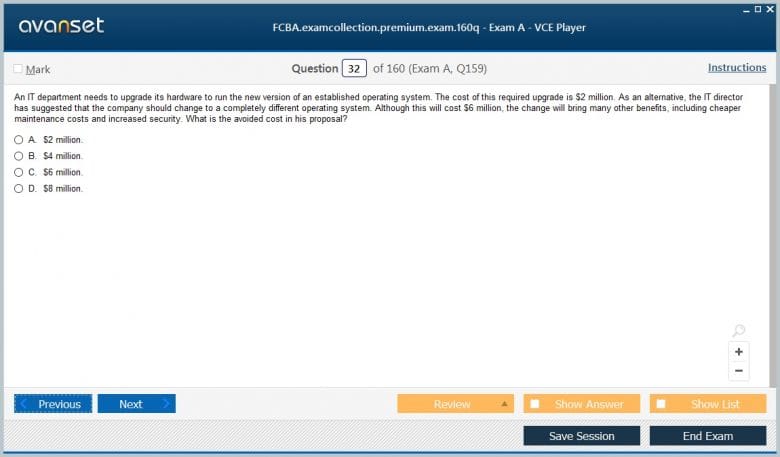
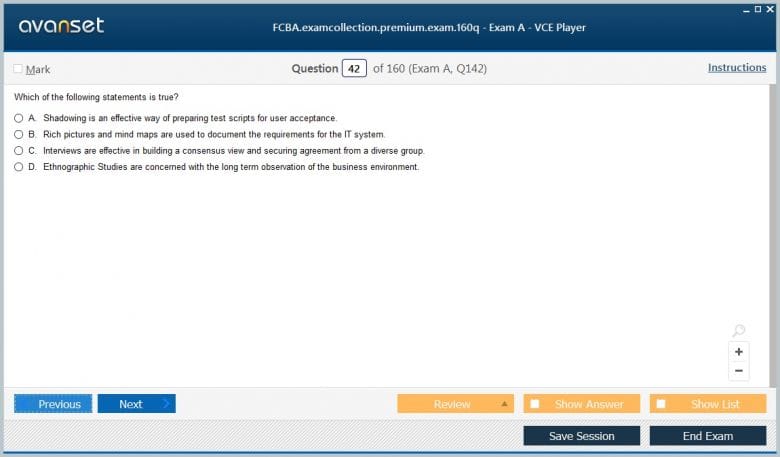
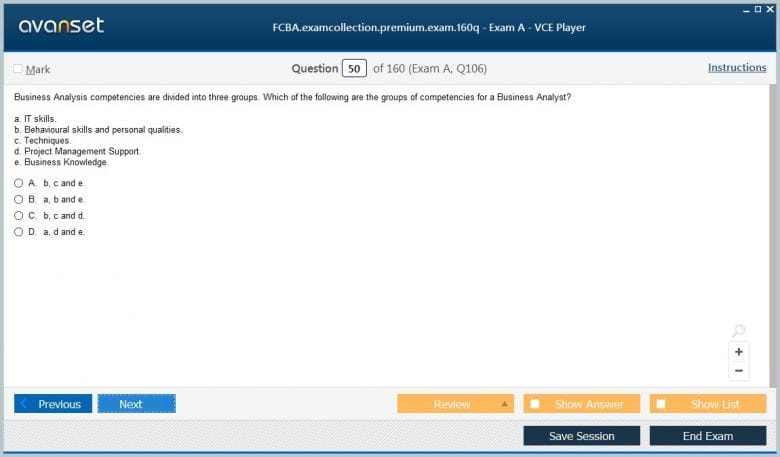
BCS FCBA Practice Test Questions in VCE Format
| File | Votes | Size | Date |
|---|---|---|---|
File BCS.certkey.FCBA.v2026-08-28.by.maisie.88q.vce |
Votes 1 |
Size 227.56 KB |
Date Aug 28, 2026 |
File BCS.Prep4sure.FCBA.v2019-01-15.by.Philip.97q.vce |
Votes 4 |
Size 183.87 KB |
Date Jan 20, 2019 |
BCS FCBA Practice Test Questions, Exam Dumps
BCS FCBA (Foundation Certificate in Business Analysis) exam dumps vce, practice test questions, study guide & video training course to study and pass quickly and easily. BCS FCBA Foundation Certificate in Business Analysis exam dumps & practice test questions and answers. You need avanset vce exam simulator in order to study the BCS FCBA certification exam dumps & BCS FCBA practice test questions in vce format.
The BCS Foundation Certificate in Business Analysis is a current entry-level qualification for people who want a structured view of what business analysts do and how they investigate change. The ExamCollection FCBA code reflects the Foundation Certificate lineage, but candidates should use BCS’s current qualification page and syllabus for exam preparation. The credential is deliberately broad: it introduces the analyst role, business context, investigation, stakeholders, business cases, requirements, process thinking, and solution evaluation rather than specializing in one technique.
The current exam is one hour, closed book, with 40 multiple-choice questions and a 65% pass mark, which is 26 correct answers out of 40. BCS does not set formal entry requirements. The format rewards accurate concepts and technique selection, but the real learning objective is to understand how analysis activities fit together from problem discovery through justified change.
ExamCollection’s BCS certifications provide the broader context. Candidates who continue toward the International Diploma will encounter practitioner modules such as Business Analysis Practice and Requirements Engineering. Foundation study is most useful when it creates a map of the discipline that later modules can deepen.
Business analysis is not simply gathering requirements for software. Analysts help organizations understand problems and opportunities, clarify objectives, investigate how work happens, identify stakeholders, evaluate options, define needs, and support decisions about change. Technology may be part of a solution, but the analytical question begins with the business outcome rather than with a chosen product.
Foundation candidates should distinguish analyst responsibilities from those of project managers, product managers, developers, testers, architects, and operational managers. Roles can overlap in real organizations, but the examination expects the analyst to focus on understanding needs, building shared models, making assumptions visible, and helping stakeholders make informed choices.
Every proposed change sits inside an environment of strategy, regulation, competition, customer expectations, technology, organizational capability, cost, risk, and culture. Context techniques help candidates avoid solving the wrong problem. A change that improves one department may damage an end-to-end service; a technically feasible option may conflict with policy or with the organization’s strategic direction.
Foundation study should therefore practice moving from a stated symptom to a broader context. If customers complain about delays, the cause could involve demand, process design, handoffs, data quality, staffing, supplier performance, system constraints, or policy. The analyst first creates enough understanding to decide what evidence and stakeholders are needed before recommending a remedy.
Interviews can reveal individual experience and rationale, workshops help groups build shared understanding, observation exposes actual work and workarounds, questionnaires gather broader input, document analysis shows formal rules, scenarios describe interactions, and prototyping makes uncertain ideas tangible. No technique is inherently best; each has strengths, limitations, and practical costs.
Candidates should learn to combine techniques. People may describe the official process in an interview while observation shows a different operational reality. A workshop can resolve conflicting interpretations that a questionnaire would only record. A prototype can expose missing requirements faster than another page of prose. Technique selection should always be tied to the analytical question and stakeholder situation.
Stakeholders differ in authority, interest, expertise, impact, and attitude toward change. Identifying them is only the first step. Analysts need to understand who makes decisions, who performs the work, who receives the service, who owns data or controls, who bears risk, and who can enable or block implementation. Missing a low-visibility but highly affected group can create serious late-stage surprises.
Stakeholder management is not manipulation. It means adapting communication and engagement so the right people contribute at the right time. Senior sponsors may need concise decision information, operational users may need detailed workflow discussions, and specialists may need precise technical or regulatory evidence. The analyst creates channels that make disagreement visible enough to resolve rather than allowing it to reappear during implementation.
Process models help teams understand how work moves through activities, decisions, queues, handoffs, and roles. The act of modeling often exposes duplication, missing ownership, unnecessary approval, rework, and inconsistent rules. Candidates should understand the purpose of process notation without assuming that a diagram is valuable merely because it is detailed.
A useful process model has a defined scope and audience. It distinguishes current-state facts from proposed future-state design and is validated with people who know the work. When analysts model only the documented process, they may miss informal steps that keep operations functioning. Foundation questions may test which technique would reveal such gaps or what kind of issue a process view is suited to investigate.
A business case explains why change is justified. It typically considers the reason for change, options, expected benefits, costs, risks, timescales, and feasibility. At Foundation level, candidates should understand why “do nothing” or a minimal-change option can be useful comparators: they expose the incremental value and consequences of investing in a preferred solution.
Benefits need owners and measures if the organization expects to know whether they were realized. Costs should include more than acquisition; training, migration, support, operations, compliance, supplier commitments, and decommissioning can materially change the economics. Risk should describe uncertainty and consequences rather than being used as a vague reason to avoid difficult choices.
Requirements describe capabilities, qualities, constraints, and conditions that a solution must satisfy. They can exist at different levels, from business objectives through stakeholder and solution requirements. Candidates should recognize the difference between a need and an implementation preference. “Reduce order errors” is not the same as “buy system X,” and “users need timely status” is not yet a detailed interface specification.
Good requirements are clear enough to validate and trace. Analysts manage changes because a requirement can affect processes, data, interfaces, testing, training, controls, and business benefits. Validation asks whether the requirement reflects the real need; verification asks whether it is expressed to the required quality. This distinction becomes increasingly important in practitioner-level study.
Business analysis continues after a solution is selected. Analysts may support implementation, acceptance, transition, benefit tracking, and evaluation of whether outcomes match the original business need. A system can be delivered on time and still fail if users cannot adopt it, the process remains inefficient, data quality is poor, or anticipated benefits never materialize.
Evaluation therefore returns to the measures and assumptions established earlier. If performance does not improve, the organization should distinguish a weak solution from weak adoption, incomplete process change, inaccurate forecasts, or new external conditions. Foundation candidates who see the discipline as a learning loop rather than a one-way requirements pipeline are better prepared for both the exam and real work.
The current 40-question exam moves quickly, so candidates need confident recognition of roles, concepts, and technique purposes. Build a study table with each technique, the question it answers, the stakeholders it involves, typical outputs, strengths, and limitations. Then solve short scenarios and explain why one technique fits better than another.
Use the current BCS syllabus and specimen material as the final scope authority. Older ISEB or BCS materials can still explain durable business-analysis ideas, but terminology, reading lists, and exam emphasis evolve. A current syllabus map prevents preparation from becoming an uncontrolled collection of techniques that are only loosely connected to the examination.
The Foundation Certificate is valuable because it teaches a common analytical language. A candidate should finish able to explain how context, stakeholders, investigation, process, requirements, options, business cases, and evaluation relate to one another. That systems view makes later specialization easier because each advanced technique has a place in a broader change process.
For career development, practice the methods on real but manageable problems. Map a process, interview a stakeholder, identify a root cause, write a measurable objective, compare options, and test a requirement for clarity. The exam confirms knowledge, but repeated use is what turns the toolkit into professional judgment.
Information and data are another part of the analyst’s foundation. Different teams may use the same word for different concepts or different words for the same thing, creating requirements and reporting problems. Simple conceptual models, data definitions, business rules, and source analysis can reveal these inconsistencies. The Foundation level does not require database design expertise; it requires recognizing when information structure is central to the business problem.
Analyst competencies matter because methods are applied through people. Listening, questioning, facilitation, critical thinking, negotiation, written communication, presentation, and relationship building influence the quality of evidence collected and the ability to resolve disagreement. Technical accuracy without stakeholder trust can leave good analysis unused, while strong rapport without analytical discipline can produce comfortable but weak decisions.
Change adoption should also be considered before the solution is complete. New processes, controls, systems, or roles may require training, communication, revised measures, operational ownership, and transition planning. Resistance can indicate fear or misunderstanding, but it can also reveal a genuine workflow, capability, or incentive problem. Analysts should investigate rather than categorizing all opposition as a communication failure.
For exam preparation, create one end-to-end case and reuse it across the syllabus. Investigate the problem, map stakeholders, model a process, identify requirements, compare options, outline a business case, and define evaluation measures. This shows how techniques relate and reduces the risk of learning them as disconnected flashcards. When a multiple-choice scenario appears, candidates can then recognize which part of the analytical chain is being tested.
Go to testing centre with ease on our mind when you use BCS FCBA vce exam dumps, practice test questions and answers. BCS FCBA Foundation Certificate in Business Analysis certification practice test questions and answers, study guide, exam dumps and video training course in vce format to help you study with ease. Prepare with confidence and study using BCS FCBA exam dumps & practice test questions and answers vce from ExamCollection.
Purchase Individually
Site Search:

SPECIAL OFFER: GET 10% OFF

Pass your Exam with ExamCollection's PREMIUM files!
SPECIAL OFFER: GET 10% OFF
Use Discount Code:
MIN10OFF
A confirmation link was sent to your e-mail.
Please check your mailbox for a message from support@examcollection.com and follow the directions.

Download Free Demo of VCE Exam Simulator
Experience Avanset VCE Exam Simulator for yourself.
Simply submit your e-mail address below to get started with our interactive software demo of your free trial.