


Premium File
101 Q&A
$76.99$69.99
Mulesoft MCIA - Level 1 Exam Questions & Answers, Accurate & Verified By IT Experts
Instant Download, Free Fast Updates, 99.6% Pass Rate
101 Questions & Answers
Last Update: Sep 30, 2026
$69.99
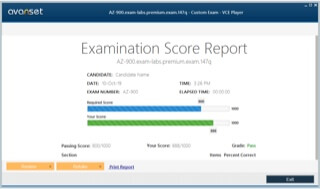
Mulesoft MCIA - Level 1 Exam Screenshots
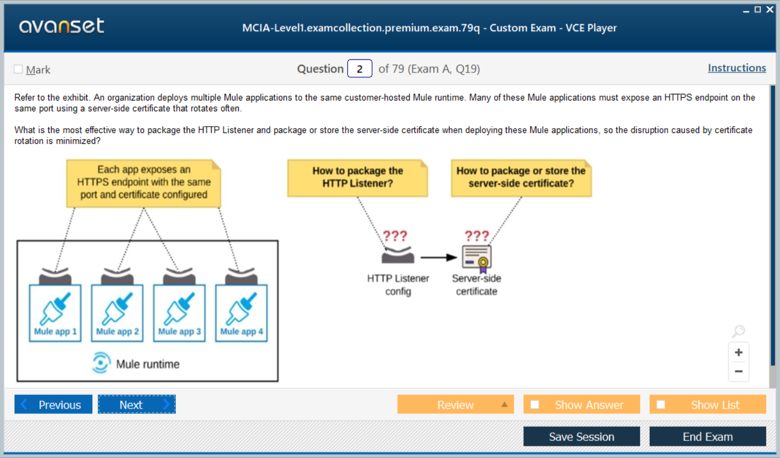
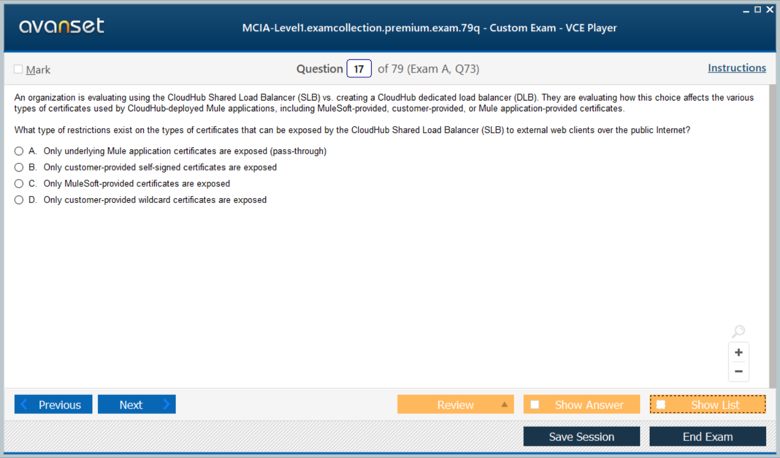
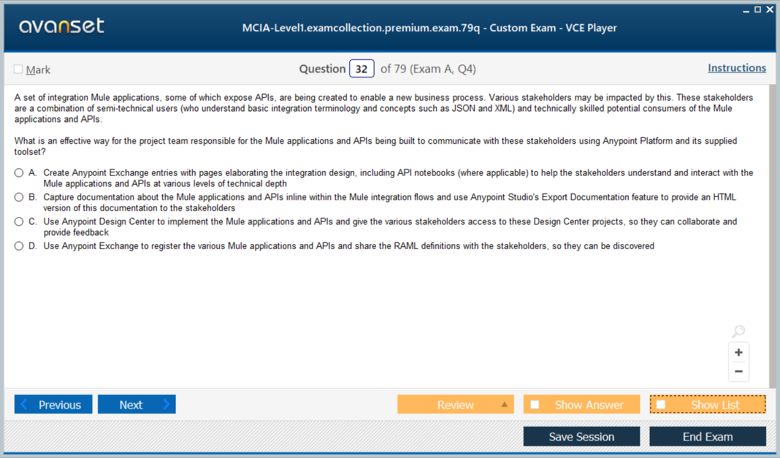
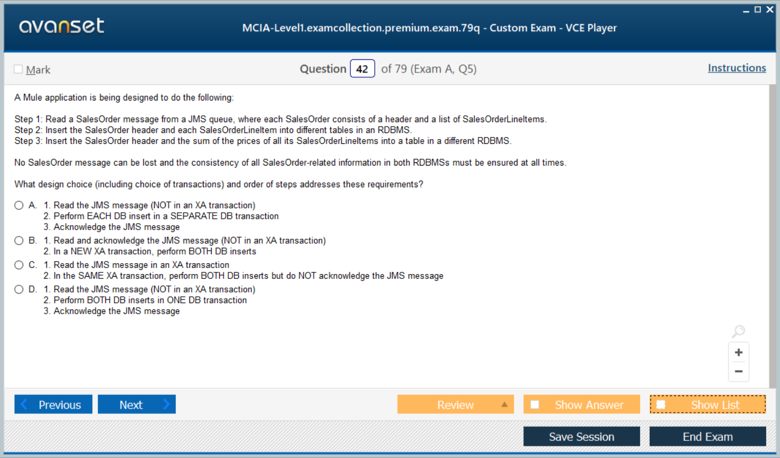
Mulesoft MCIA - Level 1 Practice Test Questions in VCE Format
| File | Votes | Size | Date |
|---|---|---|---|
File Mulesoft.questionpaper.MCIA - Level 1.v2026-08-18.by.ryan.57q.vce |
Votes 1 |
Size 2.29 MB |
Date Aug 18, 2026 |
File Mulesoft.examanswers.MCIA - Level 1.v2022-01-04.by.antoni.45q.vce |
Votes 1 |
Size 1.17 MB |
Date Jan 04, 2022 |
File Mulesoft.examlabs.MCIA - Level 1.v2021-05-20.by.niamh.34q.vce |
Votes 1 |
Size 453.16 KB |
Date May 20, 2021 |
File Mulesoft.examlabs.MCIA - Level 1.v2020-08-20.by.wangping.29q.vce |
Votes 2 |
Size 681.14 KB |
Date Aug 20, 2020 |
File Mulesoft.certkiller.MCIA - Level 1.v2020-03-31.by.heidi.27q.vce |
Votes 2 |
Size 865.87 KB |
Date Mar 31, 2020 |
Mulesoft MCIA - Level 1 Practice Test Questions, Exam Dumps
Mulesoft MCIA - Level 1 (MuleSoft Certified Integration Architect - Level 1) exam dumps vce, practice test questions, study guide & video training course to study and pass quickly and easily. Mulesoft MCIA - Level 1 MuleSoft Certified Integration Architect - Level 1 exam dumps & practice test questions and answers. You need avanset vce exam simulator in order to study the Mulesoft MCIA - Level 1 certification exam dumps & Mulesoft MCIA - Level 1 practice test questions in vce format.
The MCIA-Level-1 exam is the older name for MuleSoft Certified Integration Architect – Level 1. The credential lineage remains active, but Salesforce has updated the naming: current Salesforce material presents the role as Salesforce Certified MuleSoft Platform Integration Architect. Salesforce describes the architect as someone who works with technical and non-technical stakeholders to translate functional and non-functional requirements into integration interfaces and implementations.
That means MCIA-Level-1 should not be treated as a dead body of knowledge, but the old exam code and “Level 1” branding should not be presented as the current credential name. The modern credential is MuleSoft Platform Integration Architect, with MuleSoft certifications showing the broader current progression.
Architecture preparation should operate above individual flow syntax. The job is to decide how systems expose capabilities, how APIs are layered and governed, how data moves, where transformations belong, how identities and policies are enforced, how failures propagate, how capacity is planned, and how teams can deliver independently without creating an unmanageable integration estate.
Start by mapping business capabilities and the systems that own the underlying data or processes. An integration architecture becomes fragile when ownership is unclear and every consuming team connects directly to implementation details. Identify systems of record, channels, major domains, event sources, and dependencies before choosing API layers.
Use context diagrams that a non-developer can understand. Show which organization or system owns each capability and what information crosses boundaries. Then add technical detail in lower-level diagrams. This prevents the architecture from becoming a picture of connectors without explaining why the connections exist.
The value of API-led architecture is not the number of APIs. It is the ability to separate system access, process orchestration, and experience needs so that change in one area does not unnecessarily break another. The concept is easier to understand when placed in the broader context of the modern API as a managed interface, not as a naming convention.
For a scenario, identify a capability that several consumers need. Decide whether the backend interface is stable enough to expose directly or should be wrapped. Identify shared orchestration that belongs in a process layer and channel-specific shaping that belongs closer to the consumer. Avoid creating layers simply because a diagram template has three boxes.
Capacity models should include dependency limits, not only Mule runtime capacity. A downstream ERP, database, partner API, or legacy mainframe may accept far fewer concurrent requests than the integration layer can generate. Use throttling, queueing, caching, or batching where appropriate so horizontal scale at one layer does not simply move the bottleneck into a less resilient system.
Recovery objectives should be decomposed by capability. Some integrations may tolerate hours of backlog after an outage, while customer-facing transactions may require rapid restoration. Define recovery-time and recovery-point expectations where data persistence is involved, and decide how queued or in-flight work is reconciled after service resumes.
Data residency and privacy requirements can constrain where runtimes, logs, payloads, and backups are allowed to exist. Architecture diagrams should mark data classes and geographic boundaries so deployment decisions do not accidentally violate policy. Sensitive data may require masking or tokenization before it reaches shared analytics or observability platforms.
Cost should be modeled as an architectural consequence rather than an afterthought. More runtimes, higher availability, verbose logging, frequent polling, and unnecessary data movement all create ongoing expense. Compare alternatives using expected volume and service objectives. The cheapest design that misses availability requirements is not economical, but neither is maximum redundancy for every low-criticality integration.
Operational ownership completes the non-functional picture. Define which team responds to alerts, who can change policies, who owns certificates, who approves interface changes, and how incidents cross team boundaries. Architecture is sustainable only when responsibilities match the technical dependencies. A diagram without an operating model leaves the hardest production questions unanswered.
Availability, latency, throughput, recovery time, security, data residency, auditability, maintainability, and cost can change the correct design even when business functionality is identical. An integration serving a nightly batch and one serving a synchronous checkout may move the same data but require completely different patterns.
Quantify requirements where possible. “High volume” should become an expected average and peak transaction rate. “Fast” should become a latency objective. “Highly available” should become a target and a failure model. Architecture decisions are easier to defend when they answer measurable constraints rather than adjectives.
The principles of data integration become architectural when many systems share information. Define ownership of schemas, versioning, compatibility, validation, and transformation. A canonical model can reduce repeated mappings in some domains but can also become a huge centralized object that couples unrelated teams.
Prefer bounded models that reflect a clear business domain. Decide where translation occurs and which representation is authoritative. For events, define semantics such as whether a message describes a state change, a fact that occurred, or a command that expects action. Clear contracts reduce the temptation to interpret fields differently in every consumer.
Request-response APIs are appropriate when the caller needs an immediate result and the dependency can meet the latency and availability requirements. Queues and events are useful when work can be decoupled, buffered, retried, or consumed by multiple independent services. Neither pattern is universally superior.
Model failure propagation. In a synchronous chain, a slow dependency can consume the caller’s latency budget and create cascading timeouts. In an asynchronous design, backlog and duplicate processing become important. Choose retry, dead-letter, idempotency, ordering, and replay strategies as part of the architecture rather than as implementation details.
Architects define how clients authenticate, how authorization is applied, how service-to-service trust works, where secrets and certificates are managed, and how sensitive fields are protected. Policies should be reusable and enforceable so each project team is not inventing its own version of identity, rate limiting, or threat protection.
Separate user identity from application identity and from backend credentials. Decide when an end-user context must be propagated and when a service should act under its own identity. Map trust boundaries and verify that logging, error messages, and analytics do not expose tokens or sensitive payloads.
An integration design is constrained by the way the Anypoint platform is organized: environments, business groups, networking, runtime placement, access control, API governance, shared assets, deployment pipelines, and observability all affect how teams work. Integration architecture cannot assume infinite platform capacity or unconstrained connectivity.
Work with platform architects to define reusable foundations. Standardize environment strategy, naming, network connectivity, secrets, logging, CI/CD, and policy enforcement. Then allow application teams autonomy inside those guardrails. The objective is controlled decentralization rather than a central team approving every line of integration code.
Governance should make the right behavior easier. Reusable assets need product ownership of their own. A shared system API or policy template can become a bottleneck if nobody is responsible for versioning, documentation, support, and deprecation. Define an owner and service expectations for assets that many teams depend on, just as you would for customer-facing capabilities.
Exceptions to standards should be possible but visible. Some integrations have legitimate constraints that make the normal pattern inappropriate. Record the reason, risk, compensating controls, and review date rather than forcing teams into a pattern that does not fit. Governance is stronger when it distinguishes justified exceptions from silent divergence.
Architecture communities and enablement teams can reduce repeated design work. Publish reference patterns, hold design clinics for difficult cases, and feed lessons from incidents back into guidance. The goal is to spread architectural judgment across delivery teams instead of concentrating every decision in a small central review board.
Architecture governance fails when it consists only of review meetings and documents. Provide templates, reusable APIs, policy automation, reference implementations, design checklists, and discoverable assets. Teams are more likely to follow a standard when the standard reduces their work.
Measure governance outcomes. Track reuse where it is meaningful, policy compliance, duplicate interfaces, breaking changes, incident trends, and time to onboard a new team. If governance creates long queues without reducing risk or improving consistency, the operating model needs adjustment.
Test the design against change. What happens if a system of record is replaced, a new mobile channel appears, transaction volume triples, a region requires data residency, or a downstream service becomes intermittently unavailable? Good architecture contains change instead of requiring every integration to be redesigned.
Use lightweight architecture decision records to document important trade-offs. Record the problem, options, decision, consequences, and assumptions. When conditions change, the team can revisit the decision with context instead of treating the original architecture as permanent truth.
Older study plans may point to MuleSoft Integration Architect I, while Salesforce now uses Platform Integration Architect naming. Treat those as points in the same credential lineage, not as three unrelated architecture certifications. Update the terminology and current platform features while retaining the systems-thinking objectives.
Developer fluency still matters, and Salesforce recommends its MuleSoft Developer credential as a useful prerequisite rather than a mandatory one. An architect does not need to write every flow, but must understand implementation constraints well enough to design interfaces that teams can actually build and operate. MCIA-Level-1 remains valuable as historical language for that architect role; the current target is the Salesforce Certified MuleSoft Platform Integration Architect path.
Go to testing centre with ease on our mind when you use Mulesoft MCIA - Level 1 vce exam dumps, practice test questions and answers. Mulesoft MCIA - Level 1 MuleSoft Certified Integration Architect - Level 1 certification practice test questions and answers, study guide, exam dumps and video training course in vce format to help you study with ease. Prepare with confidence and study using Mulesoft MCIA - Level 1 exam dumps & practice test questions and answers vce from ExamCollection.
Purchase Individually
Top Mulesoft Certification Exams
Site Search:

SPECIAL OFFER: GET 10% OFF

Pass your Exam with ExamCollection's PREMIUM files!
SPECIAL OFFER: GET 10% OFF
Use Discount Code:
MIN10OFF
A confirmation link was sent to your e-mail.
Please check your mailbox for a message from support@examcollection.com and follow the directions.

Download Free Demo of VCE Exam Simulator
Experience Avanset VCE Exam Simulator for yourself.
Simply submit your e-mail address below to get started with our interactive software demo of your free trial.