



Premium File
60 Q&A
$76.99$69.99
Mulesoft MCD - ASSOC Exam Questions & Answers, Accurate & Verified By IT Experts
Instant Download, Free Fast Updates, 99.6% Pass Rate

MCD - ASSOC Premium File: 60 Questions & Answers
Last Update: Sep 15, 2026
MCD - ASSOC PDF Study Guide: 242 Pages
$74.99
Mulesoft MCD - ASSOC Exam Screenshots
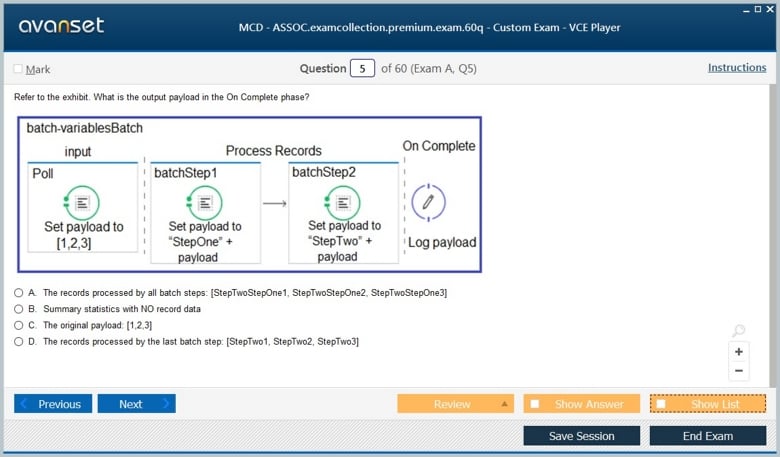
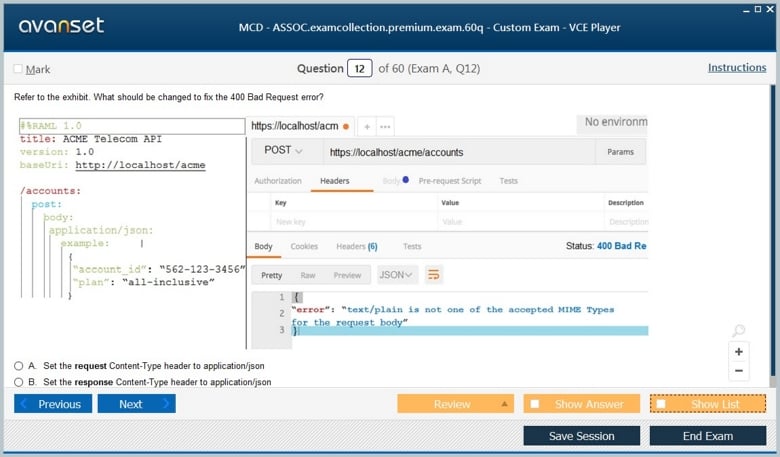
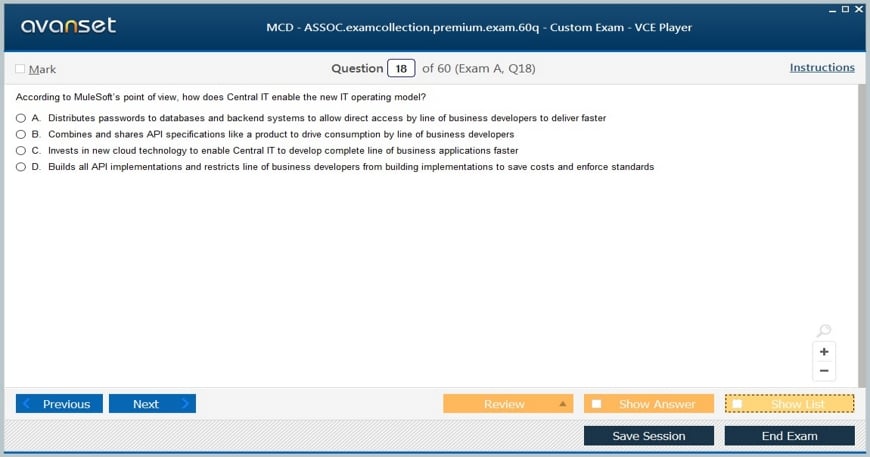
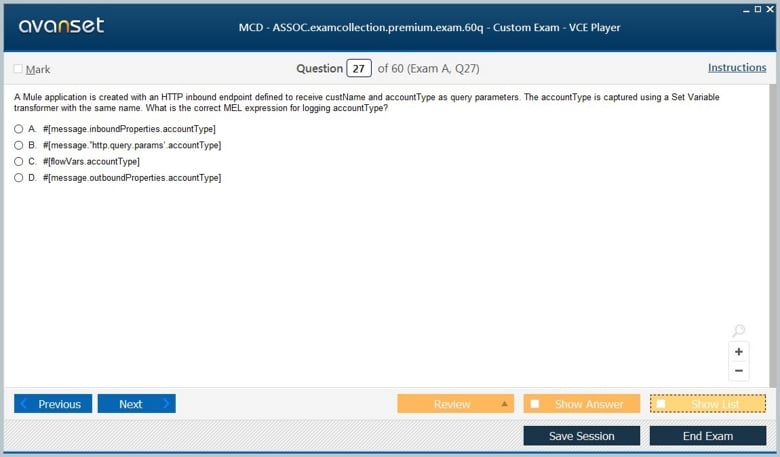
Mulesoft MCD - ASSOC Practice Test Questions in VCE Format
| File | Votes | Size | Date |
|---|---|---|---|
File Mulesoft.Test-king.MCD - ASSOC.v2026-07-29.by.Hugo.28q.vce |
Votes 2 |
Size 2.89 MB |
Date Jul 29, 2026 |
Mulesoft MCD - ASSOC Practice Test Questions, Exam Dumps
Mulesoft MCD - ASSOC (MuleSoft Certified Developer - Integration and API Associate (Mule 3)) exam dumps vce, practice test questions, study guide & video training course to study and pass quickly and easily. Mulesoft MCD - ASSOC MuleSoft Certified Developer - Integration and API Associate (Mule 3) exam dumps & practice test questions and answers. You need avanset vce exam simulator in order to study the Mulesoft MCD - ASSOC certification exam dumps & Mulesoft MCD - ASSOC practice test questions in vce format.
The MCD-ASSOC exam belongs to an older MuleSoft certification generation. MuleSoft used “MCD – Integration and API Associate” for Mule 3-era developer credentials, including a 2018 proctored version aimed at developers with limited MuleSoft experience. MuleSoft later introduced the Mule 4 Developer Level 1 certification and explicitly offered an abbreviated delta path for holders of the older Integration and API Associate credential. Today, Salesforce presents the current developer credential simply as Salesforce Certified MuleSoft Developer.
MCD-ASSOC should therefore be treated as a legacy exam code, not as the name of the current entry developer exam. MuleSoft certifications still show that lineage, but current candidates should align preparation with Salesforce’s active MuleSoft Developer and Integration Foundations credentials.
The old exam remains technically instructive because the core ideas survived the platform transition: API lifecycle, integration flows, connectors, message transformation, error handling, deployment, and operational management. The right approach is to preserve those concepts while replacing Mule 3 syntax and runtime assumptions with modern Mule 4 and Anypoint Platform practices.
MuleSoft development begins with an integration problem: systems expose and consume capabilities through interfaces. The broader idea of the modern API helps explain why reusable contracts, ownership, security, and lifecycle management matter. A Mule application is not valuable because it contains flows; it is valuable because it connects capabilities in a controlled way.
Practice by defining a small API contract before building implementation logic. Decide the resource model, request and response shapes, errors, authentication expectations, and ownership. Then implement the contract in MuleSoft. This keeps the design centered on the consumer rather than on whichever connector is easiest to drag into a flow.
Developers need a clear model of what data and metadata are moving through a flow. In Mule 4, the event contains a message and variables, and DataWeave is central to transformation. Older Mule 3 material may discuss concepts such as inbound and outbound properties or different expression-language behavior, so historical notes should be translated rather than copied directly into modern code.
Trace a request through listener, validation, transformation, connector call, response mapping, and error path. At each step, record the payload shape, important attributes, and variables. This makes debugging systematic because you can identify where the event stopped matching the assumptions of the next processor.
Do not prepare by memorizing isolated DataWeave functions. Start with input and output schemas and write transformations that map nested objects, filter arrays, provide defaults, handle nulls, convert types, and construct target structures. Then refactor repeated logic into functions or modules as the examples grow.
Good transformation code makes integration intent visible. Name variables and functions around business meaning, not temporary syntax. Test boundary conditions such as missing fields, empty arrays, unexpected values, and type mismatches. Most production transformation failures are data-shape failures, so study with messy data as well as clean examples.
Connection pooling and resource management matter because a flow can create pressure on downstream systems long before Mule runtime resources are exhausted. Understand how many concurrent calls a dependency can support and configure the integration so scale does not become accidental denial of service. A fast caller can overwhelm a slow database or SaaS API if backpressure is ignored.
Pagination is another practical example. A connector may make it easy to retrieve records, but an integration that attempts to load an unbounded dataset into memory is still poorly designed. Process large datasets in bounded units, checkpoint progress where appropriate, and understand what happens if the job fails after only part of the work is complete.
Rate-limited APIs require cooperation between error handling and scheduling. A 429-style response is different from a permanent validation failure. Respect retry guidance, use delay or queueing where appropriate, and avoid synchronized retries from many workers that create another burst. Resilience is about controlling demand as much as recovering from errors.
Credential handling should be separated from connector configuration examples found in old tutorials. Never copy secrets into source repositories or plain configuration files simply because a historical lab did so. Modernize the exercise by using protected properties or the current platform’s supported secret mechanisms and by restricting credentials to the smallest required scope.
These details are what distinguish a classroom integration from a production integration. MCD-ASSOC-era material can still show how to connect systems, but current practice must add scale, failure behavior, security, and operability. That is the layer of modernization that keeps a legacy study resource useful without preserving its outdated assumptions.
Anypoint connectors simplify access to databases, files, queues, SaaS platforms, and protocols, but the developer still owns connection lifecycle, credentials, retries, timeouts, pagination, transaction behavior, and error interpretation. A connector call that “works” in a demo may still be unsafe under load or during partial failure.
The principles of data integration are useful here. Ask whether the flow is moving data, synchronizing state, orchestrating a process, or exposing a reusable capability. That purpose should influence idempotency, error recovery, monitoring, and the amount of coupling between systems.
Retry policy should be explicit about side effects. Repeating a read is usually low risk, but repeating a payment, order creation, or file transfer can create duplicates unless the operation is idempotent or protected by a unique business key. Teach yourself to ask what already happened before deciding that retry is safe.
Error responses should also preserve abstraction. An API consumer needs enough information to correct a request or respond to service unavailability, but does not need internal stack traces, database details, or connector messages. Map low-level failures to stable error contracts and keep detailed diagnostics in protected logs for support teams.
Dead-letter or exception queues need ownership. Sending failed work to a queue is not recovery if nobody monitors, diagnoses, and reprocesses it. Define alert thresholds, retention, replay rules, and the evidence required before a failed message can be safely retried. Operational responsibility is part of integration design.
Historical Mule 3 examples may use error constructs that no longer match Mule 4 behavior. Rebuild representative failure scenarios in a current project and compare the runtime model rather than translating syntax mechanically. The objective is to preserve the reasoning—classification, recovery, visibility, and business meaning—while using the error-handling structures supported by the current platform.
Distinguish technical errors from business errors. A timeout, authentication failure, invalid request, unavailable dependency, and rejected business rule may all require different responses. Build error handlers that categorize failures, add useful context, avoid exposing sensitive details, and decide whether retry is safe.
Practice failure injection. Make a downstream service unavailable, return malformed data, force a timeout, and send a request that violates a business rule. Observe the error object and the final API response. A developer who has only tested the happy path does not yet understand the integration.
A Mule application must be configured, deployed, monitored, and changed safely. Separate environment-specific properties from code, protect secrets, make logs useful, expose health signals, and understand how runtime choices affect scaling and availability. Development is incomplete if support teams cannot tell what the application is doing.
Instrument key points rather than logging everything. Record correlation identifiers, meaningful business events, dependency latency, and failure categories. Avoid logging credentials or sensitive payloads. Build dashboards or alerts around conditions that indicate user impact, not simply around every exception.
MuleSoft explicitly created a delta path from the older Integration and API Associate credential into MCD-Level-1 for Mule 4. That makes the relationship useful for anyone holding old training material: use MCD-ASSOC to understand foundational integration ideas, then update the runtime model, DataWeave behavior, API tooling, deployment model, and current Salesforce terminology.
The current credential is better represented by Salesforce Certified MuleSoft Developer. Do not spend study time reproducing Mule 3-specific syntax unless you maintain an old environment. Modern exam preparation should prioritize the concepts and implementation patterns that remain present in Mule 4.
Versioning strategy is another bridge from legacy to current MuleSoft practice. APIs and integrations change as business rules, schemas, and dependencies evolve. Decide which changes are backward compatible, when a new contract version is necessary, how long older consumers will be supported, and how deprecation is communicated. Stable evolution is a developer responsibility, not only an architecture concern.
Consumer communication is part of deprecation. Publish timelines, migration examples, and compatibility expectations before removing an old interface. Integration teams depend on predictable change windows, and a technically clean upgrade can still fail organizationally if downstream consumers discover the change only when their applications break.
Take a simple historical Mule 3-style integration scenario and rebuild it in a current Mule 4 project. Document which ideas remain unchanged, which components have different names or behavior, and which design practices are now preferred. This produces a precise map between legacy study material and current implementation.
That is the most responsible way to use MCD-ASSOC content. The exam code itself is no longer the target, but the integration problems are still real. Learn the platform that Salesforce supports now, keep the architectural lessons from the older credential, and avoid presenting a historical Mule 3 certification as though it were the current developer path.
Go to testing centre with ease on our mind when you use Mulesoft MCD - ASSOC vce exam dumps, practice test questions and answers. Mulesoft MCD - ASSOC MuleSoft Certified Developer - Integration and API Associate (Mule 3) certification practice test questions and answers, study guide, exam dumps and video training course in vce format to help you study with ease. Prepare with confidence and study using Mulesoft MCD - ASSOC exam dumps & practice test questions and answers vce from ExamCollection.
Purchase Individually

Top Mulesoft Certification Exams
Site Search:

SPECIAL OFFER: GET 10% OFF

Pass your Exam with ExamCollection's PREMIUM files!
SPECIAL OFFER: GET 10% OFF
Use Discount Code:
MIN10OFF
A confirmation link was sent to your e-mail.
Please check your mailbox for a message from support@examcollection.com and follow the directions.

Download Free Demo of VCE Exam Simulator
Experience Avanset VCE Exam Simulator for yourself.
Simply submit your e-mail address below to get started with our interactive software demo of your free trial.